A Mysterious Shabbos in Posen

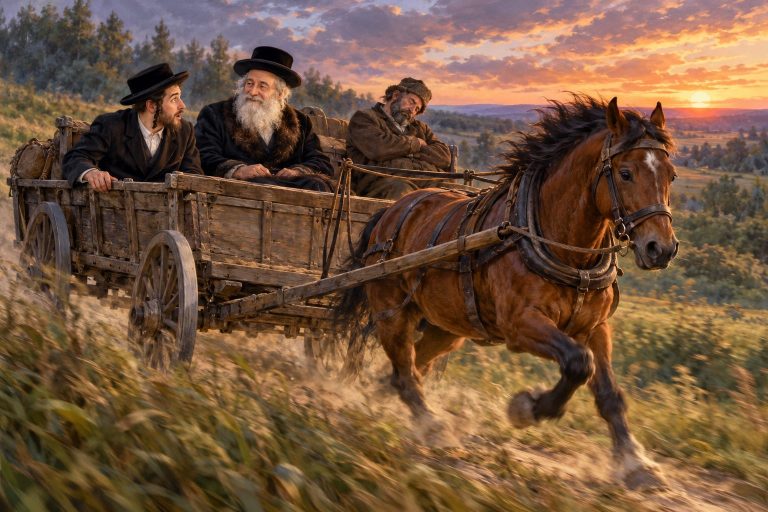
Recap: Traveling with the Baal Shem Tov to visit his parents in Posen, a young man raced miraculously across the wilderness, met a poor but joyful sufferer, and reached Posen just before Shabbos.
The Baal Shem Tov turned to him. “You see? You didn’t believe me when I said we’d reach Posen,” he said. “But I don’t know if you’ll spend Shabbos in your father’s house.”
The young man laughed in surprise. “Rebbe, what do you mean? I can see the house! It’s right there! Why would I spend Shabbos anywhere else?” The Baal Shem Tov didn’t answer.
As they entered the city, the young man could think of little besides seeing his parents. Then the horse turned down a street called Shulergas, or the “Students’ Street.” His happiness vanished. Students from a particular university often gather here. That university is full of people – students and professors alike – who hate Jews. Once, a Jewish man had entered the street by mistake, and unfortunately lost his life in a barrage of stones and beatings from these evil students. After that, they were sure no Jew would dare walk there again.
“Rebbe!” the young man cried. “The horse is going to put us in danger!”
The Baal Shem Tov remained calm. “Until now, we haven’t told the horse where to go,” he said. “There’s no need to start now. Hashem, Who is good, will protect us from evil hands.”
But the students had already noticed the wagon, and were bending down and picking up stones. The young man watched in terror. We won’t make it out of here alive, he thought. There was only one Jewish man the students allowed to live on that street: a skilled tailor, who sewed all their clothes. They needed his work, so they let him stay. In front of the tailor’s house, the horse stopped.
The tailor came outside and glanced around at his visitors in alarm and confusion. The Baal Shem Tov spoke to him calmly. “I’d like to spend Shabbos in your home.”
The tailor was willing to welcome him, but he was afraid. “Of course, Rebbe. But why would you stay here? These students are dangerous!”
The Baal Shem Tov reassured him. “Don’t worry. Everything will be alright. We’re safe.”
They woke the driver and had him help carry their bags into the house. It was time for Mincha, and the Baal Shem Tov asked the tailor whether there was a minyan. “We only have eight,” the tailor answered. “Me and my seven workers.”
“Then with the two of us, there are ten,” the Baal Shem Tov said.
The Rebbe turned to the young man. “That’s why you can’t go to your parents’ home. You’re needed here, for the minyan.” Besides, it wasn’t safe for him to walk back through that street. The young man’s parents were so close, but he couldn’t go anywhere. Without him, there’d only be nine men to daven together.
The Baal Shem Tov stood at the front and began leading Mincha. His voice was loud and full of feeling. He put his whole heart into every word. The young man trembled as he listened. He’d heard the Baal Shem Tov daven in his father-in-law’s home, but he’d never heard davening like this! The Rebbe’s deep love for Hashem could be felt throughout the whole room.
Outside, the students were getting angrier. They’d never allowed visitors onto their street like this, and now, they could hear the loud davening coming from the tailor’s house. They surrounded the house, stones in hand. The tailor and his family were certain they were about to be attacked. They had no safe way to leave.
After the tailor told the Baal Shem Tov, the Rebbe walked to the window and stared out at the students. He glared, and suddenly, their anger became fear. Their faces went pale. They became so frightened, their legs gave way, and they fell to the ground, dropping the stones they were holding. Then they scrambled up and ran. They fled like lions were chasing them!
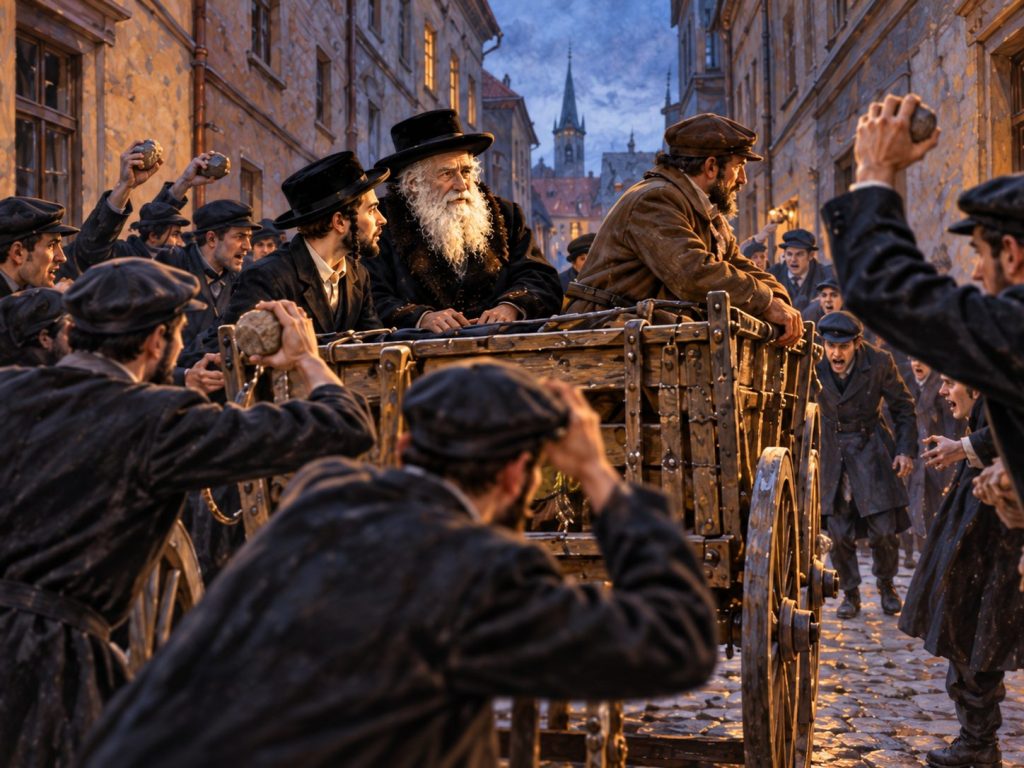
The students raced to their head professor. He was shocked when he saw their faces. They looked almost sick with fright! “What happened?” he asked. They told him about the visiting rabbi, the tailor’s house, and the terrible fear that had come over them when the rabbi looked out the window.
The professor was a learned man. He knew many subjects, could understand Lashon HaKodesh – the Hebrew used in our holy sefarim – and had even studied some Gemara. “I want to see this for myself,” he told the students. “I don’t know what kind of man you’ve just met. He could be using magic, or he may be a truly holy man… I want to find out.”
The professor and the students returned to the tailor’s house, where the Baal Shem Tov was davening Kabbalas Shabbos, the tefillos welcoming Shabbos. Once again, his voice was strong and full of passion. The professor stood quietly and watched. He remained through Kabbalas Shabbos and Maariv. When the Baal Shem Tov made Kiddush, the professor was still there.
He stayed throughout the Shabbos meal and watched the Rebbe say Birchas HaMazon afterward. He never spoke to the Baal Shem Tov, and the Baal Shem Tov never spoke to him. In fact, the Rebbe didn’t even turn to look at him! Yet the professor seemed unable to leave. Before finally going home, he spoke to the tailor. “When the rabbi is ready for morning prayers, come and find me. Wake me if you need to.”
The next morning, the tailor sent for him, and the professor returned. He stood through Shacharis and Musaf, and remained while the Baal Shem Tov ate the Shabbos meal. He scarcely took his eyes off the Rebbe. Everything he saw seemed to amaze him. After Birchas HaMazon, he went home, but first, he gave the tailor another request. “Call me again when the rabbi is ready for Mincha.”
So the professor returned for the afternoon davening as well. Afterward, everyone gathered for Seuda Shlishis, the third Shabbos meal. The professor continued watching, as though he didn’t want to miss a single thing. During the meal, the Baal Shem Tov shared a deep and beautiful Torah lesson. Everyone at the table was impressed, and even the professor, who had studied some of these topics, could follow along and admit it was life-changing.
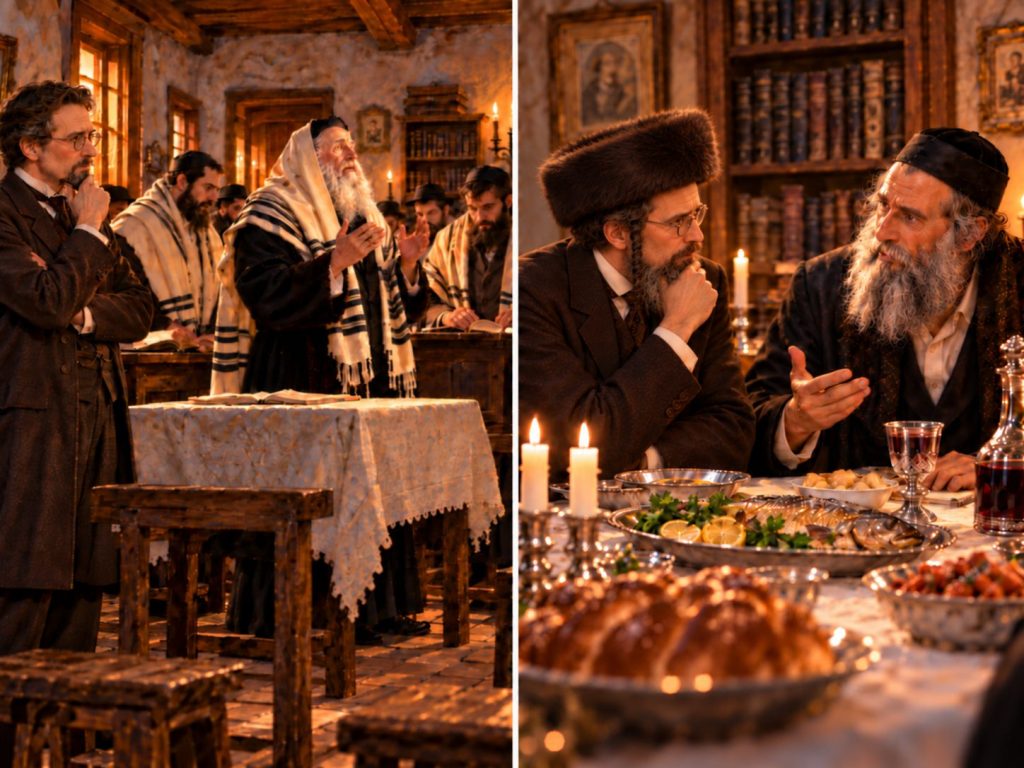
The young man listened closely. He knew a great deal of Torah himself, and he didn’t want to miss a single word from the Rebbe’s mouth. But he still couldn’t understand why the professor was there. He’d watched the Baal Shem Tov for hours and hours, yet the two hadn’t exchanged even one word. When the meal ended, the professor stayed, through bentching, Maariv, and Havdala, always watching the Rebbe.
After Havdala, the Baal Shem Tov called the driver. “Ready the horse,” he said. The professor returned to his own house, and the Rebbe prepared to leave Posen. The young man was deeply disappointed. He’d traveled all this way, but he hadn’t seen his father, his mother, or any of his siblings. Now, they were going back to Brod!
As the wagon carried them away, the young man finally spoke. “Rebbe, I know you’re a holy man, but… please help me understand. I was so looking forward to seeing my family. We came all the way here, but I never visited them at all. What was the point? Why did you bring me along at all?” He sounded sad, wondering if he’d only come along as the tenth member of the Minyan. Maybe he’d only been there to fill a blank space.
“And there are three other things I would like to ask, too,” he carries on, determined to have all his questions answered, “First, why did we stop in the tall grass to drink water? We brought our own water, so there must have been a reason for that. Second, who was the sick man in the ruined house? Why were you so happy to see one another? And third, why did we spend Shabbos in Posen in the first place?”
The Baal Shem Tov answered gently. “I can explain two of those things now. The third, you’ll understand later.” He began with the grassy place where they’d stopped for water. “Two Jewish men lost their way there,” he explained. “Robbers attacked them and killed them, and they were buried in that place. For many years, their neshamos have been unable to rise to their place in Shamayim.”
The Baal Shem Tov explained that these two neshamos needed help. If a Jew passed through that place, the holiness they brought could have helped clear away the spiritual darkness there. But no one had come that way to help them, not until the Rebbe had visited himself.
“That’s why we stopped,” the Rebbe explained. “When we made the bracha over the water with the right kavana, the neshamos were finally able to rise to Shamayim.” The young man thought back to the tall grass and the hidden well. The Baal Shem Tov had known all along two neshamos were waiting there!
Then the Rebbe explained about the sick man in the ruined house. “In every generation, there’s a tzaddik who’s ready to be Moshiach ben Yosef,” he said. This is a special tzaddik with a role in bringing the Geula, when Moshiach comes. He lives in a human body, just as other people do. People who see him may have no idea who he really is.
“If the Jewish people of that generation earn it, his special task can begin,” the Baal Shem Tov continued. “But if they don’t, he’ll pass away without being revealed. That elderly man, whose body was covered in sores, was ready to be Moshiach ben Yosef.” The young man listened in wonder. He had looked at the man and seen sickness and poverty. He hadn’t known such a special neshama was in there.
“He really wanted me to stay with him for Shabbos,” the Rebbe said. “But I knew he’d soon pass away. I didn’t want to stay and spend Shabbos in sorrow. That’s why we left.” Now, the young man understood the joy of their meeting, and the love of their goodbye. But the Baal Shem Tov didn’t yet explain why they’d spent Shabbos in Posen. That answer would have to wait.
They traveled back to Brod with kefitzas ha’derech, just as they’d come, and arrived in Brod on Monday. The townspeople could hardly believe it. “You went all the way to Posen and back?” they asked in amazement. “You only left on Thursday!” They’d traveled hundreds of miles in each direction, spent Shabbos in Posen, and still returned by Monday! Such a journey in only a few days was a miracle! The young man returned to his daily schedule of learning, but he didn’t forget the three questions. Two had been answered, one remained.
Some time later, he told his father-in-law that he wanted to start a business. He’d continue learning Torah, but he also wanted to start earning money for his family. His father-in-law, knowing he wouldn’t be around to look after them forever, agreed and gave him a large amount of money to get started. The young man set out to buy goods he could bring back and sell. His travels took him to Germany.
One Friday, he arrived in a town and found a place to stay for Shabbos. The next day, he asked his host, “Is there a rav in this town? Someone who knows a great deal of Torah?”
His host answered proudly. “Yes! Our rav is a great Torah scholar, a tzaddik, and a Chassid. His name is Rabbi Avraham, and he’s known as Avraham Ger Tzedek.”
A ger tzedek is someone who was not born Jewish, but chose to become a Jew and keep the Torah and mitzvos. The young man was eager to meet such a special rav. When he entered Rabbi Avraham’s home, he was struck by the kindness and holiness he could see in the rav’s face. Soon, they were talking about halacha, the Torah’s laws.
They asked questions, offered answers, and discussed different ways of understanding what they had learned. The visitor quickly saw that everything his host had said was true. Rabbi Avraham knew a tremendous amount of Torah! They continued talking until Mincha. After davening, the rav invited his guest to stay for Seudah Shlishis.
During the meal, the young man asked Rabbi Avraham to share some Torah. The rav began speaking, and the visitor listened with interest. Then, a look of surprise spread across his face. He knew this lesson! He remembered its questions and answers. He remembered how the ideas fit together. But how did Rabbi Avraham already know it…?
The rav noticed his expression and paused. “Why are you so surprised?” he asked. “Have you never heard anything like this before?”
The young man leaned forward. “That’s exactly what surprises me! I have heard it before. Several years ago, I traveled to Posen with the Baal Shem Tov. We spent Shabbos in a tailor’s house on Shulergas. At Seudah Shlishis, the Baal Shem Tov shared this very same lesson!”
Rabbi Avraham seemed shaken, almost startled. He inspected the young man’s face, as if he recognized it. “…I was there that night, too. I was the professor.”
The visitor stared at him. The professor? That silent man who had stood in the tailor’s house, watching the Baal Shem Tov all Shabbos? Rabbi Avraham continued, “The Baal Shem Tov’s journey there was for me. He came to rescue my neshama from the kelipos, the spiritual darkness keeping it far from Hashem, and fill it with holy life.”
The rav explained what had happened inside him that Shabbos. “Every word of tefilla from the Baal Shem Tov’s mouth was like a spark of holy fire in my heart. Each spark burned away another force of tumah. One after another, those forces were destroyed, until none of them remained.”
While the young man had watched a silent visitor standing alone in a corner, the Baal Shem Tov’s tefillos had been reaching that visitor’s neshama. Every holy word had helped free him from something that kept him far from Hashem.
“Then, during Seudah Shlishis, the Baal Shem Tov shared that Torah thought,” Rabbi Avraham continued. “At that moment, I decided to run away from Posen and come to Germany. Here, I became a ger tzedek. That lesson is very dear to me. It helped me become a Jew. Whenever an honored guest like you joins me, I repeat it. I never want to forget what those words did for me.”
The young man studied the rav sitting across from him. Years earlier, this man had been a cold, quiet professor on a dangerous street. Now, he was a great Torah scholar and a tzaddik, leading a Jewish community.
At last, the third question had an answer. The horse had never taken a wrong turn. The Baal Shem Tov hadn’t wandered onto the students’ street by mistake. The young man had spent that Shabbos wondering why he couldn’t visit his family, while the Rebbe had been calling home a neshama in ways he could not yet understand. He’d thought they’d gone to Posen for nothing. Now, sitting at Rabbi Avraham’s Shabbos table and hearing the same beautiful Torah lesson once again, he finally knew the truth.
This story was told by Rabbi Yisrael of Ruzhin and recorded in Sipurim Norayim
Beis Moshiach #1528 • י״ט חשון תשפ״ז • pp. 55-59
© 2026 Beis Moshiach Magazine. All rights reserved.
This article originally appeared in Beis Moshiach #1528. You are welcome to share it with friends and family by email or in print, provided that you do not change, add to or omit any part of it, you credit the author and Beis Moshiach, and you include a link to archive.bmoshiach.org (written out in full in printed copies).
To republish this article in a newspaper, magazine, book or website, please request permission in advance at [email protected].