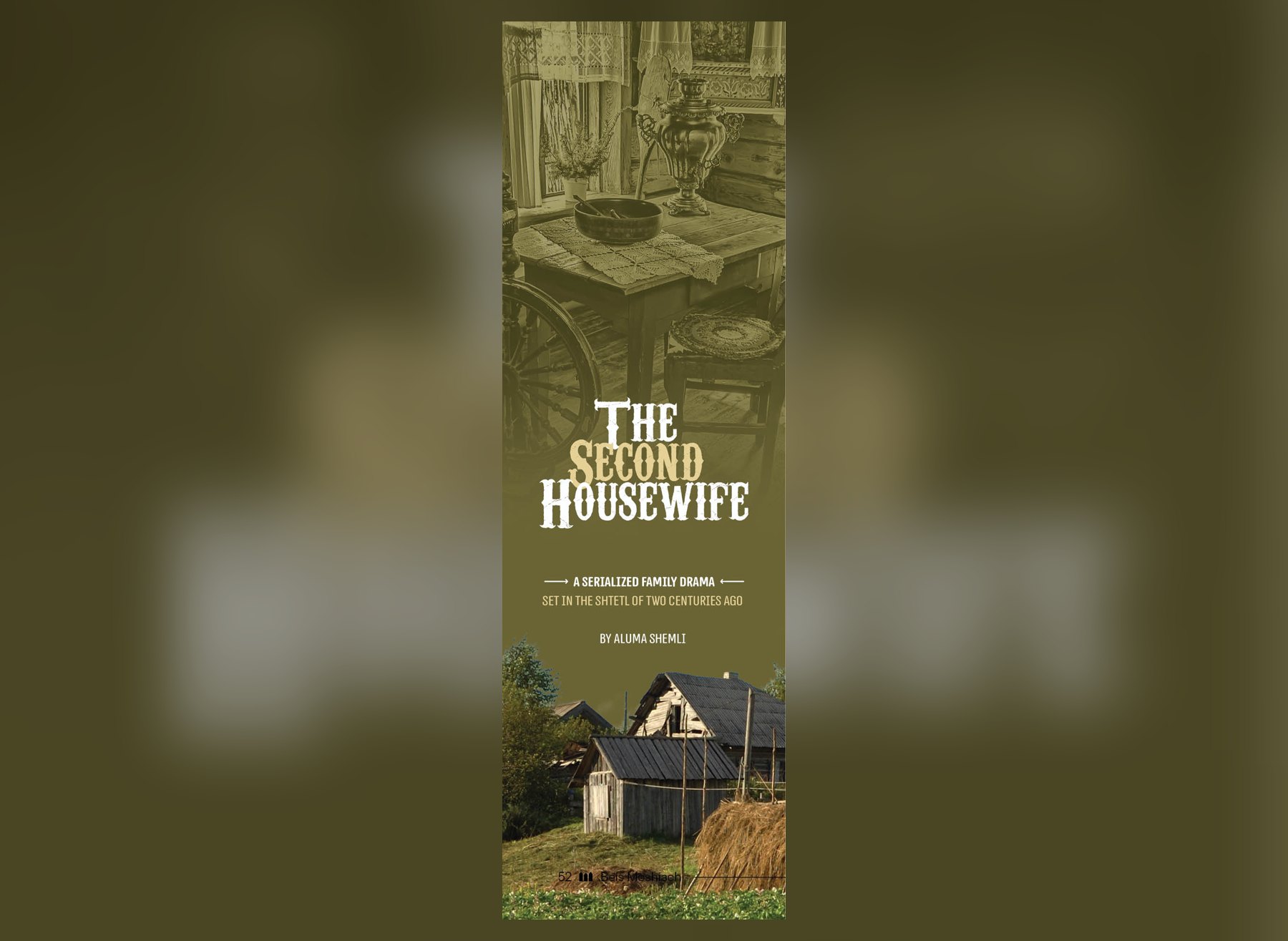
The Second Housewife – Chapter 110
Previously: Shmuel isn’t interested in traveling to a wedding in Palchova. Aidel chooses not to share with Shmuel about what happened during his absence. Akiva turned down the tempting offer to serve as administrator of the count’s newly acquired lands. Pesach Tzvi endured a Chassidishe “bitush” (“pounding”) for the first time in his life.
It was a hot summer Motzoei Shabbos. The family gathered near the dinner table for a Melave Malka. The windows were open, but the air was static. Shmuel came downstairs a bit late, taking a glance at the table with a twisted facial expression. “I have no desire to eat,” he said. “I’m right now in the middle of a very provocative sugya in the Gemara. I think I’ll go back upstairs to resume my learning. Maybe I’ll eat something later.” A moment before he went upstairs, he gave a questioning look to Aidel. “Is that all right?”
Aidel smiled and nodded, her eyes sparkling. What wife doesn’t want that her husband should prefer learning over food? None, right? He disappeared in an instant.
Around the table, everyone spoke about one issue: The Surname Law. It’s now come to Poland as well, and the head of every household will be obligated to present himself before the appropriate government offices and declare which surname he has chosen for his family.
“I can’t stand it,” Tzadok moaned. “I must know what name Tatte will choose for us!”
“So, ask him…” his wife Chana Rochel laughed.
“He’s not willing to talk about it…” he sighed despondently. “Ach.”
“It would be just so Tatte to find some kind of halachic issue with it to be stringent over and decide not to choose a surname,” Yossel laughed.
“Is there a problem in choosing a surname?” Aidel inquired quietly.
Yossel shrugged. “Not to my knowledge. However, if there is a problem, Tatte surely knows about it…”
“Think about it,” Gronem said. “Put yourselves in Tatte’s place. Wouldn’t it suit him to choose something in Zeidy’s memory?”
His brothers looked at him, furrowing their brows. “Efraimsky?” Yossel tries out loud. “Efraimovitch?” Every possibility sounds worse than the next.
“Maybe Lubianker?” Pesach Tzvi suggested with a smile.
“Lubianker…” Yossel tries the word out. “I hope not. Yossel Lubianker…”
“What about the women?” Mirele inquires. “They also get a surname, don’t they?”
Gronem nods. “Exactly. Each wife receives her husband’s surname.”
“We have to ask Tatte to consult with us before he chooses a name,” Pessia whimpers. “I don’t know if I’ll be able to handle a strange or shocking surname!”
“You?” Tzadok said with exasperation. “You should be saying ‘Thank you!’ You’ll be getting Pesach Tzvi’s name. Relax!”
“What name do you choose, Pesach Tzvi?” Pessia gives him an imploring and frightened look.
Pesach Tzvi shrugs his shoulders. “I’m a citizen of Lithuania. We’ll wait until the law reaches there and we’ll see then what my father chooses.” Pessia takes a deep breath, calming down a little.
Names continue to come up for consideration. While most of them are combinations of Efraim and Lubianka, they also bring up suggestions such as Chaikin or Chiyowitz after their grandfather, along with ‘Parnes’, ‘Rosh HaKahal’, and ‘Gvir’…
An hour later, when there was nothing left on the table except potato peels, dirty dishes, and some cold leftovers – Shmuel came down, smiling with a look of satisfaction. Aidel also smiled. While she may not know from which side to hold a Gemara, she does know quite well when he’s in the middle of something, at the height of a Talmudic debate, or a moment after he’s completed an entire sugya.
Shmuel finds a few cold leftovers that appeal to him, places them on his plate, and then goes to wash his hands. After saying Hamotzi, he asks cheerily: “What happened? Why are you all watching me so quietly? Don’t you have anything to talk about?”
Tzadok groans, Gronem chuckles, Yossel stops rocking. Pessia starts on behalf of everyone: “Tatte, we really want to know which name you’ll choose for us!”
He made a face pretending to be surprised. “What do you mean? I already gave you names when you were born!”
“Nu, Tatte,” she whined. “I mean the family name…”
“Family name?” Shmuel became annoyed. “‘According to their families, according to their fathers’ houses’! If I’m Shmuel, then you are Gronem ben Shmuel, and you are Tzadok ben Shmuel, and you are Yosef ben Shmuel. That’s how you are called up to the Torah, and that’s how you will be mentioned after your passing. Who cares how it’s written in the government offices of the gentile nations?”
“We do,” Yossel uttered. “We care very much!”
“Young, inquiring, superficial, and small-minded…” he muttered to himself, picking slightly at the food on his plate, searching for a certain crumb and putting it in his mouth.
“I just have one question, Tatte,” Yossel asked. “Are you planning on choosing a surname?”
Shmuel shrugged his right shoulder. “It’s the law.” Yossel breathed a sigh of relief. It appears that he really doesn’t feel like getting involved in an argument.
“Don’t tell us what,” Pessia asked in her most childlike voice, “just say whether you’ve already decided or if you’re still thinking about it, all right?”
He laughed, looking at her. “I’ve decided and I even registered the surname already. Are you calm now?”
“Really?” Gronem was shocked. “Why did you rush so quickly to register your name? There’s plenty of time!”
“When I came to Nikita to get the official permits necessary to rebuild the Tailors’ Shul, he stubbornly insisted that I first have to register with him,” Shmuel recalled indifferently. “And since it was clear to me what name I would choose, it didn’t bother me if I registered with him already.”
Silence prevailed. They have a surname, and their father is getting annoyed when they try to find out what it is…
Shmuel finished his bread, then started looking in the mess on his plate for something else to eat. He would be bentching in another moment, and this window of opportunity will soon close. “It’s something that combines Zeidy’s name, right?” Yossel guesses out loud. “Efraimsky? Efraimovitch?”
Shmuel looked surprised. “While I’m pleased that Zeidy’s name is important to you, it never even crossed my mind to be named after him.” After a moment, he frowned. “However, to remember my name, it’s enough that I get an aliya to the Torah. What connection is there to this law?”
“Lubianker?” Tzadok tried.
Shmuel was really laughing now. He poured himself a glass of water. “That’s good! I hope that the holy city of Lubianka will forgive me that I never dreamt of being called by its name…”
“Maybe you’ll reveal it to us anyway?” It was Aidel in a gentle voice.
“What?” Shmuel was stunned, looking at her with sheer disbelief. “Even you are young, inquiring, and superficial?”
“And small-minded,” Pessia reminded him.
Aidel blushes for a moment, then starts to inquire almost in a whisper. “Is this the name that will pass on to the children we will have afterwards?” Shmuel nodded, smiling compassionately.
“So, yes, even I am young, inquiring, and superficial,” she said softly, her face growing redder.
“And small-minded,” Pessia made sure to stick to the full litany.
Shmuel sighs, puts down his utensils, leans back, and folds his hands. “So, if that’s the way it is, I’m not left with much choice, my little group of inquisitors, young and superficial,” he sighed again. “And small-minded,” he quickly remembered to add, winking at Pessia. Everyone – sons, daughters-in-law, daughter, son-in-law, and wife – sitting anxiously, waiting with uncertainty.
“Fine,” he said slowly, keeping them in suspense with a smile. “The name that it was clear to me that I would choose, the name that essentially Hashem had already chosen for our family three thousand years ago – is simply ‘Cohen.’ You hadn’t thought of that, eh?”
Later that evening, facing the dark skies scattered with stars, Shmuel shared his anguish with Aidel. “A family of kohanim sits and deliberates over surnames while not even for a moment considering the name Cohen? Has it reached such a point that they haven’t internalized the role of this family?”
“I hadn’t thought of that name either, not even for a moment,” she said in her own defense.
“I’m not angry,” he replied with a sigh. “That’s just the way things are, and it’s so painful. If we were living as we should be, around the Beis HaMikdash, the kehuna would be so meaningful in our lives! We don’t even understand how much we are missing!”
“Because of the garments? Because you would be serving in the Beis HaMikdash?” she whispered, trying to understand, trying to feel what is lacking.
“Not just that.” Shmuel remained silent for a long while, looking up at the heavens.
“In the time of the Beis HaMikdash,” he suddenly began in a quiet voice, “in the main streets of Yerushalayim, there were rules on how to walk. Throughout the year, those ritually impure walked in the middle, while those ritually clean remained on the footpaths in order to preserve their purity. However, on Jewish holidays, the rules were reversed. The pure walked in the middle of the road, the unclean along the sides.
“Here, on our estate,” Shmuel turned towards Aidel, looking into her eyes, “they would place two bowls on the table. One with kodashim, pure untainted food, which only those ritually clean from the seed of Aharon could eat from it, and a second with chullin, non-holy food. This,” he took a deep breath, “this is not some abstract Talmudic concept; this is part of life. Each korban also has its time, until when it can be eaten, and its special bracha.”
“Would I be allowed to eat from the…kodashim?” Aidel’s eyes shone.
“From a portion of them. In a state of ritual purity, of course,” Shmuel smiled.
“Who can’t?” she asked with a tone of concern.
“Pesach Tzvi,” he furrowed his brow for a moment, “Pessia, the estate staff, and the guests.”
“Pessia too?” Aidel inquired with disappointment. “But she’s the daughter of a kohen?”
“That’s correct, however, she’s married to someone who isn’t a kohen,” he said with a smile. “Only in the event that he passes away or divorces her without having any children with him can she return to her father’s house and eat from the korbanos.”
“Chas v’Shalom!,” she replied with alarm.
He looked away from her, gazing again at the heavens.
No reaction.
To be continued…
Beis Moshiach #1436 • pp. 51-53
© 2026 Beis Moshiach Magazine. All rights reserved.
This article originally appeared in Beis Moshiach #1436. You are welcome to share it with friends and family by email or in print, provided that you do not change, add to or omit any part of it, you credit the author and Beis Moshiach, and you include a link to archive.bmoshiach.org (written out in full in printed copies).
To republish this article in a newspaper, magazine, book or website, please request permission in advance at [email protected].