The Baal Shem Tov’s Grandchildren
From the TzaddikStory.org collection
My name is Rabbi Yosef Greenberg, and more than 30 years ago, the Rebbe sent my wife, Esther, and me all the way to Anchorage, Alaska, as shluchim. We had a mission: to spread Yiddishkeit in a place that was very, very far from most Jewish communities. Anchorage is cold, snowy, and dark for a good part of the year, and we knew we had a lot of work to do.
In those early years, we were lucky to visit the Rebbe a few times. On one visit, the Rebbe gave us a beautiful bracha. He wished us “hatzlacha rabba u’muflaga”—tremendous success. We knew his words had a deep meaning and were guiding us in a way we might only understand years later.
Today, if you came to Anchorage, Alaska, you’d see a full Chabad House with a shul, a mikva, and even a museum! Who would have thought Anchorage, Alaska, would have all of this for its little Jewish community?
One part of our Chabad House that we’re especially proud of is our museum. It tells the story of Jewish life in Alaska, so that anyone, from locals to visting tourists, can learn about the Jewish community here. People are usually surprised that there are Jewish people in Alaska at all, let alone enough history to fill a whole museum!
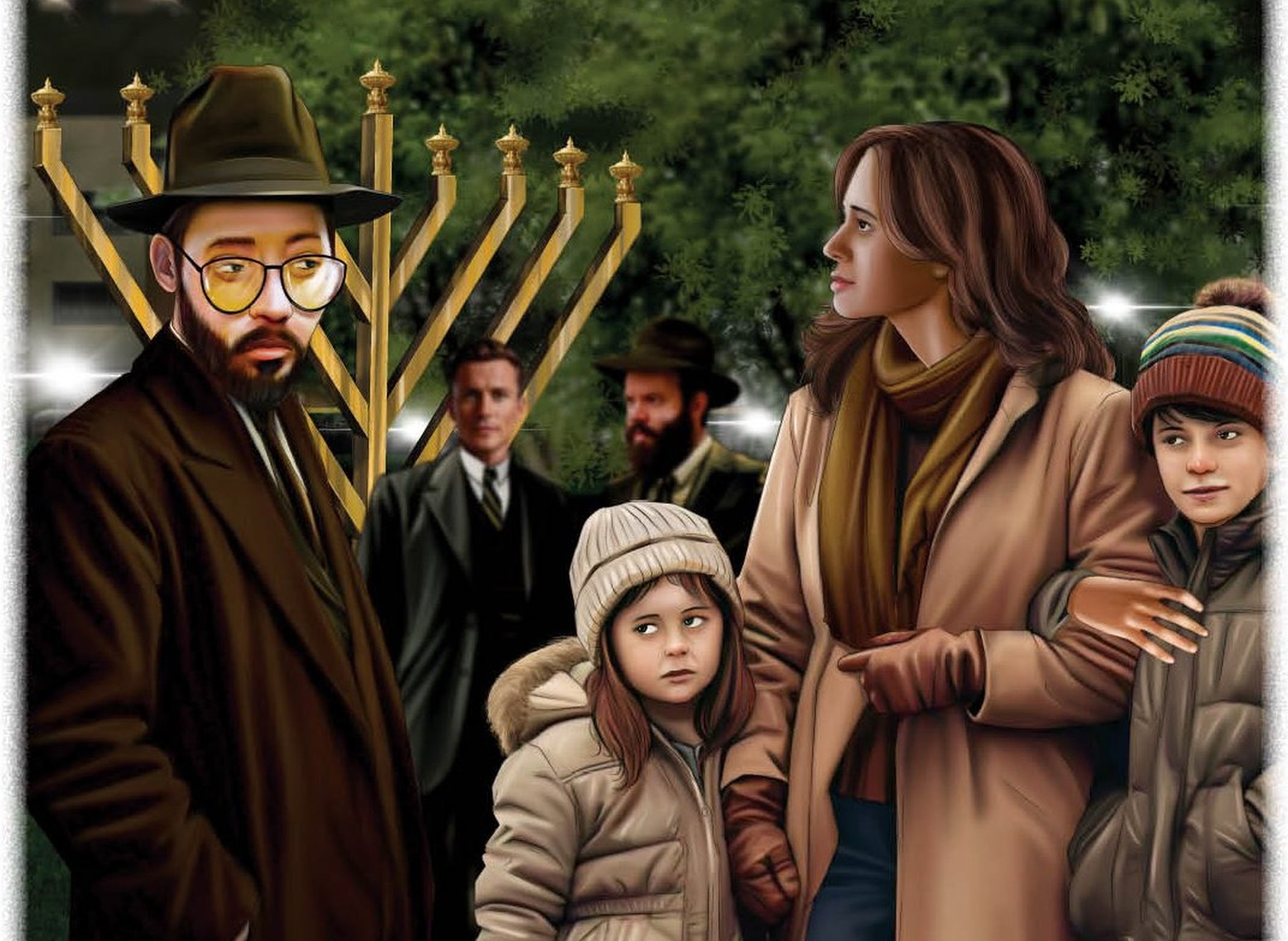
But I want to tell you about something that happened just two years after we moved to Alaska. It was one of our first big events—our Chanuka party. We were excited and a little nervous, hoping people would come to celebrate with us. It was a freezing, wintry day—though in Alaska, that’s just about every day!
We worked hard to make our Chanuka celebration special. We set up a big menorah, made yummy treats, like fresh latkes and donuts, and got everything ready. There were kids playing dreidel and coloring Chanuka pictures, and you could feel the excitement in the air.
Then, I noticed a family standing quietly off to the side. They were watching, but didn’t seem ready to come closer. So, I decided to go over and say hello. Smiling warmly, I said, “Hi, Shalom! I’m Rabbi Greenberg. So happy you could make it tonight!”
The woman looked at me, “Thank you, Rabbi. It’s… nice to be here.” Her voice sounded different. Her accent told me she wasn’t from Alaska, or even from America. She was probably from Russia, based on the way she spoke.
“Please, come join us! We have fresh latkes and donuts. Are these your children?” I asked, nodding toward the kids beside her. One was a boy who looked about 11 or 12 years old, and the other was a little girl around 5 or 6.
“We’re lighting the menorah in just a minute. I think the kids will love it!” I said, hoping to bring them into the celebration.
The lady smiled again but shook her head slightly. “We’re alright standing here, thank you. The kids are a bit tired; they just finished school.”
I looked at the children. They seemed curious, watching the other kids play and color, but they stayed close to their mother, as if unsure if they should join.
I nodded, accepting they might want a little space. “Well, if you change your mind, we’re right over there,” I said, pointing. “Feel free to join anytime!” I gave her one last warm smile and returned to the others. That was that.
* * *
A week after the Chanuka party, I received a phone call. It was the same woman. She introduced herself as Lena.
“Rabbi Greenberg,” she began, sounding a bit unsure. “I was hoping you could help us. My son, Felix, is turning 13 this summer, and… well, I’d like to give him a bar mitzva. We’re not very religious, and he’s never really had any real Jewish education… Well, none of us have.” She paused, “But his grandmother, Anna—she lives in California and is from Ukraine—she has been insisting that Felix must have a bar mitzva.”
I remembered Lena and her family from the Chanuka party, watching from the sidelines. “Of course, I’d be happy to help,” I replied warmly. “We’ll make sure Felix is ready for his big day.”
Her voice brightened. “Thank you, Rabbi. I came to the Chabad Chanuka party last week because I wanted to see what it was like at your events, and… I really enjoyed it. It felt welcoming. Just what I want for Felix’s bar mitzva.”
* * *
Over the next few months, I worked closely with Felix to prepare him for his bar mitzva. I taught him the brachos, guiding him step-by-step, and helped him learn how to recite them. I got him tefillin and showed him how to put them on. We even practiced a nice speech together. Felix was eager to learn, and each week, he grew more confident. He’d come into each session curious and a little nervous, and by the end of each lesson, he’d leave with a big smile on his face.
Sometimes, during our lessons, Felix would stop and look at me, thinking hard. One day, he asked, “Rabbi, what does it really mean to be Jewish? I mean, besides celebrating the holidays, and doing all these things?”
I smiled. “That’s a great question, Felix. Being Jewish means connecting to your neshama, your soul, and being a part of the bigger Jewish family. As it says in Tanya, all Jewish people are one big family that goes back thousands of years. It means having a special connection to Hashem, different from everyone else in the world.”
Felix thought about it for a moment, then asked, “So… does that mean my family has been doing this for a long time?”
I nodded. “Yes, exactly. Your ancestors—your family from many years ago—lit Shabbat candles, put on tefillin, kept the holidays, and prayed. When you do it, you’re doing what they’ve done for hundreds, even thousands, of years.”
Felix’s eyes lit up. “Like my babushka? She sometimes talks about what life was like in Ukraine. She says it was very different there—though maybe not as cold as Alaska!” he joked.
“Yes,” I said, smiling. “Your grandma grew up with many of these traditions. By getting ready for your bar mitzva, you’re connecting with her and everyone who came before her.”
Felix looked excited, then asked softly, “Do you think… they—all the people from before—would be proud of me?”
“I think they’d be very proud of you, Felix. You’re continuing their journey, and making it your own.”
* * *
The day of Felix’s bar mitzva finally arrived. His grandmother had flown in from California, and his whole family came to the Chabad House, dressed in their best clothes. Their smiles looked both proud and a little emotional. Felix stood there, tall and nervous, but with a real sense of accomplishment in his eyes. He recited the brachos beautifully and delivered his speech with a strong, clear voice.
As he finished, his grandmother wiped a tear from her eye and wrapped him in a big hug. I could tell that this moment was more than just a celebration for the family—it was a connection to something deep, something they hadn’t realized was missing.
Later, at the bar mitzva banquet meal, Felix’s grandmother, Anna, stood up to speak.
“This bar mitzva means so much to me,” she said, her voice a bit shaky. “You see, I was born in Berditchev, a town in Ukraine. I don’t know if any of you have heard of it.” She paused, looking around the room. “When I was a young girl, a melamed—a Torah teacher—used to come to our house to teach me and my brothers and sisters Torah. But then, right around when I was 12, turning bas mitzva, World War II started, and life changed for us. The lessons stopped, and it became harder and harder to keep up our traditions.”
She took a deep breath, then continued, “I still feel a strong connection to my Jewish ways of life, especially because our family is blessed to be direct descendants of a very great and holy man. Our family comes from a famous rabbi—maybe you’ve heard of him—Rabbi Yisroel Baal Shem Tov.”
My jaw dropped open. Felix was a grandchild of the Baal Shem Tov! Just a few weeks ago, he’d asked me if the generations before him would be proud of him, and now, seeing him here today, I had no doubt. After her speech, I stood up to address the room, feeling moved by everything I had just learned.
“Thank you, Anna, for sharing this beautiful story,” I said, my voice nearly breaking.
“This moment is really special to me,” I said, looking around at Anna, Felix, and the crowd. “You see, I’m a great-great-grandchild of the Maggid of Mezritch, the Baal Shem Tov’s closest student. He learned so much from the Baal Shem Tov that he was chosen to carry on his teachings and pass them down to others.”
I paused, letting the connection sink in. “Generations later, here I am—a shliach of the Lubavitcher Rebbe, whose teachings come from the Baal Shem Tov and the Maggid. I was sent all the way to Anchorage, Alaska, a place thousands of miles from Ukraine and hundreds of years from the Baal Shem Tov’s time. And yet, look what’s happened, all the way out here! A great-great-grandchild of the Maggid of Mezritch helped one of the Baal Shem Tov’s own great-great-grandchildren, Felix, connect with his Yiddishkeit, bringing him back to the Jewish story.”
I looked around the room, seeing everyone listening closely. “Do you realize how amazing this is?” I asked, my voice filled with wonder. “Think about it—thousands of miles from Ukraine, hundreds of years later, in a place the Baal Shem Tov and the Maggid couldn’t have even imagined, their connection is still alive, still bringing people together. Isn’t that incredible?”
* * *
I never researched it before, but they actually have two family last names that are part of their family tree: Bratslavsky and Umansky—likely connected to Breslov and Uman, places related to Rebbe Nachman of Breslov, the famous grandson of the Baal Shem Tov.
For the last thirty years, we’ve stayed in close contact with Felix and his family. Felix went on to become a founding member of Chabad in Tampa, Florida, and he invited me to his wedding. His sister has become involved with Chabad in Portland, Oregon, and I was honored to attend her son’s bris. Recently, I had the privilege of watching Felix stand under the chuppa, beginning a new chapter in his life.
This story has come full circle, and now Felix and his sister will pass it on to their own children, teaching them that they, too, are proud grandchildren of the Baal Shem Tov. But, even more importantly, they are part of the eternal family of all Jewish people—the grandchildren of Avrohom, Yitzchok, and Yaakov.
Beis Moshiach #1436 • pp. 58-62
© 2026 Beis Moshiach Magazine. All rights reserved.
This article originally appeared in Beis Moshiach #1436. You are welcome to share it with friends and family by email or in print, provided that you do not change, add to or omit any part of it, you credit the author and Beis Moshiach, and you include a link to archive.bmoshiach.org (written out in full in printed copies).
To republish this article in a newspaper, magazine, book or website, please request permission in advance at [email protected].