A Midnight Stroll In The Garden of Chassidus – Part I

Rivky and Pinny are a fictional couple, but in Rebbetzin Bruria Ashkenazi’s tale you may very much identify with their journey…
“I’ve waited so long for our evening stroll, because since the afternoon, I have been preoccupied by a very big question,” Rivky said to her husband Pinny as they went out to the neigborhood circular walkway.
Pinny mentioned the good resolution that they had made the previous evening: “We wanted to think today about our children’s chinuch. Is your question in connection with one of the children?”
“You’re right. We decided to fulfill what is written in ‘HaYom Yom’ to think every day for half an hour about chinuch.” Rivky smiled, then added in an amused tone of voice: “You see, I’m already almost a total Lubavitcher. It’s not about one of our children; my question is on the educational approach in general.”
They reached their regular park bench, far enough away from listening ears.
“Look,” Rivky said, “today when I said pesukim with the children, I suddenly noticed something rather strange. It’s hard for me to say this, since the Rebbe chose the pesukim himself. However, it really isn’t clear to me.” Pinny turned attentively to his wife.
“When I started learning Chassidus, it was very difficult for me. I was afraid what my parents would say about it, what the demands would be… But I did it anyway and the main reason was due to the Chabad approach, which strongly emphasizes how much Hashem loves us and not to be constantly afraid of punishment…”
Pinny nodded, and then added: “We were raised according to the gevura approach, emphasizing the prohibitions of Torah. I remember once when I was a boy, how I was extremely pressured over the number of aveiros I did each day. I thought that it might be better if I stayed in bed and not get up in the morning. That way, I wouldn’t hear any lashon hara or get angry…”
Rivky trembled. “And what happened in the end?”
“I eventually got up because I realized that if I won’t daven or learn Torah, I’ll still have aveiros…”
“That’s exactly what I don’t understand. We want to educate others with a sense of enjoyment, not by using scare tactics. That’s appropriate for most of the pesukim, which speak about such marvelous concepts: how Hashem created the world for us, gave us Torah and mitzvos, thereby providing us with a portion in the World to Come, how pleased He is that we make ‘a dwelling place for Him in the lower realms.’ If such is the case, then why do we also need several pesukim which seem as if they’re waggling a finger at us?”
Pinny didn’t quite seem to understand what she was getting at. “What exactly do you mean?”
“For example, there’s how Hashem stands near each and every Jew: ‘He scrutinizes him and searches his kidneys and heart, [to see] if he is serving Him as is fitting.’ That can be quite stressful! Even in the verse ‘Yagati’, it would be appropriate just to say the good ending: ‘I have worked hard, and I have been successful.’ Why do we have to despair beforehand and say that someone who didn’t strive will likely not succeed?”
When she saw that Pinny was smiling, she allowed herself to add: “After you taught me that the guidelines of Chassidus and the Rebbe are to tell a child how much Hashem loves us and how He derives enjoyment from the mitzvos he fulfills, it truly amazed me that in Chabad, they teach all children these pesukim.”
Rivky took a deep breath. She finally said it, and Pinny didn’t cut her off. Since the afternoon, she had been considering whether she should raise the subject.
Pinny is already well absorbed into the world of Chassidus, while she is still groping blindly along its path. She feels as if Chassidus is a tall and lofty mountain, and she is so small, standing at the foot of the mountain, hesitating whether she should start to climb it.
Suddenly, she began to tremble, “Maybe it’s forbidden to ask such questions in Chabad?”
She looked at her husband and saw his eyes shining. “Why are you smiling?” she asked.
“Because I’ve already been waiting so long for you to ask me about the things I learn in Chassidus. Your question is simply wonderful, and it literally touches the foundations of Chassidic thought. Do you have patience? The explanation is a bit long.”
The Man And The Bird – They’re One And The Same
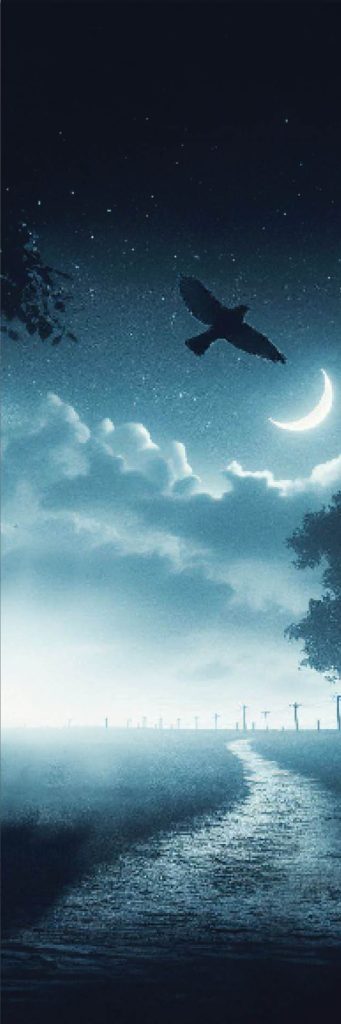
A night bird quickly cut through the air over their bench. They watched as it flew away and Pinny became quite moved: “Look, Hashem has sent us the bird for us to see literally with our own eyes the answer to your question.
“A bird needs two wings to progress in its flight. One wing is not enough. Even a Jew needs two wings to move forward in his Avodas Hashem, rising higher and higher.”
“In other words?” Rivky asked in wonder.
“Our wings are love and fear of Hashem, and it’s impossible to do without one of them, regardless of who or how old a person is. They uplift our Torah and mitzvos, and unless we have both of them – everything remains here below.
“The Baal Shem Tov once came into a Beis Medrash where great scholars toiled in the study of Torah, day and night, and said: ‘A shul filled with Torah!’ The lamdanim were very pleased by his words. Afterwards, however, he explained what he meant – the hall was filled because your Torah remains here and doesn’t rise Above because it wasn’t learned out of love and fear with a longing to connect to Hashem, rather for your own honor…’
“I know that this is important,” Rivky said. “I taught in class that the majestic Hakhel ceremony was in order to endow the Jewish People with yiras Shamayim. As the Torah says: ‘In order that they hear, and in order that they learn and fear Hashem, your G-d.’ So, you say that even in Chabad they speak about yiras Shamayim and not just Ahavas Hashem?”
“Yes, the Alter Rebbe says this explicitly in Tanya: ‘It is not sufficient to awaken the love alone…but at the very least, one must first arouse the innate fear which lies hidden in the heart of every Jew not to rebel against the supreme King of kings, the Holy One, blessed be He…’”
Rivky noticed his eyes growing moist as he added: “It is even told about the Alter Rebbe that once on the night of Rosh Hashana, when he began reciting Shemone Esrei and came to the words ‘Uv’chein tein pachdecha Hashem Elokeinu’ [= And so, instill fear of You, Hashem our G-d], he was filled with such great awe of Hashem, to the point that he rolled on the floor, repeatedly saying ‘Pach…pach…pach…’ The fear he felt was so great that he simply wasn’t able to complete the word!”
He is so moved by every Chassidishe story, Rivky noted to herself. This is a change that actually appeals to her. Ever since he became a Chassid, he has been filled with energy and emotion. In any case, she returned to her feelings and wonderment:
“But why do you also need fear? Isn’t it enough to love Hashem to avoid sinning?”
“You forgot that we have an animal soul,” Pinny replied. “It’s – like an ox, which sometimes is unwilling to go out and furrow the ground until they apply the whip.
“While it’s true that the Rebbe emphasizes the rewarding side to observing Torah and mitzvos, this didn’t prevent him from talking about punishment when the need arose.”
Rivky quickly defended her position. “The lecturer at a Rosh Chodesh gathering told how once the Rebbe called his secretary late at night and asked him to contact the editor of a certain Chassidishe periodical. During the period of the Holocaust, this paper had publicized an article raining fire and brimstone upon the Jewish People, stating that all their sorrows came as a result ch”v of their transgressions.
“The Rebbe instructed him to ask the editor not to publicize articles of this type any longer because this generation simply can’t handle them.”
“You’re right,” Pinny said. “Back in the days of the Baal Shem Tov and even before then, renowned ‘baalei shem’ would oppose maggidim (preachers) who customarily made their living by delivering sermons threatening tragedies ch”v, due to the sins he saw committed publicly. There’s even a story about a hidden tzaddik who brought a man back to teshuva after he had abandoned mitzva observance due to such a drasha.”
“Nu…so I repeat my question: Why do we need this?”
Pinny held back a sigh that threatened to burst out like a volcano. In the meantime, until he manages to convince her to learn Chassidus, he must equip himself with patience and restraint, while explaining things drip by drip in accordance with her current capacity.
Either As Children Or As Servants
“In fact, the Rebbe did say that we should use positive language, for example, just as the Torah added eight letters and called an unclean animal that entered the ark: ‘The animal that isn’t pure.’ However, in Parshas Shemini, for example, it is written explicitly and frequently throughout the Torah: ‘It is unclean for you’ – regarding animals and birds that are forbidden to eat. What is the reason for this clear difference?
Entering the teiva is part of a story, and therefore, we can describe this process by using positive words. However, when Hashem teaches us halachos, he doesn’t ‘soften’ the message with gentle words. The knowledge of what is forbidden and what is permissible – must be made clear in order that there should be no room for doubt ch”v.
Rivky nods her head and adds an example of her own: “Just imagine that during my class in halacha, I would tell the students that instead of the word ‘forbidden’ – use ‘improper’ or ‘undesirable.’ They would be totally confused. In Jewish law, you need to speak clearly.
“However, the pesukim are not halachos; they are hashkafa, more abstract in nature. So, why are very direct words used there?”
“This hashkafa is one of the founding principles of faith in Hashem, Rivky. Even this must be said in a clear manner!” Pinny tries to curb his words as a means of restraining the storm of emotions simmering within him.
“For example, take Rosh Hashana. What inspiring and uplifting things are written in Chassidus about this holiday! The day when you, I, and every Jew are privileged to crown Hashem as King!
“When the Rebbe speaks about the preparations for Rosh Hashana, he also brings the other side through the parable of a journey on a train.
“Once it was customary that fifteen minutes before a train left the station, they would blow the whistle to arouse the waiting passengers to collect their travel cases and quickly take their seats. Afterwards, they blew the whistle another couple of times, and the stragglers rushed to get aboard the car. Finally, the train slowly pulled out, and even then, there were some breathlessly running to catch it before it departed the station.
“What do you think?” Pinny asked. “How was the journey for all these people?”
“It’s quite obvious,” Rivky replied. “Those who boarded on time sat in a comfortable place, whereas those who ran to catch the train at the last minute – maybe found a standing room only spot near the door.”
“That means that together with the greatness of Rosh Hashana, we have to remember that it’s also the Day of Judgment,” Pinny said. “Thus, anyone who starts preparing for it at the first whistle – the shofar blowing during the month of Elul – ‘travels’ contentedly and serenely in the ‘train’ of the new year. However, those who don’t wake up from the tekios and only get on board at the last moment – who knows how their journey will go?…
“In other words, the Rebbe makes it clear there’s a price attached to a person’s conduct. In a most subtle manner, this allegory carries with it an extremely clear warning.”
“You’re right,” she said. “I accept the fact that we also need a little fear. But it still seems to me that someone who does a mitzva out of love for Hashem – is more excited, more enthusiastic…”
“Therefore,” Pinny concluded, “you need both love and fear. Proof of this also comes from Rosh Hashana. Perhaps you recall a portion of the Rosh Hashana davening where we allude to this fact?”
Rivky closed her eyes, leafing through a Rosh Hashana machzor in her mind’s eye. “The riddle is too difficult…”
“I’ll give you a hint: We repeat it three times on Rosh Hashana requesting that Hashem have mercy on us – either as…or as…”
“Ah…’Either as children or as servants.’ Because children listen to their parents out of love while servants work out of fear.”
“Exactly! Now, even you can understand why love alone is not enough. Our Sages, of blessed memory, say that ‘love upsets one’s usual practice’, meaning that one who loves can act in an improper manner.
“Imagine to yourself that you asked our Mindy to put everything needed to prepare a cheesecake on the milchig counter in order that you can start making it as soon as you return home from the baby’s day care. You come back, and there’s nothing on the counter. Mindy decided that it would be preferable to finish her homework first because she can always work things out with Mommy… Mommy obviously won’t get angry because she loves her.”
“You’re absolutely right. I recall that at the start of the school year, when I spoke with my students about doing teshuva, one of the girls said to me: ‘Teacher, don’t worry, Hashem is our Father and we’ll work things out quite well with Him…’”
“And if you would ask our housekeeper to prepare the ingredients for baking a cake, she would fully carry out your request. Why?”
“Because she wants to earn money, and if she doesn’t work as she should, I’ll hire someone else and she won’t have any parnassa…”
There was silence for several seconds. Rivky thought about the child and the servant, then a great idea suddenly flashed in her mind. “You know what? There’s another source for this in davening: Avinu Malkeinu! We need to feel that Hashem is our Father and we love Him, and He is also our King, whom we need to fear!”
A Journey Through The Levels Of Love And Fear Of Hashem
Pinny hesitated whether he could get into a slightly deeper discussion, or if it would be appropriate to stop here. Then, Rivky’s cheerful voice broke through his thoughts: “It’s appropriate in Chassidus to say that essentially love and fear are one and the same.”
Pinny was moved: “Ah-ha! It’s not the same thing, but they stem from one another. How did this come to cross your mind?”
Rivky was pleased to see his excitement. “So, if this crossed my mind, explain to me what it means that ‘they stem from one another?’”
“All right, but it’s a long explanation. Do you think that the babysitter will agree to stay a little longer?”
Rivky gave her a call. “Everything’s fine. Please continue, this is getting very interesting.”
“So, here’s how it goes. First of all, we need to know that there’s both ‘yira tata’a’ (lower fear) and ‘yira ila’a’ (higher fear). Even love has two types – ‘ahava zuta’ and ‘ahava raba.’ The difference is not only the level of love and fear, but their inner essence.”
“Soon you’ll be telling me that there are other types…”
“How did you know? Maybe you’re already learning Chassidus and not telling me?” Pinny had a difficult time concealing his desire that Rivky should walk in step together with him. “In any case, we’ll settle for these today.”
“But,” she asked, “can you please explain to me in words that a simple woman like me can understand?”
“Very well,” Pinny began, motioning with his hand as he did when he learned with his chavrusa. “Yira tata’a is the first lower level of fear. It refers to when a person is afraid of punishment, what you call ‘Nu-nu-nu’… Even if he’s afraid of the damage caused by the sin, this is still ‘yira tata’a.’
“In essence, this mode of fear represents how a person is afraid for himself, hoping that nothing will happen to him,” Rivky concluded.
“Quite right,” Pinny replied as he noticed that they were constantly ‘giving points’ to one another.
“However, let’s not show any disrespect or scorn for this fear, as it helps in harnessing the animal soul, which loves only itself, for Avodas Hashem.
“Even the lower level of love – ‘ahava zuta’, has the same style: love of Hashem because of the physical and spiritual good that a person receives through his Avodas Hashem.
“As it is written: ‘But as for me, Hashem’s nearness is my good!’”
“I’ve heard that a lot in my hashkafa classes,” Rivky added.
“Exactly,” Pinny noted. “If only we could feel how much good our Avodas Hashem does for us. We see it, for example, in the hadran declaration said upon the completion of learning a tractate of Gemara. It seems to me that you remember this from the siyum of the entire Shas. A beautiful song was sung there to the following words:
“May you not give us our portion among those who sit idly on street corners. They rise early, and we rise early. We rise early to pursue matters of Torah, and they rise early to pursue frivolous matters. We toil and they toil. We toil and receive a reward, and they toil and do not receive a reward. We run and they run. We run to the life of the World to Come and they run to the pit of destruction.”
Rivky seemed troubled. “There you go again. It’s not enough that they say in the hadran about the profit earned by Torah scholars? Why do we have to tell how bad it is for someone who doesn’t learn Torah?”
“First of all – because one of the Principles of Faith is the belief both in reward and punishment. We need to know that just as there is reward for those who serve Hashem, those who do not fulfill the Will of their Creator – are punished.”
Pinny looked at his wife with slight concern. Will she accept what he said? He was happy to see her nod: “The truth is that the fear of punishment also has a powerful influence. For example, it’s written that during the days of Haman, ‘the removal of Achashverosh’s ring’ (when he signed the edict) had an effect upon the Jewish People to do teshuva, far more than all the divinations of the prophets of Israel.”
“Furthermore,” Pinny continued, “there is written about ‘the advantage of light over darkness’ – the light appears brighter on a dark background. When we realize how bad life is for those who ‘sit idly on street corners’, we feel a greater sense of joy from a life of Torah and mitzvos.”
Rivky pondered for a moment. “When I think about that, I notice that I’m really trying to let our children feel this happiness that the Torah gives us, in contrast to those who haven’t merited yet to experience this feeling.
“For example, when we go to shul on Shabbos and see cars traveling along the main highway, I tell the children:
“See how good it is that Hashem gave us Shabbos. All of us are together, we have a Shabbos table, we go to visit Bubby and Zeidy, and we discuss the weekly parsha. As for those riding out there in their cars, they don’t know what a wonderful day Shabbos is! They don’t have a Shabbos table, they don’t kiss the sefer Torah in shul, and even their family is small. There aren’t a lot of children to bring joy to the home.”
“This is literally ‘ahava zutta’,” Pinny said with a gleam in his eye. “What marvelous chinuch you give them!”
— To be continued —
Beis Moshiach #1439 • pp. 46-51, 52
© 2026 Beis Moshiach Magazine. All rights reserved.
This article originally appeared in Beis Moshiach #1439. You are welcome to share it with friends and family by email or in print, provided that you do not change, add to or omit any part of it, you credit the author and Beis Moshiach, and you include a link to archive.bmoshiach.org (written out in full in printed copies).
To republish this article in a newspaper, magazine, book or website, please request permission in advance at [email protected].