A Midnight Stroll In The Garden of Chassidus – Part II
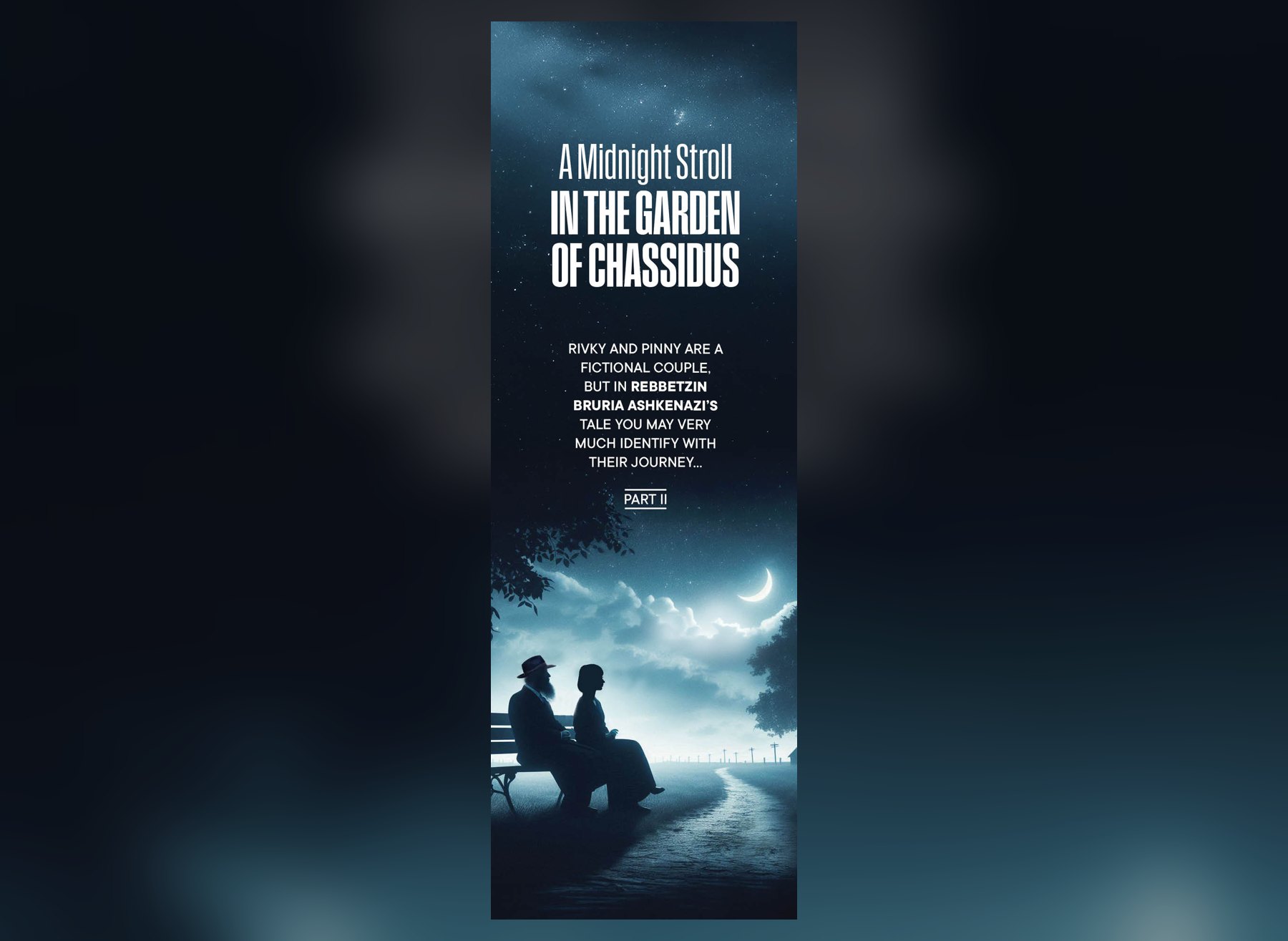
Rivky and Pinny are a fictional couple, but in Rebbetzin Bruria Ashkenazi’s tale you may very much identify with their journey…
In the previous installment, Pinny introduces Rivky to key concepts in Chassidus. They previously discussed how there are several levels of love and fear of Hashem. Showing the kids the beauty of Shabbos, for example, as Rivky does in her examplary and marvelous, is a form of Ahava to Hashem:
“If this is called ‘marvelous education’, then why do we need other types of love and fear?”
“In order not to stop in the middle of a spiritual journey. The order is to start with ‘yira tata’a’ and ‘ahava zuta’, and then we proceed to ‘ahava rabba’ and ‘yira ila’a.’
“What’s that?”
“The higher levels of love and fear, which place Hashem before all else, including ourselves.”
“Please – step by step, give me the explanations at my pace.”
“Ahava rabba” means not thinking about the reward that we will receive for our Avodas Hashem, rather we do as we should in order that Hashem will be pleased that we are carrying out His Will.”
“Yes,” Rivky interrupted. “We say this in the Twelve Pesukim: ‘Whoever is of the seed of Israel ought to rejoice in the joy of Hashem!’ But this is a very high level.”
“Quite so,” Pinny replied. It says in Chassidus that at the lower levels, we aspire for ‘a created pleasure’ – this is us, and in the higher realms, for ‘the pleasure of the Creator’”.
He stopped, letting his wife digest these new ideas now brought into the discussion.
As expected, Rivky expressed a slight doubt. “This is a considerable demand. Nullifying all of one’s desires, needs, ego… Is it possible to teach our children to have such inspiring love?”
“I’ll give you an example from an actual story. A child approached his melamed in cheder and complained that one of the children in the yard was annoying a pigeon. ‘Isn’t that forbidden? Yudele says that you’re allowed to do it. This is an aveira; it’s being cruel to animals. Hashem will definitely punish him,’ the boy said.
“The melamed looked at him and replied with a question: ‘You tell me: What do you say? Does Hashem enjoy the fact that he’s annoying a pigeon?’”
Pinny hesitated whether he should continue, wondering whether she understood and internalized her thoughts.
Rivky clapped her hands. “Good for the melamed. Instead of placing an emphasis on the punishment, he brought the child to an understanding that it’s causing anguish to Hashem, and if his friend loves Hashem, he needs to stop annoying the pigeon.”
“Even I can arouse this feeling within the children. For example, when Moishe’le bentches nicely, instead of telling him that he has a big mitzva to put in the basket of mitzvos he’s collecting, I can say: ‘Hashem enjoys so much to hear you bentching so nicely!’
“And maybe,” she added a moment later, “I need to tell him two things, as you said – for the animal soul as well…”
Pinny looked at his watch. The hands are moving rather quickly. If he could – he would stop them.
“That leaves us with yira ila’a – the higher level of fear, through which a person not only fears the sin itself, he also feels terrible shame that he has disappointed Hashem, He who is good and does good.”
“It’s not clear to me exactly what you mean?”
“I’ll give you an example. Do you remember Reb Mendel Futerfas I told you about?”
“That distinguished Chassid who was in Siberia?”
“Yes. During a certain period of time, he had difficulty obtaining strictly kosher food, and he went hungry for several days until he felt that he was going to die.
“His friend found a barrel of salted fish known to be kosher, and brought it to Reb Mendel to save his life.
“Reb Mendel knew that they sometimes spread treife fat on the barrels used to store fish, and so he was extremely hesitant. He couldn’t be absolutely sure whether this barrel had been spread with unkosher fat, and if he didn’t eat it – he might die.
“However, just then, a thought came to his mind: ‘Without question, when I finally will be privileged to get out of here and come before the Rebbe, he will see on my face the impression of the unkosher food that I ate… How will I be able to look him in the eye?”
“And so, he didn’t eat!”
Rivky became excited. “And what happened to him?”
“What do you think? Hashem made a miracle for him: A Gentile came and brought him fresh kosher fish that he managed to catch in the river, and this saved Reb Mendel from hunger.”
“So, you mean to say that just as Reb Mendel was ashamed to appear before the Rebbe, similarly, we need to feel towards Hashem when we are in a state of yira ila’a?”
Fear Of Hashem Is His Treasure
Pinny couldn’t conceal the light shining upon his face. The Chassidus content seemed to penetrate Rivky’s heart and mind rather quickly.
“You’re grasping the material so well, pretty soon you’ll know more Chassidus than me. Now, it’s possible to understand why you can’t go without fear. It’s something extremely lofty, and anyone who realizes how uplifting yira ila’a is – even more than ahava rabba – will be prepared to learn a great deal of Chassidus and contemplate matters until they reach deep into his heart and mind, including how he merits, every so often, to experience moments of true yiras Shamayim!”
Rivky looked up and observed the redness coming to her husband’s cheeks. Is this my cold and rational husband? She asked herself.
Pinny quickly returned to the safe harbor of intellect. “I’m waiting for one more question from you, about Mattan Torah.”
“Nothing comes to mind.”
“It would be appropriate if you asked: Why did Hashem hold Har Sinai over the Jewish People like a barrel? Isn’t it enough that they receive the Torah with love? Why would He have to frighten them?”
Now it was Rivky’s turn to smile. “Do you have ruach ha’kodesh?”
“No, but it’s the same kind of question you asked before, and this is also an excellent example of yira ila’a: Chassidus explains that the holding of Mount Sinai was essentially coercion out of love.
“Ask yourself: After Hashem showed the Jewish People His great love through the miracles He did in Egypt and at the Red Sea, arousing their great love for Him, how could they not accept His Torah?”
Rivky failed to accept this explanation. “What does that mean ‘coercion out of love’? It sounds as if you’re contradicting yourself?”
“It’s similar to the idea you raised before: love that brings fear! Out of our great love, we are ashamed and afraid to cut ourselves off from Him.
“My mashpia gave me a spot-on example: Soldiers finishing their grueling night training arrived at sunrise at their assembly area, collapsing on the ground for a brief rest. Only one soldier remained standing in position – an observant soldier davening Shacharis.
“When he finished, he suggested to his fellow troops that they put on tefillin. One of them grumbled angrily: “What is this religious coercion?”
“Why are you calling this ‘coercion?’” another soldier asked. “He’s simply offering you the opportunity and did so nicely. He’s not forcing you.”
“That’s coercion,” the angry soldier stubbornly retorted. “Don’t you get it? He’s one of us. He went with us for the whole march with full pack, and now when he’s tired and worn out like the rest of us, he suggests that we put on tefillin? How can we refuse him?”
Pinny waited for some reaction from his wife. Her response was quite enthusiastic. “Based on your explanations, that kind of yiras Shamayim doesn’t really sound at all like ‘Nu-nu-nu.’
“That’s…how shall I say it? – a kind of fear that is a literal treasure.
“In essence, as parents, our job is to give direction to our children to search for and find this treasure!”
Rivky got up from the bench. The hour was late. Pinny looked at her, his face beaming. “Now I have to ask, do you have ruach ha’kodesh? How did you know?”
“How did I know what?”
‘”That’s what’s written in Tanya with a direct reference on how to search: There’s no need to go far, the treasure is found within us… ‘In the manner of a person seeking a hidden treasure buried in the depths of the earth, for which he digs with tireless toil, so must one delve with unflagging energy in order to reveal the treasure of the fear of Heaven, which lies buried and concealed in the understanding of the heart of every Jewish individual.’”
Rivky breathed deeply and said hesitantly: “So, this is what you learn in Chassidus?”
A Personal Mattan Torah
They were now standing near the gate to their courtyard.
Pinny sounded quite restless as he replied: “This is the beginning of all beginnings… literally ‘the tip of the iceberg.’ Chassidus is broader and deeper than the sea! Here, even love and fear have an endless number of levels, and we’ve only spoken about two…”
Literally near the door, just as they were about to walk in the house, Pinny remembered to add one final point.
“There’s one thing regarding which I didn’t answer you: In Torah in general and Chabad in particular, it’s permissible, even important, to ask questions… When we learn Chassidus, we know that there’s an answer to every question, however, we won’t always know or understand it.
“And then…we’ll continue to live with the question and at the same time – we’ll learn Chassidus in order to know what Hashem wants of us and to carry out His Will both out of love and out of fear!”
Rivky didn’t respond, looking rather withdrawn.
In her mind and her heart, there was already a fire eagerly burning, and an inner voice singing inside her: ‘Here Hashem is holding the mountain over me like a jar with satisfaction and love to bring me through the gates of the teachings of Chassidus. How can I possibly disappoint Him?”
* * *
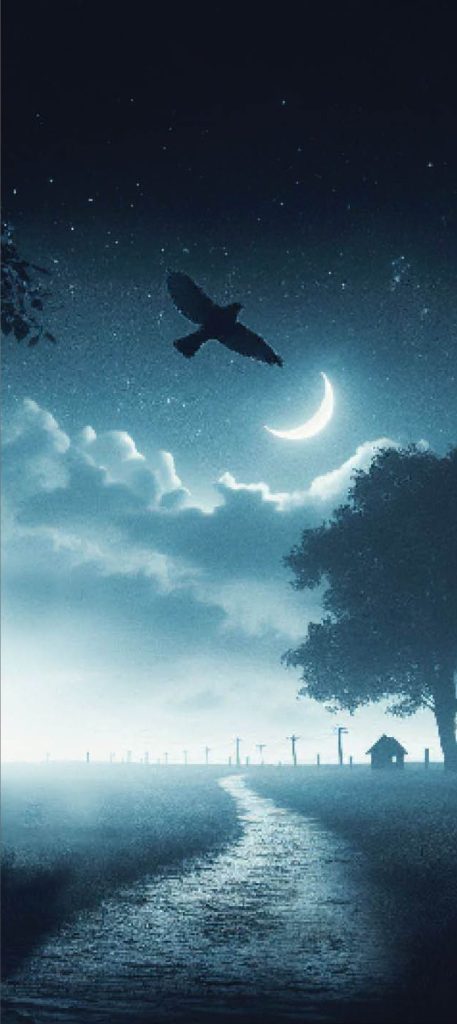
Days and years passed, and Rivky became highly “educated” in Chassidic philosophy.
She never forgot her first class in Chassidus, on the bench along the neighborhood circular walkway.
Privately, she called this bench “Har Sinai”, and when she periodically passed by there, she thanked Hashem for her personal “Mattan Torah” that took place on that spot.
And “Is fear such a small thing”? Here, she experienced “Kabbolas HaTorah” of the teachings of Chassidus.
Indeed, she had opened her eyes and saw the great light that her soul had longed for.
She looked to the heavens and prayed that it should happen again, very soon, mamash.
There would be no bench, no birds would be flying overhead. The darkness of the night would prevail no longer.
The endless G-dly light would cover everyone, and they would all stand on their feet in the courtyard of the Beis HaMikdash, trembling yet motionless.
Their ears would perk up, longing to hear the “new Torah” – the teachings of the Rebbe, Melech HaMoshiach, for which they had been waiting all along.
Beis Moshiach #1440 • pp. 42-45
© 2026 Beis Moshiach Magazine. All rights reserved.
This article originally appeared in Beis Moshiach #1440. You are welcome to share it with friends and family by email or in print, provided that you do not change, add to or omit any part of it, you credit the author and Beis Moshiach, and you include a link to archive.bmoshiach.org (written out in full in printed copies).
To republish this article in a newspaper, magazine, book or website, please request permission in advance at [email protected].