A Mind Of Her Own…
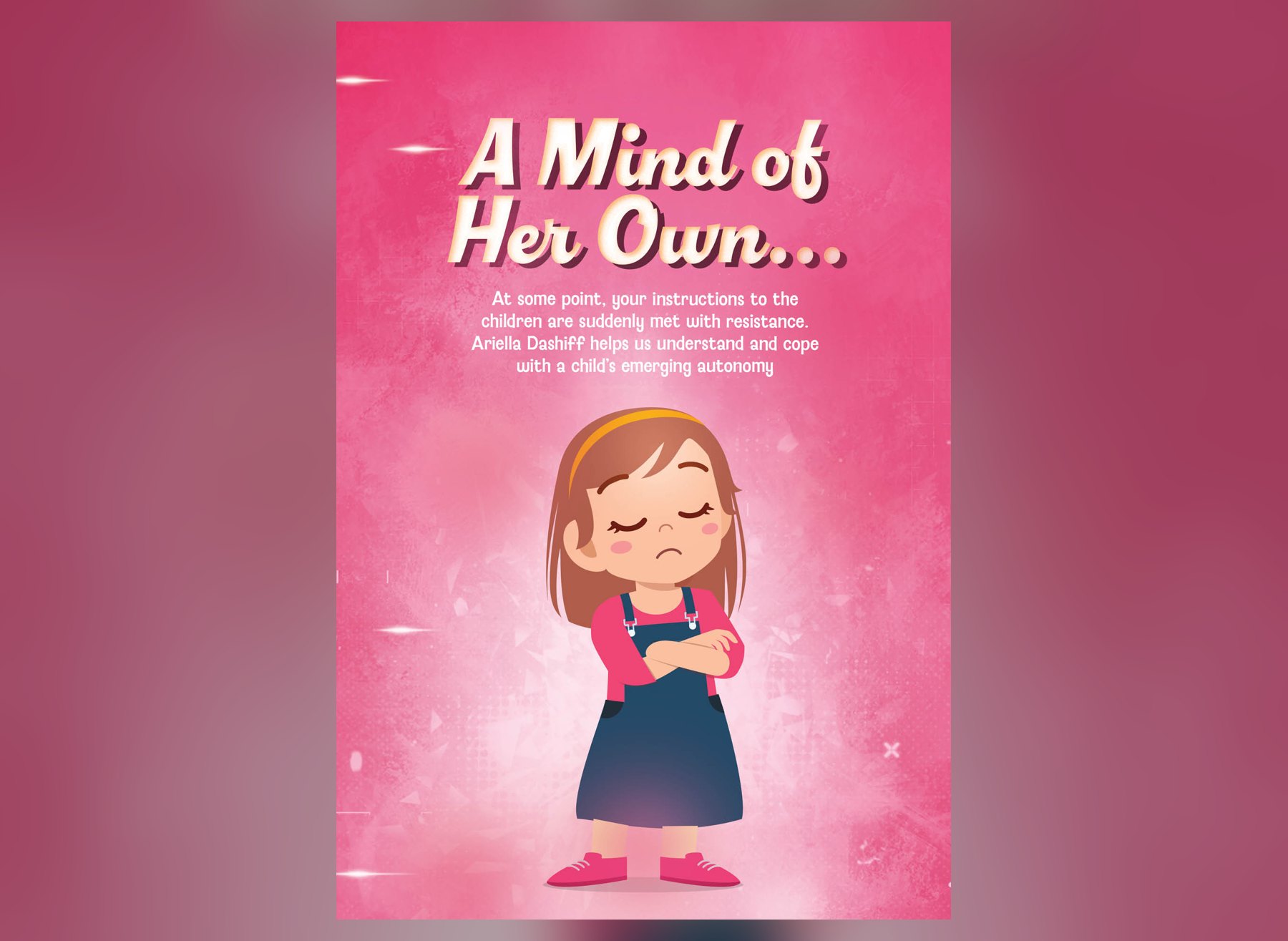
At some point, your instructions to the children are suddenly met with resistance. Ariella Dashiff helps us understand and cope with a child’s emerging autonomy
Rebellious behavior on the part of young children has many reasons:
1-Their behavior is very emotional, intense and overwhelming – because emotions control the psyche and the intellect not so much, for better and worse. If Mommy doesn’t allow going to the park, Danny hits her in frustration.
2-Cognitive development has the child beginning to understand processes and cause-effect, which is why he experiments and tests the world around him, in order to check whether the cause-effect responses he identified are indeed correct. In other words, he conducts social experiments on his parents, the morah and other children. When Abba bought an ice cream for Moshe because he was crying, Nechemya will also start to cry to see whether he’ll get an ice cream.
3-When it turns out that cause-effect works, our tots feel drunk with power! If I keep on moving the chair during circle time in nursery, Morah goes crazy! Little me can make great big Morah angry, invoke punishments and lose her cool! What a performance for all the children who join in the glee.
4-Most importantly, at this age a child begins to develop skills of independence, of free choice and he greatly desires actualizing these abilities he has just discovered. Ima told Deena that she’s big because she collected all the toys by herself, so she also wants to shower on her own, just like her big sister, Tamar.
Necessary Stage
The main difficulty we have (which, by the way, exists to a great extent, albeit on a different level, in adolescence with teenagers) is that this not very sensible creature wants to be independent which can be dangerous or annoying. He wants to cut his food by himself with a sharp knife, hold the havdala candle, decide when to bathe and go to sleep.
But when the adult changes his attitudes toward these behaviors and stops seeing them as an expression of defiance or something irritating and senseless, but as a necessary stage in healthy emotional development, he even starts to feel happy about them and relates to the child with calm and more patience and compassion. She will even know how to direct the child at this important stage in his life, since skillfully applied independence is the most important tool for developing healthy, balanced free choice. Furthermore, when a child had a healthy acquisition of independence (which shows that his parents know how to free him from his mother’s apron strings in a healthy way) he will become a more balanced, responsible adult.
Now, we need to think about how to navigate between the needs of the child to learn to take responsibility and free choice and his needs for boundaries, guidance and training.
Unfortunately, this process is going to be painful to some degree for our precious little one. I begin with this shocking announcement so that parents will enter into this process without feelings of guilt or excessive pity. I’ve seen how misplaced mercy can cause a child to become spineless or become an avowed manipulator. Childhood is the time when a person’s subconscious is shaped. What is imprinted now is very hard to change later on! Have mercy on your children and enable them to have a good life!
Setting red lines and rules at home is vital so that you don’t fall into misplaced compassion. In a shiur given by Rabbi Kornweitz on the halachos of chinuch as part of an online series on the laws of Shabbos, I learned that the Torah teaches us that the prohibitions can be taught to children who are quite young. Their psyches are ripe for restrictions and the limits help them understand and acclimate to the new world they are exposed to. Have you seen how happily a three or four-year-old explains what is permitted and not allowed to do in the yard, or why it’s important to wash hands with soap before eating?
Although we lay down the law, it’s important to give children the ability to develop their independence too. Let us ask ourselves some important questions and try to really remember the answers:
-In which areas can we let him choose? For example, let them choose among three (not more) sandwich spreads, between two shirts, or which park she wants to go to this afternoon.
-In what areas can he be given responsibility? Responsibility for cleaning the table after a meal, for setting the alarm clock (even if he didn’t do it correctly, you can always fix it).
-In which cases can you be flexible with the rules without it adversely affecting the parent’s consistency. This sounds like a contradiction, but things are not black and white. For example, bedtime is 6:45 but today she can stay up another fifteen minutes in order to play with a cousin who is staying with us.
We Are on the Same Side
One of the most important principles, if not the most important, is to be aware that we are with the child and not against him. This is not merely the intellectual understanding that we aren’t against him, but a feeling in the heart. Even when I say “no,” my heart is full of love for you. The heart’s emotions fill one’s body and speech with a special chayus, a chayus of love, that is conveyed to the child. This feeling speaks louder than the words or actions themselves.
Another thing which can be very helpful for the child and console him is when the adult expresses the child’s feelings to him and the reasons for them, and expresses empathy. “I see that you are very upset with me because I don’t allow you to visit Yossi now. It upsets you because you wanted to show him your new fire truck. What can we do… It’s late now and Yossi is probably already in the bath…” What comes next is an attempt to give the child the feeling of trust that we are on his side so that what he wants will happen a different time. “Look, I’m hanging a note on the door which says that tomorrow, when we get back from kindergarten, we will go together to Yossi’s house, so we won’t forget!”
Reactions of empathy, patience and thoughtfulness that come along with boundaries, are priceless and are even more important in contributing toward building the child’s personality than the actual solution. This is the most direct and most real form of chinuch.
Maturation Process
I am writing this section with my experience as a preschool morah and as a mother of the eleven most wonderful children in the world. I didn’t read the ideas that I’m writing here anywhere; their source is in a maamar of Rabbi Hillel of Paritch, “Isa B’Pesikta” in Pelach HaRimon and in the explanation of the nesira [severing] in the maamarim of the Rebbe Rashab in Sefer HaMaamarim 5670. Also, the stories of the precious children really demonstrate the process. You can call them conclusions that come from my personal research straight from the battlefield of life.
Adolescence is comprised of the same stages as the process of leaving galus for Geula, the process of nesira. In the initial stage of the learning process, the student is dependent on the kindness of the teacher to serve as a go-between to the subject matter being learned. When the teacher explains a topic in Chassidus to his student, for example, he wraps the topic in analogies that fit the level and world of the student. This has an advantage which is that at this stage the student is absorbing knowledge from his teacher with which he feels comfortable. However, there is a big disadvantage in that this knowledge is not the topic itself but is just an analogy to it. It is necessary to “deconstruct” the lesson from the analogy, to reach the core concept and be able to say it the way it is.
This is the nesira, the shining of a lofty, more powerful light than the vessel (i.e. the student) can contain. This great light creates a disconnect between the teacher and the student. Now, the student needs to manage on his own, to make the effort to internalize the concept. This is a descent into galus. When the teacher presents the core concept in its abstract form to the student, at this first stage, the student is confused and maybe frustrated too. This is being in galus, But then, slowly, he starts to get used to the chiddush, to the topic, to work with it, understand it well, and even try to implement it. This is the process of climbing in order lift oneself up and get out of galus. When the student has already acquired the concept internally, this is Geula. The entire process, its goal, is to make him independent.
This happens with little children too. Shanny is a sweet, quiet little girl. She walks around all day in nursery with her loyal friend, the pacifier, looking around with big eyes, having a hard time connecting with the other children. She answers no questions from the morah and doesn’t repeat the pesukim. Her parents have spoken to her for a long time now about abandoning her pacifier. Finally, the day arrived and after a nice ceremony, Shanny is given a nice present for having become “big,” and the pacifier is thrown in the garbage.
Shanny has been severed from the pacifier and during the following days Shanny is irritable in nursery. She finds it hard to sit during circle time without disturbing, and the result is all sorts of pranks and conflicts with the morah and the children. Shanny is in galus.
When the morah realized what the source of the difficulty was, she decided to give Shanny opportunities to express herself during circle time so she would be more engaged, offering lots of warmth and love, and lots of praise. All this gave Shanny the wherewithal to adjust and to get past the difficulty. This is the process of getting out of galus, which Hashem provides us with lots of help to navigate. After a week and a half, Shanny began to sit nicely at circle time. She acquired friends and her speech improved tremendously. This is Geula.
A similar thing happened with Gedalya who discovered that he could disturb the goings-on at kindergarten until his parents and teacher joined forces to make it clear to him (nesira, disconnection, distancing) that although now he was strong and capable, he still had to behave in a socially appropriate manner. At first, Gedalya was angry but his mother consistently helped him progress toward accepting boundaries while smoothing the way toward getting to the right place, by looking for where he behaved nicely, encouraging him to get a nachas note and showering him with love whenever she could. Gradually, his behavior improved greatly.
These are just two stories out of many. May we merit to quickly leave galus for Geula.
Beis Moshiach #1417 • pp. 42-45
© 2026 Beis Moshiach Magazine. All rights reserved.
This article originally appeared in Beis Moshiach #1417. You are welcome to share it with friends and family by email or in print, provided that you do not change, add to or omit any part of it, you credit the author and Beis Moshiach, and you include a link to archive.bmoshiach.org (written out in full in printed copies).
To republish this article in a newspaper, magazine, book or website, please request permission in advance at [email protected].