We Leave Tomorrow at Four
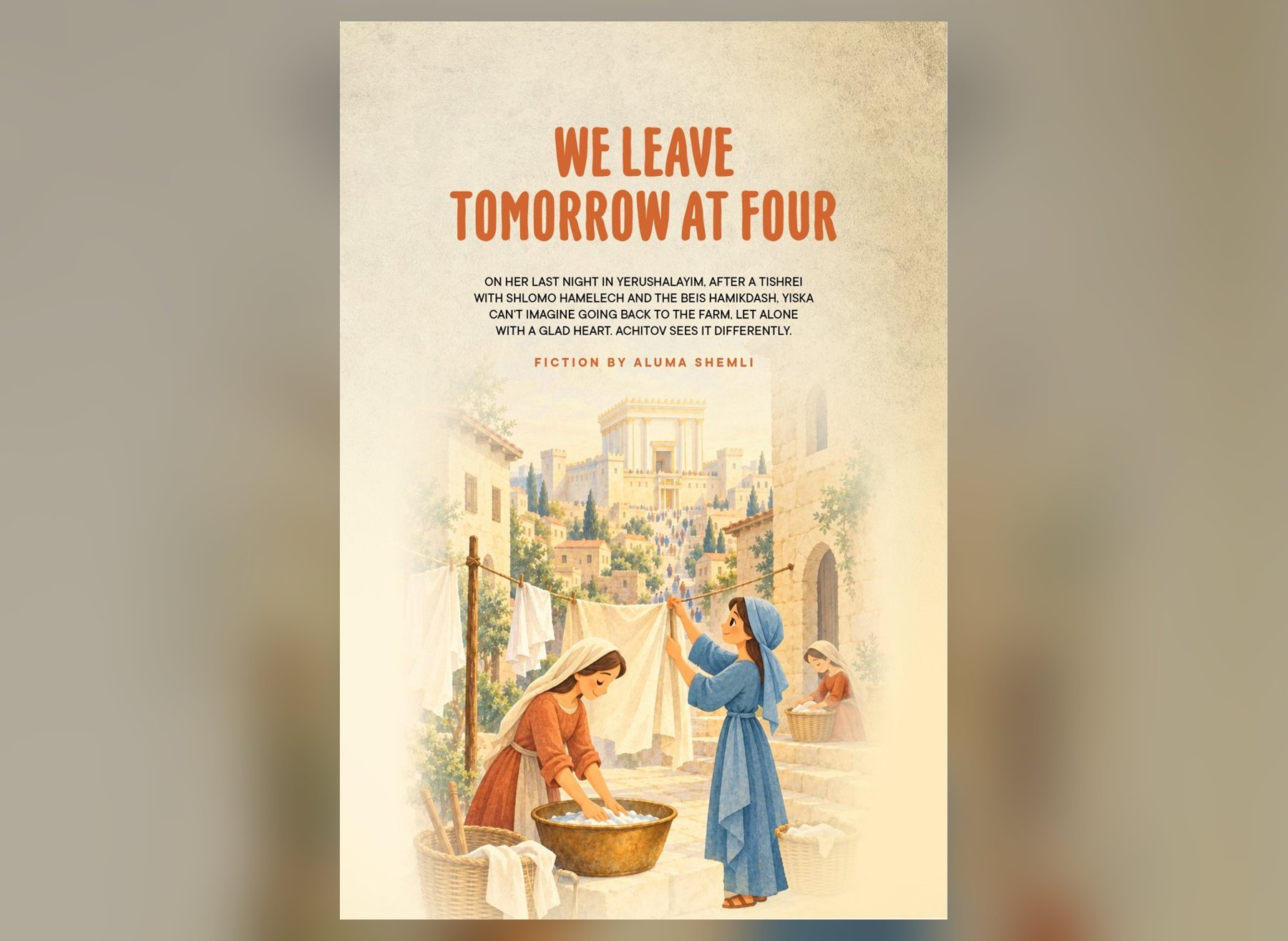
On her last night in Yerushalayim, after a Tishrei with Shlomo HaMelech and the Beis HaMikdash, Yiska can’t imagine going back to the farm, let alone with a glad heart. Achitov sees it differently.
Yiska was alone on the roof, bent over, spreading clean beans out on sacks to dry. Well, she wasn’t really alone. Tiny Sarah was curled up on her chest, inside the thick cloth strap tied around her. You could say this warm carrier had almost become her permanent home. Who knew if, after they returned, she would agree to sleep in her own cradle at home again…
The beans were damp and cold, and there were so many of them. She arranged them row by row, careful that they shouldn’t prevent the sun that would rise tomorrow from being blocked. Since she was already lending a hand to Bat-Sheva, their wonderful hostess, she might as well do it properly, right?
“Lulei Hashem she’haya lanu…” The singing rose from below, stormy. Judging by the voices and the pounding on the table, another group of excited olei regel was sitting there again. They were repeating what Shlomo HaMelech had said, working out together how to bring down to their everyday lives the things he had spoken of, sharing with one another their feelings and their excitement over all the lofty revelations bursting forth here, one after another, almost without pause, without a moment to digest and absorb. When their spirits grew too stormy for words, they gave voice in an ancient song. The verses, the melody, sometimes express things better than words.
A small pang in her heart accompanied her skilled, quick hands and her thoughts. She had already grown used to putting the children to sleep in the dimness of the small room, on the straw mattress, while listening to the tunes, to the wondrous stories rolling out from under every table, to the tearful awakenings of those gathered. If only she could have a farbrengen like this at their small farm, a ride of about an hour from Chatzor in the Galil …
When she thought about home, about everything she had left there, she stretched, blinking. It suddenly seemed so far away, as though she had lived there in another lifetime, in a period she could barely remember. The beautiful silk curtains that Achitov had bought and that she had embroidered with little pomegranates. The linen tablecloths, the ornate iron beds. Sarah’s straw cradle…
How busy she had been on that day when Achitov came back with his idea, that they should all be oleh regel this year. The goat had given birth that very morning, and the lame Canaanite wanted the shipment of spun wool they had promised him. Sarah had cried all night, and the piles of dirty clothes had long since spilled over the edges of the baskets. And her mother-in-law… she sighed.
At first she hadn’t understood where this bold, crazy, unreasonable idea had come from. Every year he went up alone—did he really need them along on this endless journey? A week on a camel. A week! And Sarah so small, and Yedidya only three and so mischievous. She’d just be running after him all day—was that why she was traveling? Running after him was more comfortable at home…
Now, after two weeks in Yerushalayim, she was embarrassed to remember her thoughts back then. But why wouldn’t she have thought that way? Until you get here, you can’t understand. And even when she went back, she didn’t think she’d find the words to explain to her sister Chagla, for instance, what she had experienced here.
He had brought her pesukim from the Torah, told her about the mitzva of Hakhel, about the new Beis HaMikdash Shlomo HaMelech had built for Hashem, told her the king had waited with the Chanukas Ha’bayis until Tishrei. Nothing had been convincing enough to leave the house and the farm, to abandon all the endless work right before winter’s arrival, and set out on this impossible journey. Only his pleading eyes had managed to melt her resistance. He had never asked her for anything with such longing before. Go, come back. She had already been through two pregnancies and births—wouldn’t she survive this month?
She looked at her hands; her fingers had already become wrinkled from contact with the damp beans. She decided to stop for a bit, stretching. At the edge of the porch she noticed the jug in which she’d soaked Sarah’s dirty diapers. Not nice! Bat-Sheva might find it tomorrow, might scrub it instead of her! She’d already had to borrow soap from her as it was—hadn’t brought enough from home… She went to the bucket, scrubbing the cotton diapers in the cool water. Her fingers were smarting. “From the frying pan into the fire…” she laughed to herself. “I didn’t want to touch damp legumes, so I’m scrubbing diapers in cold water instead…”
Even before she reached Yerushalayim she had begun to taste the excitement. Traveling between the settlements, the nights by the campfire, the olei regel bringing up memories with tearful eyes, the melodies… the people who joined them like butterflies drawn to the light.
Rosh Hashana with the king. She sighed, shivering. The moments before the shofar. How could you even crown Hashem as King before seeing an actual king even once? And the celebrations that had begun on the eighth of Tishrei… the korbanos sacrificed in numbers she couldn’t fathom. She’d thought that she, the daughter of Adriel from the Lower Galil, knew what big flocks were… There had been no end to the korbanos, until they decided to sanctify the floor of the Beis HaMikdash courtyard itself so they could sacrifice upon it. There was no other way to manage such an unimaginable quantity!
And Yom Kippur… they simply kept eating. It had taken her time to understand it… the celebrations of the Chanukas Beis HaMikdash had simply overridden the fast! Even when Yedidya was born at the end of Elul, her father had told her to fast on Yom Kippur, and now… but that she couldn’t tell Chagla. She’d ask, is that why you went, to get so excited that you ate on Yom Kippur? And she would answer her, of course not, we barely ate anything… so many people crushed together, packed in. Especially those who wanted to stand in the front row, to see every detail, every movement of the king. If someone sneezed, the whole line sneezed along with him… and then what would Chagla say? She’d screw up her face. She’d say, I couldn’t have stood being squeezed like that. And surely everyone was sweating…
She wouldn’t have an answer for that. She herself would have reacted the same way. Being in Yerushalayim in Tishrei with the king was something you had to experience; you couldn’t explain it. At least now she understood why Achitov traveled to celebrate every year, and instead of coming back well-fed and satisfied, he always came back wrung out, thinner, his fine clothes worn as if he’d been shoved into a barrel and rolled down from the top of the mountain… After seeing the dancing, in which tens of thousands of people had taken part, she was beginning to understand. That was why he slept almost a full day once he arrived home, and why it took him nearly two weeks to come back to himself, to land. He was completely somewhere else, flying…
This time, she would be like that too.
When she thought about going home, she lost her breath for a moment. Almost without noticing what she was doing, she left the scrubbed diapers on the edge of the jug and walked to the western corner of the roof from where you could see the Beis HaMikdash and its courtyard. She breathed deeply, trying to draw as much of this light, this goodness, into herself as she could.
It was amazing; even the gentiles of Yerushalayim were different, nicer… the Yevusim, those strange people with their slanted eyes, carrying and cleaning and serving all the thousands of Jews from across the land who filled the city. And the enormous vessel standing right by the Beis HaMikdash mount, endless—some generous man from Efrat funded it, standing at its opening, handing out clay cups full of wine to every oleh regel who wanted to make kiddush, generously adding sweets and endless fruit…
Someone was climbing the stairs. She could hear the wood creak beneath him. Embarrassed, she hurried to finish hanging the diapers she’d scrubbed on the rope strung loosely in the corner of the roof.
“Yiska?” She heard Achitov’s deep voice, and breathed a sigh of relief. “You’re up here?”
“I’m here…” She turned around, smiling.
“I was sitting downstairs with everyone, we were singing, talking, Yedidya fell asleep on me.” He came closer to her. “I went into our corner to lay him on the mattress. I was sure you and Sarah were long asleep… I came out looking for you.”
“And you found…” Her smile widened.
“Working hard?” he asked softly, his eyes concerned.
“No, not at all.” She smiled. “A little helping Bat-Sheva, and a lot of thinking…”
“Can I ask about what?” Almost without noticing, he was drawn to the western corner, looking at the Beis HaMikdash. She stood beside him, her hand resting gently on Sarah, curled up in the carrier.
“If only I had the words, I’d have shared it with you long ago,” she whispered, tears of emotion filling her eyes. “Everything—the king, Yerushalayim, the Beis HaMikdash… it’s, it’s wow, Achitov.”
He stroked his beard, nodding. He didn’t take his eyes off the holy Bayis, the most beautiful in the world.
“Suddenly I’m so proud, so happy to be a woman in Shlomo HaMelech’s kingdom, to be a Jew, Achitov. It’s not that I wasn’t before,” she hurried to reassure him, understanding from the smile in his eyes that he wasn’t alarmed at all. “I always knew I was a Jew, a daughter of Avrohom, Yitzchok and Yaakov. I carried my name with pride, I was careful about every mitzva. But now, now it fills me completely. I can’t even explain it… as if there’s nothing outside of it.”
“Maybe that’s the difference between hearing and knowing, and seeing,” he whispered.
“Between hearing and knowing, and being.” She corrected him, embarrassed. “Like—this is me. This is everything. The king, the kedusha, the light. There’s nothing else beyond this. I mean, there is. But the farm, the business, our home. I know all of that exists somewhere. But it’s just, it’s not… oy. You understand, right?”
Achitov nodded, his smile widening.
“Guess what’s happening tomorrow?” he turned to her.
“What’s tomorrow?” Her eyes sparkled. She was curious and excited like a little girl.
“Tomorrow,” he drew it out, speaking slowly. “Tomorrow the merchant, her father, will have ready for me a medium sack of dried figs and raisins, two large skins full of water, and a sack full of dry bread. We’ll buy fresh bread and dried vegetables from Azriel. We’ll load it all on the camel, and set out at four o’clock, happy and glad-hearted, home, to Chatzor in the Galil, to our farm.”
She went pale, truly pale. She gripped the stone railing Achitov was leaning on, her fingers whitening. “How can we, Achitov?”
He gave a short, surprised laugh. “What do you mean, how can we? Did you think we were moving to live in Yerushalayim, Yiska? We agreed from the start it would be two weeks!”
“No,” she wept. “It’s not…” She couldn’t continue.
“Yiska,” his voice was gentle, comforting. “You know we have to go back. Shimon and Bat-Sheva can’t keep hosting us forever. And back home the cattle and flock are waiting for us. The fields I prepared for sowing before we left— someone has to sow them! And besides, your sister is due to give birth this winter, and my parents…”
“Achitov,” the tears were still streaming down her face. “I don’t understand how we go back when…”
He sighed. “I don’t understand it either, Yiska! Yesterday we all crowded together in front of the king’s chamber to receive a farewell blessing. We stood there, trembling, listening to his holy words, to his heavenly voice. We saw his gaze rest on us, seeing each one of us, and we trembled. We received a smile of ‘go in peace’… did you really not understand that we’re going back?”
She tried to say something, couldn’t manage it.
“Don’t try to explain,” he finally whispered. “Cry, it’s alright. I’m here, breathing the air of Yerushalayim a moment before we leave. As far as I’m concerned, I’d stay here all night, just looking at the Beis HaMikdash. At first light I’d run there, to follow every movement of the king…”
Silence settled between them.
The men still sitting together below, trying to bring oros down into keilim, raised their voices again in a song of longing. In the street a group of olei regel passed by, talking loudly. Olei regel tend to forget that Yerushalayim also has permanent residents, people with hours for sleeping and waking, children to raise, work to do… they’re always wandering the city streets as if everyone is like them, living in a dream, beyond time and place…
“Achitov,” she whispered once she’d calmed down. He turned to her, his eyes kind, full of compassion.
“I know we’re going back,” she tried to explain, searching for words.
He looked at her, silent. He had endless patience—that too was a gift of Yerushalayim. On the farm he was always busy, always knowing, always deciding.
“We have to go back,” she explained to him, to herself. “The grapes waiting to be pressed, the new kid goat. The wool we promised that Canaanite merchant, whom I can’t stand, with his beady eyes… and besides, Sarah and Yedidya are already longing for their normal daily routine, the clean clothes are almost gone, and I feel bad asking Bat-Sheva for more favors… and my back. I can’t sleep on this straw mattress anymore…”
He laughed, surprised. “So what don’t you understand?”
“You said we’d leave tomorrow, happy and glad-hearted, at four o’clock.” She looked at him, her eyes almost accusing, full of puzzlement.
“What happy? What glad-hearted? We’ll leave at four, sure. But in tears, in heartache. As if they’re tearing us away by force, and our souls stay behind. There are moments I feel that until I come back again, I won’t really be happy.”
“Happy and glad-hearted.” Achitov smiled, his eyes shining, tearing up. “I wasn’t mistaken; I meant it.”
“How can that be?” The tears came again. “If you just think about where we’re coming from and where we’re going… leaving the king, leaving the Beis HaMikdash, the kedusha, the love, the achdus, the joy, the excitement that were here, and going where? To an ox and a cow and a donkey. To money and honor, to all the filth of this world. What is there to be happy about here?”
Achitov lowered his eyes for a moment, biting his lip. Then he raised them again, looking once more at the Beis HaMikdash. He breathed deeply. Sarah stirred in the carrier, trying to stretch, as if reminding them that she was there too. Yiska swayed slowly, in a soothing motion, stroking her. A light cloud sailed across the sky, a reminder of the approaching winter, of the Kohen Gadol who had prayed for a rainy year, of the dry, thirsty, plowed fields waiting for rain.
They had to go back.
“The king,” Achitov said suddenly, quietly, “the king isn’t only the king of Yerushalayim, Yiska. He’s the king of Israel, from Dan to Beer Sheva, from Tzor to Etzion Gever. And the truth is, he’s the king of the world. Even if not all the nations recognize it yet. All the life, the light and the good of the whole world comes through him. He’s the conduit of abundance.”
She looked at him, captivated.
“The Beis HaMikdash,” he gestured with a broad sweep of his hand, showing her the holy place, beloved, stirring tears of emotion, “the Beis HaMikdash is the place where the Shechina rests, but…”
“But?” she furrowed her brow, puzzled.
“But it’s not enough that we feel it here, in Yerushalayim, when we’re cut off from all our everyday life, cut off from the physical world, seeing the king and drinking in his words thirstily, present with him at Shacharis, at Mincha, at the Korban Tamid, accompanying him home… We need to bring this holiness with us to the Galil, Yiska.”
“What?” Her eyes widened.
He nodded. “Yes. The Beis HaMikdash needs to be inside us, to come with us to the Galil, to bring life into us, into our workers and our tenant farmers, into the members of our family who didn’t get to be oleh regel. You know what? Even into that Canaanite merchant. Let him see us, and see a different kind of life, know that there is a king, and know exactly who that king is. Nothing less.”
She fell silent, trying in her astonishment to absorb what he’d said.
“We’re actually messengers of the king now, his representatives, his soldiers.” He looked at her, serious. “We have a mission. To go and spread the light and the holiness we received here to every place. Nearly all of Am Yisrael were here—think about that… each person will carry forward what they received here! It’s amazing! Just imagine how the whole Eretz Yisrael will go up in a fire of holiness!”
She breathed deeply, closing her eyes. She tried to picture that image in her mind’s eye. Valley and mountain, river and desert, all lit up in a light of holiness… “It won’t be like this light of Yerushalayim… maybe like a small candle.” She sighed. “We are, after all, just simple people, we’re not the king, Achitov!”
“It will be, in a certain sense, even greater, Yiska!” He was serious.
“Oh, come on…” She didn’t like it when people tried to comfort her with empty promises…
“Remember Simchas Beis HaShoeiva?” He changed the subject suddenly.
“No chance I’d forget it!” She smiled with longing, tearing up. What, tears again?
“When you were sorting wheat, at night,” he furrowed his brow. “How many candles did you light to see well enough that there were no bad ones?”
“No candle at all…” She looked at him, surprised. Had he already forgotten? “The light of the Beis HaMikdash lit up all of Yerushalayim! I didn’t need to light a candle. And even if I had lit one, you wouldn’t have seen its light. It would have been swallowed up in…”
“The king told us on Sukkos…” He looked at her seriously, reciting the words of the passuk slowly. “The advantage of light that comes out of darkness.”
“The advantage of light that comes out of darkness.” She repeated after him, still not understanding, already loving the words. She could almost hear the king’s voice saying them, soft and gentle, yet striking like flames.
“Exactly.” Achitov grew animated, as if she’d explained something herself. “When there’s sunlight, you don’t notice a small candle, but at our farm, on a moonless night, a lit candle is a real lifesaver!”
She nodded, thinking she was beginning to understand, not quite sure.
“When we move away from the Beis HaMikdash, from the king,” he seemed to be pleading with her to understand, “every deed we do, every action, every good thought—they’re like a candle in the darkness. They shine with an entirely different light. It’s no great feat to shine here in Yerushalayim, to be bound to the king, to love him and want to do everything he commands. In the Galil, now that’s where we’ll really see…
“In the midst of the physical world, in the midst of all the daily concerns. With the comfortable beds, the cows, the chickens in the yard, and that Canaanite merchant—that’s when being batul to the king, batul to the one who sent us, becomes a completely different level of avoda…”
“The advantage of light that comes out of darkness,” she whispered.
Achitov nodded, his eyes, which had been sparkling until now, already suspiciously damp.
“So tomorrow,” she whispered. “At four, we set out on a mission, to light up the Galil.”
He nodded, serious.
“Happy and glad-hearted, right?” She smiled, melting into tears.
“Only happy and glad-hearted, what else?” His voice trembled.
She took a deep breath. “The truth is, if we’re taking the light with us to spread it everywhere, then we’re not really moving away from the king at all, are we?”
He nodded, wiping his eyes.
“So of course we’ll leave happy and glad-hearted,” she sighed, smiling, embarrassed. “It’ll be a little hard for me, Achitov. But I’ll try. Don’t worry.”
“Not worried…” He shrugged. “Will you come again next year?”
“Is that even a question?” She pretended to be annoyed, and he laughed.
The little one finally woke up.
This story was written inspired by a talk of the Rebbe, from Sichos Kodesh 5741, Vol. 1, p. 376 onward.
Beis Moshiach #1527 • י״ב חשון תשפ״ז • pp. 40-45, 51
© 2026 Beis Moshiach Magazine. All rights reserved.
This article originally appeared in Beis Moshiach #1527. You are welcome to share it with friends and family by email or in print, provided that you do not change, add to or omit any part of it, you credit the author and Beis Moshiach, and you include a link to archive.bmoshiach.org (written out in full in printed copies).
To republish this article in a newspaper, magazine, book or website, please request permission in advance at [email protected].