When Doubt Meets Duty
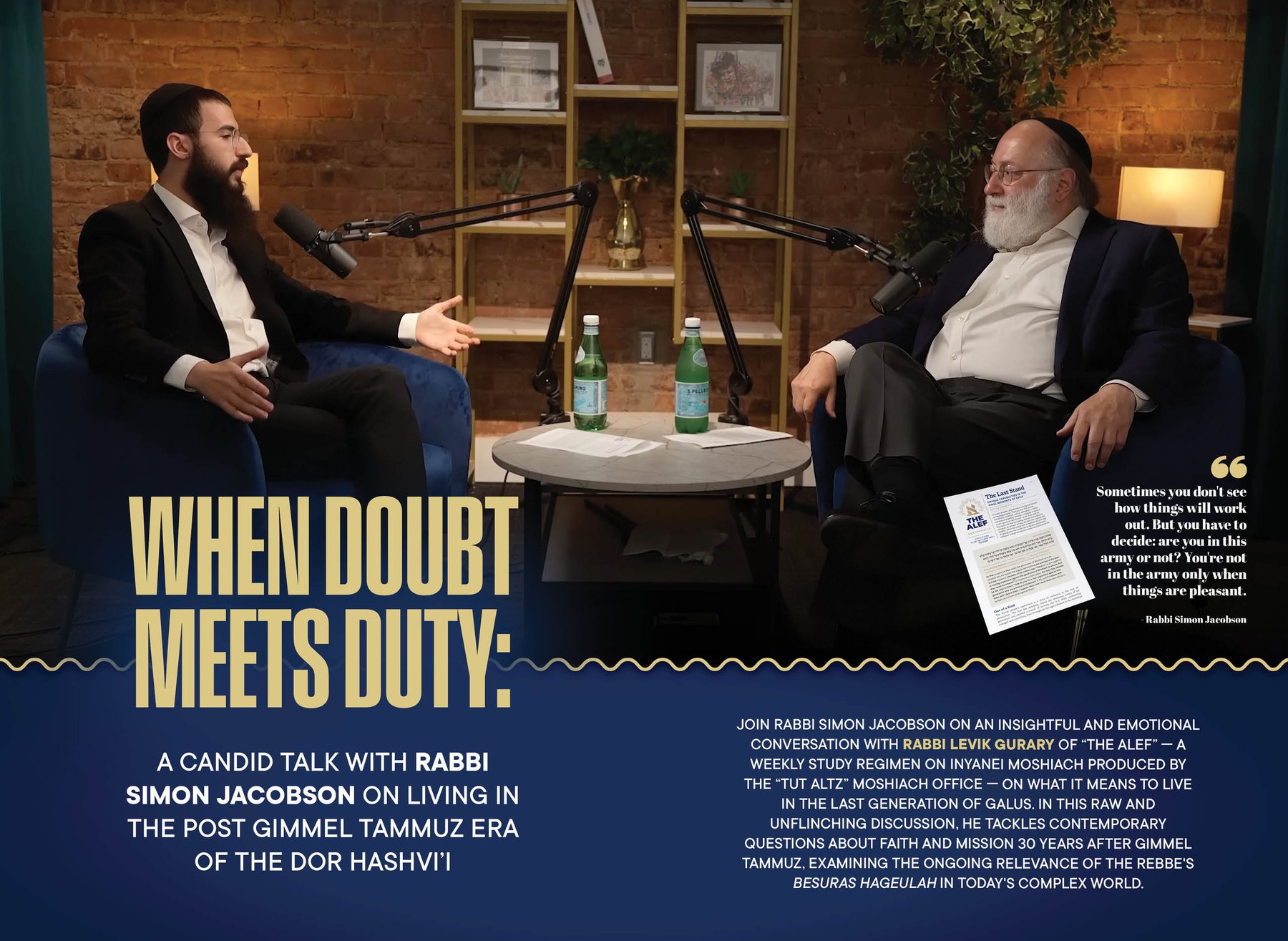
A Candid Talk with Rabbi Simon Jacobson on Living in the Post Gimmel Tammuz Era of the Dor HaShvi’i
Join Rabbi Simon Jacobson on an insightful and emotional conversation with Rabbi Levik Gurary of “The Alef” – a weekly study regimen on inyanei Moshiach produced by the “Tut Altz” Moshiach office – on what it means to live in the last generation of Galus. In this raw and unflinching discussion, he tackles contemporary questions about faith and mission 30 years after Gimmel Tammuz, examining the ongoing relevance of the Rebbe’s Besuras HaGeulah in today’s complex world.
Rabbi Gurary: My name is Levi Gurary, and I work on The Alef. The Alef is weekly Moshiach lessons that we’ve been sending out to hundreds of shluchim and Chassidim around the world to use in teaching about Moshiach. We focus on text-based Torah material presented in fresh, relevant, and articulate language for people of today.
That’s really the point of our conversation today. Similar to The Alef, we aim to explore in this podcast certain topics about Moshiach – some that are more complex, some that people have complicated feelings about – to gain clarity for ourselves and learn the right words in layman’s terms to convey these concepts to the people we teach and learn with.
The paper we’re discussing today is “The Last Stand,” the 10th edition of The Alef. We published it in honor of Gimmel Tammuz. When our team was working on it, we were considering which direction to take. Of course, the first thing that came to mind was to speak about Moshiach as a concept that has existed forever, from the beginning of creation, and to discuss the situation in which we find ourselves today.
Especially as we approach Gimmel Tammuz, considering where we’re holding now, we felt it was important to talk about the specific and unique mission that we as Chassidim are meant to spread to the world. That’s why we chose to speak about “The Last Stand” – the idea that we’re the last generation of galus and first of Geula.
We’ve been getting beautiful feedback. People really enjoy hearing about Moshiach and a brighter vision for tomorrow. But this is the first time we’re trying to argue that it’s happening now, that we are the generation. We went ahead with it, but we feel we would like to have a better understanding, both for ourselves and to share with others: How can we say that we are this generation?
I feel if I went to a person on the street and said, “Not only is Moshiach coming eventually, but he’s coming now and you are the one – it’s in your hands,” they would think I’m crazy. They might think I’m a messianic in the negative sense, perhaps a millenarian – I don’t even know what terms they would use, but they would think I’m crazy. So my question to you is: How do we bring this message in a way that people can really understand?
Rabbi Jacobson: Let me begin with this. I think some questions can be answered simply with question and answer, but many need to be answered by going back to the beginning: What is Moshiach in the first place?
I think that’s where the most confusion exists. For some, Moshiach is some type of supernatural utopia – ice cream growing on trees, pure fantasy; there are many stereotypes around it. I think once we understand what it is, it becomes much easier to answer the question “Why now?” especially now, more than ever.
Let me explain this in universal language that everyone can relate to, without using Hebrew words (though those familiar will understand which terms I’m referring to).
The fundamental question is: What is life? What is its purpose? Because Moshiach is about the fulfillment and realization of G-d’s plan for this world.
What is that plan?
We all know we live in a material world. We have bodies with physical needs – we need to eat, sleep, drink, have relationships, deal with health issues, make a living, take care of our families… the list goes on. Everyone knows this; they don’t need to read any books about it. But we’re also told that we need to live a life of purpose, a life of meaning – to direct all those material activities toward something deeper.
Now, a skeptic could question that and say, “Who says? I’m perfectly happy making money and enjoying life. What do you want from me?” But I don’t want to address that because it’s a different question. Let’s assume, for this discussion at least, that we can all agree that we need something more than just survival. We need what’s called in English “transcendence” – something deeper. Some people pursue it through travel, some through love, some through faith. But we need something more than just eating and sleeping. We need something spiritual, something transcendent.
The Rambam (Maimonides), the ultimate authority in Judaism – especially in halachic, legal matters – when explaining Moshiach, says one fundamental line: that the occupation of the entire world will be solely to know G-d. This means that while today, the world’s business has been focused on Wall Street, marketplaces, all the material matters of survival I mentioned, [a time will come when the focus will shift towards “knowing G-d”.] But what does it mean to “know G-d”?
We have a fundamental idea in Judaism that everything is about what I would call spiritualizing the material world. You’re not just eating a meal – you’re eating a meal with the intention to get stronger so you can help another person, be a kinder person, a gentler person. You make money in order to give tzedaka, charity.
The Alter Rebbe explains in Tanya, chapters 36 and 37, that since every mitzva’s purpose is to bring G-dliness into this world – to bring a higher consciousness, if you will – every mitzva is really a piece of Moshiach. Because Moshiach is the sum total of all the building blocks of good deeds that people have done and sacrificed themselves for since the beginning of time.
In other words – and this is critical in Jewish thought – Moshiach and Geula are part of a process, not just an event that happens at the end of history. It’s a process that began with Adam and Chava in Gan Eden and has continued throughout history in an unbroken chain. Every good deed, every mitzva, every sacrifice, every life given for something good releases a spiritual energy in the world that somewhat refines the world. This process which we call birurim [in the Kabbalistic vernacular], ultimately erupts into the sum total that we call Moshiach and Geula.
So Moshiach and Geula, if you think about it, represent the belief that every good deed each of us does lives on forever. Our parents, grandparents, and great-grandparents did not act in vain when they gave their lives to be good people and to do mitzvos.
Critical Mass
Moshiach is the accumulation. Now, how do we know when that eruption takes place?
You either need to have sensitive eyes or you need a leader who possesses them. We have the Rebbe. Even if you’re not a Chassid of the Rebbe per se, he’s a spiritual visionary. He’s a person who’s in touch with and takes the pulse of our times and identifies and says, if you open your eyes – I’m using the Rebbe’s words now – and you connect the dots, you will see that we have come to a point [where all this has accumulated towards a critical mass of goodness, of Geula].
And this does not require faith. Let’s just take a few examples that really drive the point home. Most of us take our blessings for granted. You and I are sitting here right now, and Jews around the world, even though we have a war and we have antisemites – I’m not saying the world is perfect – but we’ve never had it as good.
Religious Freedom
You and I are not afraid of someone outside right now waiting to arrest us or round us up like 80 years ago. Our great-grandparents would see this as messianic times from a point of religious freedom.
You can send your children to any school that you’d like to send them to. You can practice your Judaism freely. This didn’t happen by accident. This is a result of thousands of years of hard work that refined the world. That same material world which was once a pagan world that opposed and resisted anything that was G-dly and went to war against it and went to war against Jews, now is a free world in most instances.
Sceince & Technology
How about the great strides in science and technology? The Zohar says clearly that in 1840, in the Hebrew year 5500 (ת”ר), which was considered the beginning of the Industrial Revolution, there’ll be an explosion of knowledge both from above and below. And look what happened since 1840 until today—it’s only accelerating, a tremendous amount of technology.
From a mystical point of view, that’s not seen as an accident that some creators invented and happened to discover subatomic energy. That’s all part of a world that is becoming more and more receptive to spiritual energy.
The result today is that we can transcend time and space through broadcasting and podcasts like this, and through many other technological advances. Political freedoms have expanded tremendously as well.
I’ll quote even a Jew who calls himself an atheist: Steven Pinker has a whole book where he explains how the world is infinitely better today than it ever was. He explains it in terms of enlightenment and human maturity and refinement. But he basically shows the decline of violence, the decline of war, the decline of discrimination. You’d be amazed to see the trajectory of how it’s going lower and lower.
So the Rebbe looks at all this with the eyes of a Rebbe and the eyes of a Jew, the eyes of Torah, and sees it all as signs that clearly show those good deeds I was talking about have come to a climax, and we’re about to finish the finish line.
For the record, I should mention that the Rebbe is not the only one. People before the Rebbe and other gedolim that are not even Chabad also point out that you see many of the signs.
Rabbi Gurary: You mentioned that anyone using their rational mind can see this. That’s a crucial point because often our reactions to ideas and notions aren’t necessarily from a rational perspective. We’re so used to the way we see things that we’re not really always open to hear and see if it makes sense rationally. If it makes sense to the way we see things, good. If not, we push it away.
Rabbi Jacobson: [Being rational about this faith is important, because] as you know, anything built overnight dies overnight. I think the quicker the inspiration, the quicker it dissipates. In very brief terms, I would just say: if you’re an honest person, look at your life compared to the life of your great-grandparents. Is that an accident? Or is it part of a process?
I’m not even trying to force anyone to come to a conclusion—you make the decision. Some people may say it’s an accident, it just happens to be that we have a better life, but if you think about it, you see there is a trajectory, there’s a process.
Let me give you one example. A few years ago in Haiti, there was an earthquake. And all the countries of the world were competing, not to conquer the country, but to help with humanitarian aid. I was thinking about this then. Historicaly, when a country suffered a natural disaster like and earthquake or a volcano, you know what happened? All the neighbors came to rape and pillage that country and steal all its resources. And here, countries around the world with no visible self-interest are sending helicopters and planes with medical supplies and food.
There is a gravitation towards humanitarianism that didn’t exist before. Consider the billions of dollars the United States gives out in charity. Whether or not you agree with all the causes they give charity to, why would people put their hard-earned tax dollars towards helping some country in Africa that has a water shortage? There is a certain element of the world that has become more caring and more kind.
Two hundred and fifty years ago when the United States became a country, there was no such thing as freedom. You were under the ruling of a king, a monarch, the church, some tyrant—maybe he was kind, maybe he wasn’t kind. We’re living in a transfmed world.
Are Current Wars a Setback on the Process?
Rabbi Gurary: This is an argument I appreciate and often share with people. But in recent years, especially with the war in Ukraine and what happened this past year in Eretz Yisrael, plus the political extremes in America, this view seems challenged. While we’re not expecting a utopia to appear in an instant, these eventscan be seen as setbacks to what the Rebbe spoke about. This question bothers many people.
Rabbi Jacobson: That’s an excellent question, and I’ll respond directly. First, whenever you’re involved in a particular situation, it’s difficult to see the bigger picture. I recently attended a shiva where a mother lost a child. You wouldn’t sit with that mother and say, “We’re closer to Moshiach than ever because there’s world peace and technology and AI.” Right now, this mother is grieving her child. For her, Moshiach feels as distant as possible – she wants her child back.
But we must keep the bigger picture in mind: The Jewish people are living in unprecedented times with unprecedented freedom. This doesn’t minimize what happened on October 7th and other atrocities, which I’ll address momentarily.
The Rebbe actually addressed this question on Purim 5747/1987 – in what I think was the last Purim farbrengen – where he spoke about Moshiach’s coming and its immediacy. He acknowledged that we see areas where there’s moral decline, decadence, things that in some ways some people think are as bad as ever. It’s like when you’re about to finish something, the last fumes begin to emerge. While seeing it can be painful, the awareness itself is actually positive.
The only way to understand the Ukraine war, the Gaza war, the antisemitic attacks, and any tragedy is that these are the last gasps of galus. The tension between matter and spirit isn’t finished yet. We’re still psychologically trapped because even if Moshiach and Geula are literally here, we still think like we did 10 or 20 years ago.
Who is The Alef for?
This educational series is for adults—men and women of all ages. The target demographic is Jews affiliated with Yiddishkeit, but not necessarily knowledgeable about Moshiach. The systematic nature and refreshing language of the content make it welcome even to those who might be familiar with the concepts and still intriguing to the uninitiated.
How do I use The Alef?
This is perfect for a short chavrusa session, a small get-together for an occasion or the Torah learning aspect of any program. It requires no prep; each segment is concise enough to remain focused on a singular point, but comprehensive enough so that readers feel satisfied to have gained insight in the topic.
Segments are designed to be short, but open-ended enough to breed further discussion.
There is one handout for both the teacher and student. The segments strike the balance of providing an approachable reading for the balebos, along with discourse points that retain the teacher-student dynamic.
Is The Alef inspiration or information?
The segments of The Alef provide a symmetry of sources in Chassidus and Nigleh, creating a wholesome approach on any given topic. Learners walk away with the surface and inner meanings to matter at hand. Special emphasis will be placed on demonstrating the essential aspect of Geula as taught by Chassidus and how differing topics relate to that pivotal point.
At the heart of this series is a solid Torah study session. Built around a core text, these segments convey information in an engaging way. In addition, every segment will have inspiring elements, sidebars and takeaways to highlight the relevance to daily life.
How do I sign up for The Alef?
Sign up www.thealef.co to receive The Alef weekly in your inbox. Archives are available on the site as well.
To be continued
Beis Moshiach #1450 • pp. 10-16
© 2026 Beis Moshiach Magazine. All rights reserved.
This article originally appeared in Beis Moshiach #1450. You are welcome to share it with friends and family by email or in print, provided that you do not change, add to or omit any part of it, you credit the author and Beis Moshiach, and you include a link to archive.bmoshiach.org (written out in full in printed copies).
To republish this article in a newspaper, magazine, book or website, please request permission in advance at [email protected].