Confessions of Purim Hostesses
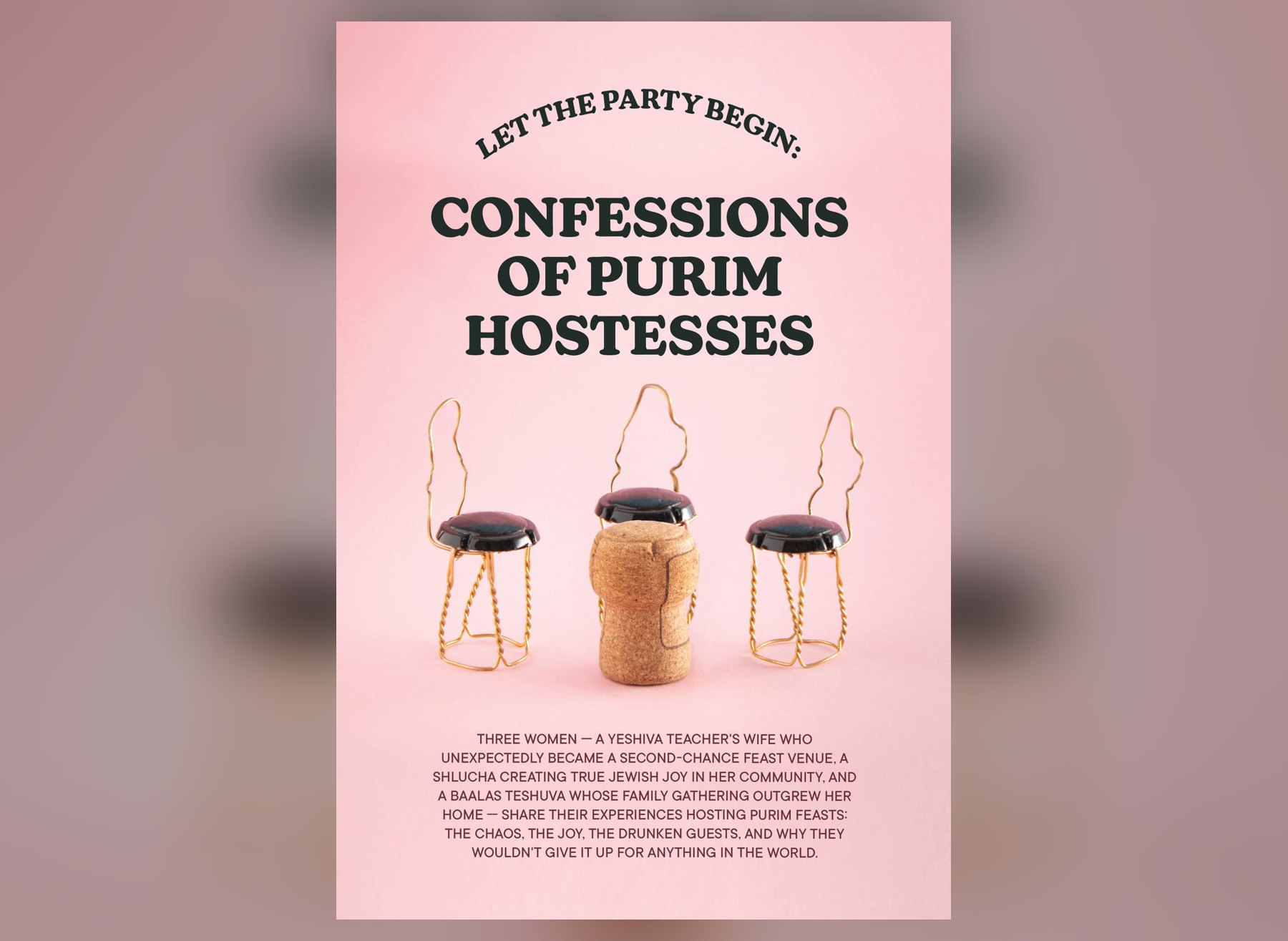
Three women – a yeshiva teacher’s wife who unexpectedly became a second-chance feast venue, a shlucha creating true Jewish joy in her community, and a baalas teshuva whose family gathering outgrew her home – share their experiences hosting Purim feasts: the chaos, the joy, the drunken guests, and why they wouldn’t give it up for anything in the world.
After the costumes which needed to be ready long before the holiday; After the meticulously packaged mishloach manos for the teachers that have already been sent; After the the Megilla on Purim evening and Purim morning; After the mishloach manos trips around town and matanos la’evyonim. The Purim Seuda is finally here.
Even those busy with Purim mivtzaim who read the Megilla again and again, eventually arrive at the feast. It’s the mitzva that serves as the grand finale of this great day. With joy, singing, abundant food, wine and mashke. And of course, let’s not forget the mess, the drunk guests, the dirt…
So, if you’re a guest, it’s perfectly fine. Help clear a bit, take some garbage bags with you on your way to the car, return to your clean house full of Purim experiences. But what if you’re the hostess…
How does it happen that your home suddenly becomes the venue for a big feast? How much of a mess is it, really? And what about the warm family atmosphere, the privacy? And the children, don’t they get a bit lost in this chaos? And the drunk guests, don’t they scare you? So unpredictable… Do you remember a difficult moment? And looking ahead, will you continue?
Burning questions indeed. Three larger-than-life hostesses answer:
Yael: A Yeshiva-Bachurim Purim
My name is Yael. I’m not a shlucha abroad or even in Israel. Just a regular woman living in an organized Chabad community. After our wedding, we would travel to my parents for every Purim. My husband’s parents are shluchim, Baruch Hashem, and their Purim feast takes place in a huge hall with hundreds of people. We, seeking a family-oriented and cheerful place, would join my parents for a feast with some married siblings, brothers-in-law, etc. There’s always one designated drunk, lots of children. The sisters-in-law bring tasty, well-prepared food. Really nice.
How it all started… Shortly after our third child was born, my husband was appointed as a Maggid Shiur in a yeshiva. He took on the role with all due seriousness, taught and farbrenged, and also invited students to eat with us for Shabbos meals. Sometimes groups would come to farbreng on Friday nights after the meal. They would sing niggunim and listen.
It was moving. In your small, private, sweet home, suddenly there were real yeshiva farbrengens late into the night. I would go to sleep on Friday night with the sound of niggunim from the living room accompanying me.
On Purim, we didn’t think of hosting any bachurim. There’s an official yeshiva seuda. But already on the first Purim, a few boys arrived, saying they came late from mivtzaim and needed to fulfill the mitzva of the feast. We invited them in and served everything we had at home. They, for their part, passed the news on. There’s a place to eat!
Every few minutes, the door would open and more pairs and trios of tired and sweaty bachurim would enter after a day-long “Mivtza Purim.” I somehow managed with leftovers that my brother transported from my mother and a raid on the grocery store and neighbors’ pantries. Since then, everything became official: close to shkiah, a “second chance” seuda begins at our home for anyone who didn’t manage earlier. It’s long since been meant not only for bachurim from the yeshiva; our home is open to everyone.
How much of a mess is it? A lot! First of all, I never know how many boys will come. After all, it’s a “second chance” meal, most guests themselves don’t know if and when they’ll arrive. Secondly, there’s no official start time when everyone washes together and sits down to eat. Every few minutes, someone else arrives, enters the kitchen, washes hands, looks for a roll… I prepare a lot of food and also many backup options. All kinds of side dishes that I can freeze afterward if they’re not used. Bourekas that can be pulled from the freezer and put in the oven. Endless challos and rolls… I don’t do fancy dishes, casseroles and stuffed foods and all sorts of food games. It doesn’t interest my audience, it’s not efficient. Those who come to us are looking to be full, and there’s plenty of mashke, of course…
The family atmosphere? It’s really not very family-oriented… We try to start together, sing a bit and notice the children a bit, but very quickly that gets lost. My daughters and I retreat to the kitchen anyway, leaving the living room for the bachurim and my husband. The truth is, the we have very nice family moments at the late hours, when around the table they’re already singing in hoarse voices and other things that this isn’t the place to detail. My daughters and I sit in the kitchen, enjoying snacking on mishloach manos and listening and laughing about what’s going on there, in the living room, these are very family moments. Although my husband and sons aren’t participating, for my daughters and me, these are sweet moments we’ll always remember. Even the terrible cleaning afterward doesn’t make us forget them.
Drunk guests don’t scare me very much; they’re mostly amusing. My husband is the one who deals with them, and he’s not 100% sober himself… Sometimes the drunk guests are even moving. When a usually-withdrawn bachur gets drunk and so much goodness comes out of him, and you understand how real it is, it brings tears to your eyes. When a somewhat cheeky student from my husband’s class suddenly insists on kissing his feet and cries: “I am dust at your feet,” what more can you say?
A difficult moment? Every year there’s a difficult moment. One that makes you say to yourself, “This is the last time!” Like when a shelf in the new bookcase broke, and the entire Shas rolled into tahina. Who really tried to sit on it? But that’s a small price compared to the great joy we have every year from this amazing seuda. I wouldn’t give up this privilege for the world!
What are my plans for the future? Of course, I’m continuing! I won’t give it up… Even the children, whom I worried might miss out on family time, already say that when they get married, they’ll always return to this chaos. There’s only one possibility that would make me close the kitchen and give up hosting: a huge Purim feast with Moshiach in the Beis HaMikdash. With Mordechai! Amazing, won’t it be?
Chana: Purim on Shlichus
My name is Chana, a shlucha of the Rebbe Melech HaMoshiach in one of the cities in central Israel. We arrived for shlichus in Elul, and immediately worked energetically on all the holiday mivtzaim. After Tishrei came Chanuka and Yud Shevat. For some reason, we didn’t think about the Purim seuda. My husband read the Megilla every hour on the hour until he became hoarse. I distributed mishloach manos that turned into bikkur bayis visits. At almost the last moment, we went to our parents for the Purim feast, exhausted. We washed our hands and sat down to breathe a little.
How it all started… The Shabbos after the holiday, at the farbrengen after davening in the sweet minyan we established, the participants shared their Purim experiences. My husband returned very agitated. They don’t know at all what true Jewish joy is! Some participated in various drinking parties, Hashem yishmor. Some drank and smoked alone or in groups. Some ate a meal at their mother-in-law’s, with the television on. “It’s not Shabbos, Rabbi! What’s the problem?”
We decided then that next year there would be a Chabad House Purim seuda. We booked a school hall, ordered catering and a invited a guest mashpia, and began inviting people. The first time, not many people came, and the mashpia didn’t really adapt himself to the audience. It was disappointing.
The following year, when we invited people, they weren’t enthusiastic. Everyone said in different words almost the same thing. They wanted something family-like, not a hall. And anyway, my husband speaks beautifully, knows everyone. Who needs an outside speaker? We gave in. We decided to invite them to our home. Family-oriented it will be, my husband would lead the farbrengen. It was a huge success! Since then, every Purim the seuda is at our home, which has meanwhile grown, baruch Hashem, both in people and in square footage… There are the regulars who don’t need to be invited anymore; they usually bring friends with them. There are those we met during the year, and we invite them personally. When it comes to women, I prepare them in advance. At the beginning, it’s neat and clean, later the mess begins. So it’s better to arrive early. And that’s how it is.
In the first stage, I still serve nicely plated portions and my husband is full of Torah insights and ideas for Purim. Little by little, more people begin to arrive in various states, women with children usually flee at this stage, the meal turns into a lebedige feast accompanied by many “l’chaims” and dancing, songs in hoarse voices. Almost drunk…
How much of a mess? Baruch Hashem plenty… and it really makes me happy. When I think about our shlichus, the Purim feast is one of the highlights. Really.
The family atmosphere? Children getting lost? As I said, the meal begins calmly. Father, mother, and guests sit at a respectably set table; there are divrei Torah and stories. Slowly it becomes wilder, and the truth? I think the children enjoy mainly the second part of the evening, the messy one… Baruch Hashem, it’s not Purim every day, and we have enough opportunities and calm Shabbos meals to go through school papers and solve riddles about the weekly parsha. On Purim, they get attention from all the guests who love to pinch cheeks, pamper with another treat, and hear a sweet explanation about a moving Chassidishe costume.
We don’t have many drunk guests. Here and there, there is one who drank too much. Usually, the truly drunk one is my husband, and he doesn’t stress me out, just amuses me. What really stresses me are the hachlatos he makes every year during the meal. “Roi! A Jew needs to study Torah! R-o-i!” When Roi (or Elad or Kobi, it doesn’t matter…) tries to evade, he immediately decides: “What do you say, once a week we learn together? An hour! Roi, an hour!” I listen from the kitchen and ask myself when he’ll find another hour for a lesson with Roi in his already busy schedule…
A difficult moment? One difficult Purim I remember from a few years ago. I was right before giving birth. I didn’t want to cancel the seuda and it’s also not really possible either… Most guys come without a prior invitation… I prepared everything in advance in case I wouldn’t be home on Purim and gave my husband instructions. Since I knew that at the crucial moment he wouldn’t be able to keep his head’ I decided to invite a young Chabad couple I knew. I explained to her exactly what her role was. To be my replacement when needed.
At the crucial moment I was still at home but didn’t feel well at all. I thought I would start with everyone, do a handover with her, and then retreat to the bedroom. She didn’t show up… An hour earlier she sent a message that she wasn’t feeling well and was sorry and hoped I was okay and really apologized. What could I say? I continued hosting. My husband served all the food and all the dishes together, right at the beginning of the meal, so I wouldn’t need to get up too much. I was nice and smiled at everyone and listened patiently to whoever needed. When something was needed, and it always was… I asked the children. In the end, I moved to the kitchen, managing the feast from there, enjoying some quiet. When the women left, I went to the bedroom, leaving my husband to deal with all his drunk guests.
The next day, just before noon, our princess was born. When I passed through the room to the car early in the morning, I closed my eyes. I didn’t want to see the destruction left from the night before. Everything that had dried up and should have been closed and what got stuck and should have been wiped immediately, you know. I just prayed that the two hours my husband had slept were enough for us to make it safely to the hospital…
My plans for the future? Of course, to continue! Over the years, I’ve discovered that not only do the members of our community need to learn what true Jewish joy is, I also need to learn. And seeing your home destroyed and dirty is part of that learning. I won’t give it up!
Miriam: A Family Purim
My name is Miriam, lovingly hosting my entire family in a small hall near my home every year…
How it all started… The Purim seuda began with our journey toward observance. In the office area where my husband worked, a young Chabadnik named Zalman was going around and formed a good connection with him. Putting on tefillin, Shabbos candles for me, a Shabbos newsletter. Slowly and gradually, the connection morphed into a regular shiur we hosted, and our home began to change. It didn’t bother me much; I came from a traditional home, and it only did us good: a bit of kiddush, a bit of shul, a bit of turning inward, less television… Zalman’s name became a concept in our home. Before Purim, he guided my husband regarding the special mitzvos of the holiday, promised to come especially in the afternoon to read the Megilla for us, to arrange the seuda for us.
I always loved hosting, but hosting in the non-religious community is very different. I loved investing in food and design. In the end, we always moved with drinks and snacks to the sofas. I was a bit nervous about the Purim feast. I imagined Zalman with his old-fashioned name as some very archaic fellow, a character from a history book. To be safe, I also invited my brother, sister-in-law, and their twins.
Zalman arrived on time. It turned out that apart from his unshaven beard, he was a modern and up-to-date young man, maybe even too much so. Really a “chevraman”. It was very joyful, lots of songs and divrei Torah. My brother also really enjoyed it. We arranged with Zalman that same day that he would celebrate the next Purim with us as well. The following Purim, Zalman came with his new wife, sweet Racheli. My husband invited his sister and her husband, but my brother wouldn’t give up either and appeared again. It was already quite crowded. I know that Chabad women reading this are probably laughing. Four couples and nine children is crowded? But for someone who must have matching chairs and a placemat under each plate, it’s crowded. Really challenging.
Meanwhile, we became much more observant. My brother and sister-in-law insisted on continuing to come, my parents were also invited, and Zalman already had a child and two more mekuravim that were important for him to bring. I thought I was going crazy. We’re not talking about design anymore! Physically, there’s not enough room at the table!
My husband decided to pay the shul near us for the use of their hall. So it wouldn’t look too empty, we invited another of my husband’s brothers. My son announced he was bringing his fiancée and her parents. It wasn’t empty…
Since then, we celebrate there. Almost all of my husband’s siblings and mine come; it’s really a special and joyful feast. Zalman and Racheli no longer can come with all their children; he sometimes manages to drop by later, bringing a lot of simcha and balagan and more mekuravim. My children already come with their children, and also some of the cousins who got married. It has become our annual family reunion.
How much of a mess? A lot… especially before Purim. Checking who’s coming, cooking and frying. I don’t give up the right to cook all these quantities in favor of some tasteless catering… After the feast, it’s actually okay; we coordinate in advance with the shul’s cleaning company and pay them and return to our neat home calmly.
What about the family atmosphere? For us, this question doesn’t apply. This is exactly the biggest family atmosphere there is. The opportunity to meet everyone leisurely for a few hours of joy.
Drunk guests? There are, certainly, but they’re ours, so it’s okay. Each woman takes care of her drunk son or son-in-law, and everything ends peacefully. As they say, it all stays in the family…
A difficult moment? Don’t recall any, baruch Hashem. These are moments of real goodness. The physical work certainly doesn’t count as a difficult moment. I love it and enjoy it anew every year.
My plans for the future are to continue cooking with joy and inviting my entire family, which will grow to the point that the shul hall will no longer be enough for us! Amen!
Beis Moshiach #1451 • pp. 44-49
© 2026 Beis Moshiach Magazine. All rights reserved.
This article originally appeared in Beis Moshiach #1451. You are welcome to share it with friends and family by email or in print, provided that you do not change, add to or omit any part of it, you credit the author and Beis Moshiach, and you include a link to archive.bmoshiach.org (written out in full in printed copies).
To republish this article in a newspaper, magazine, book or website, please request permission in advance at [email protected].