The Art of Letting Go
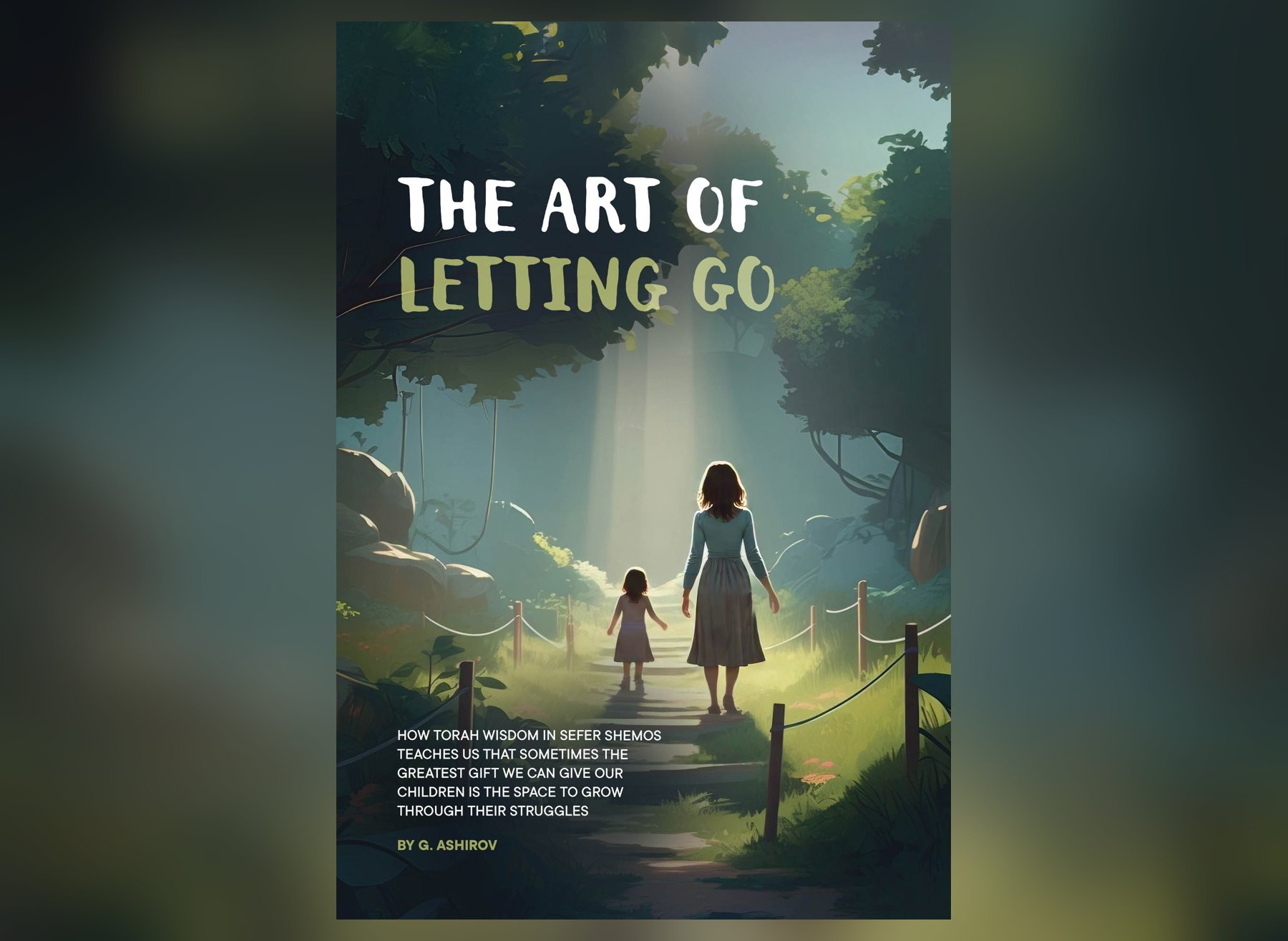
How Torah wisdom in Sefer Shemos teaches us that sometimes the greatest gift we can give our children is the space to grow through their struggles
It’s sometimes surprising to see how concepts from Torah and Chassidus can help us expand our minds and our approach to parenting, even in challenging situations.
One of the basic concepts in the teachings of Chassidus is: “ירידה היא צורך עליה – A descent is for the purpose of an ascent.” It’s relevant to our times and to many of the parshiyos we’ve recently read in Sefer Shemos, which describes the descent of the Jewish people to Mitzrayim. Following this descent, great and important things happened to Yaakov, Yosef, and the entire Jewish people. It was precisely there, in that low place, that we merited to become a nation.
The Gift of Non-Action
Between understanding something intellectually and the ability to ‘bring it down’ to the emotions and to life, there exists a great distance, especially when it involves things that concern our children who are “the apple of our eye.” Every trial, challenge, or difficulty they face affects us in the depth of our soul.
Many times when something ‘bad’ happens, we immediately rush to try to save our children from the difficulty or challenge they are experiencing, when it’s not always possible or right for them. Sometimes we haven’t even properly analyzed and understood if and what the correct way of intervention is.
In a world that often sends us immediately to look for some ‘tool’ or action that needs to be done to protect and help the child, I’d like to propose occasional non-action, staying present, and inner work between ourselves and Hashem; sometimes that’s the right thing. Like Am Yisrael, sometimes we simply need to walk a bit in the desert, even without knowing when we’ll reach the promised land… It’s not easy, even difficult, but sometimes it’s an important part of personal growth and development.
Difficulty as an Opportunity for Growth
So how do we manage to implement the basic understanding that everything is always by way of ‘hashgacha’ [divine supervision] for our benefit and their higher good, and that “no evil descends from above,” even regarding the challenges our children face? And what should we do in situations where it’s not the right move or not possible to offer them help?
To help us accept this, the Rebbe directs our attention to one of the fundamental principles that exists both in Chassidus and in the therapeutic-psychological world. Every process we experience has its external form, and simultaneously what happens beneath the surface. And sometimes the inner aspect beneath the surface can have a completely different direction or trend than how it appears on the surface [based on Dvar Malchus Shemos 5752].
In other words, what we and the child experience as suffering or difficulty is actually a necessary opportunity for growth, for discovering new strengths, or guidance towards a better channel of development for the child.
Additionally, the understanding that parenting is essentially a long-term journey or process in which we are privileged to accompany our children in the early stages of their growth and development in life can also help us. In this process, they learn the rules of life, and along the way also form their personal identity.
That being the case, we should see it as a personal journey that each child goes through, and sometimes learning and growing will necessarily be through falls or challenging situations, but these are important for them as part of the way.
This knowledge itself already makes it easier for us and allows us to adopt a certain distance in our emotional involvement in the process as mothers.
Hisbonenus
Now we can use the tool of hibonenus that the Alter Rebbe gave us – to ‘put on glasses’ of curiosity and faith, and contemplate the question:
How might this challenge of our child actually be beneficial and vital for him? Where are the hidden ‘fruits’ that this process makes possible?
To allow contemplation from a distance, or a perspective that is not emotionally involved, as caring and concerned mothers, it can also greatly help us to remember and rely on the third partner in the raising of every child – the blessed Creator.
The answers won’t always come immediately and patience will sometimes be required, but when the process is done through presence, patience, and prayer, we may receive surprising insights about what our children, and/or we, might gain precisely from the challenging path. And also to allow growth and discovery of new places of strength and resilience in our children and in ourselves, ones that we were not aware of before.
Trust
The additional important condition that allows a child to grow in such situations and not, ch’v, the opposite, is our belief in them and their ability to overcome the crisis and emerge from it strengthened!
It’s very important that each time anew, we do this inner work and strengthen our ability to rely on the child and the powers they received from Hashem. The child feels this, even if the words are not spoken explicitly, and draws strength and power from it.
At the same time, we can let the child feel and know that at every step of the way we are by their side, and available to them for support, encouragement, hugs, and consultation.
Building Resilience
Throughout the journey, we will continue to need to strengthen our ability to let go and allow reality and solutions to reveal themselves to us, sometimes without the need for direct intervention on our part. In doing so, we strengthen ourselves in resilience, confidence, emuna, and the ability to absorb life’s challenges.
This way, we build in our children’s souls a level of resilience and resistance to additional challenging situations they may face in the future that don’t always have an immediate solution, as well as additional gifts: the ability to cope with crisis situations, discovery and familiarity with their personal abilities and strengths, patience, and the ability to rely on and trust in Hashem even in challenging times, and more.
So much learning that is made possible for children is just because of our ability to stop, let go, and be like Miriam, Moshe’s sister. She was present and observed from a position of “ And [she] stood from afar,” while providing mental and emotional support ‘behind the scenes’ as needed.
May we merit to build these soul powers both in the personal context and on the general level in the process that the Jewish people are currently going through, a process of the birth of the Geula shleima from the pangs of exile. With Hashem’s help, may we merit to see how precisely from within the difficulties, a Geula and great salvation will be born that is incomparably greater than what we can imagine.
And in the words of Dovid HaMelech: “Be still, and know that I am Elokim; I will be exalted among the nations, I will be exalted in the earth!” [Psalms 46:10].
Galia Asherov is a therapist integrating arts, workshop facilitator, developer of the “Mother Therapist” method, and parenting instructor.
Beis Moshiach #1452 • pp. 40-41, 42
© 2026 Beis Moshiach Magazine. All rights reserved.
This article originally appeared in Beis Moshiach #1452. You are welcome to share it with friends and family by email or in print, provided that you do not change, add to or omit any part of it, you credit the author and Beis Moshiach, and you include a link to archive.bmoshiach.org (written out in full in printed copies).
To republish this article in a newspaper, magazine, book or website, please request permission in advance at [email protected].