A Used Tallis & A Heavenly Court Case
From the TzaddikStory.org collection
Many, many years ago, Refoel, an older Jew, lived in the city of Kiev, in the north of Ukraine. He was getting older and he could tell that he would soon pass away.
“Yaakov,” He called to his son, “Please come to my room, I have to talk to you about something important.” Refoel had lived a full and happy life as a good Jew, and now he wanted to prepare to die as a Jew.
“Yaakov, I feel like I don’t have much time left. I don’t know how many more times I’ll get to put on tefillin, or make kiddush on Shabbos.
“I want to tell you something very important. Inside my room, in the closet, in the third drawer from the bottom, is a new Tallis. I bought it so I could be buried in this new Tallis.”
Yaakov listened carefully. He didn’t want to forget any of his father’s instructions when the time finally came.
“Okay, Papa. I’ll remember that.”
“Please don’t forget my final request. I also wrote a will that explains everything I want you to do with the money and items I own.” He handed Yaakov his will.
A will is an official paper someone writes to tell their loved ones exactly what they want to happen after they pass away. It tells the person’s family who gets to keep what. A will makes sure that when a person can no longer speak for themselves, they still have a say in what happens to them and their things.
Refoel wanted to make sure his family would know what to do, and that no one would be confused. He even wrote in the will exactly how to bury him in his new Tallis.
Yaakov took the will and put it in a safe place. He couldn’t bring himself to read it. One day, it would be time, but not today.
Then one morning, Yaakov woke up, and he felt that something was wrong. He raced straight to his father’s room to check on him, and he noticed his father wasn’t breathing. He called his neighbor, who happened to be a doctor, for help right away.
It all happened so quickly.
“I’m sorry, Yaakov,” the doctor said after failing to wake Yaakov’s father up. “I think it’s too late. Your father’s soul returned to his Maker. Baruch Dayan HaEmes.”
Yaakov stood there in shock. He didn’t know what to say or do.
Yaakov remembered his father’s will, and he slowly took it out of the envelope and put it on the table.
The will reminded him of his father’s special burial instructions. Yaakov walked over to the closet. Sure enough, a brand new Tallis was sitting right there. He took it out and held it close to his heart. It was the last thing his father had bought, and something about that was so special to him. He decided to put it on the table for the people who were on their way to prepare his father’s body for burial.
A big group of people gathered outside of Yaakov’s house, getting ready for the levaya. Some people stepped inside to give Yaakov some words of comfort or ask him how they can help.
The doorknob turned, and the door opened. Standing there was a young man he didn’t recognize.
“I’m so sorry to hear about your father,” the man said in a gentle voice, “Baruch Dayan HaEmes.”
Yaakov nodded his head. He didn’t even have the energy to answer.
“Tell me, did your father buy a new Tallis for his burial?”
Yaakov nodded his head. But he was confused – why did this man want to know about the Tallis? How had he already known?
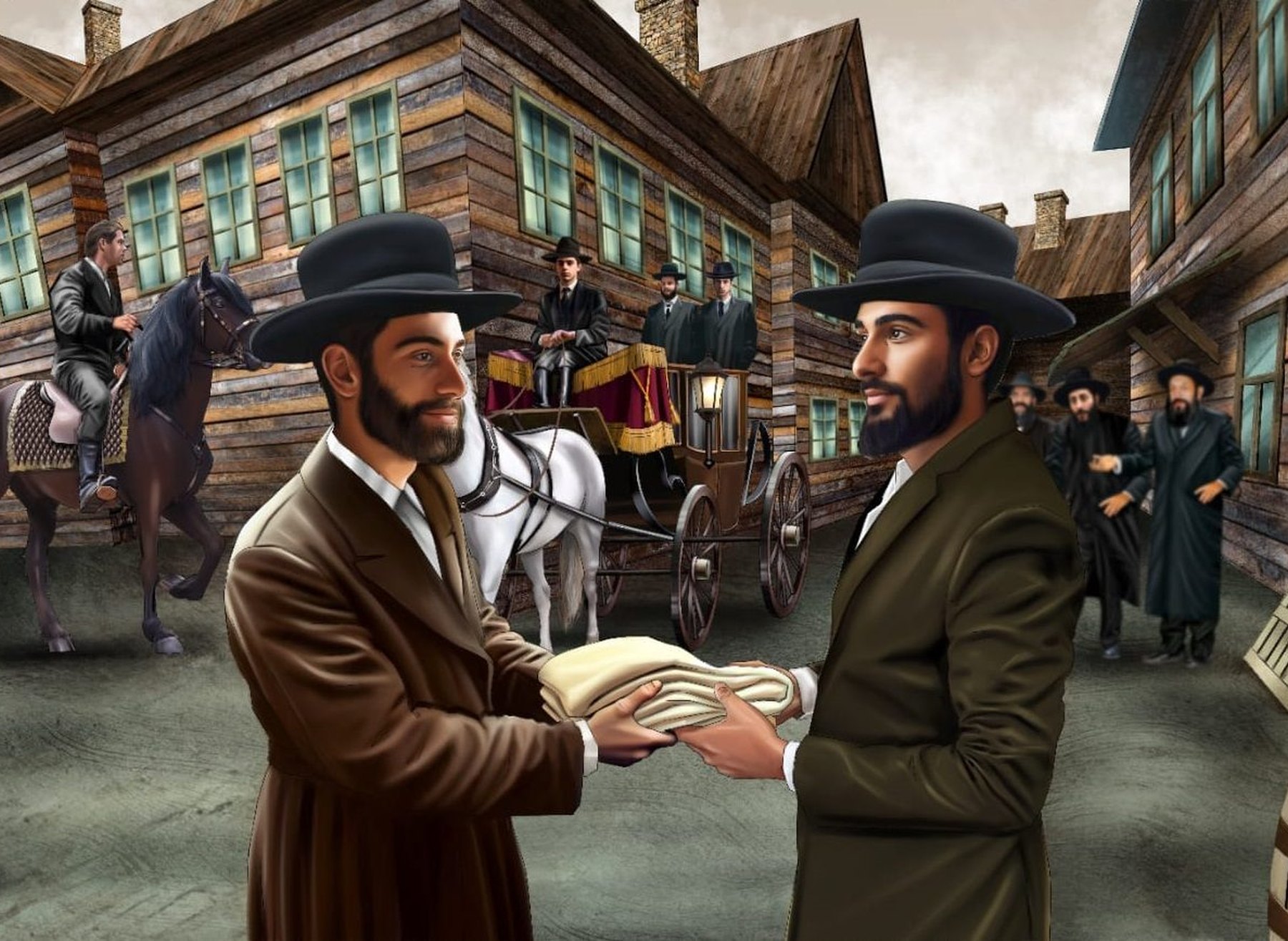
“This might be a strange request…” The man looked a little uncomfortable about what he was about to ask, “I’m getting married in a few weeks, and you see, well, I don’t have the money to buy a new Tallis. Would you like to do the mitzva of helping me prepare for my Chasuna and use your father’s old Tallis instead?”
At first, Yaakov was upset. How could this strange man ask him for his late father’s brand new Tallis? But when he thought about it a little longer, he realized this might be an opportunity to do a mitzva in his father’s memory. Surely, this would be a big zechus for him, right? But he still wasn’t sure it was the right thing to do…
Suddenly, the door opened again, and a group of the Chevra Kadisha came in. They got right to work preparing Refoel’s body for a proper kosher burial. Yaakov thought it was a good opportunity to ask the Rav who had entered with them for some advice.
“Honored Rav,” Yaakov began, “I have a question for you.”
“Of course,” The Rav said to him, “How can I help you, young man?”
“I’m wondering what I should do with this Tallis,” Yaakov explained, “My father left special instructions to bury him in this new Tallis.”
“Nu, so what’s the problem?” the Rav asked.
“Well, you see, this Chosson came in telling me he doesn’t have the money to buy himself a Tallis for his Chasuna, so he wants to know if he can have it. So now I’m wondering, which would honor my father’s memory more?”
“Hm, that’s a good question… I think…well… it would be a great zechus for your father if you used the new Tallis for a mitzva. And burying him in the old Tallis he spent many hours davening in will be a zechus for his neshama as well,” the Rav said, and with that, he left the room to rejoin the Chevra Kadisha.
Yaakov was happy he asked the Rav about it. He didn’t have to worry about if he’d done the right thing or not anymore. He let the Chosson know he could have the new Tallis and wished him Mazal Tov.
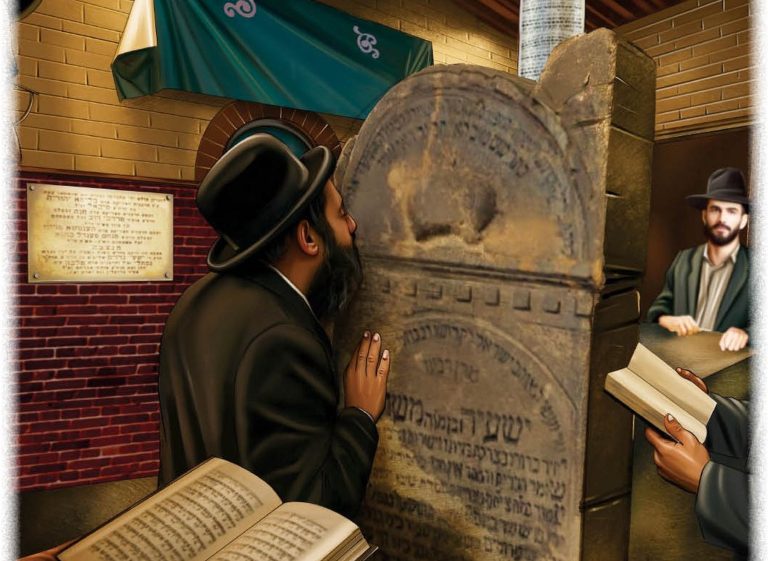
The rest of the day went by quickly. Before Yaakov even realized, they were on their way to the Jewish cemetery, where they bury all the town’s Yidden that passed away. Yaakov said Kaddish and asked the Rav about the new halachos he would need to keep, like sitting shiva, now that he was in Aveilus.
The week of Shiva wasn’t easy. People came from near and far to comfort Yaakov and share memories of his beloved father. Yaakov davened before the amud three times a day to give his father’s neshama an aliya, and he was exhausted.
Sleep didn’t come easily for Yaakov after the Shiva. It had only been one week since his father passed away, and he already missed him so much. He wished he could have spent just one more day with his father, to say goodbye. Finally, he fell asleep.
That night, Yaakov had a dream. His father visited him, looking very upset, and said, “You didn’t follow my instructions! I’m so embarrassed – everyone else has a new Tallis, and I don’t. Instead, I have this worn out Tallis to wear. Why did you do this to me?! Why would you embarrass me like this?”
Yaakov woke up instantly. He was shaken, and he didn’t know what to do. Yaakov thought about what his father had said in the dream, and he couldn’t understand why his father was so upset. Why, in the Olam HaEmes, would he care about something so silly as whether or not his Tallis was new? Bodies wear clothes. Not souls!
Yaakov decided it was just a weird dream and continued on with his day.
That night, it was surprisingly easy for Yaakov to fall asleep. He was so tired that even though his mind kept racing with thoughts of his father, he fell asleep as soon as his head hit the pillow.
Again, Yaakov had the same dream. This time, he woke up confused. Yaakov wasn’t a simple man – he was a talmid chacham. He knew having the same dream twice must mean it was important. So he took out a sefer to help him understand what the usual minhag was for burying a person in a Tallis.
He opened up the Bava Basra to daf 74a that talks about the Tallis of a dead person. The question was about whether it should have Tzitzis or not. He learned there was a custom to bury the person in the Tallis they davened in, even though in Eretz Yisrael, they don’t do that. Yaakov breathed a sigh of relief; based on everything he’d learned, he believed he’d done the right thing. After all, even the sefer said it was better to bury the person in the Tallis they davened in than to bury them in a new one.
Slowly, Yaakov felt a little better, and he was able to return to his daily life. Although he missed his father, he felt comfort in knowing that he was surely in Gan Eden and close to Hashem.
* * *
Yaakov eventually found a wife and got married. They lived a very happy life together and raised a large family of children. But then, something terrible started happening. Yaakov got very sick. He went to the doctor to find out what was wrong, but no one could tell him why he was sick! The doctors gave him medicine to help him feel better, but they couldn’t make the sickness go away.
One day, Yaakov was in a deep sleep, and he felt like he was flying through a dark tunnel. It was something he’d never felt before, and he was very scared! Was he dying?! Finally, Yaakov felt himself coming out of the tunnel, into the light, to be welcomed by his entire family. He felt a little better, but he was still confused.
“What’s happening to me?!” Yaakov tried to say, but his mouth wouldn’t talk. Before he knew what was going on, he found himself in front of the Beis Din shel Maalah, the heavenly court that a Yid faces after he passes away. It’s the place where Hashem weighs a person’s mitzvos, aveiros, and everything else a person did in their entire life, to decide what should happen to their Neshama next.
Yaakov didn’t know if this was good or bad. He wanted to ask, but he couldn’t speak.
All of a sudden, he heard a voice:
“Yaakov – you are in the Beis Din shel Maala. You will understand more soon.”

Yaakov began to feel a little worried. He thought back over his entire life, and it looked like he was watching it in a video. He remembered every time he listened to his Yetzer Tov and did the right thing, and every time he didn’t. Now was the moment of truth, when it mattered most.
Yaakov didn’t feel ready for his life to end. Suddenly, he had a big desire to do more mitzvos and learn more Torah! But it seemed like it was too late. Yaakov watched the scale move back and forth, weighing his mitzvos and aveiros. He held his breath.
Then, he heard the voice again.
“Yaakov, Yaakov, we’ve found a big mistake you made. You did not keep Kibud Av, by listening to your father’s final request. You didn’t wrap him in the new Tallis – instead, you wrapped him in his worn out old Tallis!”
Yaakov was silent. What did he have to say for himself? He felt so embarrassed! He knew he couldn’t fix it, because it was already over. His father was already buried, and now, Yaakov himself was no longer in the physical world either! His eyes moved back and forth from one end of the Beis Din to the other. He felt nervous and small. He didn’t know what to do with himself.
To his great shock and surprise, an important-looking man dressed in silk suddenly appeared in front of Yaakov, and he began to speak. “The new Tallis was given to a Chosson on the day of his Chuppa. Yaakov did it after asking a Rav. Why shouldn’t this big mitzva tip the scale?!”
The Beis Din looked at each other and sat deep in thought. Yaakov watched the scale go back and forth, and he held his breath once again. And then, it tipped! The scale tipped to the side of the mitzvos, and the Beis Din agreed it was the right thing to do. Yaakov should go back down into the world.
Yaakov breathed a sigh of relief, but before he knew it, he felt himself flying back into the dark tunnel he was in before.
“Oh no – is this good or bad?!” Yaakov wanted to say, but he couldn’t speak. Suddenly, with a big thud, he came out the other side.
Yaakov woke up from his deep sleep, but he felt different than he usually did on a regular day. Instead of feeling tired and taking a few minutes to wake up fully, he practically jumped out of bed!
“Modeh Ani! I’m alive! I can’t believe it – am I alive?!” Yaakov ran over to his wife and children to make sure everything was really okay. Everything was just as he’d left it the night before – except things were different. Yaakov had been given a second chance at life. He knew he’d make this second chance worthwhile.
After a few days, things went back to normal. But it wasn’t truly the same. From that moment on, his life totally changed. He started feeling better, and the doctors were able to help him. It seemed as though he was never sick to begin with.
Yaakov never forgot what he went through in Shamayim, and it reminded him to be a better Yid every day. He fixed his ways and became more careful with his mitzvos. He decided it was time to connect with a Tzaddik and learn from him.
But from the moment Yaakov made that decision until he got around to doing it, a lot of things got in the way. Yaakov was busy with his children and family, and going to work. It just never seemed like the right time to travel to a new Rebbe. And so, it just didn’t happen.
* * *
Eight years later, Yaakov realized he still hadn’t gone to find a Rebbe.
“That’s it!” He said to his wife one morning, “I’ve decided to make this happen. I’m going to put everything on hold, and find a Tzaddik.” Yaakov’s wife nodded in agreement. She understood that this was very important.
The very next morning, Yaakov left Kiev and decided to go to the village of Husiatyn. It was the first time he’d been around Chassidim or a Rebbe. He saw people that looked like Talmidei Chachamim, people sitting around learning in Yeshiva, and the Gedolei HaTorah coming and going.
Yaakov started chatting with the Chassidim and asking them about their life as a Chassid. They discussed what was so special about Husiatyn and their way of connecting to Hashem. Yaakov was feeling inspired by the Husiatyner Chassidim, and he wanted to meet their Rebbe.
“To meet the heilige Rebbe, you need to wait until Shabbos,” One of the Chassidim explained to him.
“That’s okay,” Yaakov answered, “I can wait.”
In the meantime, Yaakov took the time to write a detailed letter to the Rebbe, explaining what had happened to him and how he wanted to become a Chassid.
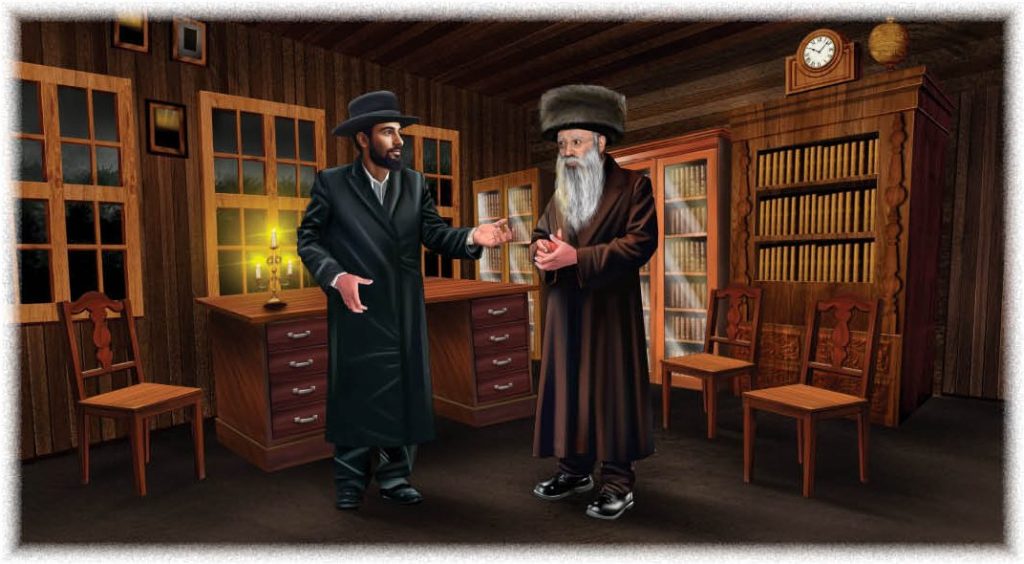
The day finally arrived, and Yaakov waited in line for a few hours. Many people were hoping to see the Rebbe, and Yaakov waited as patiently as he could for his turn to come. Finally, it was his turn! He had his letter in his hand, and he walked into the Rebbe’s room.
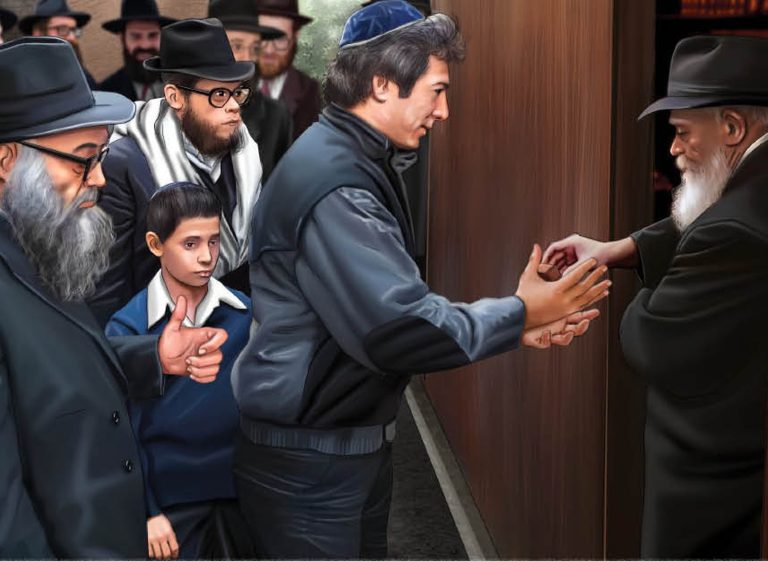
When he lifted his eyes to see the Rebbe, he immediately fainted in shock. He woke up to the Rebbe’s Gabbai standing over him, “Are you okay, Chassid?! Are you okay?”
“It’s him! It’s him!” Yaakov said in a loud whisper. He couldn’t believe that, in front of his eyes, sat the Tzaddik that came to defend him in the Beis Din shel Maalah. In fact, he even recognized his clothing!
“What are you saying, Yaakov? It sounds important,” the Gabbai asked,
Yaakov explained. He told him the story of the Tallis, and how in the end, he was only allowed to come back to the world because the new Tallis was used for a mitzva.
The gabbai was shocked when he heard that it was the Husiatyner Rebbe that had visited him in his dream.
He said, “You should know, this bekeshe he’s wearing, he actually doesn’t usually wear. It’s been sitting in his closet for eight years – but today, he decided to wear it without any explanation.”
“It was sitting in his closet for eight years?!” Yaakov was even more shocked now than he was before. “That’s when I went up to the Beis Din shel Maala! It was eight years ago. And today, he put it on for the first time since… it can’t be a mistake that it’s the day I finally came to visit.”
The Gabbai looked at Yaakov with wide eyes. He couldn’t believe what he was hearing. But one thing he knew for sure: None of this was a mistake.
Yaakov finished his meeting with the Rebbe and left inspired to be a better Jew. He knew the Husiatyner Rebbe was a special person, and he wanted to be connected with him, to help him serve Hashem the best way he could.
* * *
Every time we do a mitzva, it means so much to Hashem. We might wonder, “What’s the big deal about an old Tallis?” But even small actions are powerful in Heaven. Sometimes, we think we’re doing the right thing and have good reasons for it, but we should always remember that everything we do is important, so we never make a big choice without thinking about it first. Every good deed, every mitzva, every action can change the world in a powerful way.
This story was published in a weekly Karliner newspaper; a slight variation of this story is noted. The version presented here was written in Sefer Imru Tzaddik, page 70.
Beis Moshiach #1452 • pp. 54-59
© 2026 Beis Moshiach Magazine. All rights reserved.
This article originally appeared in Beis Moshiach #1452. You are welcome to share it with friends and family by email or in print, provided that you do not change, add to or omit any part of it, you credit the author and Beis Moshiach, and you include a link to archive.bmoshiach.org (written out in full in printed copies).
To republish this article in a newspaper, magazine, book or website, please request permission in advance at [email protected].