The Battle for Jewish Caen
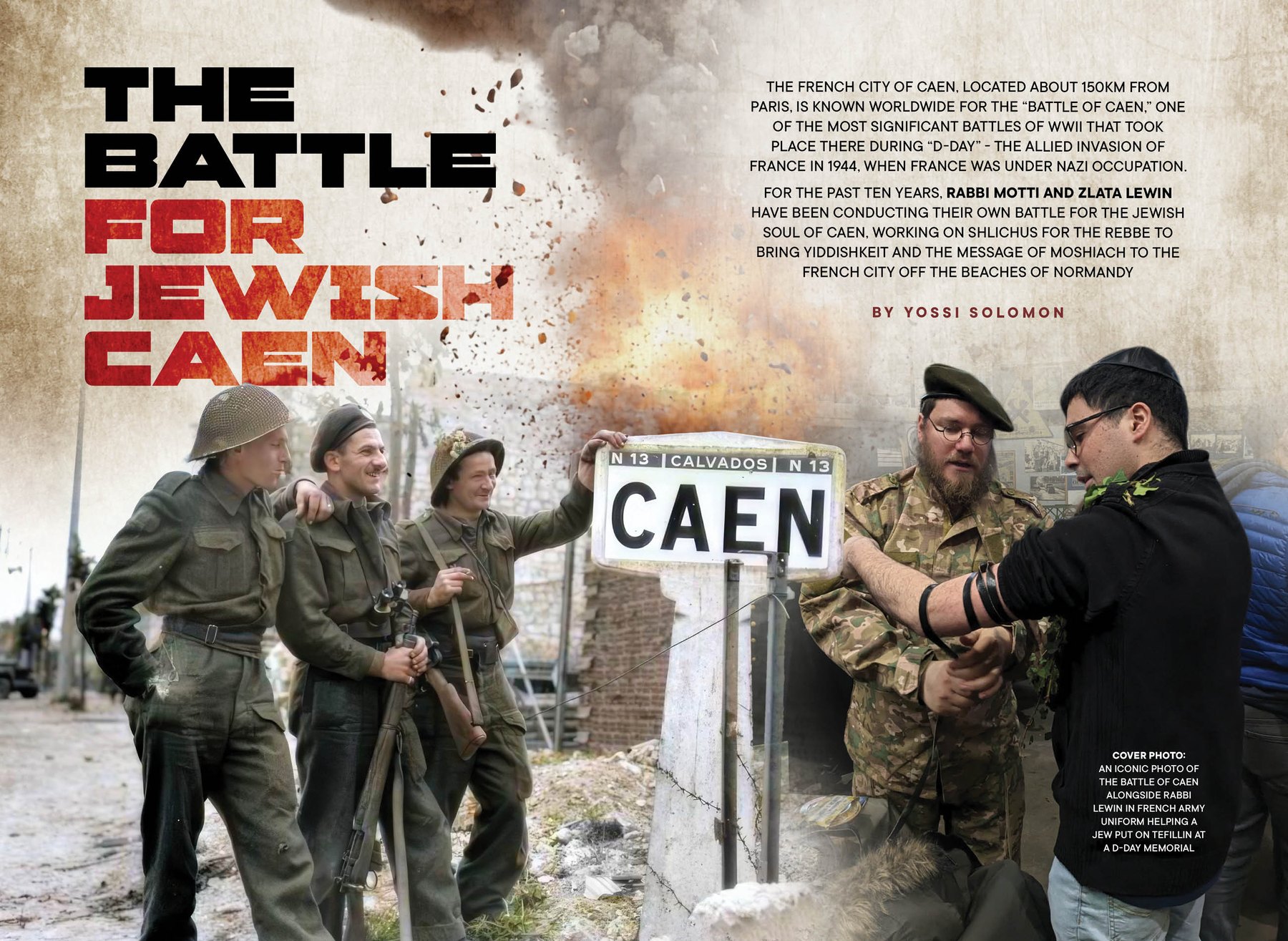
The French city of Caen, located about 150km from Paris, is known worldwide for the “Battle of Caen,” one of the most significant battles of WWII that took place there during “D-Day” – the Allied invasion of France in 1944, when France was under Nazi occupation. For the past ten years, Rabbi Motti and Zlata Lewin have been conducting their own battle for the Jewish soul of Caen, working on shlichus for the Rebbe to bring Yiddishkeit and the message of Moshiach to the French city off the beaches of Normandy
For the past ten years, Rabbi Motti (Mordechai) Lewin and his wife Zlata have been working on shlichus for the Rebbe, in the city of Caen, located west of Paris. They engage with all segments of the population, both young and old, each generation with its own challenges. Additionally, they work with thousands of tourists who visit the area throughout the year.
Rabbi Lewin shares with the readers of Beis Moshiach the challenges he has faced since beginning his work in the city. He talks about the ongoing activities and recounts wonderful stories from his place of shlichus.
Journey To Caen: Decision And Initial Challenge
How did you end up on the shlichus in Caen, and why specifically there?
“I grew up in Sarcelles, France, in a Chabad family. As a bachur, I learned in yeshiva in France and followed the standard Chabad path. After getting married, we went on shlichus to a vacation town, Deauville, in Normandy, where my brother, Rabbi Shmuel Lewin, was working as a shliach. However, we knew this was temporary until we found a place of our own.”
During their time in Deauville, they received several offers to go on shlichus to the city of Caen, the capital of Calvados, which had previously been the capital of Lower Normandy. The city is located 150 km west of Paris, near the English Channel. The city’s name is known worldwide because one of the most significant battles of the last generation took place there, during the Allied invasion of France in 1944, when France was under Nazi occupation. The place is a historical landmark, till today.
A few months later, they decided to go on shlichus to Caen in 5775. Before coming to the city, they met with the head of the local Jewish community and the local rabbi for an introductory meeting. During the meeting, those two men tried to explain to them that there was no need to be there: “Although there is a Jewish community in the city, it is small and far removed from religious observance,” they explained with good intentions.
“We explained that their words only spurred us on to come to the city and carry out the shlichus of the Rebbe.
“It turned out they were right, more than they had anticipated. When we went for Shabbos, we went to shul and found only two or three people there… meaning, even on Shabbos there was no minyan. Far from it.
“Motzoei Shabbos, we wrote to the Rebbe and asked, ‘We received an offer to go on shlichus in Caen, we came for Shabbos and found only two or three people in the shul. Should we remain here on shlichus anyway?’”
In the letter they opened to in the Igros Kodesh, the Rebbe wrote to someone who wanted to join a new company that it was good thing and was also worthwhile for the neshama, for it is written, “Whoever saves one soul of the Jewish people, it is as if he saved an entire world.” The Rebbe continued, “With time, you will find that there are many more souls in your area to work with.”
“For us, this was a clear answer to go on shlichus,” says Rabbi Lewin.
Heavenly Encouragement
“Every beginning is difficult” – Can you share some of the challenges from the early days of the shlichus?
The shlichus in Caen is special. The biggest challenge I faced was knowing where to begin. You move to Caen, wake up the next day, but there’s no community to work with. Your entire life is the Rebbe’s shlichus but with whom and what do you begin? The main difficulty was setting up a new framework, finding Jews and ensuring they came to the shul.
As things began to fall into a certain routine, a real challenge emerged in terms of educating the children. Over time, a child was born, then another, and another – you want to fulfill your shlichus, but you also have children at home that need to be educated properly. You constantly have concerns about their education and upbringing. There was no Jewish kindergarten or school in the city.
How did you deal with these challenges?
The very thought and understanding of the great privilege we have to work in the Rebbe’s shlichus strengthened us. There were times when I thought of giving up, but then I would receive some heavenly chizuk, showing us that our shlichus in Caen is important.
What kind of ‘heavenly chizuk’ did you receive?
For example, a message from a family I didn’t think I had an impact on, but they wrote to me about how lucky they felt that we were there, as they felt we were strengthening them. Or when I suddenly discover another Jew living in the area whom I hadn’t known about before. Every new Jew I find in the city is a real treasure.
Of course, we also consulted with our mashpia until we found a solution for educating the children, which, though costly, was worthwhile. At various times, we bring in a group of girls to help with the children, and in practice, we created a sort of kindergarten where my wife Zlata prepares the curriculum, and the girls implement it.
You mentioned earlier that you wake up in the morning and there is really no large community to work with. What is the focus of your daily activities?
Our activities focus on several fronts. First, our work is with about a hundred Jewish families living in the city. There is a very high rate of intermarriage here, about seventy percent. Additionally, about 30,000 students study in Caen, including many Jews. We provide shiurim, etc. The city also has a medical center for patients with serious illnesses, and we often find ourselves working with them.
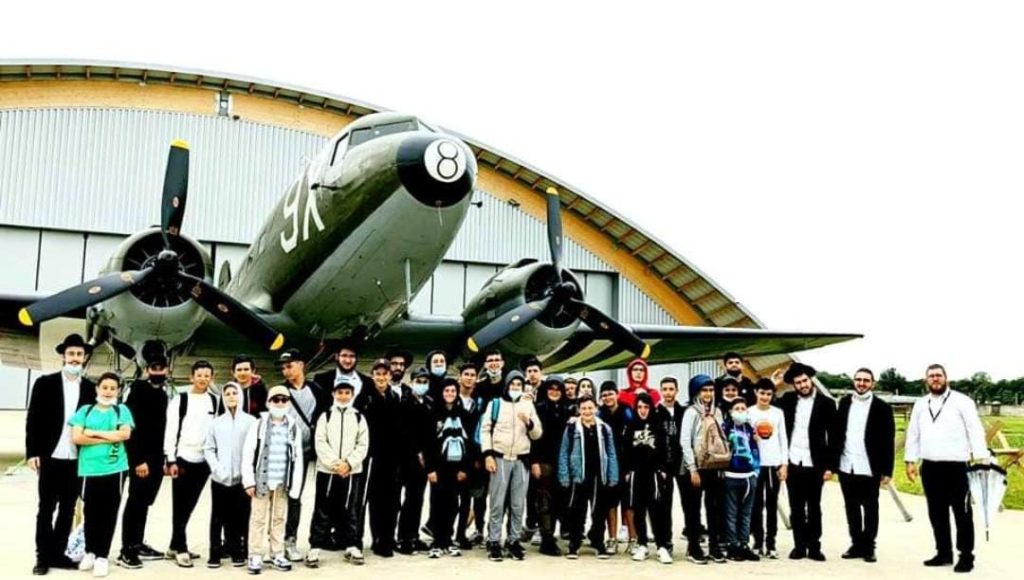
Besides working with the local residents, we also engage with the many tourists who come here due to the historical beaches near the city, from where the Allies invaded during World War II. We organize tours for the tourists and tell the story of the place from a Jewish perspective.
Another project we initiated in the area of the invasion beaches was to begin writing a Sefer Torah in memory of the soldiers who died there. The writing takes place in the locations where soldiers were killed: bridges, beaches, and bunkers. Anyone who participates in our tours gets a letter in the Sefer Torah.
A Jewish Spark In Every Corner
The challenge faced by the Lewin family isn’t simple. Sometimes it is easier to work in cities with tens or hundreds of thousands of Jews than in cities with small communities. The challenge of ‘you will be gathered one by one’ is a real test.
The way to approach this sometimes needs to be particularly creative:
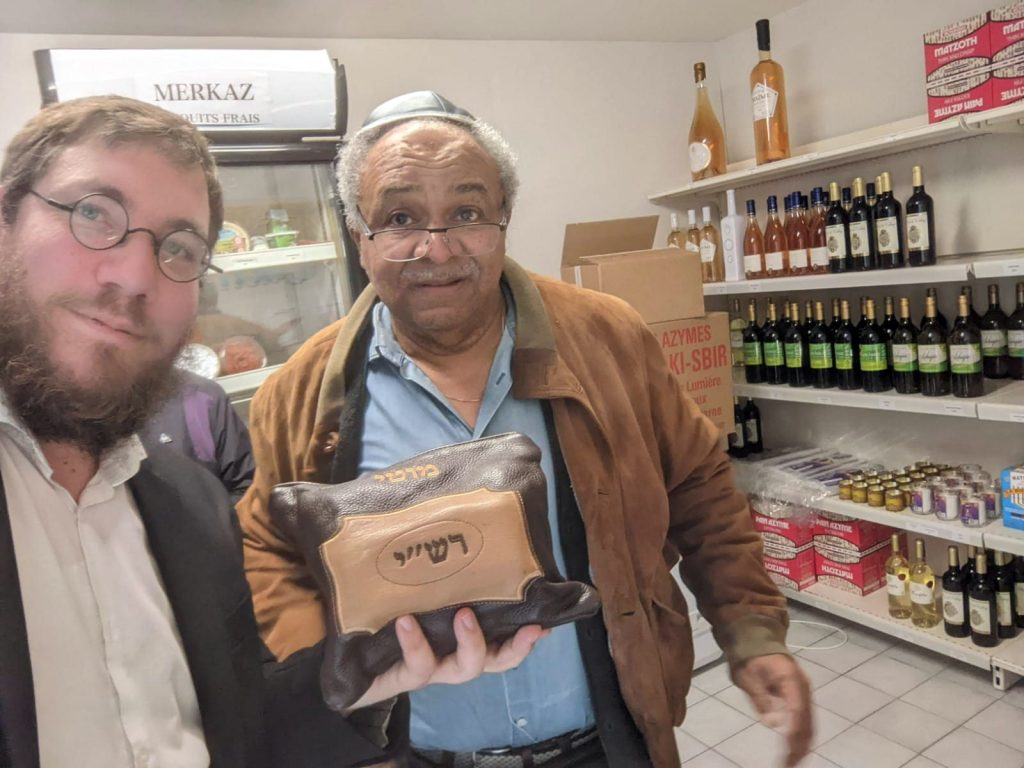
R’ Lewin recounts, “Five years ago,we wanted to open a kosher grocery store in the city, but since opening such a store requires a lot of effort and a significant investment, we hesitated.
“In the end, after consulting with several of my shliach friends, they explained that a Chabad House in small cities like ours needs a kosher food store, because many Jews, especially tourists, won’t necessarily call and ask to come to Chabad House, but there is a good chance they’ll look for a place with kosher food. As a result, we decided to open a food store; some of the mehudar kosher products come from Paris, while the meat is imported from Poland.”
As a result of opening the store, they met several Jewish families in the city they hadn’t known before.
“An interesting example: One day, a person came into the store who looked part-African. He was looking for kosher food and began talking to me about Judaism, even introducing himself as a Jew. It seemed strange to me, so I asked for permission to speak with his mother.
“It turns out that his father was a non-Jew from Africa, but his mother is Jewish and lives on the other side of France. There is a shliach there who knows her and has been mekarev her.
“Thus, thanks to the kosher grocery store, this man began to lay tefillin for the first time in his life at the age of 62!”
Can you share some stories from life on shlichus?
There are many such stories. One day, a man called me saying that he had already contacted four rabbis, and I was the fifth, but none of them had responded. He explained that his grandparents, on both sides, had been taken from their homes during the Holocaust. Although his parents are alive, they never spoke to him about Judaism. He now wanted to know whether he was Jewish, and if so, he wanted me to teach him about the concentration camps and Judaism.
I asked him where he was, and he named a city about an hour’s drive from us. We do operate there occasionally, but rarely. I invited him to come to our office for a meeting. A few days later, he called and said he was coming to see us, an hour there and an hour back, and wanted to know if during the meeting I could tell him his family tree and answer whether he was Jewish.
I explained to him that I was not a historian and couldn’t answer his questions about his family tree, but as a rabbi, I would investigate his Jewish status as far as I could.
When he arrived, we spoke for about an hour, but I didn’t find anything that conclusively proved he was Jewish.
Just before we ended the meeting, he mentioned something about his older sister, with whom he had not been in touch for many years, but she had married a Jew.
For me, this was excellent information, because if his sister married a Jew according to Jewish law, it would be easier for me to check with the Beis Din where she was registered to see if a kesuba had been given. I asked him to find out where she had married and for more details. He didn’t know much, other than that she had married in 1973 and he gave me her husband’s name.
In my community, there was a Jew with the same last name as her husband’s, but the chances they were related were very slim.
I told the man who had come to me, “There is a person in my community with the same last name as your brother-in-law. I will ask him and hope that Hashem helps me find the answer after I speak with him.”
I called that Jew and asked him if he had a brother named the same as the person I was inquiring about. The answer was yes. His anniversary was similar, too. I then asked for his brother’s phone number so I could talk to him. It was a truly amazing hashgacha pratis. Through his brother, I was able to confirm the Jewish status of the man who had reached out to me.
It was a double miracle, since out of the five rabbis he called, I was the only one who answered, and thanks to the fact that his brother-in-law davens in my community, I was able to resolve his issue.
And here’s another story: Once, when I was invited to an official ceremony in the city, I was supposed to sit in a specific chair in the first row, but for some reason I decided that this time that place wasn’t for me and chose to move to an empty seat at the other end of the row.
I sat down next to a person I didn’t know, we shook hands, introduced ourselves, and even started a pleasant conversation. After fifteen minutes, I discovered that his father was Christian, but his mother’s name was ‘Levy’ and she was Jewish. I informed him that he too was Jewish, and since then we’ve developed a close friendship.
Once he came to our kosher food store exactly when we were holding a bar mitzva for one of the community’s children. He was present at the ceremony, was very moved, and decided that he also wanted to have a bar mitzva…
Every Date And Every Event Is A Good Reason…
What does most of your activity focus on?
One of the girls who was with us as a morah and later got married came back after some time to spend the chagim with us along with her husband. Her husband, who is a tamim from Eretz Yisrael, asked me what challenges we face in our shlichus in Caen.
I told him that we have two challenges that most of our activities focus on: chinuch, which is our top priority, and fighting the phenomenon of assimilation. There are Shabbosos when we host five-six couples, and we are the only ones where both spouses are Jewish… The plague is terrible.
In the big cities of France, like Paris and Marseilles, most Jews won’t marry non-Jewish women, and that’s their red line. The main struggle of the shluchim there is to get people to eat kosher. But in our city, there are no red lines. Most Jews won’t even observe Yom Kippur. Therefore, our fight is first and foremost against the phenomenon of assimilation.
How do you manage to fight it?
For us, every date and every event is a good enough reason for a meeting between the community’s young people. This way, people get to know each other better, and there’s a greater chance for relationships between Jews.
We also have a light, weekly class in Judaism mainly designed to create a welcoming community atmosphere. It’s amazing to see how they try to attend the encounter every week, where hearts open up and a fertile ground for relationships between Jews begins to form – this is in addition to the influence of the divrei Torah. We invest a lot of effort in activities with young people, as they are the next generation.
We invest efforts in the ‘Bar Mitzva Club’ project – preparing boys for their bar mitzva. Even after the celebration, we continue to accompany them in everything related to Jewish spiritual matters. Some of them leave our city over time, but we maintain contact. It’s enough that I send a WhatsApp message like “How are you? What about the tefillin? Do you put them on every day?”
There was a case where a mother of two boys, whose husband is not Jewish, lived an hour’s drive away from us. She asked me to prepare her children for their bar mitzva. Of course I agreed, and each time they drove an hour to get to me. She told me that the children felt that the lessons weren’t just for the sake of acquiring knowledge, but came from the soul. Despite five years having passed since the older one’s bar mitzva and two years after the younger one’s, they haven’t missed a single day of putting on tefillin, which shows the deep impact they experienced.
We also have a preparation program for bas mitzva girls, where my wife prepares them for their bas mitzva and for a full Jewish life.
You mentioned earlier the difficulty in educating your children. How involved are your own children in the shlichus?
They are definitely involved. They say divrei Torah during Shabbos meals in front of our guests and participate in activities according to their abilities. In general, their Jewish-Chassidish appearance causes a kiddush Hashem. When a Jew comes to our home, they immediately approach him and help him acclimate with their special innocent charm. If needed, they give him a kippa, help him learn to say a bracha on the food, and more.
The shlichus that the Rebbe gave to his shluchim is to bring about the hisgalus of Moshiach. How do you work on this?
First of all, we have a special shiur on inyanei Moshiach and Geula. Given the background you’ve already heard about Caen, this is definitely challenging.
Additionally, the topic of Geula is present in every shiur we give, as well as in ongoing conversations with Jews. We have succeeded, boruch Hashem, in instilling this topic, and people definitely understand the importance of the coming of Moshiach, and even talk about it themselves. They understand that we’ve entered a new and different era where nothing is logical. We are approaching something big that is about to happen, and we explain to them that the Geula is coming soon, and it depends on the good deeds we do.
Both as shluchim and as Chassidim, we must always see how we can help another Jew and thereby bring the Geula closer. Everyone needs to be aware of this privilege and fulfill it, thus bringing about the hisgalus of Moshiach soon.
What are your plans for the future?
A few months ago, we purchased a new location for the Chabad House, and during this period we are working to expand the place to turn it into a magnificent building that will include a mikva, a kosher food store, a lecture hall, and a reception area.
Additionally, I’m thinking about establishing a museum that will focus on the tourist aspect of our area – the landing beaches – from a Jewish perspective. Such a museum could bring many more Jews who would express interest in their history and culture…
“I’ll tell you an interesting story,” says R’ Lewin, and he told me about someone in the community who wanted to introduce another Jew to him who is not from Caen.
“Since it was close to Yom Kippur, I told that person that since I was going on erev Yom Kippur to the mikva, which is very significant, how about if he joined me and brought along his friend.
“The friend came and I spoke with him and found out that he is in fact a Jew that I had never met. This was his welcome, immersing in a mikva and putting on tefillin for the first time in his life at the age of 65.”
Beis Moshiach #1457 • pp. 10-17
© 2026 Beis Moshiach Magazine. All rights reserved.
This article originally appeared in Beis Moshiach #1457. You are welcome to share it with friends and family by email or in print, provided that you do not change, add to or omit any part of it, you credit the author and Beis Moshiach, and you include a link to archive.bmoshiach.org (written out in full in printed copies).
To republish this article in a newspaper, magazine, book or website, please request permission in advance at [email protected].