The Rebbe’s Criticism Was a Gift
I met Rivka Rochel Goldstien in 770. Without knowing anything about her, from her upbeat manner I could tell that she has an inspiring story and message. I was not mistaken. “I’ve had a long career, boruch Hashem, and was very fortunate to work with many outstanding, inspiring Lubavitch Shluchim. What I’m most known for is my energy!” she says with a smile.
“My full name is Rivka Rochel. I was zoche that the Rebbe chose the name Rochel for me as an additional name to avoid having the same name as my mother-in-law ob”m, so I try to use it.” What a zechus!
Finding a School in the Phone Book
“I was born in Dayton, Ohio, but I grew up in Elizabeth, New Jersey,” she begins. “Both of my parents ob”m were American, mid-western Jews who never learned to read Hebrew. In our home we only kept ‘basic’ Jewish holidays, and even that in a Conservative way.
“My whole life is wondrous hashgacha pratis,” Rivka Rochel emphasizes. “When we moved to New Jersey my mother didn’t know what school to enroll me in, so she opened the phone book to get some ideas. As soon as she saw ‘Jewish Educational Center,’ she thought, ‘Why not?’ The school was established by the renowned educator Rabbi Pinchas Mordechai Teitz zt”l. I had an amazing education, continuing on to Bruriah High School. When I was twelve years old I wanted to keep kosher and Shabbos, and my parents were very supportive of me.
“Upon graduating from high school, I aspired to attend a Beis Yaakov seminary, but Hashem had other plans…”
Walking into a New World
“It’s no less hashgacha pratis how I ‘fell’ into Lubavitch,” Rivka Rochel continues. “I met Rabbi Izzy Rosenfeld ob”m through NCSY in Linden, New Jersey. He was an advisor to Jewish teens who were strengthening their religious observance, and also served as the director of the Jewish Community Council in Crown Heights.
“One day Rabbi Rosenfeld approached me and said, ‘How about spending Shabbos in Crown Heights on a ‘Pegisha’?’ It sounded interesting! I went, and it whetted my appetite to find out more about Chabad. My next step, in the winter of 5736, was going to learn in Beis Chana in Minnesota, and then I ended up working at the program thirteen times!
“It introduced me to a totally different vocabulary. In school I’d learned about the Tanaim and Amoraim of the Gemara, and in Chabad the focus was on the Rebbe and the Admorei Chabad. I also hadn’t been familiar with concepts from the Tanya and Chassidus. It was like walking into a new world.
“Afterwards, I spent time learning in Beis Rivka Seminary, and then went out-of-town to teach. One of the places that I taught was the Maimonides Hebrew Day School in Albany, NY, run by the extremely talented and creative Shluchim Rabbi Yisroel Rubin and his wife Rochel.
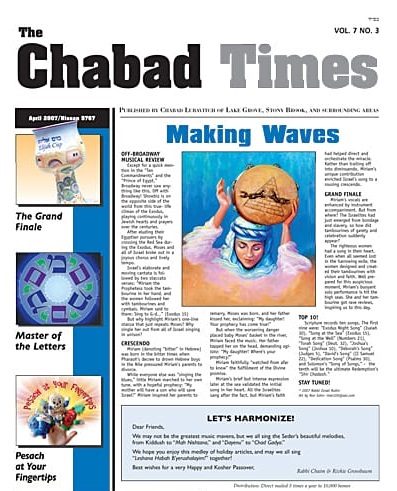
“In 5748, Rabbi Rubin organized a special event in Albany, ‘The Week of the Jewish Woman.’ He asked me to make the flyer, which was a very complicated process in those days. A picture was chosen from clip art, all the words were placed in linotype, and then everything was pasted down, photographed, and then brought to the printer.
“Rabbi Rubin included this flyer in the report that he sent to the Rebbe. Afterwards he received a phone call from the Rebbe’s secretary, telling him that the Rebbe asked specifically who was responsible for the flyer, and that the Rebbe said that the woman in the flyer was not tzniyus. The Rebbe also noted that there was no ‘בס”ד’ on top of the flyer.
“The criticism was like a dagger to my heart. It was the worst day of my life! I’d chosen an image of a woman wearing a long dress and long sleeves, but perhaps the collar was a little low. Since then I always make sure that every photo I use is unquestionably tzniyus, and I also put ‘בס”ד’ on whatever I do.” She adds, “I wrote an apology letter to the Rebbe.”
A Directive from the Rebbe, Then and Now
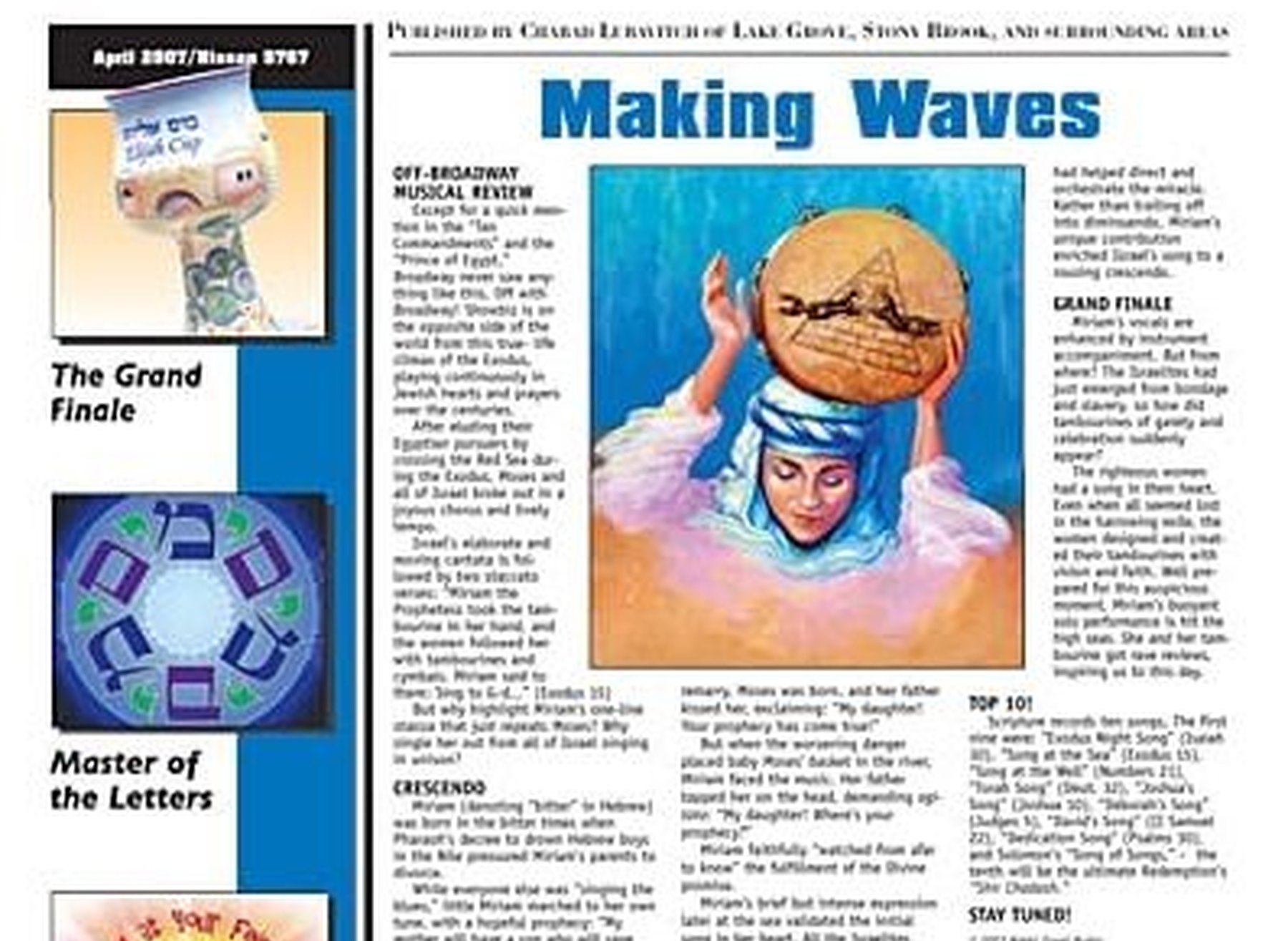
“Six years later I moved to Monsey and looked for a job as a teacher,” Rivka Rochel continues. “Rabbi Rubin asked me if I would be interested in working with him on a newspaper that Shluchim could send out to their communities. He himself has a tremendous gift for writing about Yiddishkeit in such a positive way, relating it to what’s happening in contemporary times. I replied, ‘Alright, let me give it a try.’
“Throughout my life, I’ve often taken on pioneering challenges, and I have always believed that success is 1% inspiration and 99% perspiration. I’ve never shied away from hard work – but this was before the convenience of the digital age, and printing a newspaper was a complex undertaking in a field that I knew nothing about. But, boruch Hashem, we were successful. Our first newspaper was sixteen pages, personalized for each location where it would be distributed, Albany, Monsey and Long Island.
“The work was difficult, and I wasn’t sure if I was suited for it and should continue. This was in 5755, after Gimmel Tammuz, and how I wished I could ask the Rebbe what to do…
“Aidel Backman, a friend of mine who writes children’s books, suggested writing to the Rebbe through the Igros Kodesh. I’d never done this before. Soon afterwards, I was at the Rubins’ home in Albany, and when I noticed that they had a set of Igros Kodesh, it prompted me to write to the Rebbe about my predicament.
“I explained to the Rebbe that I’d had many good years as a teacher and that making the newspaper was too hard for me. The Rebbe responded with a letter to someone from Kfar Chabad, telling him to continue publishing articles about Chabad in the newspaper because it will motivate people to learn Chassidus. I took this as a clear directive from the Rebbe that I must continue working on our fledgling newspaper project.
“It was arduous, time-consuming and expensive. I remember spending my grocery money to keep the newspaper going. But there was a bracha in it, and the newspaper expanded to more than fifty editions that were personalized for each Chabad House, publishing the material that they submitted.
“There were between 1000 and 18,000 copies of every holiday edition, depending on the size of the community. The printing totaled over 200,000 copies of each issue.
“Throughout the thirteen years that the newspaper was published we received a tremendous amount of feedback from Shluchim, telling us how much it was helping them with their shlichus.
“Early on, we sometimes received material or photos that were questionable, or even clearly inappropriate. That’s when the ‘bell’ went off in my head and I’d recall the Rebbe’s criticism of the tzniyus of the woman in the flyer that I once made… It was clear that the Rebbe foresaw that I was going to be publishing newspapers at a time when he wouldn’t be there to edit them. The Rebbe’s instructions to me in the past, that I was once so upset about, ended up becoming my greatest gift, directing me to maintain the highest standards of tzniyus in my work.”
Rivka Rochel concludes with words from the heart, “By hashgacha pratis I ended up in a Jewish school, received a Torah education, and discovered Lubavitch. But I’m just another foot soldier, glad to be part of the team that merits spreading the wellsprings of Chassidus.
“Ashreinu ma tov chelkeinu!”
Beis Moshiach #1464 • pp. 40-41, 50
© 2026 Beis Moshiach Magazine. All rights reserved.
This article originally appeared in Beis Moshiach #1464. You are welcome to share it with friends and family by email or in print, provided that you do not change, add to or omit any part of it, you credit the author and Beis Moshiach, and you include a link to archive.bmoshiach.org (written out in full in printed copies).
To republish this article in a newspaper, magazine, book or website, please request permission in advance at [email protected].