A Woman’s Journey in Gemara Study
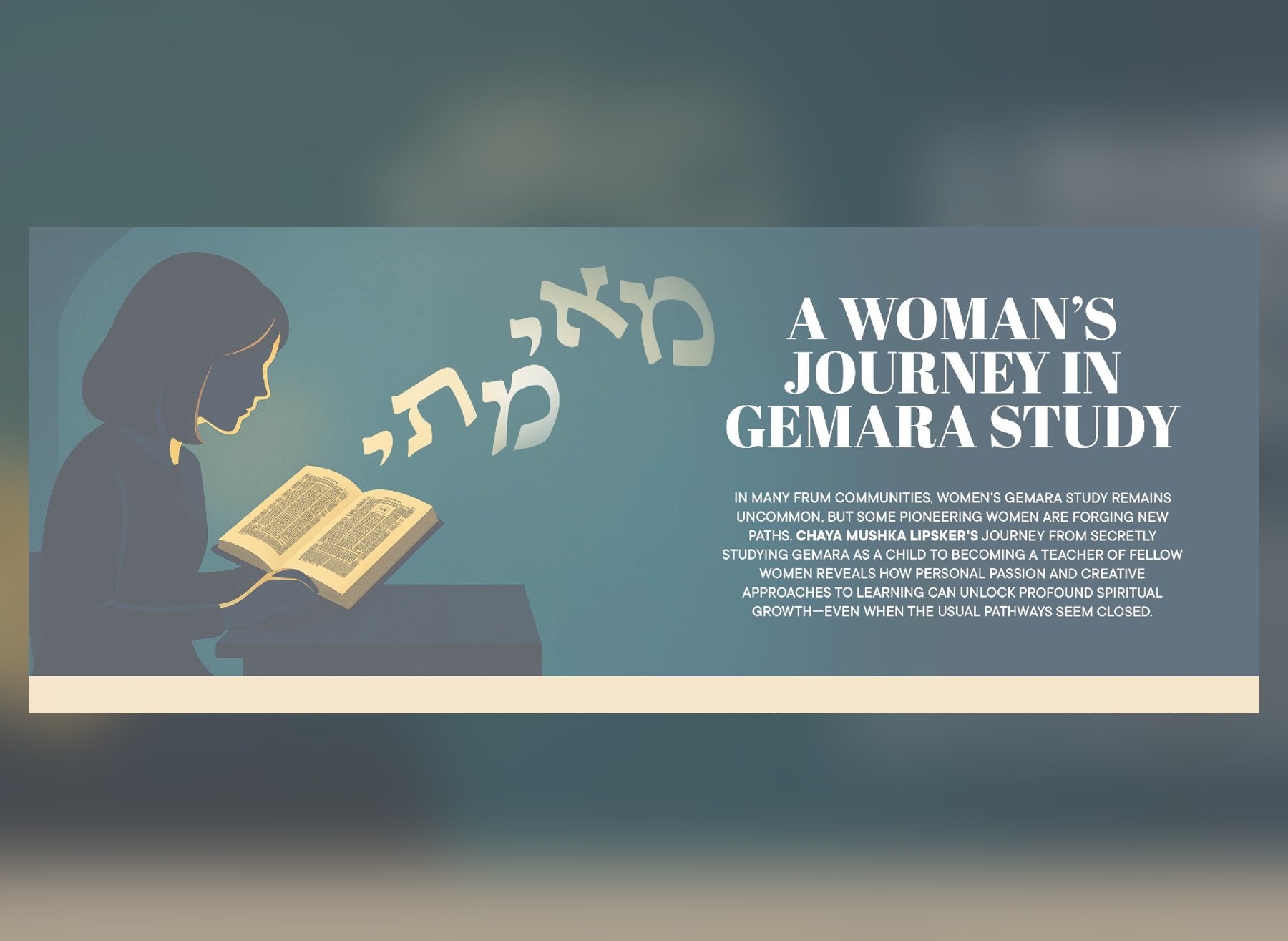
In many frum communities, women’s Gemara study remains uncommon, but some pioneering women are forging new paths. Chaya Mushka Lipsker’s journey from secretly studying Gemara as a child to becoming a teacher of fellow women reveals how personal passion and creative approaches to learning can unlock profound spiritual growth – even when the usual pathways seem closed.
Last Tishrei, amid all the classes and learning, I met an amazing friend who took learning one step forward and decided to leverage and transform it into the highlight of her life. Chaya Mushka Lipsker is an amazing lecturer who studies and teaches Gemara. With her, every story in the Gemara becomes a legend, every seemingly dull topic becomes a magical experience. Let’s dive in.
Delving Deep Into Gemara
I was born into a Chabad home to wonderful parents who love learning very much. I grew up in a home full of Torah, where they study all week and especially on Shabbos. In addition to divrei Torah at the Shabbos table and learning halacha, my father would teach us Medrash Tanchuma on the parsha every motzoei Shabbos, and my mother loved to teach us from the Sefer HaTodaah (Book of Our Heritage) at every opportunity. In general, I absorbed a tremendous love of Torah from home.
Personally, I always wanted to study Gemara. I remember Shabbasos when I would sneak the Gemara into my room and try to understand it. I tried to study Meseches Megillah, and even though it’s a relatively easy mesechta, I got very confused. The Gemara began with a proof for a certain position, then brought explanations for the completely opposite position. I felt like I was getting lost. I didn’t understand the logic.
I managed to see that the Gemara has a strong internal order and logic, and I was sorry that I didn’t have access to it. I understood that the Gemara speaks in a language I don’t understand, and I decided to go and study, but it wasn’t simple. I didn’t know of any place of Torah that teaches women Gemara, and honestly, I didn’t even know a single woman who studies Gemara. It was really taboo. They suggested I go study Gemara at university, but that wasn’t for me. I didn’t want professors to teach me how to study the holiest thing in the world.
Through wonderful hashgacha pratis, I reached the women’s Beis Medrash “Mattan” in Yerushalayim, and there I studied Gemara and halacha for beginners and advanced students. By the way, years later I studied for a master’s degree in Gemara, but only after I managed to study Gemara on my own.
In recent years, I teach women Gemara and Chassidus, and I really see how thirsty women are to listen and understand.
Why specifically Gemara? Isn’t there enough to study in the bookcase?
There is no substitute for Gemara! It is the foundation of the Jewish bookshelf. Personally, I saw that since I started studying Nigleh, my Chassidus study also improved wonderfully, and this is of course true vice versa. Nigleh and Chassidus not only can but must go together. You can see this in practice – from Rabi Shimon bar Yochai to the Alter Rebbe – the inner dimension of Torah is always connected to the revealed.
Most Chabad girls I know don’t study Gemara. Does the Rebbe want women to study Gemara?
The Rebbe speaks in one of his sichos (Emor 5750) about Gemara study for women. The Rebbe compares Torah study for women, which has begun to gain momentum in recent years, to learning Chassidus, which went through a similar process, and it turns out that not only is the process similar – it stems from exactly the same reasons! Chassidus was revealed specifically in recent generations for two reasons: the spiritual decline of generations – it was meant to give additional strength to a people weakened by the long years of exile, and also preparation for Geula – Chassidus is a ‘taste’ of the teachings of Moshiach. And the Rebbe explains that these are exactly the two reasons for Torah study for women in recent generations – this is also our way of dealing with the difficulties that the new generation presents and also and especially a significant preparation for Geula when the earth will be filled with the “knowledge of G-d” and “they will all know Me.”
This sicha isn’t so well known.
True, and it’s very worthwhile to know it! One day I sat with a group of friends in the Beis Medrash, and I told them that the Rebbe greatly encourages Gemara study for women. Most of my friends in the Beis Medrash are not Chabad, and they had some difficulty believing this. I showed them this special sicha, and they immediately asked: “Do your Chabad friends know this sicha?!” They couldn’t understand the gap between this special sicha and the way things actually are.
Following The Heart: Learning That Is Relevant
I’m convinced that I need to study Torah, but where to begin? I’m standing before the large bookshelf, confused. The Tanya winks at me from there, the stories from Nach on the top shelf don’t let go of me, and that’s not all – the fascinating maamarim, the Shaar HaBitachon in Chovos HaLevavos, and halachos that I must know. What to choose?
I have the privilege of studying maamarim of the Mitteler Rebbe with Rabbi Schneebalg. In one of the shiurim, he asked us why at the end of the Amida we ask Hashem, ‘Open my heart to Your Torah’ – after all, in order to succeed in studying Torah, it’s the mind that needs to be open?! And the answer is that it doesn’t matter what the mind understands; the determining factor is the heart. If the heart is in it – it will also recruit the mind to crack the topic, and if the heart isn’t in it, it simply won’t happen.
The Rebbe writes this much more directly in the HaYom Yom: “If the matter is pertinent – then they understand and grasp very well.” The daughters of Tzelofchad come, women who were never for a moment in their lives in a Beis Medrash, and bring proofs and arguments that change reality – they impact Am Israel, Eretz Israel, and Toras Yisrael. In contrast, there are those who know by heart all the words of the Tannaim and Amoraim, and it never occurred to them to bring such evidence. How is it that they were the ones who succeeded? Because it was personally relevant to them!
Therefore, in my view, the question is not what I ‘should’ learn, but specifically what moves me and will make me happy to learn. To choose a topic that really moves me and learn it in a way that really makes me happy – this is the best way to make learning meaningful.
The Gift Of Learning
What is the greatest gift a woman receives from learning?
Herself! Torah study introduces us to our innermost place, because in the end, after we peel away all our wrappings – each of us is ‘one’ with the Giver of the Torah.
Now for the practical: How can one integrate learning into daily life, with the myriad of tasks placed on women?
Although there’s no substitute for regular study, one of the most important lessons I learned was from a status that a friend posted. It was on Friday afternoon, on erev Simchas Torah last year. Hours before the country turned upside down, a friend posted a screenshot of a unique story. I can tell you that I celebrated Simchas Torah last year with this story.
The story was about one of the Chassidim of the Rebbe Rashab, who was a merchant and came to celebrate Simchas Torah in Lubavitch with his Rebbe. Before the hakafos the Rebbe lingered, and after some time turned to that Chassid and asked him what he does for a living. The Chassid answered that he buys merchandise at the big fair once a year, and during the year he travels around various settlements and sells his wares.
Naturally, merchandise that’s supposed to support a family for a whole year costs a lot of money, so the Rebbe Rashab turned to the Chassid and asked him how he pays for such an enormous amount of merchandise. The Chassid replied that indeed he can’t pay such a large sum, so he pays on credit – he takes the merchandise without paying, and only after he sells it does he transfer the payment to the merchants.
When the Rebbe Rashab heard the answer, his eyes lit up. He turned to the Chassidim and told them that this is exactly the idea of the hakafos [also the plural form for credit extensions]. In hakafos we rejoice with the Torah, but we don’t always have what to ‘pay’ for this joy, so we dance in hakafos. We rejoice even if we have no reason – and this is how we buy joy for the whole year, because the Torah is the source of our joy, ‘The precepts of G-d are upright, rejoicing the heart,’ and it makes sure to ‘cover’ the payment for the dancing and gives us many reasons to rejoice during the year.
One posting that I read in a minute changed the entire Yom Tov for me from one extreme to another! And this joy affected me long after I left the Yom Tov and was exposed to the extent of the horrors and their severity. The entire war looked different after opening it with such intense dancing.
So yes, our time is very limited, but we have the possibility to bring learning into our routine – it doesn’t have to be a lot of time; even fifteen minutes can be meaningful. Today there are almost infinite ways for meaningful and deep learning – in audio, video, statuses, social networks, newsletters, radio, dedicated groups, and by phone. Just choose.
I personally was so influenced by this status that since then, every Friday I myself write a status about a point that touched me from the weekly parsha and publish it. It’s not always simple, and sometimes it really requires more time from me than I planned to dedicate – but I saw for myself that Torah has the power to change reality, even when it’s only a few words.
And I’ll add a personal note: how many times have I heard lectures and decided to change? Countless times, um… it lasted exactly three days, and again I needed new fuel and ‘drive.’ But consistent Torah study changes the essence once and for all and makes me better.
May we merit to hold the Torah tight with both hands, embrace it close to us, and bring our personal and collective Geula.
Beis Moshiach #1467 • pp. 44-47
© 2026 Beis Moshiach Magazine. All rights reserved.
This article originally appeared in Beis Moshiach #1467. You are welcome to share it with friends and family by email or in print, provided that you do not change, add to or omit any part of it, you credit the author and Beis Moshiach, and you include a link to archive.bmoshiach.org (written out in full in printed copies).
To republish this article in a newspaper, magazine, book or website, please request permission in advance at [email protected].