Chabad of the Home Front Command
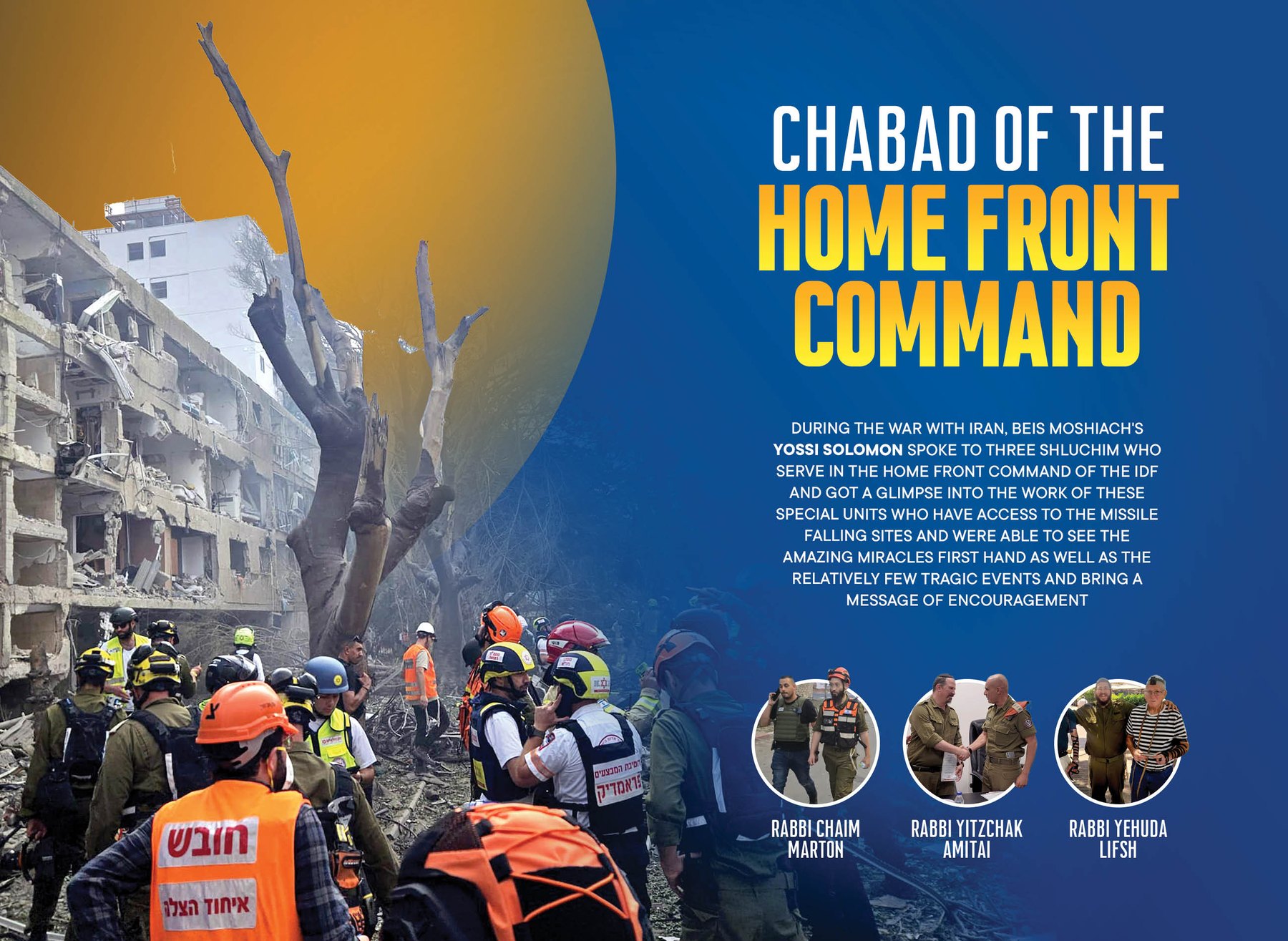
During the war with Iran, Beis Moshiach’s Yossi Solomon spoke to three shluchim who serve in the Home Front Command of the IDF and got a glimpse into the work of these special units who have access to the missile falling sites and were able to see the amazing miracles first hand as well as the relatively few tragic events and bring a message of encouragement. Rabbi Chaim Marton, Rabbi Yitzchak Amitai, Rabbi Yehuda Lifsh
Since the war with Iran broke out, hundreds of rockets have struck cities across the Land of Israel. Time and again, sirens pierce the skies – by day and by night, especially at night – shaking countless hearts.
Amid all this – with the front lines lie far away, between Tehran and Isfahan – there is another front, located deep within the Israeli home front: on the streets of Tel Aviv, Haifa, Ramat Gan, and Beer Sheva.
The soldiers of this front are none other than the personnel of the Home Front Command. They arrive at impact sites and take command of the situation: rescuing people, helping with evacuations, directing security forces where needed, and ensuring the safety of residents who just experienced a rocket falling from the sky – directly onto their heads.
We spoke with three Chabad Chassidim who serve as members of the Home Front Command. They are present at impact zones, move around emergency stations, and are rushed to emergency rooms. Yet even amid uniforms and briefings, they never forget their true mission: to spread light, lay tefillin, strengthen the soldiers, and remind everyone – even between a rocket strike and an explosion – that “The Land of Israel is the safest place in the world,” and that all these miracles are nothing less than redemptive.
In an interview with Beis Moshiach, they share stories from the field, talk about the miracles they’ve seen, and the unshakable faith that bursts forth powerfully from every corner.
Shluchim in Uniform
Where can we find you these days?
Rabbi Chaim Marton: I’m a team commander in a Home Front Command battalion in central Israel. We are prepared to respond to any incident involving a rocket strike or a disaster, G-d forbid, and wherever we are, we try to add a light of chayus and joy.
Rabbi Yehuda Lifsh: I currently serve as part of the Home Front Command’s Identification and Casualty Recovery Unit (IDCU), stationed at Wolfson Medical Center in Holon.
Rabbi Yitzchak Amitai: I serve as the rabbi of an infantry brigade within the Home Front Command. Our brigade provides security at strategic locations throughout the country, and I serve with them in all their activities across the country.
Can you share what you witness at the scenes where you operate?
Rabbi Marton: We arrive at impact zones as fast as possible – rescuing, locating, and assisting with everything needed. As part of the military rabbinate, we also handle casualties according to Jewish law, with utmost respect for human sanctity.
Rabbi Lifsh: Our job is to encourage the wounded, bring them faith and confidence, and of course, deliver the Rebbe’s message: that Israel is the safest place in the world. We also strengthen those around us with the Rebbe’s campaigns – checking mezuzos, buying letters in a Sefer Torah, and more. Everywhere I go, I encounter a great awakening of Jewish faith; I see soldiers growing stronger spiritually – whether putting on tefillin or simply thanking Hashem.
Miracles in Real-time
What goes through a Chassid’s heart when he’s standing in an impact zone surrounded by soldiers, frightened citizens whose whole world has collapsed around them, and he knows at the same time that he is a shliach of the Rebbe?
Rabbi Marton: I feel the sense of shlichus both in moments of readiness and in action. I know that the soldiers look to us – soldiers-Chassidim – and expect words of encouragement. As the Rebbe’s followers, we have the strength and message to uplift every Jew.
One rocket fell in Petach Tikva, in the ‘Neve Gan’ neighborhood where I serve as the Rebbe’s shliach. Sadly, there were casualties. I arrived as part of my official role and as part of my shlichus.
I called Rabbi Shmuel Hendel to bring the Mitzva Tank, and I asked him to come to the base as well to uplift the soldiers. He came, and during the outreach work with the soldiers, we received an alert to enter a shelter. It was a unique moment – dozens of soldiers sitting together with nearby civilians – and I knew that my job was to share the Rebbe’s words suitable for this time. I told them: just hours earlier I was at a painful scene in my own neighborhood, but even then, we know this is the land that “the eyes of G-d are upon it always.” I shared that out of a 100-unit apartment building, only one apartment – that sustained a direct hit – was damaged. Everyone else escaped unharmed. That’s the kind of light we can bring even from within a war zone. This is the kind of power the Rebbe gives every Jew.
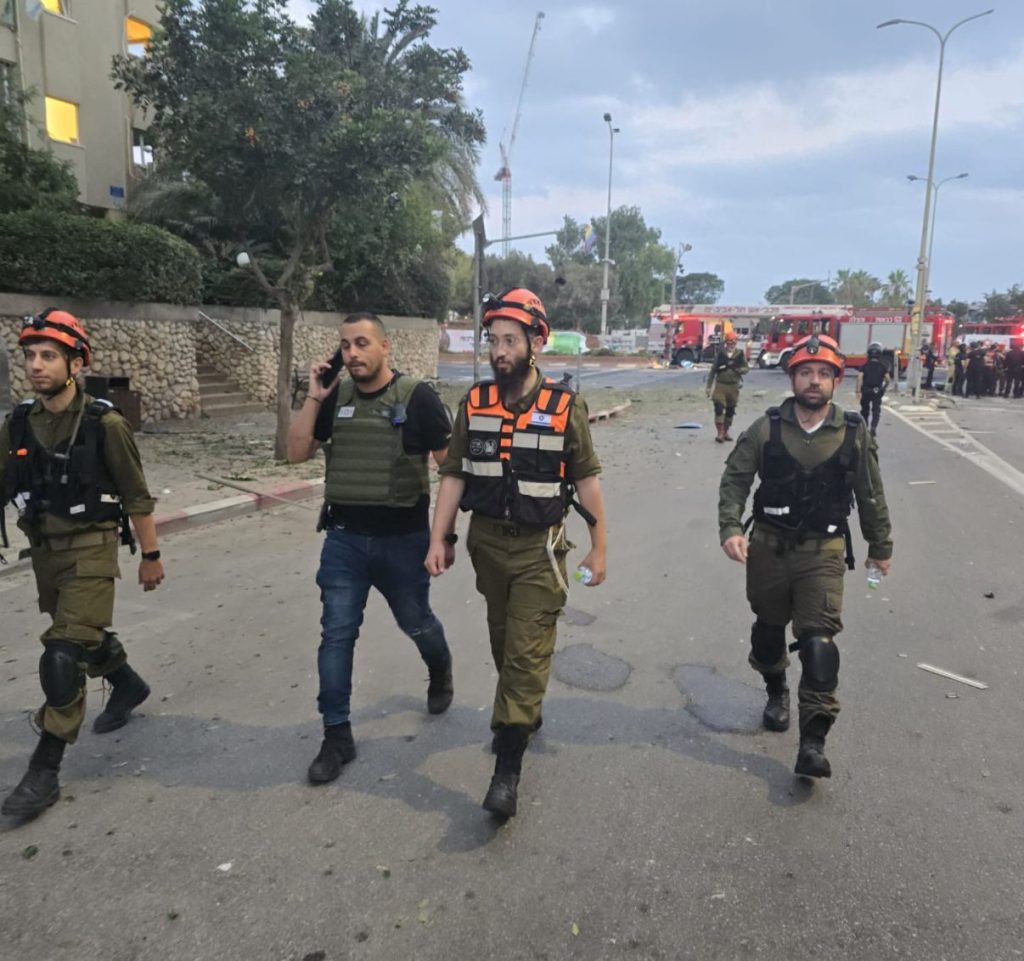
Rabbi Amitai: It’s a great merit to sanctify Hashem’s name and help Jews carry out the Rebbe’s campaigns, including ensuring soldiers have kosher food. There’s a tremendous opportunity here to bring the Rebbe’s light to the troops.
The Power of Tefillin on the Battlefield
Have you seen times where laying tefillin or speaking words of faith changed the atmosphere in the field?
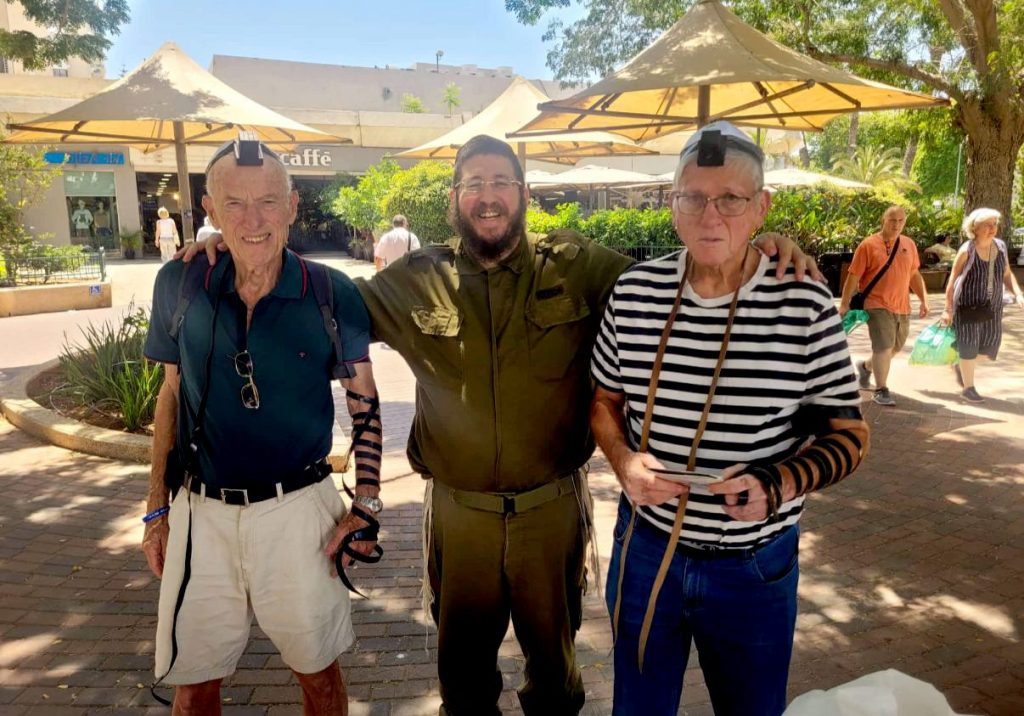
Rabbi Marton: Absolutely. From day one when I joined the unit, I do a tefillin ‘round.’ I brought tzitzis for the soldiers, and I saw how contagious it became. Some initially refused to touch the tefillin. One soldier described himself as “a complete atheist.” I told him he was free to say no, but I had a “crazy habit” – every day I would ask him again.
A few days later, he called me over and asked to put on tefillin. He said it came from his neshama and gave him strength.
Another story: one morning I wasn’t at the base and texted a non-religious soldier – whom I usually help put on tefillin – asking if he could do my tefillin round instead. I didn’t really expect him to do it, but he sent back photos of himself helping other soldiers lay tefillin. It’s amazing to see someone who himself needed “outreach,” become the one doing the outreach.
Rabbi Amitai: Definitely. Tefillin gives strength, especially during tough missions. One night, after staying up all night on duty, the soldiers were exhausted. I brought them tefillin, and they felt renewed energy. They even said so themselves.
* * *
If in the past, only Chabad emphasized miracles during wartime, it seems like this time – like every other topic raised by the Rebbe – it’s everywhere. The phrase “miracles and wonders” is now commonplace. News outlets and social media are full of awe at the miracles. “Even if you’re blind, you can’t miss the miracle,” wrote one journalist.
Eyewitness to Wonders
Can you share miracle stories you’ve witnessed?
Rabbi Marton: In my neighborhood, two homes were destroyed by a rocket containing over a ton of explosives. Still, everyone survived – families ran out holding children. That’s a miracle you can’t describe.
One secular woman wrote to me: “Rabbi, I’m not religious, but I’m convinced the only thing that saved me was repeating ‘Shema Yisrael’ over and over during the siren and explosion.”
Rabbi Lifsh: I’ve met people whose lives were saved in clear miracles. A rocket hit their building, or they were caught in the blast wave – but moments before, they reached shelter.
Some people didn’t make it to shelter or were hit by debris from the shock wave – which could rupture internal organs from the force of the blast – but doctors at Wolfson did CT scans and found no damage. The doctors themselves said it’s medically inexplicable.
In places with direct hits, there were often no injuries at all – boruch Hashem!
I can tell you that for years now the Home Front Command has spent billions of dollars preparing for the possibility of war with Iran. According to all assessments, they anticipated as many as a thousand (!) missiles landing in Eretz Yisrael, resulting in mass casualties and massive infrastructure collapse. In response, they prepared large areas to cope with the casualties, as well as thousands of beds and temporary shelters. But in reality, we’ve seen miracles upon miracles. Most rockets are intercepted, and those that land often hit deserted areas. Casualties are minimal.
In just a few days, Israel took out a large portion of Iran’s launchers – something Russia hasn’t accomplished in years of war in Ukraine. Israel is 80 times smaller than Iran, yet we see Hashem’s hand at work.
Rabbi Amitai: I mainly deal with the painful scenes – bringing those who didn’t survive to proper Jewish burial. Still, I witness miracles. For instance, at Soroka Hospital, just hours before a rocket hit, the entire department was moved to a different building – saving hundreds of lives!
Spiritual Awakening in the Field
What are your conversations with secular colleagues like?
Rabbi Marton: One female commander told me she never believed she’d say it, but she now sees clearly there is a higher power directing things. It’s hard to deny. These moments are opportunities to share the message of Geula.
Rabbi Lifsh: During downtime, soldiers talk a lot. Even those from non-religious homes understand this is a moment before the Geula. The younger generation, especially, shows massive spiritual awakening.
In Ramat Aviv, where I serve, I see this clearly. Elderly people who attend protests often feel angry and distant from religion – but the youth are different. In the past year and a half, 150 local teens have bought tefillin. Kids wear tzitzis openly and go to shul with kippot – it’s unprecedented. In Ramat Aviv they call the young generation who are taking an interest in Torah and mitzvos, the “Victory Generation, Dor HaGeula.”
Even among soldiers, no one outright rejects it. Some may decline to put on tefillin for various reasons – saying, “I’m not used to it,” “I don’t know how,” or “It’s not what I do.” But no one says anymore, “I don’t believe.” That kind of outright denial used to be common – but not anymore.
Rabbi Yitzchak Amitai: I’ve had many conversations with soldiers, and I’m amazed at how deeply they are connected to the ideas of Moshiach and Geula.
There was one soldier who seemed completely disconnected from anything to do with Moshiach and Geula. I was shocked to see a Moshiach patch on his arm. I asked him – quite surprised – “What’s that got to do with you? You barely show up for prayers…”
He replied, “Because I’m so sure it’s going to happen, I don’t take this off for even a moment. I know that in our current situation, Moshiach could come at any second…”
Generation of Geula Emerging
How do you see faith and spiritual light increasing precisely through the threat and darkness?
Rabbi Chaim Marton: People are beginning to realize that the Rebbe spoke about this exact situation decades ago, and that everything happening in the world now is part of preparing for the coming of Moshiach.
There’s a lot of discussion with soldiers about Geula – and they get it. In general, it’s much easier now to talk with them about the Rebbe’s teachings that the world is moving toward Geula. “The time of your redemption has arrived.” This comes through clearly in my conversations with soldiers – even those who don’t consider themselves religious or connected to Torah and mitzvos. They still understand and accept it.
Rabbi Yehuda Lifsh: The Rebbe’s words are now spreading everywhere – whether it’s his statement that “Eretz Yisrael is the safest place in the world,” or “Hinei, Moshiach ba,” or the teaching from the Medrash that says:
“In the year that Melech HaMoshiach will come, the King of Persia will provoke the King of Arabia, and G-d will say to the Jewish people: ‘My children, do not fear – for the time of your redemption has arrived.’”
This is also the time to publicize more of the Rebbe’s directives – that we must go all the way against our enemies, without compromise or stopping halfway. We truly see how the Rebbe’s words are coming true all the time.
Rabbi Yitzchak Amitai: Chassidic teachings explain that in moments of hardship or danger, the deepest level of the soul – the yechida – is revealed in every Jew. I see that most clearly in the most difficult and complex scenes. It’s astonishing.
Shlichus During Wartime
How do you see your shlichus during these turbulent times as part of the spiritual battle?
Rabbi Chaim Marton: Precisely in times like these, each of us is called to action. People are looking to us – in the communities and on the bases – to tell them what they can do to bring the Geula.
If this is something we speak about all year, then all the more so now, when Moshiach feels so real and imminent. There’s no time to rest until the storm passes; this is “crunch time” – these are the moments we’ve been fighting for our entire lives.
That’s why we must increase our efforts to explain to the public the significance of the times we’re in, and if needed, go deeper – by adding classes on Moshiach and Geula, and the Rebbe’s mivtzaim.
Rabbi Yehuda Lifsh: These days, I combine two areas of shlichus: my permanent post in the Ramat Aviv neighborhood and my military role at Wolfson Medical Center. We’re in daily contact with local residents, and it’s clear that mivtzaim like mezuza-checking and Mivtza Moshiach have gained massive momentum in recent weeks.
Beis Moshiach #1468 • pp. 24-30
© 2026 Beis Moshiach Magazine. All rights reserved.
This article originally appeared in Beis Moshiach #1468. You are welcome to share it with friends and family by email or in print, provided that you do not change, add to or omit any part of it, you credit the author and Beis Moshiach, and you include a link to archive.bmoshiach.org (written out in full in printed copies).
To republish this article in a newspaper, magazine, book or website, please request permission in advance at [email protected].