Before the Smoke Cleared
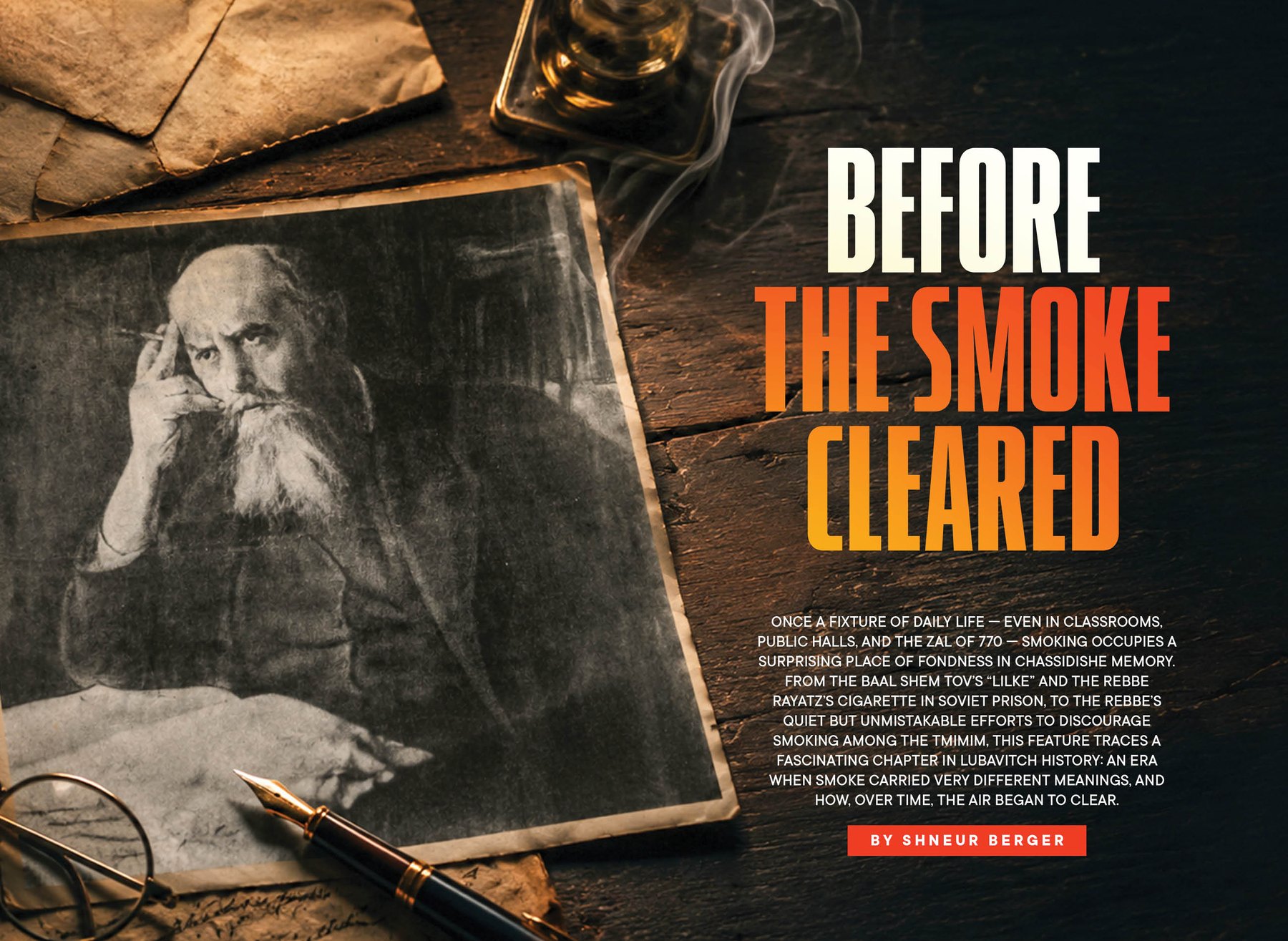
Once a fixture of daily life – even in classrooms, public halls, and the zal of 770 – smoking occupies a surprising place of fondness in Chassidishe memory. From the Baal Shem Tov’s “lilke” and the Rebbe Rayatz’s cigarette in Soviet prison, to the Rebbe’s quiet but unmistakable efforts to discourage smoking among the Tmimim, this feature traces a fascinating chapter in Lubavitch history: an era when smoke carried very different meanings, and how, over time, the air began to clear.
One of the interesting accounts given by the Rebbe Rayatz from the first hours of his imprisonment, on the 15th of Sivan 5687 (1927), is the scene of his formal intake as a prisoner. A female clerk, one of dozens, sat across from him and began filling out a questionnaire about the newly arrived “guest” prisoner. The Rebbe, in his prison diary (Yoman HaMaasar), describes her questions as well as his own answers, which sounded strange to her ears and left her dissatisfied.
This is how the Rebbe describes it in his diary: “‘What am I to do?’—the clerk asks herself, smoking her cigarette—‘I cannot write such things. I must ask every question listed here, and write down the answer, but words like “G-d,” “religion,” “commandments”—I cannot write these.’
“‘Is it possible,’ I ask, ‘for a prisoner to smoke as well?’
“‘Yes, smoking is not forbidden in this hall, but the prisoners don’t smoke, and if you wish to smoke I’ll ask permission from one of the officials standing in the group in the middle of the building.’ She said this in a manner that the senior officials standing not far from the table could hear.
“With a faint smile on his lips, one of the three senior officials approached and asked with feigned surprise: ‘This citizen wishes to smoke a cigarette?’ And turning to me: ‘Smoking is not forbidden here, you may smoke.’
“I took out my cigarette, and the official was kind enough to offer me his cigarette to light mine from. I thanked him and mentioned that I had matches of my own.”
The exchange with the clerk concluded with an eloquent, proud response that the Rebbe delivered with dignified bearing, specifically so it would be recorded and quoted in the protocol: “I am Rabbi Schneerson, son of the renowned Rabbi of Lubavitch, with the title of ‘distinguished citizen for generations,’ born in Lubavitch, educated in yeshiva, lived approximately eight and a half years in Rostov and about three years in Leningrad, engaged in study: divine Chassidic inquiry, and clarification of the laws and commandments of the Jewish religion—and like all observant Jews, I have no connection whatsoever to politics, and I have nothing further to add.”
And how was this received? The Rebbe Rayatz relates: “The resolute speech, the clear answer, the composure, and the smoking of the cigarette, these were the natural instruments for that which is above nature…”
As noted, this passage is one of many in which the Rebbe describes the subject of smoking in prison, its necessity for preserving a prisoner’s human dignity, and how his own smoking helped him through those fateful hours and days when his life hung in the balance.
The Tzaddikim Who Smoked
It is difficult to comprehend today, but until about thirty years ago, smoking was an inseparable part of daily life everywhere. Teachers smoked in classrooms, public spaces were open to cigarette smoke, and even enclosed aircraft had a smoking section in the rear. Smokers were not the social pariahs they are today—on the contrary, a smoker commanded a certain status, determined largely by the quality of his cigarettes, cigars, or pipe.
This history, which many of us still remember well, is not so distant.
In what follows, we examine this subject through the lens of our Rebbes and leaders across the generations. It is important to clarify from the outset: their thoughts are not our thoughts, nor are their ways our ways. The Rebbes’ engagement with smoking was on an entirely different plane than we can comprehend. While for ordinary people a deep draw of smoke represents a simple physical pleasure, for the supreme Tzaddikim it was a matter of unique and wondrous spiritual elevation.
Here is a small glimpse of what is recounted in Praises of the Baal Shem Tov concerning the smoking of the lilke (pipe): “And if they saw with our light—the pure and radiant light of our eyes—that he would sometimes sit idle and smoke the lilke and the like, certainly it was regarding him that our master the Ari said: ‘For whom is all the desire of Israel?’—that engagement in mystical unifications (yichudim) is greater than engagement in Torah study. Yet not all day, for the Torah is the source from which the life-force of the practice of these unifications emerges.
“And our master [the Baal Shem Tov] was an extraordinary genius who occupied himself with Torah all his days, and who can adequately recount his praise? Who could compare to him?!
“And his holy disciple, Rabbi Yaakov Yosef, said before his passing that he beseeched Hashem yisborach that he might gain, through all the Torah and mitzvos of his entire life, what his teacher, our holy master, the Light of Israel, gained through the mystical unifications he performed while smoking the lilke a single time.
“And on one occasion he showed his disciple, Moreinu HaRav Dovid, Av Beis Din of the holy community of Ostroh, the new heavens and the new earth that he had created through the mystical unifications he performed while engaged in smoking his pipe—and Rav David fainted from awe and fear.
“His brother-in-law, Rabbi Gershon of Kitov, also once remarked: ‘If only I might have in the World to Come what Rabbeinu gains from smoking a single pipe…’”
There are many more such stories about the Baal Shem Tov and the Tzaddikim of the generations. It is similarly told of the Alter Rebbe that one morning he walked to the mikva and passed by the home of his son Rabbi DovBer, the Mitteler Rebbe. The Mitteler Rebbe was standing inside near the open window, deeply absorbed in thought, a pipe in his mouth. His father, the Alter Rebbe, approached and quietly took the pipe from him. When the Alter Rebbe returned from the mikva, he found his son standing in the exact same position, his mouth still open as if the pipe were there, so deep was his absorption that he had not even noticed it had been taken.
Striking is the testimony of the Gaon of Rogatchov, who was once consulted about smoking on Yom Tov. He replied that he had never experienced the taste of smoking and therefore could not render an opinion on the matter. When told that the Rebbe Rashab had in fact smoked on Yom Tov (though in truth the Rebbe Rashab was careful that smoking not be done publicly on Yom Tov; only on Simchas Torah was he seen smoking), the Gaon responded with astonishment: “Can one compare oneself to the Rebbe? He is a supreme Tzaddik, and their smoking is an entirely different matter.”
Another interesting story connected to the Rebbe Rashab’s smoking took place during the Aseres Yemei Teshuva in 5727 (1966). During that period, the Chassid, Rabbi Asher Sassonkin, who had recently managed to leave the Soviet Union, entered for a private audience with the Rebbe.
During the yechidus, R’ Asher presented the Rebbe with cigarettes from Russia. The Rebbe responded: “Generally, I do not smoke.” Nevertheless, he took one and instructed that the rest be distributed in the Beis Medrash.
R’ Asher then told the Rebbe a story about the Rebbe Rashab: at one point, a rumor circulated that tobacco was mixed with whiskey, making it chometz and therefore forbidden on Pesach. The Chassid, Rabbi Shmuel Gurary arranged specially homemade tobacco and sent it via messenger to the Rebbe Rashab. In practice, the Rebbe Rashab did not smoke it (it is told that some weeks before Pesach, a group of yeshiva bachurim would travel to sort wheat for shmurah matza baking, and at the same time would also sort tobacco for the Rebbe’s Pesach smoking).
When Rabbi Shmuel Gurary heard that the Rebbe had not smoked the tobacco he prepared with such care, he was deeply hurt. He entered the Rebbe’s presence and explained that he had done everything with the highest standard of kashrus. At that point the Rebbe Rashab expressed regret for not having smoked it. One Chassid ventured to ask the Rebbe Rashab why he regretted it: “After all, you simply practiced iskafya (self-restraint).” The Rebbe Rashab replied: “Iskafya can be practiced in other areas…”
When the Rebbe heard this story from R’ Asher, he responded: “I have a story about not smoking…”
In a letter from Adar 5668, the Rebbe Rashab wrote to the wealthy Chassid Rabbi Shlomo Zelkind Persitz (Igros Kodesh, vol. VI, p. 114): “In yesterday’s letter I forgot to mention the matter of the cigarettes—they were surely prepared in a kosher manner for Pesach, as I told my son [the Rayatz], and I asked that they be sent and that I be informed of how they were made.”
In the chronicles of Chassidic history there are several references to our Rebbes’ smoking. In Shemuos v’Sippurim it is told that on one occasion the Rebbe Rashab was visiting Moscow and staying at the home of one of the city’s wealthy men. The host’s son was somewhat ill, and the doctors had forbidden him from smoking but he ignored them and continued. His father scolded and argued with him endlessly to no avail.
When the Rebbe Rashab was staying in their home, the wealthy man asked him to influence his son to stop smoking. “Why do you smoke,” the Rebbe gently asked the son, “when you are unwell?” The son replied: “But the Rebbe himself is not in good health, why does the Rebbe smoke?” The Rebbe answered: “I smoke because my father smoked.”
The Rebbe MH’M related about the Rebbe Rayatz and the Rebbe Rashab that after a telephone was installed between their respective rooms, it frequently happened that the Rebbe Rashab would call his son the Rayatz and say: “You may come in, I would like to smoke.” The Rayatz would then enter, strike a match, light the cigarette, and the Rebbe Rashab would smoke while speaking with him about the subject he was then occupied with.
The Rebbe Rayatz himself smoked frequently, as noted throughout his sichos and memoirs and, as mentioned, the subject arises repeatedly in the account of his imprisonment and release.
How did the Rayatz’s smoking come to an end? It is told that in the year 5700 (1940), due to his deteriorating health, the Rebbe Rayatz stopped smoking all at once. Evidence of this can be found in a letter he sent to Professor Fishel Schneersohn (13 Iyar 5700), in which he wrote that he had completely given up smoking: “My health situation still has nothing to gladden… The Gerzon diet I follow only halfway and partially, as there are things I am very careful about such as smoking, which I have given up entirely… May Hashem send me a recovery.”
Did the Rebbe himself ever smoke?
There are unconfirmed accounts that the Rebbe did indeed smoke for an extended period. However, this stopped during his time in the United States, living in close proximity to his father-in-law the Rebbe Rayatz, when someone mentioned that the smell of cigarettes was detectable in the Rebbe Rayatz’s apartment on the upper floor and from that point the Rebbe ceased entirely.
The Rearguard Battle Against Smoking
Over the years, as medical research advanced and the harmful effects of smoking became increasingly documented, awareness grew that the human body, the divine “vessel” through which a Jew serves his Creator, was being damaged. In those years, studies and articles began appearing proving how harmful smoking was to health, though the vast majority of the public had yet to take the matter seriously.
For example, in 5702 (1942), an article was published written by Gene Tunney, former heavyweight boxing champion of the world and a senior officer in the US Naval Reserve, someone who inspired many Americans, containing sharp words against cigarette smoking. The article was translated into Hebrew and published in the newspaper Haaretz under the headline “Smoking—Poison to Mankind.” In it, Dr. Raymond Pearl’s research was cited showing that of 100,000 heavy smokers (those smoking more than ten cigarettes a day), 53,774 died before the age of sixty—compared to only 43,436 non-smokers who failed to reach that age. “Smoking,” Pearl concluded, “inevitably shortens life, and the degree of shortening depends on the amount of tobacco regularly consumed.” The article’s author concluded with dark humor: whoever smokes as much as he can will fall ill with many diseases and won’t have to wait until old age to reach paradise; he’ll arrive there while still young.
The Gezeira
The first formal gezeira regarding smoking came approximately ninety years ago, when in the month of Elul 5697 (1937) the Rebbe Rayatz asked that yeshiva students refrain from smoking during Rosh Hashana. This was not a blanket prohibition on smoking, but a request appropriate to the Yemei HaDin, when gravity and seriousness should define a bachur’s existence: “I wish to note that even those who smoke throughout the year and on Yom Tov, on Rosh Hashana they refrain, and rightly so. The bnei Torah should be careful in this, and should influence their acquaintances as well.”
A year later, as Rosh Hashana 5698 approached, the Rebbe Rayatz wrote again that bnei Torah should refrain from smoking even in private: “I propose the following conduct for the two days of Rosh Hashana: minimize unnecessary speech, minimize eating, drinking, and sleeping—and do not smoke cigarettes, even in private.”
These letters were addressed to yeshiva students and bnei Torah, but in practice all Chabad Chassidim took it upon themselves to abstain from smoking on the two days of Rosh Hashana.
Several years later, the Rebbe Rayatz directed that younger yeshiva students be forbidden from smoking throughout the entire year. This was no small matter, as smoking was an integral part of many bachurim’s daily lives. He transmitted the prohibition in a letter to Rabbi Mordechai Mentlick, the Rosh Yeshiva at Tomchei Tmimim Yeshiva in New York: “I hereby issue my order to my friend to compile a list of all students who smoke, and to absolutely and completely forbid smoking for students under the age of twenty, without distinction whether cigarettes, cigars, or pipes. This prohibition applies to all students at all times, throughout all 24 hours of the day. This directive is to be enforced with full strength and excellent supervision by my friend.”
The Rebbe Rayatz added that any talmid who violated this order would be “severely punished” (12 Teves 5703).
For students over twenty, he strongly urged in that letter, for their benefit both spiritually and physically, that they work toward quitting, by gradually reducing smoking day by day until they gave it up entirely. He blessed those who fulfilled this request, saying it would go well for them both spiritually and materially.
Rabbi Mentlick promptly reported back on the results and the Rebbe Rayatz expressed his satisfaction: “I was very pleased to hear, and may Hashem grant them success in their learning and in their yiras shomayim, and may they be G-d-fearing, Chassidim, and lamdanim.”
He also wrote to the maggid shiur, Rabbi Shneur Zalman Gurary: “Concerning the list of those who smoke, I was glad to hear that they have committed themselves to giving up smoking, and they should no doubt be monitored to make sure they follow through on their commitment.”
Not many days passed before the Rebbe Rayatz again inquired of the yeshiva administration: had the younger students stopped entirely, and had those older than twenty reduced or ceased their smoking?
The Rebbe Bends Down to Pick Up Cigarette Butts
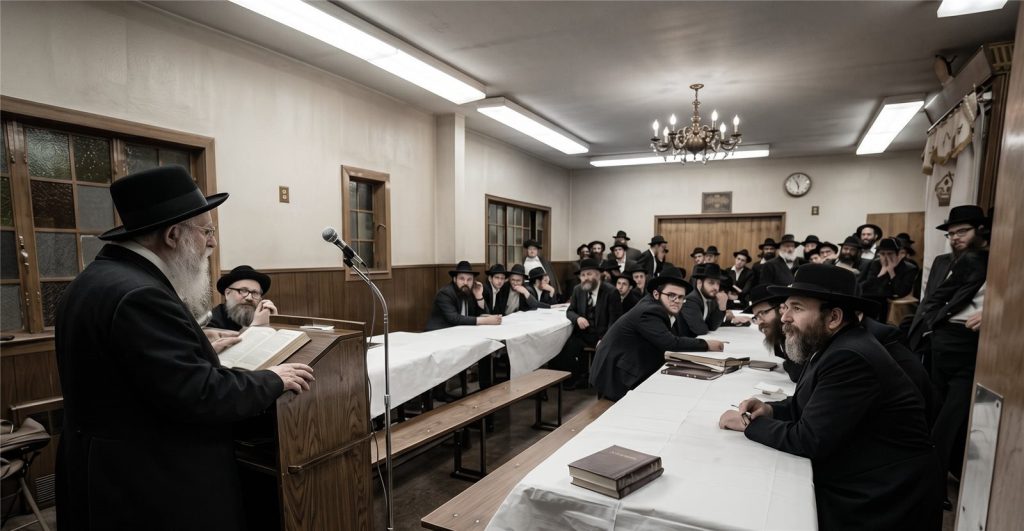
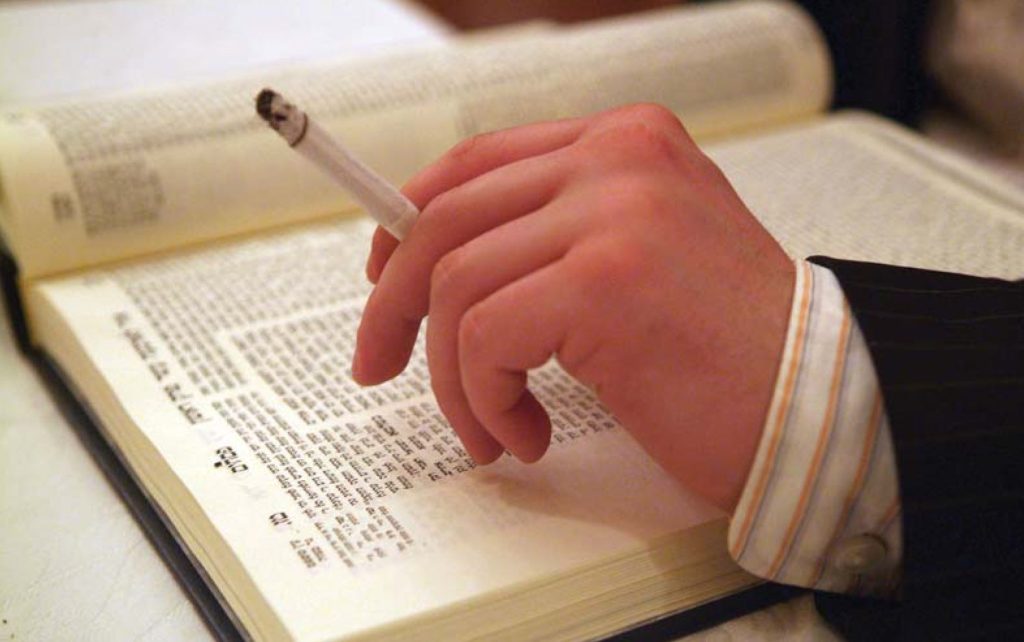
In practice, not all students over twenty managed to quit. Smoking had become addictive, and breaking the habit was difficult. Even in later years, bachurim learning in the main zal of the yeshiva at 770 Eastern Parkway continued to smoke. As was the norm in those years, smoking in public and enclosed spaces was considered entirely normal. It is therefore unsurprising that the zal in 770 was often filled with smoke during seder. Cigarette butts on the tables and benches were a common sight.
On more than one occasion the Rebbe himself bent down to pick up cigarette butts and place them in a nearby garbage can. After this recurred repeatedly, bachurim made sure that areas where the Rebbe passed would be clean. Still, the Rebbe occasionally noticed empty boxes and cigarette stubs rolling around and would bend to pick them up. As a result, the tmimim gathered and made a significant resolution: no more smoking within 770.
The meeting was documented in a diary by the talmid, Rabbi Saadia Maatuf: “Thursday, 22 Iyar 5734 [1974]. Today something very interesting happened, from which much can be learned. At the conclusion of Mincha, the Rebbe left his siddur in its place (rather than taking it with him as usual), walked to the kerias haTorah platform, and everyone present watched, not knowing what had occurred. I was standing very close to the platform and saw the Rebbe bend down and reach under it, retrieving an empty cigarette box. He exited the small zal, looked for a garbage can, and not finding one, placed the box on the small shelf near the secretariat, where letters are placed… Everyone was astonished that we had not noticed the box, as we always watch carefully that no mess be present where the Rebbe stands. The box was taken by the student Chazan. This incident led to the decision not to smoke in 770 at all—one can only hope it holds.”
Evidently, quitting was harder than ever, because two years after that gathering, in 5736 (1976), during a private audience with one of the Chassidim, the Rebbe spoke about smoking and remarked: “Regarding cigarette smoking—there is already the letter of my father-in-law the Rebbe,” thereby signaling his displeasure at the tmimim’s smoking.
Following this, a special assembly was held for the yeshiva students at 770, at which the yeshiva administration addressed the cessation of smoking. The assembly took place in the month of Adar Rishon 5736: “The mashgiach, Rabbi Dovid Raskin, began by announcing the request that all students cease smoking, following the Rebbe’s words during a private audience.”
In the wake of the assembly, the Rebbe Rayatz’s letter on cigarette smoking was again publicized at 770. The yeshiva administration also issued a new regulation requiring anyone who wished to smoke to leave the zal.
In subsequent years, public health awareness of the dangers of cigarettes grew dramatically and over time the proportion of smokers among Chassidim and tmimim declined sharply as well.
Our Rebbes Did Not Forbid It
The Rebbe expressed his opposition to smoking at any age, but never agreed to impose a blanket prohibition, despite various requests that he do so. In a letter from 5739 (1979) he addressed the question of why rabbis do not simply forbid smoking outright: “I gather from your letter that you are aware of the halachic difficulties involved in imposing a prohibition. Traditionally, rabbinic authorities have been reluctant to impose prohibitions even in uncontested situations, when this would involve a ‘gezeira that the majority of the public cannot abide by,’ a situation in which imposing a prohibition would necessarily bring many people to the status of intentional violators rather than inadvertent ones.”
In the same letter the Rebbe addressed another point, the fact that the health risks of smoking had not at that time been proven with absolute certainty: “You are surely aware that there are those, a minority, to be sure, who argue that the health danger of cigarette smoking has not been proven beyond all doubt. This is perhaps one of the reasons that the production and sale of cigarettes has not been outlawed by health authorities.”
The Rebbe also explained that if cigarettes were to be formally prohibited and thereby equated with drug use, young people might permit themselves to smoke drugs, which is obviously far worse than cigarettes.
The letter concludes with the Rebbe’s final remarks on the matter: “Needless to say, these and other considerations do not justify the use of something already prohibited by the commandment ‘and you shall greatly guard your souls.’ But I mentioned the above in order to respond to your letter regarding some of the reasons why no prohibition has been imposed on cigarette smoking.”
In this letter, and in another letter from the same period, the Rebbe clarifies that there exists the possibility that a cigarette could be developed that is not harmful, one from which the harmful substances would be neutralized, and therefore there is complexity in issuing a blanket prohibition on cigarettes.
The Chabad poet Tzvi Yair (Rabbi Tzvi Meir Steinmetz) also wrote to the Rebbe about the danger of smoking, and wondered why many members of Anash, especially the tmimim and the kollel members, continued to smoke heavily. The writer suggested that the Rebbe issue “guidance” on the matter, likely meaning a prohibition on cigarette smoking. The Rebbe responded: “It is difficult for me to take the initiative in such a matter, because:
Many of the elder Chassidim have been smoking for many years, and the Rebbeim said nothing to them.
It is known that several Rebbes themselves smoked, etc.
My father [Rabbi Levi Yitzchok Schneerson] smoked extensively, with the full knowledge of the [Rebbe Rashab], as is obvious and clear.” (See the sidebar about smoking by Rabbi Levi Yitzchok.)
An interesting incident occurred on Sunday, 3 Teves, 5750. A man who came to 770 to receive a dollar from the Rebbe noticed several young men smoking outside. When he passed before the Rebbe during the dollar distribution, he complained: “Why don’t you tell them not to smoke? Is smoking good or bad?”
The Rebbe gave him a surprising answer: “It depends on the person’s habit; if someone is used to smoking and he stops, it could harm his health.” The man was not deterred, and requested: “Please tell them not to smoke. If you tell them, they will listen to you.” To this the Rebbe replied: “I am not a doctor…” It was clearly evident that the Rebbe was refusing to comply with the man’s request.
Improving the Spiritual Health of Our Jewish Brethren
We close with the Rebbe’s letter from 5739 quoted earlier: “Since you have written to me on this subject, I wish to take this opportunity to express a practical thought, seeing how much you are concerned with a matter related to physical health, even though there is no consensus about it and some people believe that in certain cases it has a positive side, and that stopping smoking can sometimes cause more harm than smoking itself.
The Rebbe continues: “And all of these are points that this is not the place to discuss—I am confident and certain that you are engaged even far more so in improving the spiritual health of our Jewish brethren, namely strengthening the observance of Torah and Mitzvos in daily life.
“In this area there is absolutely no room for any doubts or disagreements that Torah and Mitzvos are ‘our life and the length of our days’… These things must be repeated even one hundred times. That is: even if a person has tried 99 times without success, he is still obligated to try one more time; and all the more so if he has only just begun to fulfill this Mitzva.”
He Stopped Smoking Because of the Rebbe
Rabbi Eliyahu Yochil Simpson, the gabbai of the Rebbe Rayatz, was a heavy smoker; he smoked cigarettes filled with strong tobacco. Some years earlier, many doctors had concluded that smoking causes more harm than good, but quitting, as is well known, is no simple matter.
Shortly after Rabbi Simpson began his role as gabbai, he stopped smoking following a brief question from the Rebbe Rayatz. It happened when he entered the Rebbe’s room immediately after smoking, and the Rebbe asked with slight displeasure whether he had just smoked…
Rabbi Simpson heard the Rebbe’s question and the subtle hint contained within it, and understood that smoking bothered the Rebbe. From that moment on, Rabbi Simpson stopped smoking entirely.
Many years later, when the Rebbe MH’M ascended to the Nesius and the farbrengens moved to the large zal, it was common for the crowd to sit and wait before the Rebbe’s entrance while many smoked their last cigarette before he came in.
But in order for the smell and smoke to dissipate completely before the farbrengen, Rabbi Simpson would knock on the table and announce shortly before the Rebbe’s entrance: “Stop smoking!” Within a short time the clouds of smoke dispersed, the smell cleared (largely thanks to the air conditioning), and the Chassidim were ready for the Rebbe’s entrance with 770 free of cigarette smoke.
In later years, a law was enacted in the United States prohibiting smoking in enclosed public places, and since then there has been no smoking in 770 at all.
The Rebbe Rayatz Smoking in Front of His Father
The Rebbe also related an interesting story about an amusing situation that arose when the Rebbe Rashab and his son the Rayatz once traveled abroad on communal matters. A situation developed in which the Rayatz presented himself as a “rav,” while the Rebbe Rashab presented himself as a “businessman.”
The reason for this was that on his travels abroad, the Rayatz would customarily purchase rare and precious books, and in order to bring them across the border safely, it was necessary to find favor in the eyes of the customs officials so they would not hold up the precious books.
When they arrived at the border station, the officials treated the first-class passengers politely, showing special honor to the “rav,” while the “businessman” received lesser honor. Thus the Rayatz was seated in a particularly comfortable chair and was even offered a cigarette…
The Rayatz had no choice but to sit down and smoke the cigarette—in front of his father the “businessman,” who remained standing…
The Rayatz was always careful never to smoke in his father’s presence out of respect, and certainly not to sit while his father remained standing… “But in this case,” the Rebbe related, “the Rebbe [Rayatz] could not refuse or reject the honor offered by the customs officials, since he wanted to find favor in their eyes.”
The Rebbe Rashab enjoyed the situation that had arisen—“on this occasion he ‘caught’ him” (“דא האט ער אים דערצאפּט”)… and the Rebbe Rayatz described his father’s delight as he watched the Rayatz sitting, half sitting and half standing, smoking a cigarette and glancing at the customs official to win his favor… (From the sicha of Yud Shevat, 5720.)
Smoking While Reclining at the Seder — Rabbi Levi Yitzchok
At the seuda on the first night of Pesach 5730, the conversation turned to the topic of reclining (heseibah), and among other things the Rebbe said: “In truth, there are additional matters during which one should recline such as at shulchan aruch etc. yet in practice this is not done.”
At this point he revealed: “My father would recline even while smoking. [He then added:] When I was in Warsaw, I did not see the Rebbe Rayatz recline while smoking.”
A few days later, on the night of Shevii shel Pesach, the Rashag asked the Rebbe: Regarding what had been said on the first days, that his father would smoke while reclining, did he do so every time he smoked?
The Rebbe: He reclined only once, in order to demonstrate that this too should be done while reclining.
The Rashag: When he ate the rest of the meal, did he also recline?
The Rebbe: No.
The Rashag: If so, it turns out that smoking was more important than the meal?!
The Rebbe: Eating—one reclines anyway, since the k’zeisim are eaten while reclining. The reclining during smoking was only to demonstrate that this activity too is associated with the concept of reclining, as mentioned above.
As far as the Rebbe Rayatz’s practice, the Rebbe noted that he did not see the Rebbe Rayatz in Riga reclining while smoking.
The Rashag noted that in the sefer Darkei Chaim, which records the customs of the Tzaddik, Rabbi Chaim of Sanz, author of the Divrei Chaim, it is mentioned that this Tzaddik “would smoke his pipe (lulke) in the middle of the Seder.”
Beis Moshiach #1512 • pp. 12-22
© 2026 Beis Moshiach Magazine. All rights reserved.
This article originally appeared in Beis Moshiach #1512. You are welcome to share it with friends and family by email or in print, provided that you do not change, add to or omit any part of it, you credit the author and Beis Moshiach, and you include a link to archive.bmoshiach.org (written out in full in printed copies).
To republish this article in a newspaper, magazine, book or website, please request permission in advance at [email protected].