One Step Away from Gan Eden
From the TzaddikStory.org collection
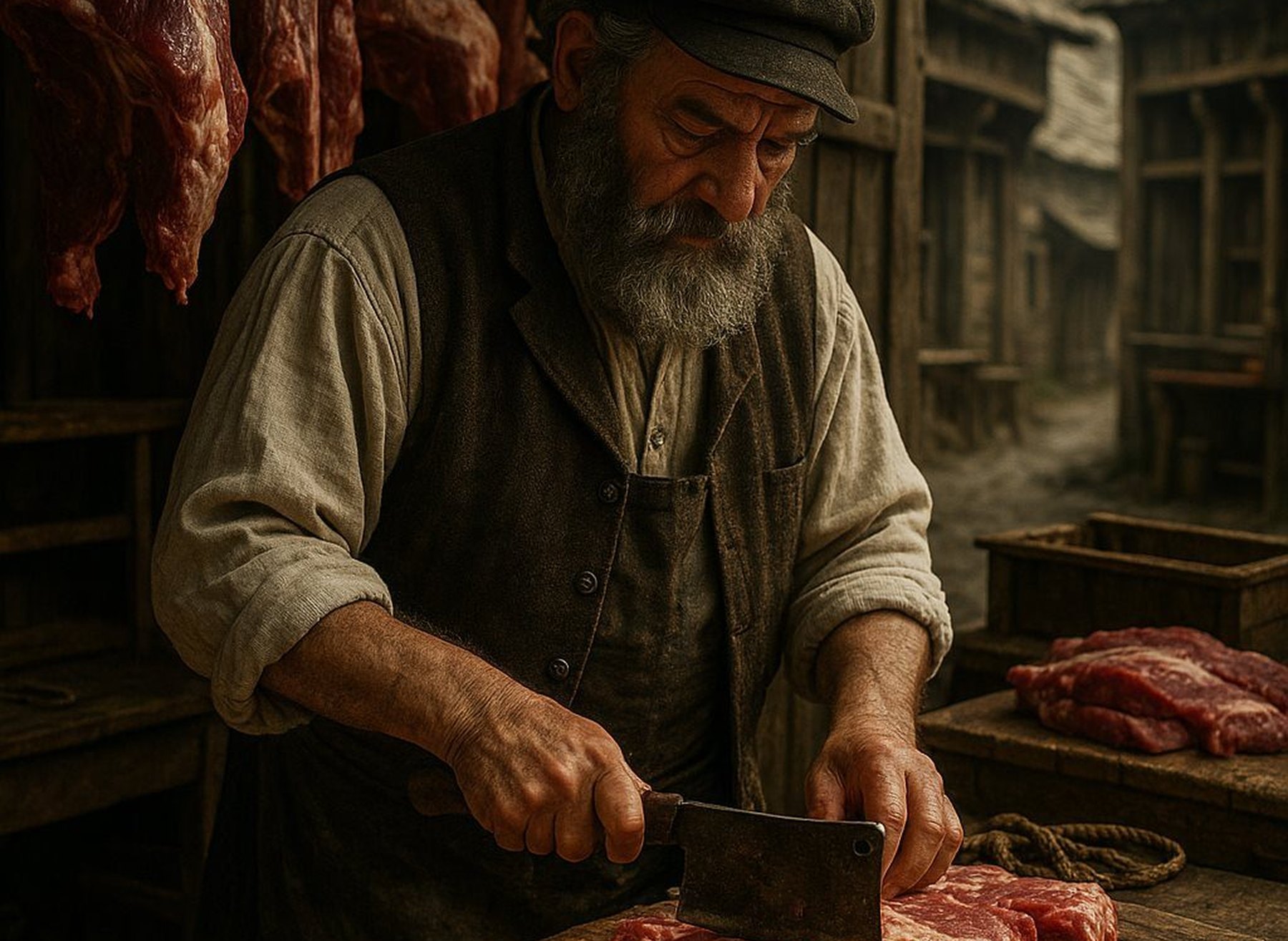
A woman was crying, as she bent over the new grave in the beis ha’chayim (cemetery) in Kozhnitz. She was the butcher’s wife.
No one was around as her tears fell onto the stone. What was she sobbing about? Life was getting too hard for her to handle. Just last week, her husband passed away. Who would be the father to their children? Who would make kiddush on Friday night? Would they ever be happy again?
That was bad enough – but then, right after shiva ended, the knocks started coming.
* * *
Meanwhile, in Shamayim, Yitzchok – the butcher – sat and worried. He wasn’t thinking about himself. He was thinking about his children. What would happen to them now? Who would guide them? Who would help his wife raise them?
Yitzchok had always tried to keep the Torah and do the right thing. He gave tzedaka. He closed his shop early on Fridays to prepare for Shabbos. He never cheated a customer! But still… he wasn’t in Gan Eden.
He had been rescued from a low, low place – a pit so dark and frightening, he didn’t even want to look back at it. But he hadn’t reached the light, either. He wasn’t sentenced to Gehinnom… but they still weren’t letting him into Gan Eden. Instead, he was stuck in the middle – nowhere. A place with no name. No warmth, no peace. Just waiting.
It was a hard, hard place for a neshama to be. What was this all about… Had he done something wrong?
* * *
Now, who was knocking at the butcher’s family’s door? Many people. The moneylender. The grocer. The carpenter. All of them had given Yitzchok things he’d needed for his children – on credit. And none of them had been paid back!
“Oh, I’m so sorry, I’ll pay next week…”
“You know I’ll be back in a few days – I promise to get you the money.”
That’s how it always went.
It was nothing new. The butcher was always in terrible debt. He could barely sleep at night. He didn’t make enough money, and no matter how hard he tried, there were always people to pay – and never enough to go around.
He really did try. It’s not that he wanted to hurt anyone. He just got in too deep. Too many bills, too many mouths to feed. And nothing ever seemed to work!
It literally killed him. Maybe it was a heart attack. Maybe it was something else. But the stress… it swallowed him whole.
Now that Yitzchok was gone, would they ever see their money? And the family – would they make it?
They didn’t think so. That’s why they came yelling at the poor widow, just days after shiva.
“You have to sell something,” the grocer snapped. “We deserve to be paid back – it’s not fair!”
“Yeah,” said the carpenter, “he borrowed from us. You’re his wife, these are his kids – it’s your problem now.”
* * *
Inside, Yitzchok’s children were hiding in the kitchen. They didn’t like hearing grown-ups yell. They hated seeing their mother worried. And, worst of all – they were hungry.
“Ma,” whispered one of the younger boys, tugging on her sleeve, “do you think we could have some food…?”
But the kitchen was empty. There was nothing to eat.
Not only had Yitzchok left no money to pay back his debts – he hadn’t even left enough to buy bread for lunch.
His children were hungry, thirsty, and scared. And outside their home, angry voices kept shouting. “I’m telling you, if you don’t pay back what you owe, you don’t want to know what we’re going to do!”
Some were demanding thousands. Others were just threatening, hoping to scare the widow into paying something – anything. It was too much.
Yitzchok’s wife didn’t know what else to do. She stepped out of the house, and ran through the streets of Kozhnitz – straight to the beis ha’chayim.
She needed to cry. She needed to speak to her husband. And there, by his fresh grave, she broke down.
* * *
A few days later, there was a knock at the door. It was the shamash of the great holy Maggid of Kozhnitz. The Rebbe was calling for her. She quickly put on her Shabbos finest and hurried to the shul.
Sitting in the Maggid’s study, she felt a little calmer. This was the room her husband used to speak about, every Shabbos – full of stories, divrei Torah, and kedusha.
But still… Why had the Maggid called for her?
“Ma’am,” the Rebbe said gently, “what is troubling you? Who is demanding you repay your husband’s debts? And how much do you owe?”
She told him everything – about the grocer, the moneylender, the carpenter, the shouting, the empty kitchen.
But as she spoke, her heart pounded. What if the Rebbe was about to ask for money, too?
“Please, Rebbe,” she said nervously. “If my husband owed you something… I promise I’ll try to pay. Just give me some time…” The Maggid smiled softly. “No, thank you. You don’t owe me anything. And you have nothing to fear. I will pay off your husband’s debts.”
She blinked.
Had she… heard that right?
“In addition,” the Maggid continued, “come to me every Thursday. I will give you an envelope with enough money for Shabbos, and everything your family needs for the week. Your children should never go hungry again.”
She could hardly believe it. She had heard stories about the Maggid… but this? This was something else. Her hands shook. Her lips trembled. She wanted to cry again – but this time, they would be tears of relief.
Hashem had helped her! Her children would be fed. They would be safe. But one question still burned in her heart.
Why? Why was the Maggid personally taking care of her family like this? The Maggid didn’t answer.
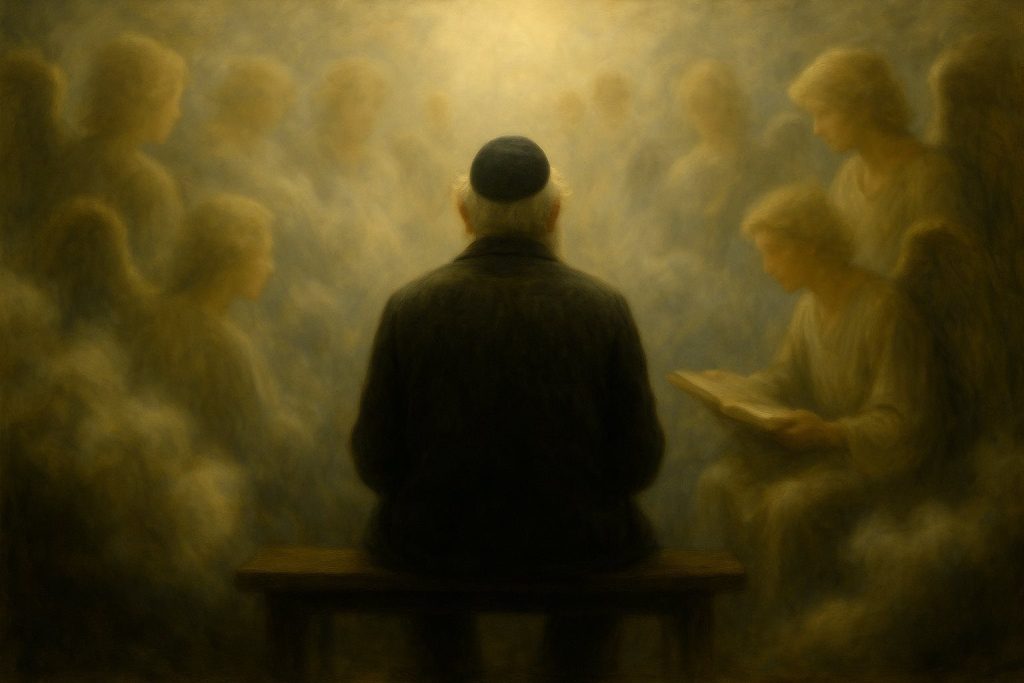
He only gave her a warm look and a gentle goodbye.
* * *
The full story only came out years later – after the Maggid of Kozhnitz passed away. That’s when the mystery was finally solved.
You see, when Yitzchok the butcher left this world, his soul rose up to Shamayim. But the welcome wasn’t warm. Right away, angels gathered around, demanding a full judgment. His mitzvos and aveiros were taken out and placed on a giant heavenly scale.
“Let’s see how he did,” one angel said, flipping through pages of his life. “Here, he gave tzedaka. But over here – he didn’t. And here, he helped someone. But then… he spoke without thinking.”
Every word, every deed, every moment of his life was weighed and looked at. Nothing was skipped. And slowly, the not-so-good side of the scale began to sink lower.
Before Yitzchok could even speak, some angels grabbed him by the arms and began dragging him towards a dark, frightening place – a place where neshamos go to be cleaned after serious mistakes. “No!” one voice suddenly cried out.
A figure ran toward them – a glowing neshama, full of fire and light.
“Stop! Leave this man alone. He is a good neshama! He is great! You cannot take him to that place!”
The angels turned around. “And who are you to stop us? Do you know what he did? Do you remember how careless he was when he was alive? He deserves this!”
The glowing soul shook his head. “You must not know the full story. Did you hear what he did when he was a wagon driver…?”
The angels paused. “No… what did he do?”
The story began.
* * *
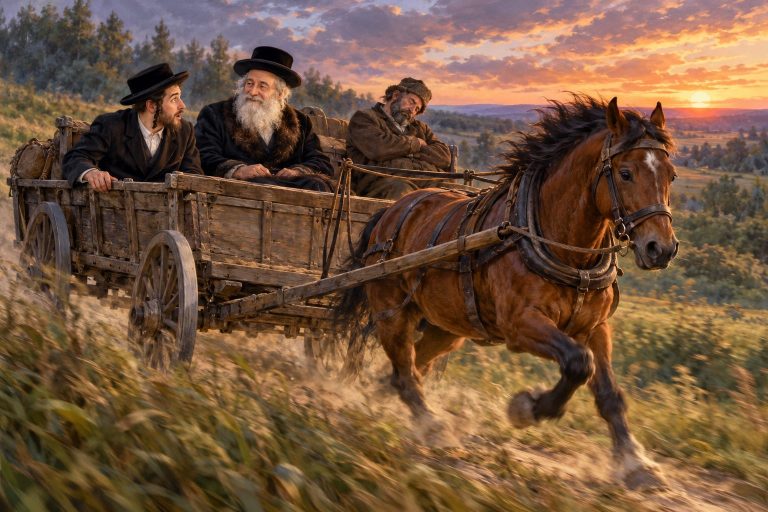
Before Yitzchok became a butcher, he worked as a wagon driver. When people needed to travel to another town, they’d hire him and sit in his wagon, pulled by a strong brown horse. He was reliable, respectful, and always on time.
One day, he was taking a few great talmidei chachamim down a narrow, winding road. The wagon wheels bumped along the dirt path as the Rabbonim inside spoke words of Torah, deep in discussion.
Suddenly, from the bushes – robbers! Terrible, violent ones. They carried knives, clubs, and had dark looks in their eyes. These were the kind of people who would hurt others just to steal a single coin. There were no police nearby, no other wagons on the road. Just forest and sky.
The robbers leapt onto the wagon.
But Yitzchok didn’t run!
He jumped down from his seat and fought them off. He kicked. He shouted. He grabbed a wooden block from beneath the wagon and swung it with all his strength. A few of the robbers… Well, let’s just say they weren’t getting up again. The rest ran off into the trees.
He had saved the lives of those talmidei chachamim. He had saved a wagon full of Yidden from certain danger. And in the eyes of this Heavenly Court, we say saving even one Jew is like saving the entire world.
The glowing soul pointed at Yitzchok. “This is the man who saved me. Because of him, I lived. Nothing else he did matters anymore.” The angels looked at each other. Slowly, the scale lifted. The accusations fell silent.
Yitzchok was free.
He stood tall, his neshama shining. The gates of Gan Eden were about to open before him.
But they didn’t. They stayed shut.
Why? What had he done now?
To be continued
Beis Moshiach #1470 • pp. 56-59
© 2026 Beis Moshiach Magazine. All rights reserved.
This article originally appeared in Beis Moshiach #1470. You are welcome to share it with friends and family by email or in print, provided that you do not change, add to or omit any part of it, you credit the author and Beis Moshiach, and you include a link to archive.bmoshiach.org (written out in full in printed copies).
To republish this article in a newspaper, magazine, book or website, please request permission in advance at [email protected].