Miracles on the Mined Bridge
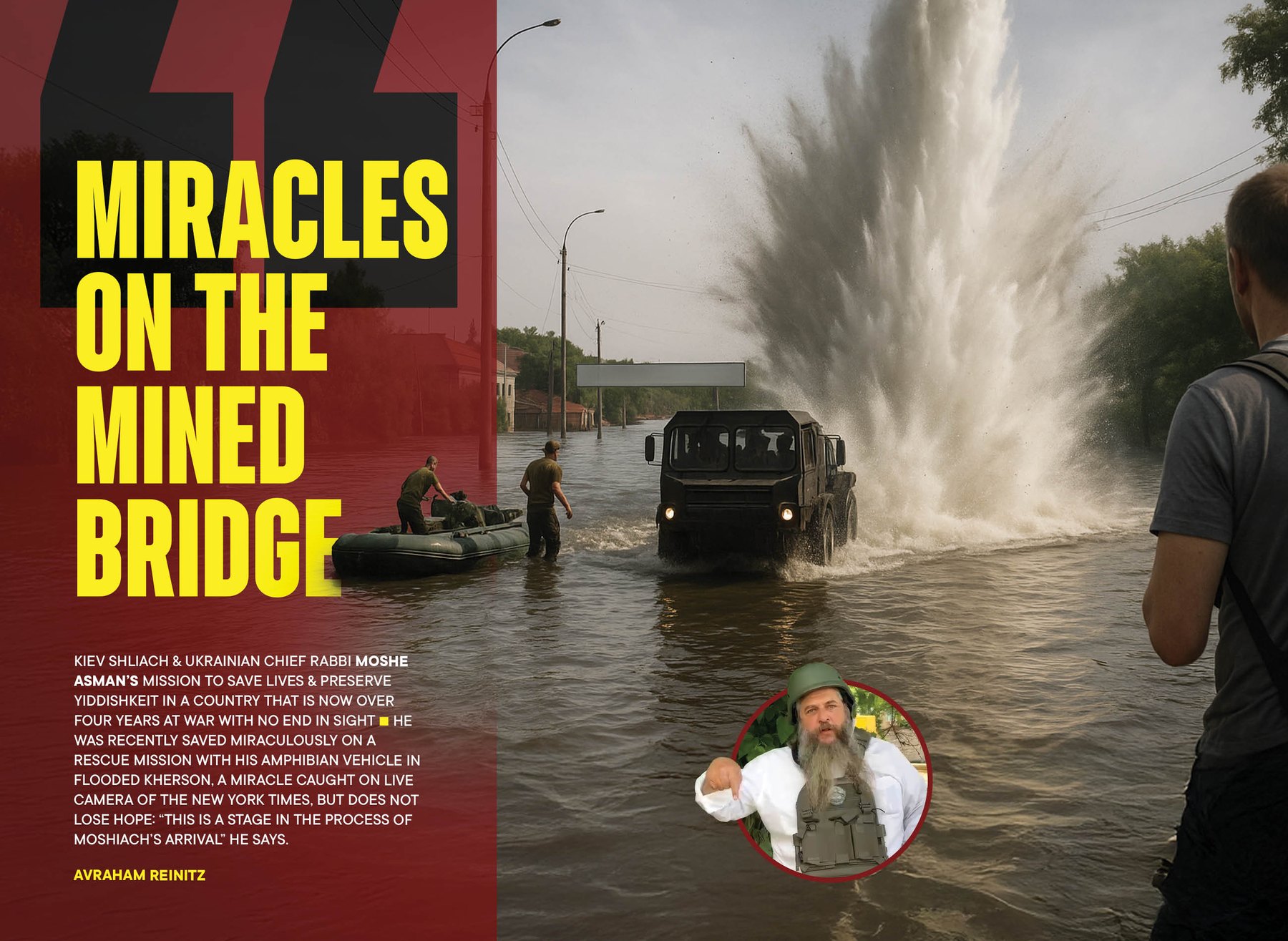
Kiev shliach & Ukrainian Chief Rabbi Moshe Asman’s mission to save lives & preserve Yiddishkeit in a country that is now over four years at war with no end in sight. He was recently saved miraculously on a rescue mission with his amphibian vehicle in flooded Kherson, a miracle caught on live camera of the New York Times, but does not lose hope: “This is a stage in the process of Moshiach’s arrival,” he says.
The raging waters of the Dnieper River flooded the streets of Kherson, turning the bombarded city into an artificial lake of danger and despair. The Russians, in a cruel strategic move, blew up the Nova Kakhovka dam, sealing the fate of thousands of civilians. But within the chaos, when all hope seemed lost, a special vehicle moved – an amphibious jeep capable of traveling on land and sailing in water. On board, the Rebbe’s shliach and Chief Rabbi of Ukraine, Rabbi Moshe Asman, was driven by one purpose: to save lives.
Beside him in the vehicle were two others: a driver and a local escort, a soldier who knew the flooded topography of the city and knew where to navigate through what were once bustling squares and streets. They sailed between half-submerged buildings, searching for survivors trapped in their homes. The sight was surreal, silent testimony to the cruelty of war. But the enemy was not content with just flooding the city. From the other side of the river, they watched and waited.
Suddenly, a sharp whistle cut through the air, followed by a tremendous explosion. A Russian shell landed and exploded in the water, just meters from the jeep. A massive column of water, as tall as a building, rose to the sky. “The Russians saw us from across the river and fired directly at us. Only because it was in the water – were we saved,” Rabbi Asman recalls the moments of terror. “If we had been on land, I wouldn’t be talking to you now…”
On the nearby shore, a group of New York Times photographers captured the dramatic moment with their lenses. The video documentation of the water column went viral and received millions of views worldwide, chilling testimony to the open miracle and great sanctification of Hashem’s name, as the whole world saw how Jews risk their lives to save other people.
They didn’t manage to rescue the people they had hoped to help. When they reached the safe shore, Rabbi Asman stood there to explain in English to the cameras what had happened, but then another whistle was heard. “Another bomb, and I fell. The phone broke,” he recounts. When the dust settled, they ran crouched to shelter until they found an empty van without seats. They jumped inside, lay on the cold metal floor, and the vehicle sped away to a higher and safer place.
This dramatic event in Kherson is a microcosm of the inconceivable reality in Ukraine, a war that has been ongoing for over two years with no end in sight. While in Eretz Yisrael, the war with Iran that everyone so feared began and ended within twelve days – the campaign in Ukraine is a long and bloody war of attrition.
“From the first day of the war, I have not left Ukraine,” Rabbi Asman declares. “We save people’s lives. Saving lives is something we didn’t need to deal with before.”
Shlichus Under Fire
How do you manage to hold minyanim, classes, and activities under such conditions?
“It’s not easy,” he admits. “Life in Kyiv and other cities in Ukraine has become a continuous nightmare. In Kyiv, there are bombings almost every night. The situation is only getting worse.” The war routine consists of different types of missiles and rockets, and civilians have become unwilling experts capable of identifying the type of missile… “This week there was a record number of 500 missiles, some ballistic or cruise missiles. Sometimes you hear them exploding in other parts of the city, sometimes you see them with your own eyes, passing over us or even exploding nearby.”
Air defense systems try to intercept the threats, but success is only partial. “Sometimes they manage to intercept them, but there’s no miraculous success like in Israel,” says Rabbi Asman, understanding that no place in the world can be compared to “the land which the eyes of the L-rd your G-d are always upon, from the beginning of the year to the end of the year.” A unique privilege for banim la’Makom …
“Against ballistic missiles, Ukraine has the American Patriot system, but against drones they use machine guns,” he explains. The sight of pickup trucks with soldiers operating machine guns has become part of the city’s landscape. “Every day we hear shootings. That’s our background music,” he says with bitter irony. Nights are constantly disrupted, leading to chronic fatigue and exhaustion among residents who cannot function in their work.
For most of the population, there are no standard shelters in homes. The only refuge is the subway stations. Understanding the critical need, the Jewish community under Rabbi Asman’s leadership took on the mission. “We built two large shelters according to all standards,” he says proudly.
One was built in the Great Synagogue, a 145-year-old historic building. “There are walls downstairs that are a meter thick. We decided to turn the basement floor into a shelter. It’s both underground and the walls and ceiling are very thick. It turns out, they used to build more solidly…”
Additional shelters were established in the refugee town of Anatevka and at the “Simcha” school, in accordance with the new Ukrainian law that prohibits opening an educational institution without a standard shelter.
What happens when an alarm sounds in the middle of davening or a shiur?
“When we daven in the shul, if it’s a major bombing, something dangerous, we go down to the basement floor. In school, every day, almost without exception, an alarm sounds. The children are used to the procedure: they go down to the shelter and continue their studies there.”
Rabbi Asman, who understands the weight of his responsibility as a public leader, makes sure to serve as a personal example. “At the beginning of the war, I said in the media that you must go to shelters every time. There are people who have already gotten used to it and don’t always go, but I go, also because of the example.”
This reality has created a generation of children who know the sounds of war up close. “Every small child already recognizes which missile is approaching, they know all the details. There are ballistic rockets fired from MIG aircraft, and it takes three minutes to arrive. You can’t prepare.” When such a missile is launched, which can reach anywhere in the country within minutes – an alarm sounds throughout all of Ukraine.
‘Kabbalistic Rockets’ Against Ballistic Missiles
How do your families cope? How do you explain to children what’s happening?
“Within the difficult reality, the children themselves grow spiritually,” says R’ Asman and he tells an example regarding his young son. “At the beginning of the war, my little boy said: ‘They’re shooting ballistic missiles at us, and we’ll shoot Kabbalistic rockets at them.’ When I asked him what he meant, the child detailed: ‘Torah, Mishnah, Gemara, Tanya, tzedaka and maasim tovim.’”
This innocent yet profound idea, expressed by a child, became a cornerstone in R’ Asman’s public speaking. “I took this idea and I talk about it on television and everywhere,” he says. The message resonates: facing the brutal force of the Russian enemy there is an immeasurably great spiritual power, and it is the true weapon of the Jewish people.
The concern for children and families is at the top of the list of priorities. “It’s difficult. We try, we also employ psychologists, we pour on the love, we organize all kinds of activities and clubs.” One way to relax the children is to take them out of the bombed cities to the town of Anatevka, which was established by Rabbi Asman back in 2014 to house Jewish refugees from the war in the Donbas region. “We do Shabbos retreats and camps there. We take the children from the city. It’s safer there, because the enemy deliberately shoots into population concentrations in cities. In a small town, it’s safer.”
The Yeshiva That Protects the Army
How does shlichus change in wartime conditions? What is required of you that wasn’t required in peacetime?
R’ Asman responds immediately without hesitation: “Saving lives. In the simplest sense of the term.”
Ukraine currently has extensive mandatory conscription up to age 60, and often civilians are drafted directly from the street. The battles are fierce and casualties heavy, and a large portion of the conscripted fall on the battlefield. Exact numbers are unknown, but we’re talking about hundreds of thousands of deaths on the Russian side, and tens of thousands of deaths on the Ukrainian side.
The price of war also struck R’ Asman in the most painful way. His adopted son, Matisyahu, was sent after brief training to the most dangerous front in the Donetsk region. “Exactly a year ago, on the 11th of Tammuz, there was a strong Russian attack,” R’ Asman recounts with a trembling voice, “Matisyahu was killed by a mortar shell hit.” For a month, his body remained in the combat area, and only with great effort was it finally brought for a full Jewish burial with a military ceremony in Kyiv.
Within this dangerous reality, R’ Asman managed to reach an unprecedented agreement with army commanders. R’ Asman’s assistant, Rabbi David Milman, who enlisted and was appointed by the Chief of Staff as Chief Rabbi of Ukraine’s army, was authorized to recruit civilians to the army’s spiritual unit.
Following the arrangement, dozens of community members participate in special spiritual activities for the soldiers and are officially considered as serving in the army. This status protects them and saves their lives. Jews who were previously distant from Torah and mitzvos now understand that spiritual activities for the soldiers is what saves their lives.
International Platform for Spreading the Light of Geula
The war has made Rabbi Asman an internationally recognized figure. He is well aware of the platform he received and sees it as a tool for spreading the Rebbe’s Besuras HaGeula. “I became famous, and people in Ukraine and also around the world look at the posts I upload. Sometimes tens of millions see them.” He decided to use this exposure to the fullest. “I understood that this is part of the shlichus, and I must bring the Rebbe’s message, dvar Hashem, to the whole world. I speak about the seven Noahide laws, and also about Eretz Yisrael.”
He sees this as a sacred mission and duty. “Sometimes millions watch a post, so that one word of Torah becomes a million words of Torah.”
He invests greatly in this, prepares his messages professionally, and brings about tremendous kiddush Hashem. He gives hope to many people who have lost their relatives and are in a difficult mental state.
Miracles on the Mined Bridge
What did you receive from the Rebbe that helps you cope?
“At the beginning of the war, when we were besieged in Anatevka under constant bombardment, I wrote to the Rebbe through the Igros Kodesh and asked ‘ad mosai?’ The answer I open to had to do with Pesach. I thought the war would end on Pesach, and I told people that something would happen on Pesach,” he recalls. Indeed, the miracle happened. “It turned out that the Russians fled the Kyiv area exactly on Pesach. In one day, on Pesach, they simply retreated, after being just kilometers away from our homes.”
Throughout the entire war, I receive encouragement and strength from the Rebbe, literally on a daily basis. Without the Rebbe’s koach, we wouldn’t have been able to get through these two years.
Were there situations where last-minute changes or a split-second decision, saved you or community members?
“Absolutely,” R’ Asman nods and recalls one of the chilling stories from the early days of the war, when the anarchy was at its peak. “In this war we see a chain of miracles and hashgacha pratis. I’ll tell you a story that happened with my son, Yossi, who escorted one of the first convoys that left the burning city.”
“The departure was dramatic, just like Yetzias Mitzrayim in miniature,” he recounts. “With ten minutes’ notice, a group of about 250 people organized to flee. They managed to pack one suitcase per family, one garment per child, tefillin, and a Megillas Esther. That’s it.”
The first and most dangerous challenge was getting out of the city itself. “At that point in time, the Ukrainian army had already blown up all the bridges around Kyiv, to prevent Russian forces from reaching the capital. Only one last bridge remained, which was also mined. The army attached a high-powered bomb underneath it, which could be activated by remote control the moment the Russians tried to cross. The feeling of tension and terror that gripped everyone as they climbed onto this bridge was inconceivable.”
Then, at the most tense moment, a tremendous miracle occurred.
“There were 22 vehicles in the convoy, and my son Yossi was in the last vehicle, closing the convoy. Throughout the entire journey, a private car was stuck behind them, trying again and again to push in and enter between the convoy vehicles. Yossi, feeling heavy responsibility, didn’t know who the car’s occupants were, and since they weren’t part of the group, he blocked them with his vehicle and prevented them from entering.
“Just as the convoy finished crossing the bridge, my son saw in the mirrors how a special police force stormed the car behind him with drawn weapons. The officers pulled the car’s occupants out, laid them on the ground, and removed a large quantity of weapons and combat equipment from the trunk. It turned out these were disguised Russian saboteurs who tried to use the Jewish convoy to pass through checkpoints and reach the bridge. Suddenly they were struck by the chilling realization of the terrible danger from which they were saved. A split-second decision prevented an attack that could have ended in a terrible disaster.”
But the chain of miracles didn’t end. “Further along the way they received an urgent message that they had to pass through a certain village by a specified time. Near that village was a strategic fuel depot, and Ukrainian intelligence knew that the Russians planned to bomb it at exactly that time.”
The convoy increased its speed. “They managed to pass through the village, literally half a minute before the bombing. They still managed to hear the tremendous ‘boom’ of the explosion behind them, but by chasdei shomayim, they were already out of the danger range.”
Are there moments when you considered leaving?
“I said from the first moment that I’m not leaving,” he declares. “I thank Hashem for putting me in the right place at the right time, to help masses of Jews, and also many non-Jews.”
Seeing Geula From Within the Churban
How do you connect between the current galus and the expectation of Geula?
“I see signs of Geula,” he answers decisively, “and I say this on television too. Look, it’s written that before Moshiach comes, nations will provoke each other.” He clearly identifies the global axis of evil. “From the north evil will open – that’s Russia,” he states, despite being born there. “At first people didn’t understand, but I explained, and today they understand more. Russia, Iran, China and North Korea, this is the axis of evil. Russia supports Iran, sold it weapons and nuclear technology.”
He even recounts that he warned Prime Minister Netanyahu in their meetings: “I told him that the Iranian drones are practicing on us in Ukraine, and then they’ll send them to Israel.” Indeed, Ukraine’s current enemies are Eretz Yisrael’s enemies.
The current struggle, according to his view, is a process of breaking this axis of evil. He sees today’s Russia as an attempt to revive the Soviet Union and Stalin’s spirit. Our conversation takes place close to the Chag HaGeula of the 12th-13th of Tammuz, and he notes this: “Every Chabad Chassid knows that during Stalin’s time, our Rebbe, the Rayatz, was arrested and tortured by the GPU. It’s the same thing. They want to renew this, and everyone there is silent.”
But from within the great darkness, he sees the light. He points to miraculous interventions, like the toughening of Donald Trump, whom he calls “a great miracle,” and sees in his efforts to bring peace to the world – part of the Rebbe’s actions in the world, which bring us one step closer to Geula.
From the inferno of Kyiv, he continues to spread the message of hope and faith, certain that the great breaking of the global axis of evil will ultimately lead to the great repair, to the fulfillment of the destiny of “the wolf shall dwell with the lamb,” and to the true and complete Geula with the revelation of the Rebbe Melech HaMoshiach, teikef u’miyad mamosh.
Beis Moshiach #1473 • pp. 14-21
© 2026 Beis Moshiach Magazine. All rights reserved.
This article originally appeared in Beis Moshiach #1473. You are welcome to share it with friends and family by email or in print, provided that you do not change, add to or omit any part of it, you credit the author and Beis Moshiach, and you include a link to archive.bmoshiach.org (written out in full in printed copies).
To republish this article in a newspaper, magazine, book or website, please request permission in advance at [email protected].