Why Shluchim Must Daven B’Avoda
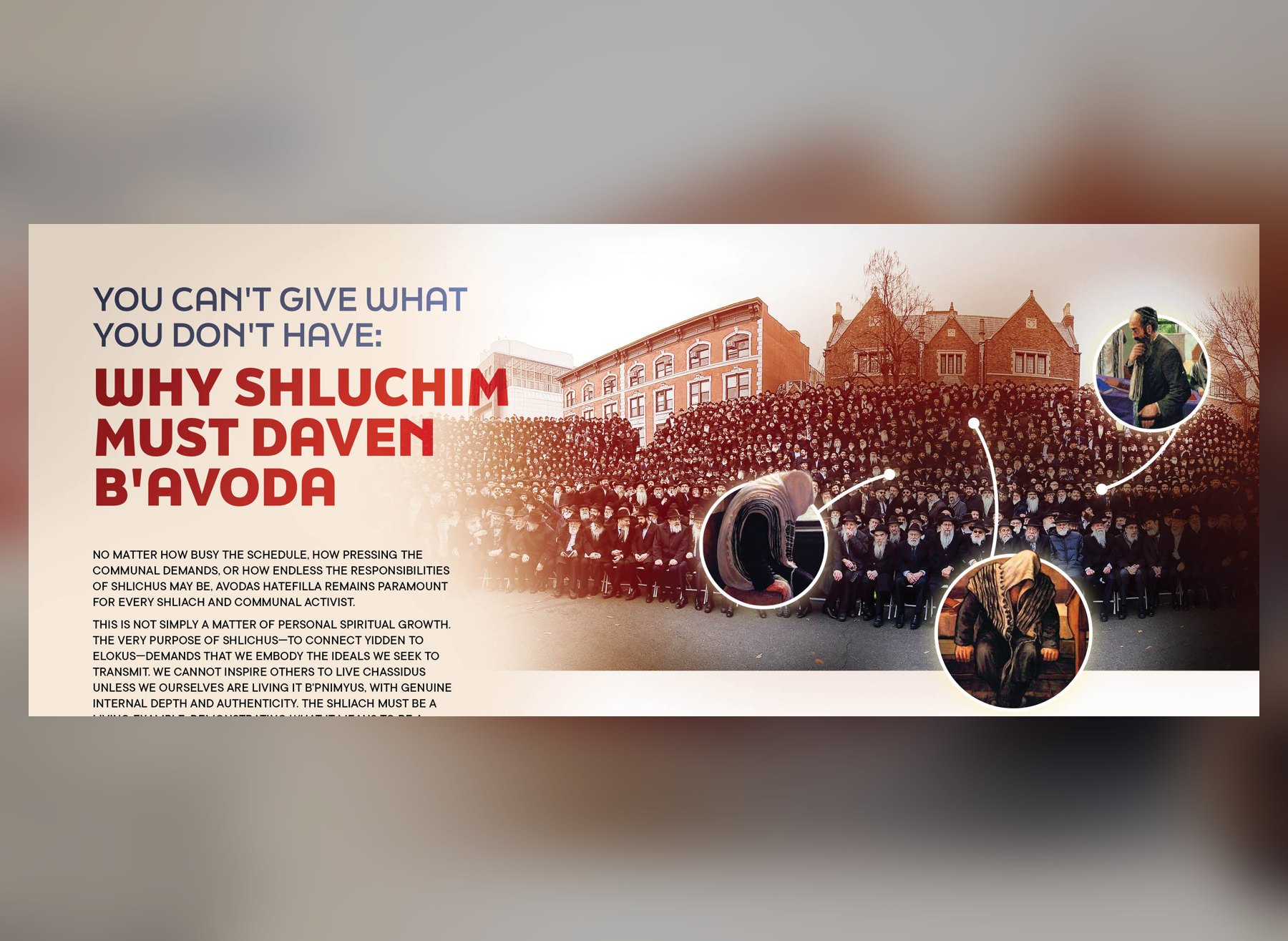
No matter how busy the schedule, how pressing the communal demands, or how endless the responsibilities of shlichus may be, avodas hatefilla remains paramount for every shliach and communal activist. This is not simply a matter of personal spiritual growth. The very purpose of shlichus – to connect Yidden to Elokus – demands that we embody the ideals we seek to transmit. We cannot inspire others to live Chassidus unless we ourselves are living it b’pnimiyus, with genuine internal depth and authenticity. The shliach must be a living example, demonstrating what it means to be a Chassid who lives Chassidus from within.
The International Kinus HaShluchim almost always falls out on Parshas Chayei Sarah. The parsha tells of the first ‘shlichus’ in history. Avrohom Avinu sends Eliezer his servant, and what did Eliezer do to succeed in his shlichus? He prayed to Hashem for success. About this, Chazal say: ‘The talk of the servants of the Avos is more beautiful than the Torah of the children.’ In this context, tefilla is elevated even above Torah study.
Hashem commands Moshe Rabeinu: ‘Remove your shoes from upon your feet.’ ‘Shal’ (remove) is an acronym for ‘she’nechaven l’emes – that we should align ourselves to the truth.’ But in order to succeed in directing ourselves to truth, we must remove all our ‘blockages’ and ‘habits’ in order to feel the kedusha.
The Torah teaches us that the foundation of shlichus is to daven that we align our inner selves to truth, to the ratzon of the meshaleiach, the Rebbe Melech HaMoshiach. Even if there is a shliach who has already become accustomed to his current situation where he invests less in tefilla, etc., the Torah teaches him to daven to align himself towards truth, and then Hashem helps and we align ourselves to His ratzon.
A story is told about one of the tzaddikim who, on one of his travels, saw a machine that was a novelty in those days. On one side they inserted a log of wood and from the other side came out a finished barrel. It was a wonder. After some time, the tzaddik visited the same place again, and to his great surprise, the unique machine had stopped working. When he asked what happened to the machine, they explained that a central screw that was in it had worn out and caused the machine to stop.
The tzaddik derived a lesson from this in avodas Hashem: There is a Jew who has everything; he studies Torah diligently, invests in mitzvos, etc., but there is a ‘central screw’ upon which everything stands – and that is ‘avodas ha’tefilla.’ As explained in Chassidus, tefilla is the ‘spinal column’ that upholds all the observance of Torah and mitzvos. Tefilla is the foundation of everything, and it is what gives chayus to everything.
Inner Faith: Through Tefilla
Sometimes a situation occurs where the shliach weakens in matters of emuna or of Moshiach and spreading Besuras HaGeula. He feels a bit of a decline in his avoda.
In order for emuna and bitachon to be instilled in the shliach in a way of pnimiyus, he must daven. To feel Elokus, one must daven at length as much as possible. During tefilla, a person leaves his reality, he contemplates the greatness of Hashem and then he is elevated. He stops the routine flow of life and does an honest self-accounting with himself. Tefilla is like the question of ‘Ayeka’ (Where are you?). Where am I in all that I have learned? Am I only learning and quoting, or am I internalizing the study of Chassidus into my life even in places where it’s difficult for me.
The requirement to daven at length and thereby internalize the study of Chassidus is demanded of each and everyone, and especially of the Rebbe’s shluchim. A shliach might think to himself: It’s truly important to daven at length, but that’s appropriate for yeshiva bachurim. Now I’m a shliach, I’m busy, I have many concerns; debts, projects, politics. I don’t have the head for this.
In general, unlike the period of study in yeshiva – on shlichus one also deals with matters of this world (tachtonim), and then it’s harder to connect to subtle and holy matters. But the truth is exactly the opposite. Davka a shliach needs to engage more in avodas ha’tefilla. The shliach, more than anyone else, needs to strengthen bitachon and emuna. He needs to strengthen within himself Chassidishe temimus and inner peace – and for this one must daven at length. Only then will there be a ‘dwelling for Hashem,’ and he will instill this in the ‘lower realms.’
The time of tefilla is to be elevated – on one hand; on the other hand, with the need to instill this throughout the day’s labor in the tachtonim.
Admittedly, it would seem that the shliach has a justified claim – after all, he doesn’t have time to daven.
First, there is time for everything, the question is how important it is to you. Everything depends on priorities. For a meeting with a wealthy donor you found time, but for a meeting with Hashem you didn’t find enough time?! Everyone needs to find time and he will see that everything will work out.
A shliach told of a huge public Seder night he organized. On erev Pesach he discovered he didn’t have a budget for even half the event. That shliach received guidance from the mashpia, Rabbi Mendel Futerfas, that whenever he has trouble, he should daven at length – and everything would be resolved.
And so the shliach did. He left all his concerns and poured himself out in prayer before Hashem. Immediately upon finishing his davening, someone came to him who wanted to personally participate in the Seder. He heard that money was lacking to finance the event, and he paid for everything!
One must “Cast upon Hashem your burden and He will sustain you.” The most pleasant feeling is to feel that we are in good hands even in difficult moments. This can be experienced through tefilla. If the Rebbe demands that everyone daven at length, then the Rebbe will arrange everything in the best way.
Mental Availability and Concentration in Tefilla
For this, one needs to begin with “turn from evil.” So that there will be mental availability to meet with Hashem, one must ensure there are no things that distract one’s concentration. The cell phone should not be in the area during tefilla; one can leave it in the car. During tefilla one must forget about everything. Now is the time of my meeting with the Creator of the world, and to be completely immersed there. “For the sake of the unification of the Holy One, blessed be He” – the intention is to unify one’s thought to Hashem.
There are cases where a shliach needs to lead the minyan and he’s busy, so he can get up earlier and begin with hisbonenus of Chassidus before the minyan, or daven b’arichus in Maariv, etc. If he can’t every day, then at least on Shabbos. And if on Shabbos it’s impossible, then one can dedicate one of the weekdays and make it a ‘Shabbos’ and thus daven at length.
There must be a fixed commitment in the soul (kvius b’nefesh) – to daven with avoda at least once a week. It’s easy to talk about it, and it truly requires work and investment. It’s not for nothing that it’s called avodas (the work of) ha’tefilla…
A story is told about a Chabad Chassid in the period after World War II who remained alone. He began to search for his fellow Chassidim. However, the known identifying signs of Chassidim had changed during the war. Beards were shaved, people had become thin, etc. Our acquaintance thought how he would be able to discern who were ‘anshei shlomeinu,’ and found a solution. He went to the shul and observed people. Whoever placed his hand on his forehead before prayer to meditate before davening – he was a Chassid.
Indeed, this is the identifying sign of a Chassid. Hisbonenus in the study of Chassidus before and during davening is one of the foundations of Chassidus. One must meditate even for a few moments, but it must happen.
To Be a Personal Example
There can be a shliach who gives many classes in Chassidus and inyanei Geula and Moshiach, but he learns only to convey the content to others. But in truth, the other person can sense whether these are words of truth or if it’s only superficial. Chassidus is true wisdom, but he wants to see how it changes him in a practical way and not just in theory.
Of course, even if one is not permeated by it, one must spread the ideas of Chassidus, but there’s no doubt it will work much more if it is truly permeated within us. When one davens at length at least once a week, one ‘lives’ inyanei Moshiach on a different level. Even the declaration of ‘Yechi Adoneinu’ takes on incomparably deeper meaning.
In the Dvar Malchus sicha of Parshas Chayei Sarah 5752, the Rebbe says that the work now is “to prepare oneself and the entire world to greet Moshiach.” After avodas ha’tefilla – preparing oneself becomes much more pnimi.
I once heard from the mashpia Rabbi Reuven Dunin a’h, that once he wanted to check out the davening of the famous mashpia, Rabbi Nissan Nemanov. He sat down next to R’ Nissan while he was davening at length, and R’ Reuven began to sing aloud the niggun ‘U’foratzta’ that the Rebbe taught. Rabbi Nissan continued davening as usual…
R’ Reuven decided to raise his voice and drum noisily on the table. R’ Nissan put his fingers in his ears and continued to daven with dveikus. R’ Reuven explained afterwards that this is a true Chassid. He is so completely immersed in tefilla that no one can truly disturb him.
* * *
We’ll end with an interesting vort. The word ‘Tanya’ consists of the letters ‘Ten Yud-Alef’ (give 11), and the word ‘Tanya’ in small gematria equals the number 11.
We know the importance of the number 11 in the seventh generation. The 11th of Shevat, the 11th of Nissan, etc. Also, the Rebbe demands from us to reveal the 11 within our soul, which alludes to the power of mesirus nefesh that is above our regular abilities.
The Rebbe therefore asks from every Chassid and shliach: Give 11. Give me all your strengths and more than what seems to you that you’re capable of; exert yourself and invest in avodas ha’tefilla. Devote yourself entirely to bring not only ‘personal Geula,’ but mainly the general Geula, with the hisgalus of our Nasi.
Beis Moshiach #1483 • pp. 20-23
© 2026 Beis Moshiach Magazine. All rights reserved.
This article originally appeared in Beis Moshiach #1483. You are welcome to share it with friends and family by email or in print, provided that you do not change, add to or omit any part of it, you credit the author and Beis Moshiach, and you include a link to archive.bmoshiach.org (written out in full in printed copies).
To republish this article in a newspaper, magazine, book or website, please request permission in advance at [email protected].