Finding My Two Treasures
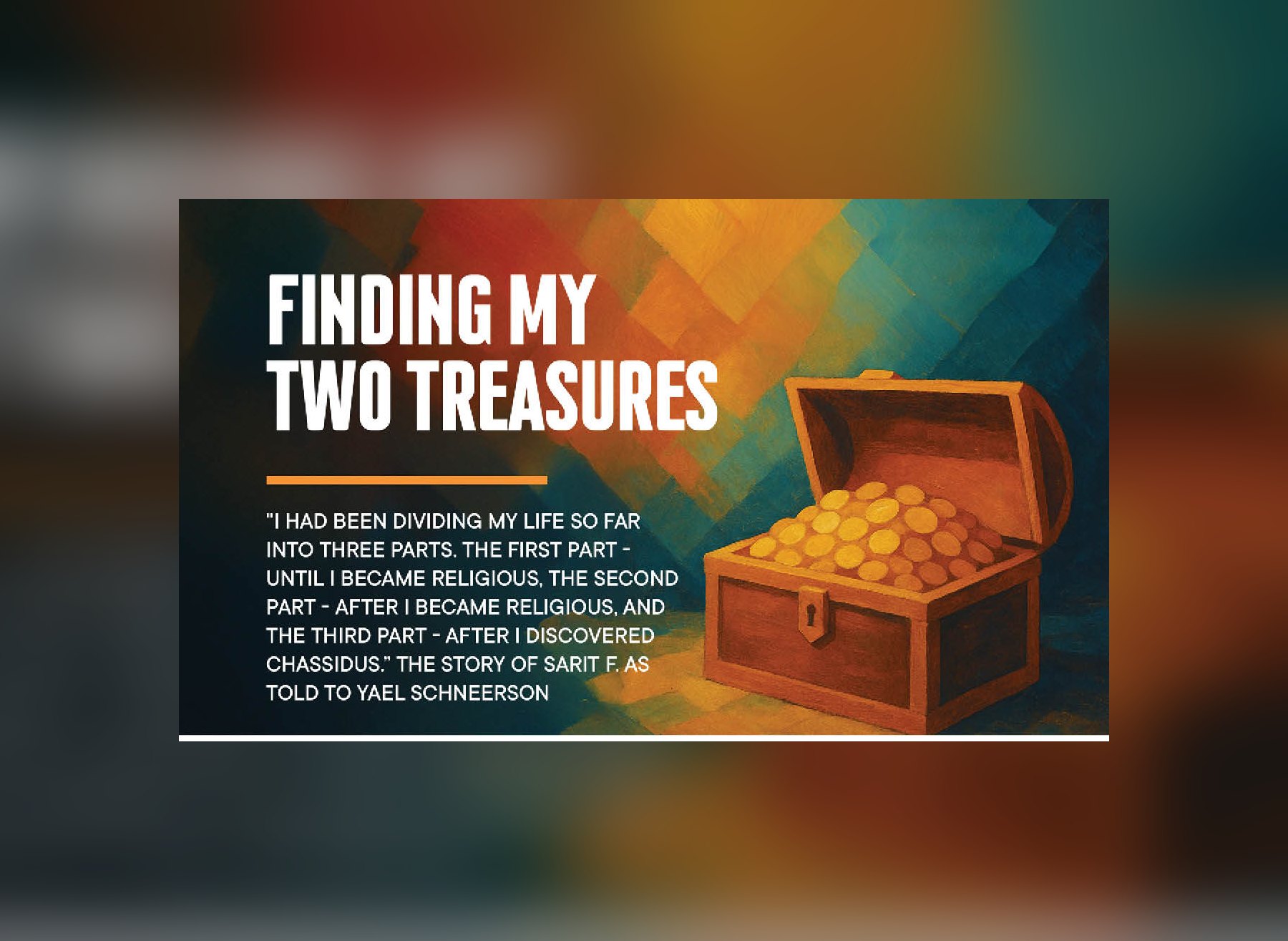
“I had been dividing my life so far into three parts. The first part – until I became religious, the second part – after I became religious, and the third part – after I discovered Chassidus.” The story of Sarit F. as told to Yael Schneerson.
I had been dividing my life so far into three parts. The first part – until I became religious, the second part – after I became religious, and the third part – after I discovered Chassidus.
But let us not put the cart before the horse.
I grew up in a warm and loving traditional family that tried to fulfill all my needs. Until age ten, I knew almost nothing about Judaism. True, we fasted on Yom Kippur, conducted a Pesach Seder, ate matza on Pesach, and kept very basic kashrus. But aside from that, Judaism meant nothing to me. A collection of old and charming rituals – if I wanted to continue observing them, fine, and if not – then not.
I began to be exposed to the rich and full world of Judaism after the army. I worked at a company where there were also some religious employees. The new concepts I learned through them led me to understand that Judaism was not a collection of charming rituals I had known in childhood, but something much more comprehensive and deep.
Step by step, I began to draw closer. I learned more and more, met rabbanim, and they devotedly showed me the way. I was already a mature young woman, established in my work, and slowly I continued to progress on my path, trying to participate in Jewish classes as much as I could and observe practical mitzvos.
After two years as a baalas teshuva, thanks to a family I used to visit for Shabbos meals, I met my husband – also a baal teshuva who had gone through a similar process to mine. However, unlike me, he had managed to study for some time in a yeshiva for baalei teshuva, and also continued afterward to study in the yeshiva’s kollel for married men.
Lights Dimming and Difficulties Surfacing
We married and began real life… Initially, the great ‘lights’ that every new baal teshuva is privileged to experience shone with all their intensity, but slowly they began to dim. To tell the truth, to this day I remember those lights with longing. The tefillos full of kavana I had, the enthusiasm for every mitzva, every bracha, everything holy.
Life swept me into it. Work, children, dishes, laundry, various tasks and others. My life of Torah and mitzvos entered into routine, but this routine was quite gray and punctuated with demands, tasks, and difficulties. ‘Regular’ life.
Years passed, the children grew, and with them the challenges. According to a well-known saying, we carry small children in our arms, and we carry the older ones in our head, and actually also in our heart.”
When Sarit discovered that her second son began to ‘drift away,’ as she puts it, she didn’t know how to deal it; neither did her husband.
We didn’t understand what he had to look for there, in the place we had left. We watched with dread as he was drawn in our few family gatherings to conversations with my brother, who had always been a sharp opponent of the entire process we had undergone. I couldn’t forbid him from talking to his uncle, of course, but I tried to minimize the meetings to a minimum. This no longer helped. They managed to find other channels of contact. Very quickly my son also found new friends who helped him pull himself out of our world.
This was (and still is) a very, very difficult period for me and my husband. The shock, the feeling of ‘where did we go wrong,’ the helplessness of ‘what do we do now.’ And if that wasn’t enough, my husband’s business, a business he had invested his whole self in, also went through a severe upheaval during that same period, and the financial situation, which had never concerned us, began to oppress us, greatly.
Drowning
I felt like I was drowning in the sea. Although since I became religious there had been challenges here and there, everything paled in comparison to the current difficulty. I felt that I couldn’t cope, couldn’t hold on, and more than that, questions arose within me toward Hashem: “Hashem, why me? Why is this happening specifically to me? What do You want? What are You waiting for me to do?”
Within all the pain and sorrow, the shock and confusion I was immersed in, I knew deep inside that Hashem was arranging all this for me, and there was a purpose to it. What was it? I couldn’t understand, and this lack of understanding was harder for me than anything. I was certain that if only I understood better why I was going through all this suffering, it would be much easier for me to bear it.
With all the sorrow and difficulty, Sarit tried to continue life as usual, at least outwardly. But one day, when she arrived at work with a storm of emotions raging inside her, she was surprised when a work colleague approached her.
Chani is a gentle and warm young Chabad woman, relatively new to our office. She usually isn’t very involved in everyone’s conversations, and it doesn’t suit her to ‘nudge’ someone, especially about personal matters. Despite all this, something in her heart, as she told me later with a half-apology, wouldn’t let her move on with the day, and she gently pressed me to tell her what was happening. I couldn’t hold out against her genuine desire to help. I broke down fairly quickly. I told her briefly about everything I was going through – my difficult feelings lately, my desire to understand what Hashem wants from me, and why He brought me to this place.
Chani listened silently and with empathy. Then she said that my questions were difficult, and she didn’t know if she could answer them for me. But certainly in Chassidus there are answers to all questions. “Have you ever studied Chassidus?” Chani asked me. I nodded, remembering that once, at the beginning of my journey, I had participated in some Tanya classes. It was actually interesting, but then I continued in other directions.
Chani promised me that it was much more than interesting. “Really life-changing,” in her words. To tell the truth, I was skeptical. But I promised to come with her to one class.
That class led to another one. And suddenly I felt like someone thirsty who had walked for a long time in the desert. He had already gotten used to not drinking, and didn’t even feel thirsty, and only when they bring him water does he realize how much it had been missing for him, and he swallows every drop eagerly.
The Rebbetzin who gave the class was patient and tried to answer all my questions at length. When she saw that I wasn’t satisfied, she recommended deeper study with a chavrusa on the topics that touched me most of all.
The study of Chassidus opened gates before me that I hadn’t known. I discovered a new world, and I didn’t understand how all this had been hidden from me all these years.
Why Do They Need Me?
True, my challenges in the meantime hadn’t changed. My son still hadn’t returned to us, and the financial situation continued to worry us. But I myself had changed. I discovered a new world, I discovered the true essence of life, I discovered that there is much, much more here beyond what my eyes see and what my heart and mind are capable of absorbing and understanding.
I discovered that my relationship with Hashem goes way beyond a relationship of ‘give and take,’ of ‘I’ll be okay, and You be okay with me.’ I discovered that I hadn’t even begun to understand what the meaning of the Creator is, of creation, of what we’re doing here in this world.
“Although even after years of studying Chassidus,” the Rebbetzin tells me, “we only understand how much we don’t understand, this understanding is liberating. It allows us to see the world from a new angle, different, more true.” Following this understanding, I stop placing myself at the center and expecting everything to work out around me the way I want. I place Hashem at the center, and surrender myself to fulfilling His will.
There’s a well-known story about a Chassid of the Alter Rebbe who lost his assets. When he came to the Rebbe, he detailed what he needed to return to his former status. The Alter Rebbe said to him: “You’re enumerating what you need, but before that you must ask yourself a different question: Why are you needed?”
Although I didn’t faint like that Chassid, I think this story completely encapsulates the inner transformation I underwent. Until then it was clear to me what I needed, and it was hard for me to accept the fact that Hashem wasn’t giving it to me. Now I began to look around me and search for why they need me, what my mission in the world is, and what Hashem expects from me in the specific challenges He places me in.
I Found Hashem Between the Straits
There is a well-known interpretation of the verse “All her pursuers overtook her bein ha’metzarim – between the straits” – all pursuers of Hashem – anyone who seeks Hashem, finds Him “between the straits,” in a time of ‘straits,’ which is an elevated time.
I too found Hashem specifically between the straits. Between the straits of my personal difficulties, in the place where I felt I was almost collapsing under the burden, almost getting lost within the difficulty. Hashem was waiting for me right there, and specifically from that place I merited reaching closeness to Hashem, in a new and much higher place in my service of Hashem.
Sometimes I meet with Chabad women and girls who have known Chassidus since age zero and aren’t sufficiently aware of the treasure they possess. I turn to each and every one of them: Don’t wait to reach a personal ‘bein ha’meitzarim,’ G-d forbid, in order to discover Hashem. You have merited a precious treasure; don’t leave it closed in the bookcase. Search for Hashem in your surroundings. He is waiting for each and every one of you.”
Beis Moshiach #1473 • pp. 48-49
© 2026 Beis Moshiach Magazine. All rights reserved.
This article originally appeared in Beis Moshiach #1473. You are welcome to share it with friends and family by email or in print, provided that you do not change, add to or omit any part of it, you credit the author and Beis Moshiach, and you include a link to archive.bmoshiach.org (written out in full in printed copies).
To republish this article in a newspaper, magazine, book or website, please request permission in advance at [email protected].