To Tell or Not to Tell?
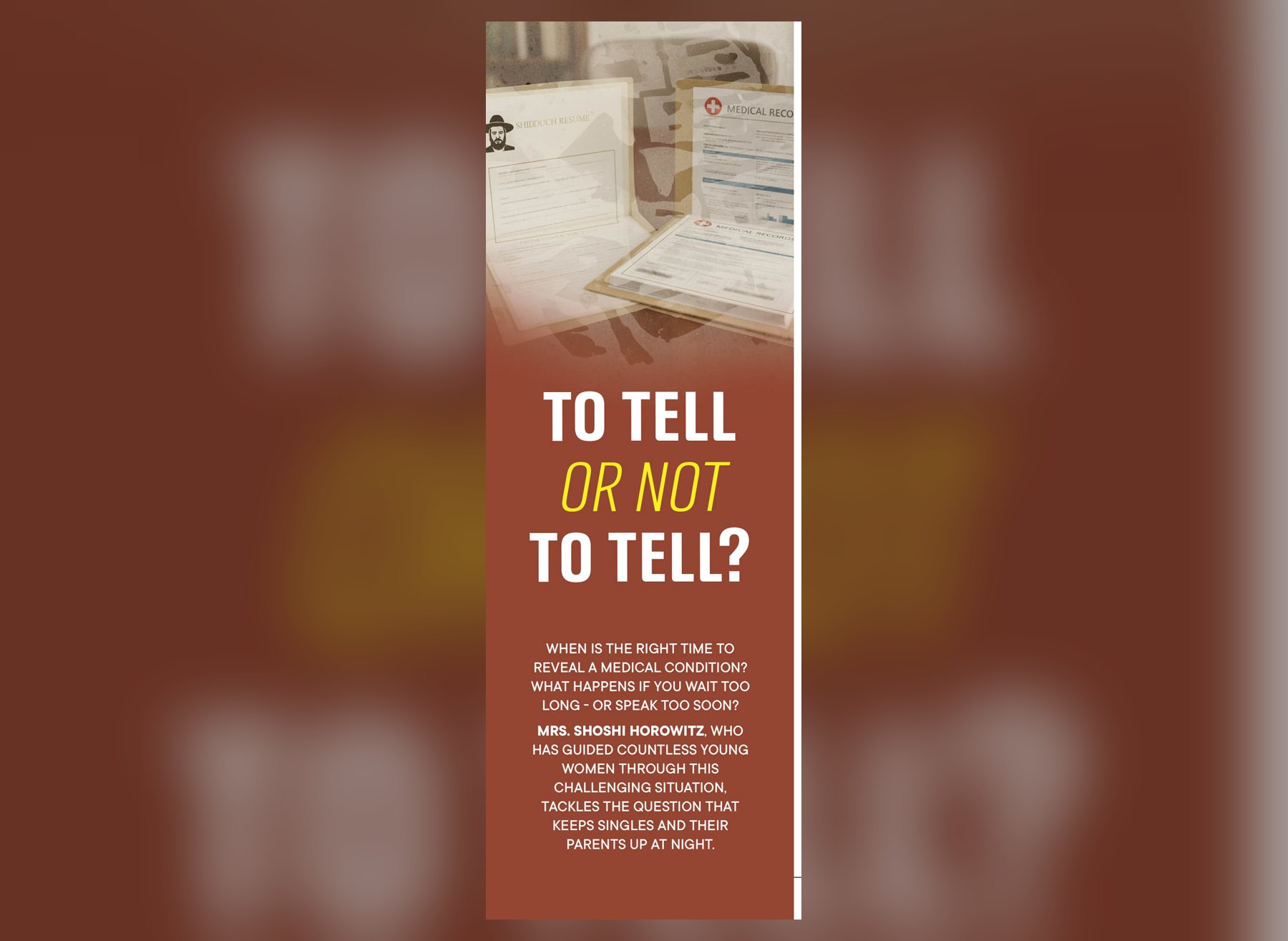
When is the right time to reveal a medical condition? What happens if you wait too long – or speak too soon? Mrs. Shoshi Horowitz, who has guided countless young women through this challenging situation, tackles the question that keeps singles and their parents up at night.
Question: I have a chronic illness that, boruch Hashem, doesn’t interfere with my functioning but does create certain limitations. I’m worried that my dating prospects will be adversely affected because of my illness. Currently, no one except my family members knows about it. When is it right to tell? Should I tell the shadchan in advance?
Answer: First of all, you’re not alone. There are quite a few young women and also young men with a medical history, and they ask themselves exactly the same questions. It’s natural to be apprehensive, and that’s completely understandable. But that doesn’t mean we should let fear control us.
Step One: Truly Understand the Medical Situation
Before any decision, it’s important to understand the medical picture well. Turn to the most expert doctor in the field – a top doctor or department head at a recognized hospital, not just a family doctor, and certainly not an alternative practitioner, however nice they may be. Request a comprehensive medical opinion on the possible effects of the illness on daily functioning, pregnancy, and married life.
Reliable knowledge is the foundation for any correct decision, both halachically and emotionally.
Step Two: Conduct a Responsible Halachic Investigation
With the medical opinion in hand, speak to a Rav who understands medical issues or to the Puah Institute and ask: Is there an obligation to tell? When is it right to do so?
There are cases where one must tell even before the first date, and in other cases one can wait until more advanced stages. Each case is examined on its own merits, and even the same medical issue can manifest differently in different people dealing with it.
Some time ago I spoke with a doctor who specializes in a disease considered particularly difficult, and she explained to me that doctors can assess the level of impact and possible deterioration according to the data.
Of course, we say every day “Borei refuos” and believe that Hashem is not limited. There are letters in which the Rebbe instructs people not to despair from a health situation because Hashem is not limited and medicine today is advancing. When Hashem decided to “set an end to darkness,” cures were found even for problems considered incurable. But even though a Jew believes, he goes in the way of nature. We believe in miracles, but act responsibly.
The Nisayon and the Kochos
There’s no doubt that a chronic illness is a nisayon, and dealing with it in shidduchim is an additional and not simple nisayon.
But it’s important to remember what the Rebbe wrote more than once to people who dealt with difficulties: “And if as you write you have come to despair and [feel] that you are not fit for family life, this is nothing but the temptations of the evil inclination, and therefore it’s understood that you must fight against them in accordance with the Creator’s will… and the matter depends only on his will, and if according to his opinion the matter is connected with difficulties, this doesn’t mean the matter is impossible, and according to the camel so is the burden.”
According to the camel, the load. If you were given a nisayon, you were also given the strength to deal with it. Maybe it’s not always comforting to hear this, but it’s the truth. Everyone has nisyonos, and everyone receives the exact kochos to deal with them.
I once heard from a formerly older single woman (who kept a personal diary in the period before the wedding and called it “Chana at the Station”) the following story:
“Once I returned from work with severe leg pain. I could barely walk, I shuffled slowly, and I saw a young woman running past me quickly. I was a bit envious of her. I arrived at the stop, and my bus came immediately and she remained behind, waiting. I realized that you can’t know who will arrive first and where.
“Each one sits at a different station on her journey,” she continued to write. “Before my wedding I studied a lot of Chovos Halevavos and the Rebbe’s sicha on bitachon in Hashem (a sicha on Parshas Shemos, Likutei Sichos volume 36). Several years later, when I was married and in an advanced pregnancy, I met a young woman who had married four years earlier and still hadn’t been blessed with children. She told me she was learning that same sicha, and I remembered how I learned it when I was still waiting. Then I realized: each one sits at a different station at a different time, each one and her journey.”
Going with Halacha, Receiving True Happiness
In the “HaYom Yom” for 27 Tishrei there’s a special saying, that one who lives according to the Torah is happy both materially and spiritually. Once I spoke with a young woman who has a rare medical issue that is also visible, and she said to me: “If I were in a less observant circle, maybe I would have already met someone and gotten married.” I thought a lot about what she said. True, maybe in a less observant society it would have been easier for her to get married, but in such a society there is usually less commitment, and therefore a greater chance that the marriage would fall apart at a moment of difficulty. You need to remember that this is just the confusion of the yetzer hara.
Even when the struggle is difficult, you need to believe that in the end you will establish a home. And if the Rav paskens that you are permitted to marry, the halacha determines reality. There is a bachur who is destined to be your partner, and part of the nisayon is to conduct yourself with emuna and wisdom, to consult with a Rav, and to remember that the Rav has special siyata d’shmaya to direct you to your divine plan.
And therefore, even if it’s tempting to gloss over problems or hide them, without permission from a Rav there is no bracha in it. I’ve encountered quite a few cases where the home fell apart due to dishonesty. More than the medical problem itself, what disturbed the other side was that they were deceived.
I’ve seen cases where a shidduch fell through because of a medical issue. It hurt a lot, but in the end it turned out that this was a message from heaven; it simply wasn’t the right shidduch. After the true shidduch came, they only thanked Hashem that the previous shidduch didn’t work out.
And Regarding the Shadchan…
This really is a complex question.
There are cases where sharing the problem with the shadchan is actually helpful: the suggestions are more tailored and serious, and everything is done with transparency, and there’s no tension between dates – what to say and how the other side will react, etc.
However, there are also cases where sharing with the shadchan at the beginning of the shidduchim journey causes unnecessary labeling, and she tries to “match problem to problem,” instead of matching personalities.
I knew a young woman with a significant medical issue whom they tried to match with a bachur who also has a medical issue. She didn’t feel a connection. When she consulted with a psychologist, she told her: “You don’t stick one problem to another problem.” In the end, they both married other people, with completely different difficulties, and despite the health problems established beautiful families.
Therefore, if it’s a significant medical matter, that according to halacha there’s an obligation to tell about before the date, or if it’s something external that is immediately visible – it’s preferable to tell the shadchan in advance, so that she’ll only make suggestions with a real chance of success. In other cases, when there’s no obligation to tell and it’s not immediately visible, one can conduct oneself normally without telling the shadchan. But one must take into account that a shidduch that progressed well may fall through when the other side learns of the problem, and this will cause great disappointment.
Therefore, one needs to know both options and decide what is right and suitable for you.
Opening the Heart, Broadening the Perspective
It’s worth knowing: when there are medical complexities, sometimes you need to open your mind and heart. There are people who look for a perfect shidduch according to a long list of conditions, but sometimes flexibility is precisely the key. You can consider suggestions from communities close to yours, check suggestions from families with a different style, baalei teshuva, other groups – as long as there is spiritual compatibility, similar values and mental health.
It’s sad to see parents or those in shidduchim who don’t read the picture correctly, and check and check about such marginal things, as if it’s a regular shidduch, and waste time and energy for nothing, when there’s a very significant obstacle related to health. In such cases one needs to take into account that it may require quite a bit of time until a shidduch works out.
Not long ago I encountered a particularly sad case – a bachur from a very respected family, who has a complex health issue. And his parents checked and checked about a certain suggestion, as if it’s a regular shidduch. They tried to check the yichus of the young woman from both sides – which of the parents studied in Chabad etc. … Obviously, the shidduch fell through even before the first date. Doing things this way is exhausting and wastes unnecessary energy. In every shidduch one needs to check objectively with a mashpia and Rav about what is essential and what is secondary.
And a word to parents and family: if the shidduch works out, don’t make faces. Indeed, you had to compromise, and perhaps give up things that in another shidduch you wouldn’t have given up on, so that your son or daughter could marry. However, you must remember and believe that this is the shidduch, and this is the divine plan. Even if the one joining your family is not so similar to the family, and comes from a less prestigious family and sometimes a bit of a problematic family, this isn’t a shidduch of free choice but of hashgacha pratis, and your role is to accept the plan and not remind the one who married into your family how problematic their background is and how much you compromised. Just accept them with joy and love into the family.
What’s truly important is the person’s personality, yiras shomayim, stability, values, seriousness, not the peripheral stuff. Don’t compromise on essential things, but allow for flexibility. A true shidduch doesn’t depend on information in a medical file, but on connection and appropriate communication.
I read a special story about Mrs. Esther Malka Levinson (in the book HaKoach HaNashi by Freidy Brod), who was disabled. When her husband had yechidus the Rebbe asked him: “What do you prefer, an apple that’s spoiled on the inside but shiny on the outside, or an apple that’s especially delicious on the inside but with a spot on the outside?” This is a very special story, about a healthy young man who married a young woman with physical limitations due to polio, but with a special personality. Boruch Hashem, they merited to establish a large and magnificent family.
Seeing the Good Between the Lines
Over the years I’ve come to see that Hashem doesn’t only give a nisayon, He also adds gifts to it. Whoever looks correctly sees the good between the lines.
I’ve seen young women with a medical issue who were required to tell in advance, and did successful shidduchim and I’ve also seen hashgacha pratis in shidduchim that fell through due to medical issues. There was a young woman with an external issue who agreed to compromise on a certain suggestion that was problematic in many respects. After five dates the bachur said it was hard for him to get used to the external appearance, and he wasn’t interested in continuing. Several months later she married an excellent bachur who suited her from the get-go.
Another young woman I knew, charming, fell ill with a serious disease at age 18, recovered, and after recovery taught second grade in a small school of shluchim. At a parents’ meeting, one of the mothers suggested a shidduch to her, a mekurav of theirs. Today they are shluchim there.
Another young woman I know is dealing with one of the difficult and rare diseases (that are tested by “Dor Yesharim”) and the Rav ruled that even before the first date the bachur needs to know about it. And she married in an especially original and interesting way.
Her husband comes from a broken family. His parents couldn’t manage raising the children, and some of them were removed from the home. While in shidduchim, he was a madrich in a yeshiva for young people. He was disappointed by the shidduch suggestions that came his way, and decided to help himself. He took bachurim from the yeshiva out for coffee conversations and as they spoke he asked how many children there are at home. When he heard there are daughters of marriageable age, he asked good friends of his to redt the shidduch.
In summary, Hashem doesn’t make mistakes. Every shidduch comes at the right time and in its own way.
Sometimes the path goes through a medical nisayon and the result is just right, because it’s part of your divine plan.
Beis Moshiach #1493 • pp. 44-47
© 2026 Beis Moshiach Magazine. All rights reserved.
This article originally appeared in Beis Moshiach #1493. You are welcome to share it with friends and family by email or in print, provided that you do not change, add to or omit any part of it, you credit the author and Beis Moshiach, and you include a link to archive.bmoshiach.org (written out in full in printed copies).
To republish this article in a newspaper, magazine, book or website, please request permission in advance at [email protected].