I Thought I Knew My Son…
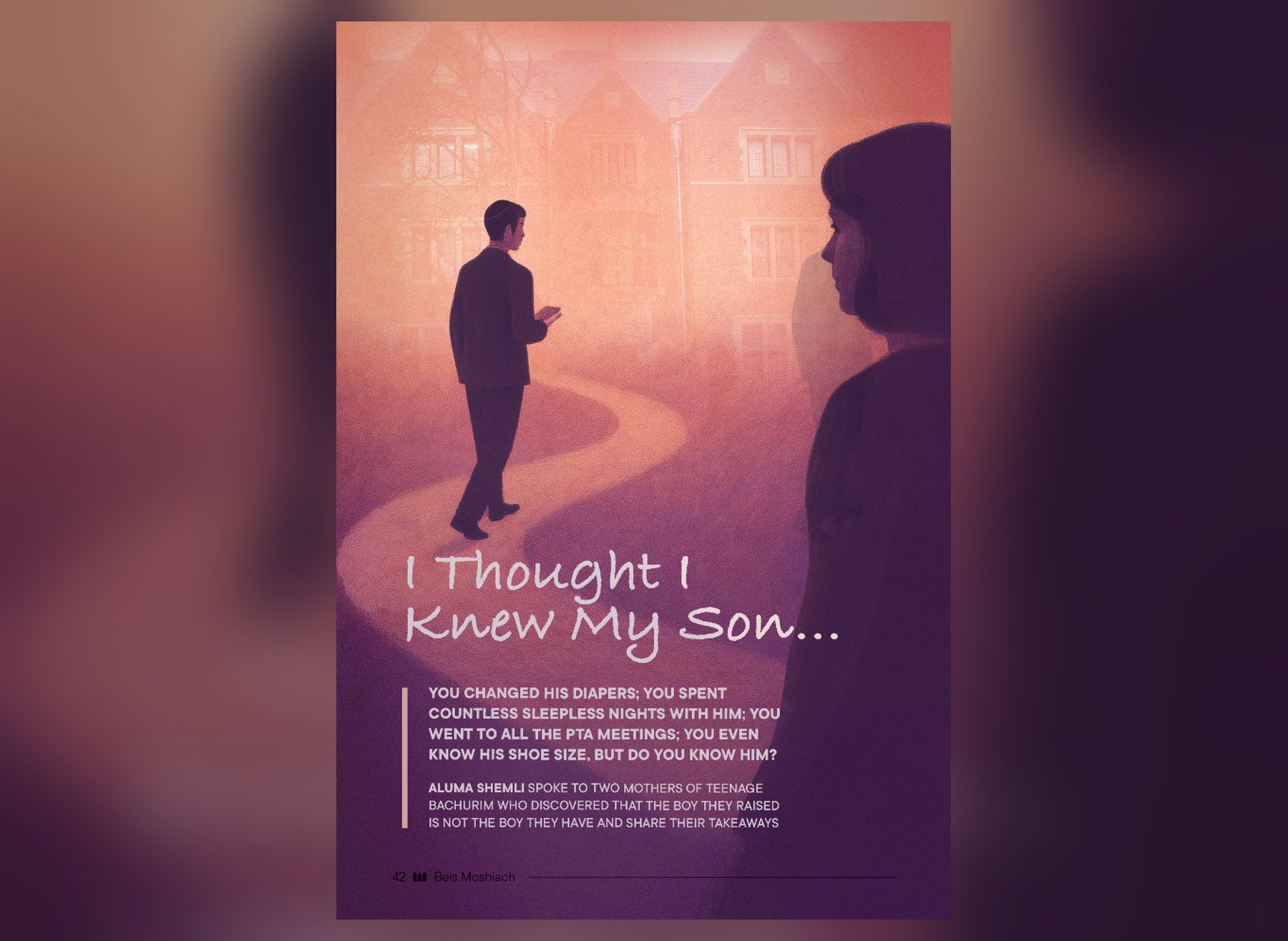
You changed his diapers; you spent countless sleepless nights with him; you went to all the PTA meetings; you even know his shoe size, but do you know him? Aluma Shemli spoke to two mothers of teenage bachurim who discovered that the boy they raised is not the boy they have and share their takeaways.
What Do We Really Know About Them?
We got up for him at night, helped him turn over for the first time, baked him a honey cake in honor of his hachnasa l’cheder, and hugged him fiercely. When we go to pack his suitcase bein ha’zemanim, we know exactly which undershirts he prefers and which seam in his sock bothers him, and before an off-Shabbos we prepare the salad he likes and that special cake.
We’re sure we know what’s going on with him. After all, we conceived and gave birth to him… we raised him, listened to him when he came back from kindergarten and from cheder.
But one bright day we discover to our horror that perhaps we know everything about him, but actually we know nothing… Most of his days and nights are spent outside the house, in the company of other bachurim, under the influence and guidance of rabbanim we might meet once a year and don’t really know. Even if our son is one of the rare ones who picks up the phone every day, five minutes of conversation only give us some idea of how he’s doing and what his mood is, and allows him to ask for what he needs (money, probably…); not much more than that.
Really, how much do you really know about what’s happening with your son in the yeshiva dormitory or on Kevutza? Soon he’ll get married. Do you really know how Chassidish he is? What music does he like to listen to by himself? And what’s his favorite pastime? How much does he really share with you beyond the official ‘protocol’ from his introverted bachur world?
Hila and Sarah-Leah are two mothers who were very surprised to discover how little they knew about their son in yeshiva gedola, and how little they knew him at all. They share their feelings, panic, insights, and what they took with them going forward.
Flowing on Still Waters
A bit about the relationship with your son before you discovered what you discovered…
Hila: Dovidi was my prince, really. For years he was an only son among many daughters, until he finally got a brother, a month before his bar mitzva. He was a very impressive child, the kind that grandmothers on the street see and spit against ayin hara… handsome, lichtig. In class too he always got excellent grades, excelled at everything. He gave us tremendous pride. I was very connected to him, waiting for him to return from yeshiva, enjoying listening to what he learned and what happened to him. He wasn’t much of a chatterbox, but I knew who his friends were, which teachers he got along with better and which less. Going to PTA meetings was a pleasure.
In mesivta he surpassed himself, learned and progressed. He had some gashmiyus difficulties because the food wasn’t tasty and wasn’t enough either. I don’t know if he was particularly spoiled (thanks to me, probably), or if the situation was really difficult, but in any case, I would send him supplements with great love. Food he likes, cut vegetables, cash for pizza in an emergency…
When he went to yeshiva gedola, I didn’t pay attention when he started complaining about the academic level, about the boring rosh mesivta, about the friends. Of course I believed him. After all, he’s so talented, and it could be that the level really wasn’t suitable for him. I tried to convince him to keep going, to talk with the staff. Maybe transfer him to a higher-level class. Between us I started thinking about better yeshivas. Because my son was perfect, right?
Sarah Leah: Shneur is a sandwich child. Born a bit early and quite small. I always felt I needed to protect him, and as is the way of Jewish women, I was always full of guilt regarding him – that I don’t dedicate enough time to him because of the little ones, the big ones, the house, work… that I don’t invest in him and don’t help him as I should.
In learning he was fine, above average, but not brilliant. He learned well and got reasonable grades. Socially he was quite quiet. He had a few good friends and that’s it. Never enjoyed trips or parties with many participants. He was shy and gentle.
The teachers always praised him. They said he’s a good child with good manners, keeps all the rules, learns nicely, doesn’t make problems. I always had a feeling that there was something being missed here, but I couldn’t put my finger on it.
Actually my husband, the only one I shared my feelings with, calmed me down: “Give him his time,” he would say. “He’s completely fine. He’ll grow and develop and find his place in the world. Stop protecting him as if he’s a poor little bird.” Sometimes he would say “Stop looking for problems…”
Toward the end of elementary school, we encouraged him to register for a small yeshiva that gives a lot of attention to each boy. He really enjoyed it very much. In his third year he decided he wanted to continue in one of the big and crowded yeshivas. I took a deep breath and let him be farhered wherever he wanted. I very much hoped he wouldn’t be broken when he drowned in the social sea and the staff would barely remember his name.
Looking Behind the Curtain

Tell us about the moment when you suddenly realized you didn’t know him at all.
Hila: It was during the period when I started thinking about other yeshivas for Dovidi. I didn’t really understand yeshivas, and the one he was in was excellent anyway. My husband wasn’t at all cooperative and claimed he was spoiled – he’s in a good yeshiva, and should stop complaining. One day I was organizing some shelf in his room, and found some notebooks he had put in a corner, under clothes. Since he was never organized, I was sure he himself didn’t notice they were there, and I didn’t suspect it was something personal.
I opened the notebook to check which sister it belonged to, to put it in its place, and then my heart sank. It was a kind of diary he wrote for himself, with all kinds of tasks and insights, including markings and details of how he progressed in each topic. It became clear to me that the subjects that interest my son are very different and far from what I thought. He was involved, according to what was written there, in series, sports, and other things that aren’t pleasant to mention in a respectable publication.
I pushed the notebook back to the same place and kept quiet, stunned. For several days I didn’t say anything, but when the mashpia called to say that our Dovidi wouldn’t continue next year in the yeshiva, because he’s not on the Chassidishe level and might spoil the friends, I was no longer surprised. I just couldn’t understand how he managed to operate and advance in all these areas without us knowing anything, absolutely nothing!
Sarah-Leah: Shneur went to yeshiva gedola and became quieter than he was before. Even when he came home he remained quiet, which usually didn’t happen previously. On an off-Shabbos I often found him sitting in front of the Gemara. On Fridays, on Shabbos afternoons, even on Sunday while he waited for me to finish ironing. My guilt reached the skies, I was sure it was hard for him, that he was trying to use every moment to review the material, to fill gaps. When he wasn’t with his Gemara, he would seclude himself in his room with the CD player. I had no idea what he was listening to, and didn’t see a reason to ask.
Deep in my heart I very much hoped I wasn’t burying my head in the sand like an ostrich.
And then came the wedding of a distant relative of ours, and we had to travel there together, my husband and I. We went in to say “mazal tov,” ate a bit, danced a bit, and went back home. On the way to the car someone approached us, full of enthusiasm. “You’re Shneur’s father, right?”
We nodded. It turned out he was one of the mashgichim in the yeshiva. He sang our Shneur’s praises. About learning Tanya, about the siyum mesechta he’s making, about the shul he speaks in every Shabbos, about the elderly person with whom he spends time… We thought he was confused, tried to check with him about which Shneur he was talking about. It turns out our closed and average child had taken upon himself to learn more and more mesechtos beyond the curriculum and was tested on them, he already knows almost thirteen chapters of Tanya by heart, he has a shul where he regularly reviews a sicha of the Rebbe on Shabbos morning and they love him there very much. There’s also one elderly person he learns Mishnayos with every evening, whom he listens to and patiently accompanies home.
We were truly stunned. We never imagined where our son had progressed, how much he was loading on himself, what he was striving to reach. We tried not to ask too much so as not to reveal the embarrassing situation that we knew nothing.
All the way home I cried. My husband was silent. We found no words. It was tears of joy about the great nachas that landed on us unexpectedly, about the amazing boy who grew up in our house, such a quality young man, striving, immersed in such lofty things.
There was also sorrow in my crying; I was hurt. About not knowing anything; that I didn’t even guess what my son was involved in. I wondered why he hid it from us. Was he afraid we would weaken him, discourage him, try to bring him down from all these amazing achievements?
My husband was concerned that this was exaggerated, unhealthy tzidkus. In his opinion, an eighteen-year-old boy should enjoy time spent with friends, sometimes go wild, struggle with the yetzer hara. Exaggerated tzidkus and such maximum time utilization don’t indicate a good mental state in his opinion. He felt pressured and was trying to please. Whom? We didn’t know.
Talk to Us!
A word about the yeshiva and the education system today.
Hila: I would have wanted them to talk to us first. Staff that decides to expel a boy from yeshiva discovered signs long before. They saw something, certainly tried to stop it, deliberated, held some staff meeting, decided. Why didn’t they involve us at some stage in the middle? If I hadn’t found the notebook a few days earlier, the sky would have fallen on me like it fell on my husband…
The thought that certainly the parents know exactly what kind of ‘gem’ they have at home isn’t correct and isn’t accurate. And with all that he’s eighteen, parents still have influence on their child. At least we would have davened, written to the Rebbe, tried to talk with him, something!
Sarah-Leah: I’m certainly not complaining. I believe that much of the good that befell us is thanks to the yeshiva, the atmosphere there and the amazing staff. Still, I would have been happy if they shared with us what’s happening with our child. First of all, parents love so much, worry so much, why not make them happy with a short phone call, with a joyful message about their dear son, with something that will give them strength for days to come?
Furthermore, if my husband’s concern is really justified and we’re dealing with unhealthy people-pleasing, this too is something we need to know about and treat. Contact with parents is really important, for the yeshiva and also for the son.
How do you go on after such a discovery?
Hila: How do you go on?… Today our Dovidi no longer observes anything. I believe his heart is still connected to the Rebbe and Hashem. He went off the derech completely, and does whatever comes to his mind, really. We, like all parents in our situation, move between frustration and disappointment to rachamim and tefillos. Lots of tears, lots of therapists, lots of despair and lots of hope.
Sarah-Leah: At first, this information was our secret. We enjoyed every moment of happiness, didn’t share with anyone, still didn’t allow ourselves to worry about anything, just rejoiced. Later we went together to visit him in yeshiva, took him out for a falafel, excitedly told him about everything we heard about him, how much it made us happy. He was very embarrassed, but it seemed good to him that we know and are happy. He told us he was so afraid he wouldn’t succeed in keeping his hachlatos and then they would laugh at him, that he preferred not to tell anyone, only his mashpia. He listens to Tanya with Elior Volner’s tunes every free moment, to absorb another chapter and another one, and learns additional mesechtos he took upon himself. It seemed he was doing well and was full of inner satisfaction from his sticking to the goals he set for himself.
We contacted his mashpia, tried to clarify if this wasn’t too much, if there wasn’t unhealthy people-pleasing here. The mashpia calmed us down, promised that our bachur knows what he’s doing, is at peace with himself and very calm. Just to be sure, we sent him for several conversations with an educational counselor, and he too calmed us down, boruch Hashem.
How is the relationship between you now?
Hila: Better, to some extent. More real. We had to learn how to build the relationship anew. If our relationship before was the prince and a team of pampering admirers, today we speak openly, get angry, sometimes laugh, love and also fight. He no longer tries to hide anything from us (though sometimes there are things I would prefer not to hear) and naturally the connection is real and yes, without the deceptions that were there before, when we didn’t even suspect anything.
Sarah-Leah: Truth is, a bit stressful. I’m on a high when I think about this amazing boy, amazed at how he grew up so good, so values-oriented. I feel like one of the mothers of tzaddikim from long ago, who understood she was raising a special child. At the same time, I know it would be uncomfortable for him to know these feelings, so I suppress this thought when he arrives and behave toward him like toward a completely regular bachur. I ask him to throw out garbage, get annoyed when he doesn’t put a plate in the sink, joke with him about the silliness of a little brother. I know this is what’s best for him.
In closing.
Hila: Always pray. Every child needs tefillos, even those who seemingly only give us nachas.
Sarah-Leah: Always believe in your child, he’s capable of much more than you imagine for yourselves.
A Word From a Tamim
What does my mother know about me?… The truth is, nothing.
That is, she knows my basic characteristics, what things I like to eat, what makes me feel good and what doesn’t, how it’s most comfortable for me to sleep, and what kind of child I was in ‘cheder.’ She can tell you about my development and about all my childhood illnesses, what vaccinations I received and what I’m sensitive to, but about my life today she doesn’t know much, almost nothing. She just thinks she knows…
She has no idea who my friends are and what style of friendship we have, how I learn and with whom, what I listen to at night and where I go when I need to get some air. What kind of relationship exists between me and my rebbis in yeshiva, and even what I decided to stop eating and don’t touch in the dining room.
It’s not that we don’t talk, we sometimes talk every day. When I want to share with her things that happened to me or various experiences, I tell her and know she always listens, happy to know every new detail about me. But there are topics I still don’t want to share, for various reasons, and they remain hidden with me.
Sometimes I do something or read something or enjoy some song and a thought passes through me: “I wonder what my mother would say if she knew…” This isn’t about guilty feelings, because I don’t do bad things and am not afraid of the moment she might ch’v hear about it, not even afraid to sadden her. I simply keep new, personal areas of interest to myself. The question is more a question of curiosity. One day, when she discovers that her son is interested in… knows a lot about… how will she react?
I have a feeling she wants to know everything about me, and is also quite sure she knows almost everything about me, except maybe what mesechta we’re learning and who my chavrusa is for iyun. She doesn’t even pretend to know that. Maybe she’ll have a bit of shock. It’s a bit disappointing to discover how much she doesn’t really know me as I am today.
It’s okay, I’m sure that my father and mother too, when they met, already had independent opinions and didn’t necessarily go exactly on the path their parents laid out for them, and apparently were also somewhat different from what they were in their childhood. There’s even something positive in this. When I’m completely transparent in front of my mother, like I was at age seven, then my relationship with Hashem and with the Rebbe also depends on what finds favor in my mother’s eyes and what she told me yesterday before I went to bed. Today I build my relationship with the Rebbe and take responsibility for my thoughts, words and actions without going through parental supervision. This is a more real place, more serious, worth a million times more.
And by the way, it’s nice asking me now, a boy in yeshiva gedola, but already from the upper grades of elementary school she didn’t know everything about me, certainly not what I did in camp, and this only intensified in mesivta. Not something that started now, when I come home once a month.
Warm regards to my mother. There’s a good chance she’s reading this article…
Beis Moshiach #1474 • pp. 42-47
© 2026 Beis Moshiach Magazine. All rights reserved.
This article originally appeared in Beis Moshiach #1474. You are welcome to share it with friends and family by email or in print, provided that you do not change, add to or omit any part of it, you credit the author and Beis Moshiach, and you include a link to archive.bmoshiach.org (written out in full in printed copies).
To republish this article in a newspaper, magazine, book or website, please request permission in advance at [email protected].