I Walked Rebbetzin Chana to Shul on Rosh Hashanah…
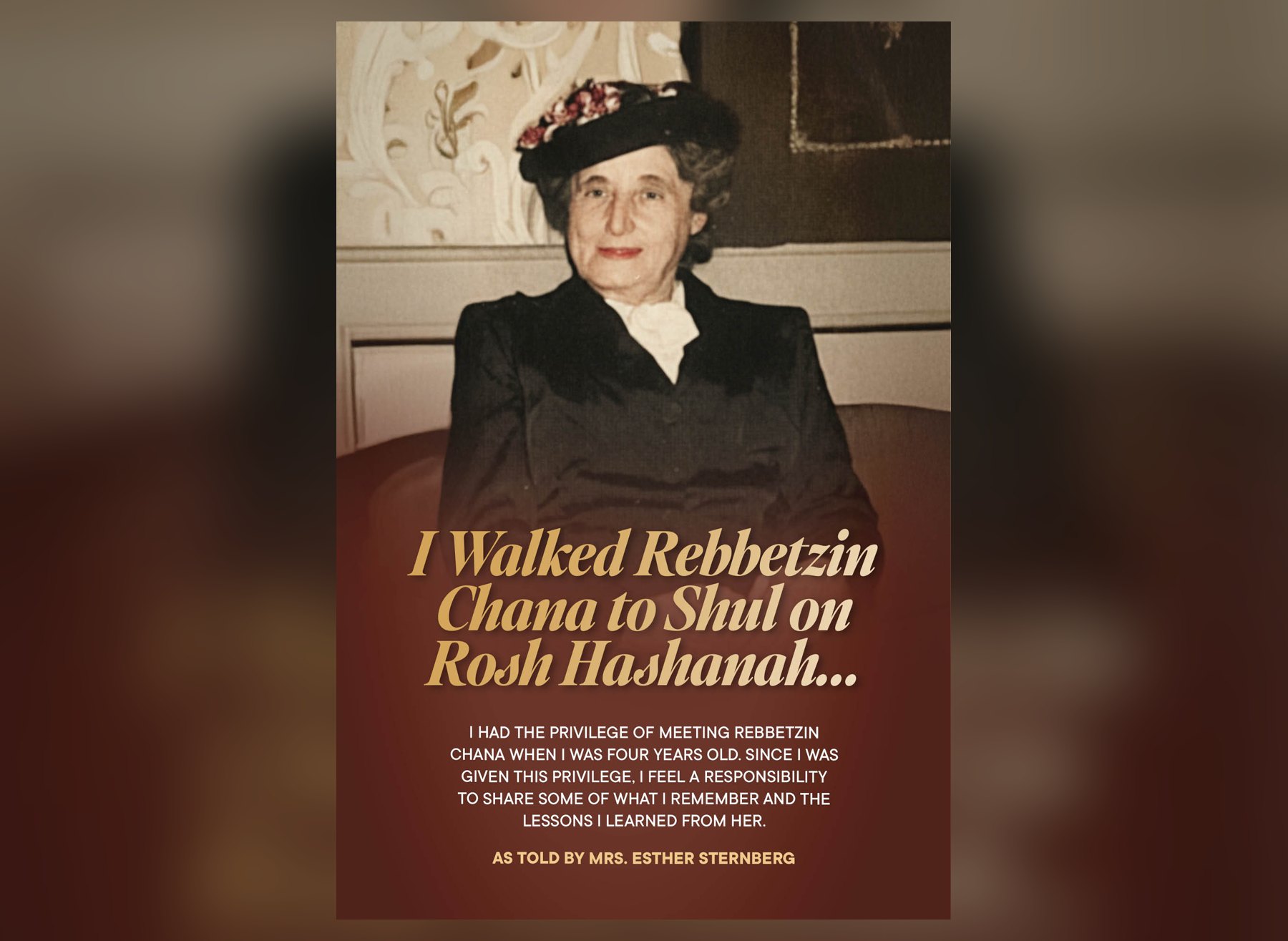
I had the privilege of meeting Rebbetzin Chana when I was four years old. Since I was given this privilege, I feel a responsibility to share some of what I remember and the lessons I learned from her. As told by Mrs. Esther Sternberg.
The Rebbe’s Shofar Blowing
I was four years old when Rebbetzin Chana arrived in America. My mother, Rebbetzin Chava Gurary, was a very warm and friendly woman, and she was concerned that Rebbetzin Chana might feel lonely in America. She began visiting the Rebbetzin every Shabbos and took me with her. At that age I wasn’t aware of who the Rebbetzin was, but I was there every Shabbos and that’s how we became close.
On Rosh Hashana we would daven at 770. The women’s section was very small, and it was very difficult to hear the shofar blowing from inside. The only way we could hear was to stand on a small balcony outside 770.
One year we stood on the balcony as usual, but it was still very difficult to hear the shofar blowing. The Rebbe was the baal tokei’a. We knew that if the Rebbe had difficulty blowing the shofar, it wasn’t for physical reasons, but for spiritual reasons. My mother stood right next to Rebbetzin Chana and saw that the Rebbetzin had great anguish over the fact that the Rebbe was having difficulty with the shofar blowing.
My mother’s heart went out to the Rebbetzin, so to ease her distress, she said afterwards: “The shofar blowing sounded wonderful!”
The Rebbetzin asked: “Did you hear anything?”
My mother answered: “Yes, I heard, and it was wonderful.” She wanted the Rebbetzin to be calm and at peace.
Walking With a Queen
One year, before Rosh Hashana, I met the woman who used to bring the Rebbetzin to shul. She called me and said: “Esther, this year I really want to daven like a mentch. Could you go at 11 in the morning to bring the Rebbetzin?” This wasn’t a burden, but a great honor, and of course I agreed immediately.
At 11 in the morning I knocked on the door, and the Rebbetzin peeked through the peephole and invited me in. She still wasn’t dressed for shul; she didn’t prepare to go out until she was sure someone could bring her.
She asked me to wait for her in the dining room while she got ready. I sat by the table and saw a telegram lying before me. I wouldn’t peek, but the telegram was lying openly. It was sent from Liverpool, England: “Shana tova u’mesuka from Leibel, Regina and Dalia.” This was Rebbetzin Chana’s youngest son, Rabbi Yisroel Aryeh Leib who lived in Liverpool, his wife and daughter.
Rabbi Yisroel Aryeh Leib passed away in 5712 (1952). However, since the Rebbetzin had suffered many losses and tragedies in her life, the Rebbe didn’t want her to know about her son’s passing. And so, throughout the year he would arrange for telegrams and letters to be sent from Liverpool, so that the Rebbetzin would think her son was still alive… The Rebbe continued this for many years until his mother’s passing.
For many years, every Rosh Hashana, I brought the Rebbetzin to shul, and each time I saw a new telegram lying on her table.
When the Rebbetzin was ready, she called me to her room. She would put her hat over her sheitel, and asked me to attach the pin to the sheitel so it wouldn’t fall. To tell the truth, I was very afraid to insert the pin, because I wasn’t sure how deep it needed to go. The Rebbetzin told me not to worry, and since she needed help, I placed the pin in the sheitel with trembling hands.
And so I walked, slowly, arm in arm with the Rebbetzin, the short distance from her building on President Street to 770. The feeling was indescribable. I knew I was accompanying a queen…
When we arrived at 770, all the women in the women’s section stood to greet her, and she sat in her place.
Mystical Blessings
One Shabbos I saw the Rebbetzin walking around Kingston Avenue as if she was looking for something. I stopped her and asked, “Rebbetzin, do you need something?”
The Rebbetzin answered gently, “Yes, there’s something I need very much.” She explained that this Shabbos there was an aufruf, and she was related to both sides of the family. The chassan was Berel Raskin, today the owner of Raskin’s fish store. His mother was Mrs. Duba Raskin from Raskin’s fruit store. The kalla was Esther Lipsker whose father was at that time the owner of the grocery store on the corner of Union and Kingston.
The aufruf kiddush was taking place but it was only for men, so the Rebbetzin had no way to wish mazal tov to the parents from both sides.
The Rebbetzin asked me: “Just take me near their stores, and I’ll bentch them.”
Of course no one was in the stores at that time, because it was Shabbos. But I went with the Rebbetzin near the closed fruit store and grocery store, and she stood there and davened fervently for several moments, giving the chassan and kalla her most heartfelt wishes…
There was something spiritual and wonderful about this entire event. No one except her and me knew about these brachos.
Years later, when I started teaching at Bais Rivkah, I wanted to give my students a glimpse into Rebbetzin Chana’s character and told this story. That’s how the Raskin and Lipsker families learned about the great gift they received on the Shabbos before their wedding…
“I Want to Go to the Wedding”
In the 1950s and 1960s, Crown Heights was a very diverse Jewish community with many Chassidic courts and non-Chassidim too. Most of its residents were not Lubavitcher Chassidim.
There was a young girl from the Lower East Side of Manhattan who davened at the shul of my grandfather, the Kopyczynitzer Rebbe. She was about to get married and rented an apartment in the building where Rebbetzin Chana lived.
The Rebbetzin was friendly toward her and interacted with the young woman with great warmth. They would chat when they met entering or leaving the building. The young woman was very excited by the attention the Rebbetzin gave her, and gave the Rebbetzin an invitation to her wedding in Manhattan. The Rebbetzin promised to attend, and the girl was so proud and pleased. She told my mother that the Rebbetzin would come to her wedding.
When my mother heard about this, she was troubled. She knew that the kalla and her mother meant well by inviting the Rebbetzin, but she suspected they weren’t aware of the effort she would invest in this trip. The wedding was in the middle of winter, in Manhattan. In those days there were no taxi services and you had to stand in the middle of the street and stop a yellow taxi. And anyway, how would the Rebbetzin get home after the wedding?
My mother therefore decided to call the kalla’s mother and explain the situation to her. She called her at home and discovered she was at her daughter’s apartment arranging things.
My mother called the daughter’s apartment, asked for the kalla’s mother and explained the situation to her. Surely she didn’t understand how difficult it would be for the Rebbetzin to get to her daughter’s wedding. The kalla’s mother said with complete understanding, “You’re so right. We gave the Rebbetzin an invitation because we thought it was a nice gesture. What can I do now?”
My mother urged the kalla’s mother to call the Rebbetzin, thank her for her good wishes, and tell her she doesn’t expect her to travel all the way to Manhattan for the wedding. Instead, maybe the chassan and kalla could come before the wedding to receive her bracha.
The kalla’s mother thanked my mother for letting her know what was right to do. My mother hung up, and two seconds later, her phone rang. Rebbetzin Chana was on the line.
“Why does it bother you that I want to participate in the mitzva of rejoicing with the chassan and kalla?”
“Why do you think it bothers me?” my mother stammered. She didn’t understand how the Rebbetzin knew about the conversation so quickly…
The Rebbetzin explained that when she picked up the phone to make a call, the lines crossed (not an uncommon occurrence in those years) and she had heard my mother talking with the kalla’s mother and telling her how difficult it would be for the Rebbetzin to come.
“I really want to go to this wedding; it’s a very great mitzva. Why did you interfere?”
My mother apologized to the Rebbetzin and promised her that she would arrange it all.
She called the kalla’s mother again and told her that the Rebbetzin really wanted to come. She asked her to arrange transportation for the Rebbetzin to Manhattan and back. The kalla’s mother did this happily, and the Rebbetzin attended the wedding.
This girl wasn’t a Lubavitcher Chassid, and the Rebbetzin didn’t know her very well. She was just someone who happened to rent an apartment in the same building – but this was our Rebbetzin; she didn’t miss an opportunity to bring joy to another person.
A Childhood Friend Suddenly Revealed
When I became a kalla, of course my chassan and I went to the Rebbetzin to inform her about our shidduch. My husband doesn’t come from a Chabad family and didn’t have many relatives in New York. The Rebbetzin asked about my chassan’s family, but I told her, “You won’t know them; he’s not from a Chabad family.”
The Rebbetzin calmed my chassan, and he soon opened up and began talking about his family. The moment he said his grandmother’s name, Rebbetzin Rachel Reizel Friedman from Odessa, the Rebbetzin became very excited. It turned out that his grandmother and the Rebbetzin were close friends in Russia.
“Did she survive the war?” the Rebbetzin asked. Indeed, she survived, and was about to leave Russia that very month.
The Rebbetzin was happy to hear that her friend was alive and that her grandson was in New York. From then on she felt responsible for him, that he shouldn’t feel lonely.
My brother got married around the same time, and he and my husband studied together in kollel. The Rebbetzin used to stand outside her building, greet people and chat with them. The Rebbetzin noticed that my husband and my brother got along well and would walk together to kollel and chat on the way. The Rebbetzin called my mother to say how much it pleased her that they felt close, since brothers-in-law don’t always see eye to eye. She wanted my husband to feel comfortable in his new family.
A Mother to All
Many women, today elderly, remember Rebbetzin Chana giving them motherly advice when they were young, how to care for their children. She always had wonderful and practical ideas. She really cared for all the neighborhood children and encouraged their parents to take good care of them and feed them well (this was the period after the Holocaust). She loved to see healthy, rosy-cheeked children running and playing in the neighborhood. Most of these children weren’t Chabad Chassidim, but residents of the Jewish neighborhood.
The Rebbe visited his mother, the Rebbetzin, every day. The Rebbe had a key to his mother’s apartment. The kitchen was to the right of the entrance. The Rebbe would enter and go to the kitchen to check if his mother had guests. The Rebbe was happy that his mother was friendly with the community women and it didn’t bother him if she hosted guests, on the contrary.
One woman told me that once the Rebbe entered while she was visiting the Rebbetzin. She was so embarrassed, since they were talking about all kinds of everyday topics, but the Rebbe sat, waited, and didn’t disturb his mother.
* * *
I’ve shared with you some of my memories from the time I spent with Rebbetzin Chana. I’m passing this privilege forward. Now it’s your turn to take to heart Rebbetzin Chana’s inspiration. Support the institutions that bear her name. Live according to her standards: refinement, modesty and kindness. Strengthen the observance of the three mitzvos of women that spell out the name Chana – challa, nidda and lighting candles, and encourage others to do so as well.
(From remarks delivered by Mrs. Esther Sternberg to the women of ‘Machon Chana’ on Rebbetzin Chana’s yahrzeit, 6 Tishrei 5776).
With Rights Come Responsibilities
In the month of Elul 5734 (1974) we began the Shabbos candle campaign, to encourage women and girls to light Shabbos candles. When Mivtza Neshek campaign began, we were a branch of Nshei Chabad in New York, and our accounts were paid by the Rebbe’s secretariat.
After we printed the first booklet for candle lighting, the various expenses totaled $4,000. I submitted the bill to the Rebbe’s secretariat as usual, and expected a check within a few days. I needed this money to pay the printer, designer, photographer, etc. I called Rabbi Chodakov, the Rebbe’s secretary, to find out what was delaying the funds.
Rabbi Chodakov told me he needed to speak with me personally and asked me to come to his office. When I arrived at his office, Rabbi Chodakov said: “Do you know what a great zechus you have to start an institution that brings the Rebbe so much nachas?”
This was strange, because Rabbi Chodakov wasn’t known for giving compliments. On the contrary, he always demanded more and more. He went on and told me how distinguished I was and how fortunate I was to have received this zechus.
Now I knew something was up.
Finally he told me: “You need to know that with every great privilege, comes responsibility. From now on you’ll be responsible for raising funds for the Neshek campaign yourself.”
I took this lesson to heart, and tried to live with it, and from here everything changed, grew and expanded…
Beis Moshiach #1477 • pp. 58-62
© 2026 Beis Moshiach Magazine. All rights reserved.
This article originally appeared in Beis Moshiach #1477. You are welcome to share it with friends and family by email or in print, provided that you do not change, add to or omit any part of it, you credit the author and Beis Moshiach, and you include a link to archive.bmoshiach.org (written out in full in printed copies).
To republish this article in a newspaper, magazine, book or website, please request permission in advance at [email protected].