He Brought Jabad to Argentina

How Rabbi Berel Baumgarten a”h, a “Made in the USA” Tamim, Transformed the Landscape of Jewish Argentina and South America
“Made in the USA” were the words the Rebbe used when presenting young Berel Baumgarten to the Rebbe Rayatz. Among 770’s first students, he traveled North America in the Rebbe’s shlichus and eventually was sent to the South American continent, building its foundation across South America and touching hundreds of souls. After the Rebbe’s heart attack on Simchas Torah 5738, he stood before an open Aron Kodesh and gave his life for the Rebbe. Months later, on 16 Adar I 5738, he passed away at fifty-five – mesirus nefesh in its literal sense.
It all began with a strange feeling of anxiety that gripped the young shliach, Rabbi Berel Baumgarten.
It was Yud-Beis Tammuz, 5717 (1957). R’ Berel was on his way from Argentina to Brazil when he reached the border crossing on the banks of the Paraná River. The feeling of loneliness only intensified and weighed more heavily upon him. He, who was accustomed to such journeys, could not understand the reason for the emotions that suddenly enveloped him. Was it because he was stuck in a remote place on the Chag HaGeula? He himself could not explain it.
He decided to take action and sent an urgent telegram to the Rebbe, asking that he think of him. The very act of sending the telegram brought him relief, and he continued on his way.
The car in which he was traveling was loaded onto a ferry that was supposed to take him to the other side. While on the ferry, he encountered a group of Jews who mocked him, his clothing, and his Chassidic appearance. To avoid arguments, he simply got back into his car and sat in it while the ferry made its way through the water channels.
While they were in the middle of the river, the ferry suddenly collided with a small boat. His car lost its grip and slid into the water with Rabbi Baumgarten inside it. He quickly realized he was in great trouble. The vehicle began to sink. He tried to open the door, but the water pressure prevented it from opening. He tried with superhuman strength, but the force of the water overpowered him. He realized that disaster had befallen him, and he already saw his entire life passing before his eyes. He began to think about reciting Vidui.
But suddenly he heard an inner voice commanding him: “Open the door!” He didn’t understand why or how. He had already tried with all his might. But faithful to the inner voice, he tried again, and this time the door opened miraculously. He was pulled from the vehicle into the water.
But the problem didn’t end there. He didn’t know how to swim. How would he find his way now toward the surface?! At that moment he felt as if an invisible hand was grasping him and lifting him upward, until his head surfaced above the water, and only then was he able to breathe fresh air…
The people who remained on the ferry reacted with excitement at the sight of him. One of them tried to throw a rope toward him, but he couldn’t catch it. Then one of the sailors threw him a life preserver, and with its help he managed to float until a motorboat reached him and he climbed aboard.
The boat brought him back to the border crossing from which he had departed, and everyone looked at him in disbelief. No one had ever heard of a person managing to escape from a car sinking into the deep river waters. Everyone looked at him with admiration and said that he was a holy man and that Heaven had saved him…
When he returned to New York, the Rebbe received him with a smile and said: “Nu, have I thought about you or haven’t I thought about you?” referring to the telegram he had sent to the Rebbe…
Later, he was told that in the midst of the Yud-Beis Tammuz farbrengen that took place that day, the Rebbe suddenly turned and asked “Where is Berel?” referring to Rabbi Berel Baumgarten. Everyone was surprised, since they knew he wasn’t supposed to be present at the farbrengen. The Rebbe therefore instructed his brother to say ‘l’chaim’ on his behalf…
Among the Trailblazers
“Shluchei Adoneinu” – Chassidim who at a certain point in their lives decide to dedicate themselves completely, setting aside their entire existence to devote themselves absolutely to the Rebbe’s shlichus. For them, this is not just a momentary decision, but a life path saturated with infinite bittul to the meshaleiach.
In this group of trailblazers, who inscribed on their banner the paving of the way for Melech HaMoshiach, one figure stands out – exceptional and extraordinary, whose short but meaningful life became a lighthouse illuminating the entire world of outreach: the revered R’ Berel Baumgarten a’h.
R’ Berel’s fascinating life journey serves as an example not only of the historic leap into the waters by the pioneers of outreach in those formative years, but also of the many milestones that shaped the map of spreading Judaism and Chabad Chassidus throughout the world. He was a young tamim, a yungerman who was completely devoted and committed one hundred percent when he was sent overseas to illuminate neshamos and establish empires.
A Tamim Made in America
Dov Ber (Berel) Baumgarten was born on 25 Menachem Av 5682 (1922). Who could have imagined that this child was destined to become one of the foundation stones of the global Chabad outreach revolution, and to leave with his unique personality an indelible mark on hundreds and even thousands of souls?!
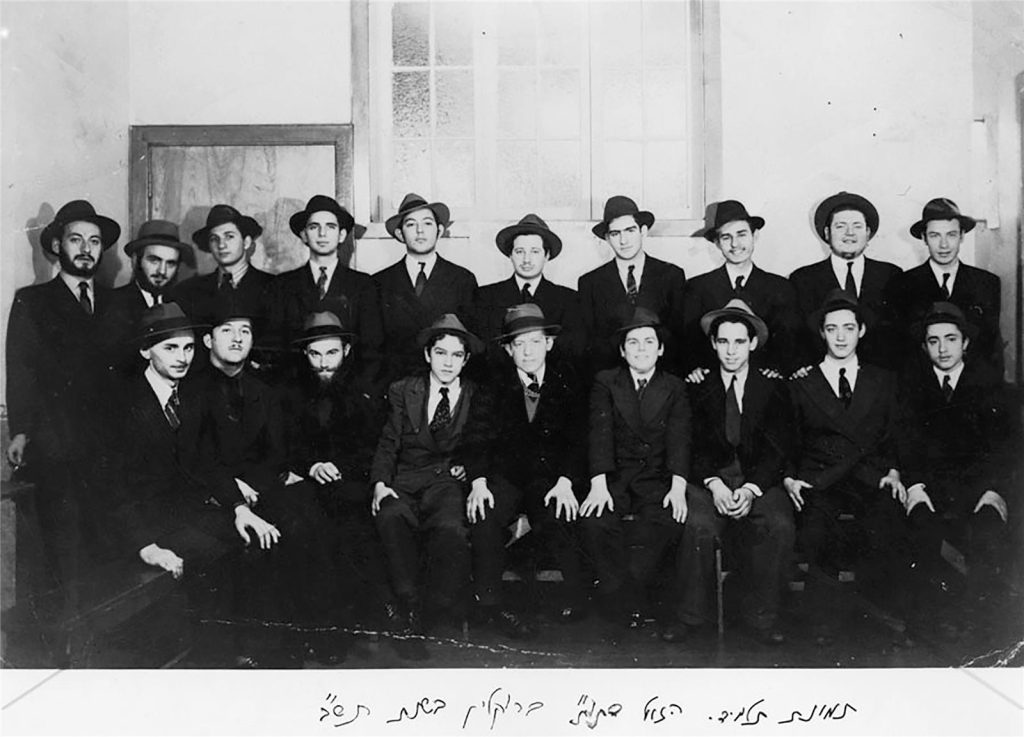
With the arrival of the Rebbe Rayatz to the United States, and with the opening of the central Tomchei Tmimim yeshiva at 770, young Berel was among the very first students, the “founders,” who merited to establish the nucleus of a new generation of Chabad in America.
Moving testimony to his complete devotion already in his early days can be found in the following fact: Every Shabbos he would walk for many long hours from his home in the Brownsville neighborhood to the Greystone Hotel in Manhattan, the temporary residence of the Rebbe Rayatz during his first stay in the United States. All this just to participate in the holy farbrengens.
This devotion did not escape the eyes of the Rebbe Rayatz, who affectionately called him “mein oleh l’regel” – “my pilgrim”…
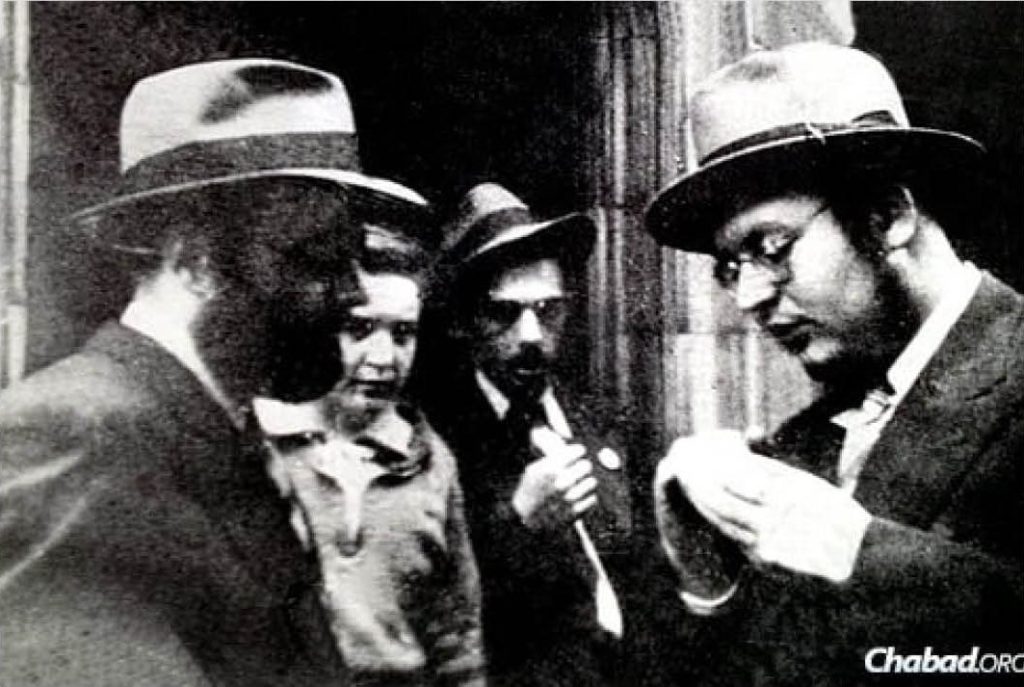
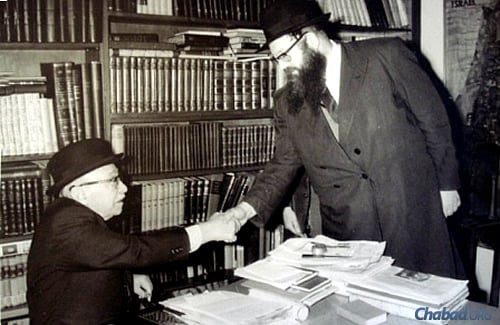
At the age of eighteen, in 5701 (1941), when the Rebbe arrived in the United States and the Rebbe Rayatz established the “Merkos L’Inyonei Chinuch” and “Machne Israel,” young R’ Berel devoted himself to this holy work. From this period, a rare photograph has survived documenting a special moment in which Berel gave the Rebbe a pin with the logo of the “Mesibos Shabbos” organization (see photo).
In connection with this, it is told that someone asked the Rebbe why he brought R’ Berel into every farbrengen of the Rebbe Rayatz, and the Rebbe replied that it was because he was involved in Mesibos Shabbos… This testifies to the beginning of his relationship with the one who would become the leader of the seventh generation, a connection that would only grow over the years.
As part of his work, R’ Berel regularly visited the Rebbe’s private home, where he submitted various documents related to the mosdos the Rebbe headed. These visits received personal and special treatment from the Rebbe, who hosted him by offering a sweet drink in special glasses – though R’ Berel preferred to maintain this custom by sipping only a glass of cold water and nothing more.
We have testimony about his complete bittul to the Rebbe even during the leadership period of the Rebbe Rayatz. Above all of them stands that moving incident in which the Rebbe took him and presented him before the Rebbe Rayatz, saying: “Made in the USA.” The meaning of these words was that Berel was a tamim “made in the United States” – praise and glory beyond measure, testifying to the essence of R’ Berel’s neshama.
During the following years, R’ Berel engaged in a wide variety of shlichus activities, both revealed and hidden. He faithfully fulfilled the Rebbe’s wishes in many varied tasks: obtaining rare sefarim that arrived on American shores from battered and smoke-filled Europe; removing bothersome guests who entered and disturbed the private audiences in the Rebbe Rayatz’s room; arranging the order of entry for yechidus for bachurim; on one occasion he was even assigned the task of obtaining a certain medicine for the Rebbe Rayatz without raising questions about its kashrus, as the Rebbe Rayatz needed it urgently. These are just a handful of countless assignments carried out by him with great devotion.
All this, in addition to organizations in whose activities he took a leading part, such as “ATaH” – Igud Talmidei HaYeshivos that the Rebbe Rayatz established at that time; Berel immediately became the organization’s director. There were also activities in which he participated not as director, but only as an energetic activist, such as distributing issues of HaKriah V’HaKedusha which served in those years as a key way of spreading Chassidus.
In 5704 (1944), the Rebbe Rayatz chose him, along with two other tmimim, and formed a “Beis Din” with the three of them. Their role was to ensure the status of genuine yeshiva students, so that the American military authorities would exempt yeshiva students from military service. This was a delicate assignment of supreme importance for the continued existence of the Torah world in the United States.
That same year also saw the beginning of extensive activity among Jewish soldiers in the American army to strengthen their Jewish awareness. Of course, R’ Berel also took a leading part in this work, with endless enthusiasm and devotion.
If all this were not enough, as a continuation of his studies in the yeshiva, the Rebbe Rayatz appointed him as head of the ‘Achei Tmimim’ department at the yeshiva branch in Brooklyn.
It would be difficult and even wrong to try to summarize the multi-faceted character of R’ Berel in such a limited space. Through the stories and small episodes before us, we have nevertheless tried to sketch general outlines of the character of a young tamim and scholar, a prolific shliach, who was devoted one hundred percent to the Rebbe.
The Rebbe Said: ‘You Have Revived Me’
On Shabbos Mevorchim Iyar, Parshas Shemini, 5715 (1955), the Rebbe established the Tzeirei Agudas Chabad organization in the United States. Among the board members, R’ Berel was also chosen and he devoted himself to this highly responsible position.
The activities of “Tzach” began throughout New York City, but soon spread beyond state borders as well, and constituted a significant breakthrough in spreading Judaism outward.
The years of R’ Berel Baumgarten’s youth testified to his future greatness. In his role as a board member of Tzach, R’ Berel excelled in organizing and taking an active part in countless events that Tzach held among communities, institutions, campuses, and universities.
These visits were initially conducted throughout New York State, but later the Chassidim expanded and reached more distant states in the United States. When one considers the fact that in those years the idea of Chassidus and Chassidim was an unfamiliar phenomenon in America in general, and in the academic world in particular, the very idea of trying to influence university students to change their lifestyle from one extreme to another – from university life to a life of Torah and mitzvos, not to mention the life of a Chassid – was so revolutionary that it didn’t occur to anyone at all… R’ Berel took this nearly impossible task upon himself and carried it out with great faithfulness.
He would take with him bachurim and yungerleit who helped him with singing and Shabbos tefillos, as well as in personal conversations with community members and students – but from the diaries, letters, and reports it is clear that R’ Berel was the main speaker everywhere – as with his personality he conquered one target after another. Not only did his speeches leave a strong impression on the listeners, but also the Chabad niggunim he sang during visits to universities (besides being a wonderful “baal tefilla”) had their effect. Every time he began a niggun, he would first explain the deep content of the niggun.
On these trips, R’ Berel brought many neshamos to Torah and Chassidus. After each such Shabbos, thank-you letters arrived from the communities and universities he visited.
An episode unto itself is the tale of several professors who once met R’ Berel. Through his efforts, they had private audiences with the Rebbe to resolve their questions. Needless to say, they emerged like “new people.” Some of them subsequently changed their way of life.
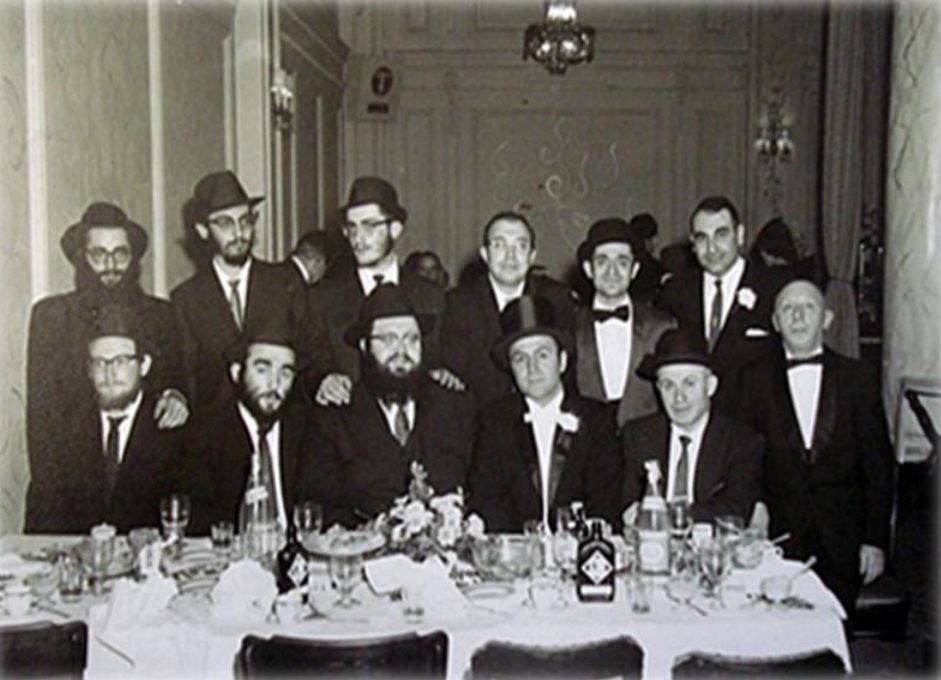
The “conquest” and tremendous revolution in this activity can be summed up in one word that the Rebbe conveyed to R’ Berel. It was when one of these professors – R’ Shneur Zalman Shmeidler – underwent a hatafas dam bris as his family was Reform and in his youth he had not been properly circumcised. Afterwards, a pidyon ha’ben was also held, with a heartfelt Chassidishe farbrengen.
Rabbi Leibel Groner related that in the days preceding the event, the Rebbe was very tense and hardly answered letters. After the seuda, R’ Berel brought the Rebbe a detailed report from the bris and pidyon ceremony, as well as some “farbeisen” (food) from the special farbrengen. Unusually, the Rebbe washed and bentched, and responded to the report with one word: “Hechiyisani” (You have revived me). R’ Leibel related that after this event, the Rebbe was again in a state of open joy…
Foundations of the Lubavitch Kingdom in Argentina
R’ Berel’s travels throughout the United States continued to increase and expand in quantity and quality. He extended his travels to Italy and South America, until after a few years the Rebbe instructed him to influence the Jewish community in Argentina – which has the largest Jewish community in South America – which led to a new chapter in his shlichus work.
For six years, starting from 5716 (1956), R’ Berel visited Argentina for fixed periods of time where he accomplished great things but he did not settle there permanently until 5723 (see sidebar). Throughout all those years, he merited to receive a series of special instructions from the Rebbe, including publishing ‘Kuntres U’Maayan’ of the Rebbe Rashab in Spanish.
It is interesting to note that R’ Berel never received an explicit instruction from the Rebbe to settle permanently in Argentina (some explained this with an ulterior motive – because the Rebbe Rayatz had already assigned a certain shlichus to R’ Berel, and the Rebbe wanted his actions to be an extension of that shlichus, not a new shlichus).
From this point forward, R’ Berel’s official shlichus in Argentina began and this became his entire existence.
Rabbi Tzvi Yechiel Grunblatt is the current director of Chabad mosdos in Argentina and the one who took over after R’ Berel’s passing. When he first met the charismatic Rabbi Baumgarten, he saw before him an American Chassid with a big beard, who certainly looked unusual on the fashionable streets of Buenos Aires.
R’ Baumgarten’s shlichus to Argentina and South America began with that unique hashgacha pratis that accompanies the Rebbe’s shluchim. Before his first trip to South America, which was undertaken for business purposes as part of his search for parnassa, R’ Berel requested a bracha from the Rebbe. The Rebbe gave him ‘shmura matza’ and instructed him to distribute it to Jews he would meet on his way.
“The Rebbe told him not to give it for free,”” relates his son, Rabbi Pinchas Baumgarten, as he reconstructs his father’s fascinating story. “The Rebbe told him to distribute it, but to ask for some payment; to put on tefillin or to affix a mezuza on the door – anything that would express personal commitment to mitzvos. The Rebbe added that he would also reach a place where the demand for matza would be so great that he would be forced to break it into pieces, and there he would need to give it for free, and that is where he needs to settle.
“And indeed, when he arrived in Buenos Aires, a large crowd gathered that wanted to receive pieces of the matza, and he was forced to break them into pieces. This incident of distributing the matza brought the community closer to my father.”
The Chassidic joy, authentic warmth, and captivating simplicity of Rabbi Baumgarten, together with his extensive Torah knowledge, made him a magnet for Argentine Jews, many of whom were far from a life of Torah and mitzvos, and even further from the world of Chassidus. “When the local Jews saw him, they looked at him like an angel from heaven; they had never seen anyone like him,” testifies Rabbi Grunblatt emotionally. “He is a holy man – that was the feeling that gripped the hearts of those who met him.”
Throughout his years in Argentina, R’ Berel served in a variety of roles that testified to his being a man of many talents, devoted with every fiber of his soul: rosh yeshiva, teacher, rav, menahel ruchni in a Jewish old age home and orphanage, and more… Wherever he went, he left a deep and lasting impression on the Jews he met. The shmura matza he received from the Rebbe was a symbol of his assignment: to feed the hungry souls, sometimes even “for free,” and to connect them to emuna.
The Rebbe Teaches What True Success Is
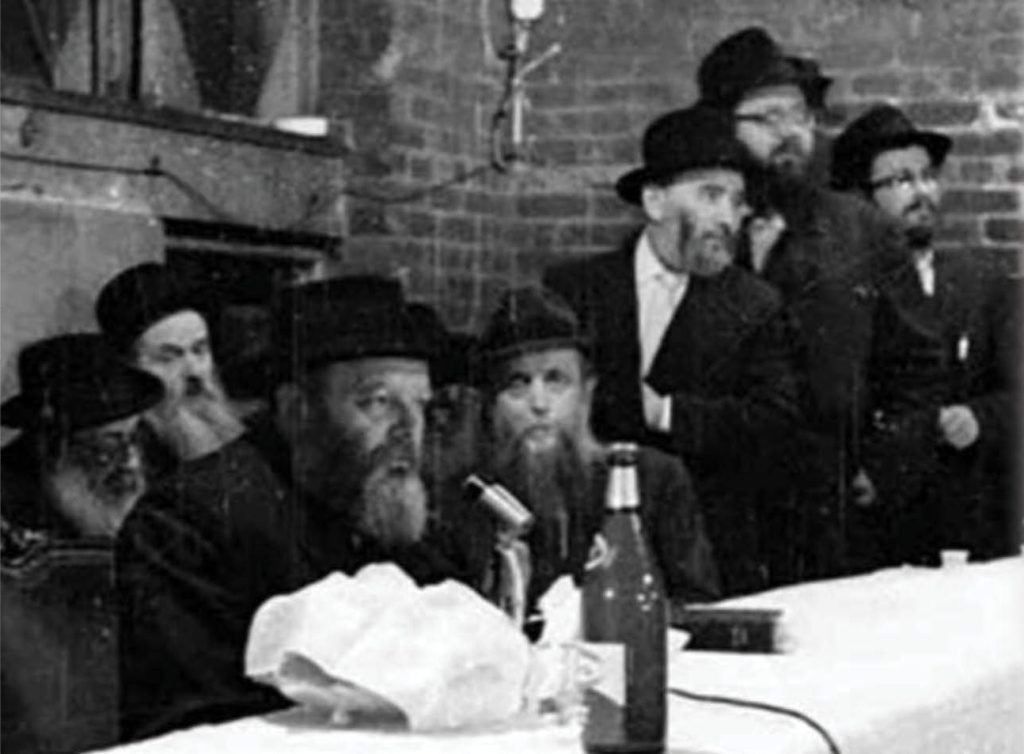
“R’ Berel Baumgarten made an impact on countless people,” adds R’ Grunblatt, and continues to tell about the first results of his efforts. “By 5718, a few years after his arrival in Argentina, there were already three Argentine yeshiva students studying at the central yeshiva in 770: Mordechai Saruga, Aharon Tawil, and Chaim Swed,” which testifies to the power of his influence.
Among the various positions R’ Berel filled in Argentina, he was rosh yeshiva at “Yeshivas Chafetz Chaim” in Buenos Aires. This yeshiva, it is important to note, was not a Chassidishe yeshiva and was different than Chabad yeshivas. As a child of frum parents, Rabbi Grunblatt himself was sent there to study in 5727. Inspired by their esteemed teacher – Rabbi Baumgarten – Grunblatt and many of his classmates would subsequently connect to Chabad Chassidus and constituted the initial and significant nucleus of the Chabad community in Buenos Aires, which began to grow rapidly.
In a personal letter he wrote in the winter of 5732, R’ Berel describes his role at Yeshivas Chafetz Chaim: “As rosh yeshiva at Yeshivas Chafetz Chaim, I taught for five years with great success both in that the situation of the talmidim changed completely for the better from one extreme to another, and in sending talmidim to yeshivas. I succeeded in sending about 35 students to Eretz Yisrael and North America, and even some of them whom I could not convince to travel to ‘Tomchei Tmimim’ traveled to ‘Kol Torah,’ Slabodka, Ponevezh etc. And here too my students became known for their knowledge of Torah and yiras shomayim, etc.
“At that time in my life, I didn’t know the difference between Chabad and Satmar,” recalls R’ Grunblatt. “All I knew was R’ Berel Baumgarten, and that he was a true Jew…”
This was the essence of R’ Berel’s shlichus: not theories and definitions, but a living, breathing, inspiring figure, representing Jewish and Chassidic truth in its simplicity and power.
In 5721, the first official shliach was sent to Argentina, none other than Rabbi Aharon Tawil mentioned above, one of those influenced by R’ Berel on his first visits to Argentina.
In the diaries from the “Chofs” (1960s), one can find several times how at a farbrengen the Rebbe requests from those influenced and taught by R’ Berel to sing from the rich trove of Sefardic Jewish piyutim (Sefardim constituting a significant percentage of Argentina’s Jewish community).
It is told that at one of the private audiences with the Rebbe in the “Lameds” (1970s), R’ Berel complained about his situation on the shlichus in Argentina. This was after he had visited London and Eretz Yisrael, where he saw the impressive development of Chabad – large buildings and significant expansion – while in Argentina he was still operating under very modest conditions, without his own mosdos and buildings. Upon his return to Argentina, he stopped in New York and had a yechidus, but contrary to his habit, he did not prepare a letter detailing his activities. When the Rebbe asked why, R’ Berel replied that compared to the successes in other places, he felt he had not achieved anything significant.
In response, the Rebbe took out from the drawer the report from the staff of the yeshiva at 770 and pointed to a section praising the success of four Argentine students that R’ Berel had sent. “This is success. Success is not measured in buildings, but in students,” the Rebbe emphasized, and added: “The neshamos you have brought me are more precious to me than so-and-so’s buildings…”
To this very day, most Chabad Chassidim in Argentina are descendants and fruits of R’ Berel’s mekuravim during his shlichus in Argentina – they were the true “buildings” that R’ Berel built for the Rebbe.
Mesirus Nefesh Before an Open Aron Kodesh
R’ Berel suddenly passed away at the height of his power and activity, at only fifty-five years old. Seemingly, a tragic end to such a rich life of shlichus. But there were those who knew about this in advance, and specifically from this event even the greatest skeptics would learn what is the devotion of a shliach to the meshaleiach and what is true kabbolas ol.
After the Rebbe’s heart attack on Simchas Torah 5738, R’ Berel stood before an open aron kodesh arousing heavenly mercy, and declared that he was giving his life for the Rebbe shlita for his health and for the continuation of his activities, like Rebbetzin Devorah Leah who gave her life for her father, the Alter Rebbe.
A few months later, on the 16th of Adar I, 5738 (1978) – R’ Berel passed away as did two other Chassidim who had also made a similar declaration. This was mesirus nefesh in its literal sense.
His will, written with care and precision, is too long to be included here in its entirety but it is interesting for anyone who wishes to study it. We will copy a few lines that express the depth of his soul, his humility, and his uncompromising devotion:
“I know in my soul that aside from all the damage I have caused and perverted and transgressed, against this I have nothing to place on the scale, for I do not have even one complete mitzva without ulterior motives, and do not consider this humility, etc., but this is der gantzer bitterer emes [= the entire bitter truth]. And therefore I have nothing to rely on except one thing, and that is – that I was a faithful servant to my master and king, his honor the Rebbe shlita.
“Therefore my son and two sons-in-law should write a tzetel [note] to C’K the Rebbe shlita, and request from him that he have mercy on me to release me from the harsh judgments, and that I not wander for extended times in the olam ha’dimyon, and he, shlita, if he wants he can, and he is good. And moreover I have talmidim or mushpaim [here is found a list of about fifteen Chassidim from the ‘first rank’ – the “work of R’ Berel’s hands”], who without me would have been people of the marketplace like . . . and they are ‘the real deal,’ therefore, in reward for the above, you request as I command that his honor the Rebbe, may he live, have mercy on me, and take me out of the miry clay, and guard me, etc., and I will come to rest as soon as possible.”
This will testifies to enormous humility, absolute trust in the Rebbe, and concern even after death for the “fruits” of his shlichus. These words are intended not only for his family members, but for every shliach and Chassid – a message of devotion, self-nullification, and responsibility.
A short time after his passing, members of the Chabad community in Buenos Aires, who were grateful for his enormous work, asked the Rebbe to send another shliach who would take upon himself the management of Chabad activities in the country.
They specifically requested that it be Rabbi Grunblatt, who was not yet married. This request testified to the deep trust and appreciation they felt for him. The Rebbe responded to their request, and from here began a new chapter in the history of outreach in Argentina in preparing the entire country to be mekabel pnei Moshiach Tzidkeinu.
The life story of the revered Reb Berel Baumgarten a’h, is a rich tapestry of mesirus nefesh, self-nullification to the Rebbe, and an uncompromising struggle for spreading Yiddishkeit and Chassidus. He was a pioneer, a trailblazer, who harnessed all his enormous talents to transform desolate souls into flourishing Chabad empires. His character can serve as inspiration for each of us, to learn what true shlichus is, what is devotion to the Rebbe, and the power of a soul that illuminated entire worlds.
‘Safra Rabba’ – The Power of the Written Word in Shlichus
A prominent and important characteristic of Reb Berel’s personality was his being a “Safra Rabba” – a great scribe. Throughout his life, he invested in writing, not for the sake of writing itself, but for the purpose of his shlichus. First and foremost, he wrote detailed reports to the Rebbe about all his activities. In his letters, he detailed every matter and issue down to the finest details, and in return, he merited receiving detailed and precise guidance on every step.
Additionally, he wrote many letters to his friends, and in them one can find countless pearls from his extensive work and his inner thoughts. It should be noted that after the passing of the Rebbe Rayatz, the Rebbe requested to receive the letters that R’ Berel had written to his friend R’ Tzvi Shusterman, in which he documented the passing and the course of the funeral. These letters constantly remained in the Rebbe’s desk drawer, rare testimony to the importance the Rebbe attributed to this documentation.
When the Employee Threatened Him with a Gun
R’ Berel’s shlichus didn’t begin and end only with the spiritual influence he had on others. Rabbi Baumgarten was a man of action. “When he became the director of the Jewish orphanage, he fought for the children’s rights. He fought so they would receive fresh food, as he noticed that the employees were stealing it and leaving rotten food for the children,” relates one of his family members. “It’s easy to understand that this approach didn’t make him particularly popular among the orphanage staff, who were accustomed to running things as they pleased, without real supervision. But for Rabbi Baumgarten, there was no other way.
“Once, he turned on the kitchen lights exactly when several employees were stealing meat intended for the children. When one of the thieving employees threatened him with a gun, he responded with rare courage: he opened his shirt and invited them to shoot him… When they saw he was serious, they left everything and fled the kitchen – an act testifying to his mesirus nefesh for others.”
Financial Hardships and Moments of Despair
As mentioned in the main article, only in 5723 did Reb Berel move to permanently reside in Argentina. This prolonged delay, during which his students and “fruits” had already returned to the field of shlichus and continued spreading the wellsprings, had to do with R’ Berel’s basic need to earn a living during those years. He crossed the American continent from end to end, and often even wandered far to Europe – where he operated in Milan and other cities.
On these travels, R’ Berel met many business people with whom he formed close relationships, as was his way. These connections developed into one-time transactions of purchasing and transferring goods from country to country with the aim of earning his parnassa. In the responses that came from the Rebbe for R’ Berel, one can find dozens upon dozens regarding parnassa.
As an example of the instructions he received on this subject, we’ll bring the response he received on 19 Marcheshvan 5719 (1958), in answer to what he wrote about a new parnassa proposal he received from one of Anash for a trip to Argentina: “In all the parnassa proposals that he wrote from there or here (before the trips there), he explained in detail about the certain and great profits and that at most it only depends on time, etc. And behold, it’s been about two years and in practice nothing has come! Not even one thing from the above! (What about the sausages that he wrote that some of them already arrived here?).”
In fact, the sausage business didn’t succeed, and in response to the letter in which he announced the failure of this business – as in other letters – the Rebbe instructed him “to consult with experts in the field and to act according to their instructions.”
In later stages, he reported that his trip to Argentina was being delayed for parnassa reasons (R’ Berel waited until they arranged a suitable position for him in Argentina). Among other things, he wrote to the Rebbe: “For my part, I forgive everything and will travel immediately, all according to the instruction of the Rebbe, which it seems to me that this too [the effort for parnassa] is the instruction of the Rebbe.”
The Rebbe crossed out the words “it seems to me that,” and emphasized the words “this is the instruction of the Rebbe” (and added) “provided that there will be parnassa.” The Rebbe deeply understood the distress and the basic need, and guided him personally on how to manage parnassa alongside shlichus matters.
Several times the Rebbe instructed him that all business dealings and means of livelihood should be done in a legal and proper manner only. However, in late 5720, he was caught in a certain offense, an incident that cast a heavy shadow over his life and significantly delayed the establishment of his permanent residence in Argentina: R’ Berel sent a package of nylon stockings by mail, with the misleading label “books.” Along with it, he also transferred a pearl necklace, intended for his father-in-law, with whom he had business ties. This act led to charges against R’ Berel in American court. Until the verdict was issued, he was forbidden to leave the country’s borders – a severe blow to a peripatetic shliach, whose activity depended on free movement between countries.
Throughout the period of legal proceedings, R’ Berel received dozens of instructions from the Rebbe, with precise guidance on how to conduct himself. The Rebbe not only supported him spiritually but also guided him in very practical matters. R’ Berel also hired the services of a top-tier attorney, about whom his clients testified that he had never lost a case – a clear hint that the Rebbe directed him to wise practical choices as well.
In the end, he was sentenced to a fine of $500 along with six months in prison – a harsh verdict. The appeal that R’ Berel filed was also rejected, and the case seemed lost. But then, in an open miracle, the picture suddenly changed. The Rebbe instructed three elderly and respected Chassidim – Rabbi Moshe Harlig, Rabbi Shlomo Aharon Kazarnovsky, and Rabbi Yisroel Jacobson – to approach the judge and speak to his heart. Their dignified appearance, the power of their influence, and the respect they aroused in his heart indeed affected the judge, and the original verdict was changed for the better, and the imprisonment was canceled. It was a miracle that illuminated the path of the devoted shliach in the difficult moments he experienced.
It’s easy to imagine R’ Berel’s state of mind during this affair, and the moments that were filled with “mara shechora” (melancholy). Precisely in such moments, the Rebbe stood by his side and encouraged him with all might. Thus the Rebbe wrote to him in one of the responses during that period: “It is certainly unnecessary to urge him that he should not fall in spirit if there was an error in conduct in some matters in the past… for he is accustomed to all human actions, and as our Sages said that a person does not grasp a halachic matter unless, etc. And it is customary that a person learns from mistakes many times over – regarding upright conduct for the future.” The message was clear: one should not be broken by past mistakes, but rather learn from them and strengthen oneself for the future. This is the Chassidic way to grow from the fall and rise up.
His financial situation was always difficult. Even in the years when he was already established in Argentina, his mosdos were always in debt. Sometimes he even had difficulty obtaining food for his home.
During a particularly challenging period, when feelings of “mara shechora” and despair threatened to take over, he entered the Rebbe’s holy chamber for a yechidus. The Rebbe looked at him and said immediately: “No more complaints!” and the Rebbe threw his pencil on the table.
“You must go with joy,” the Rebbe encouraged him, and added a sharp message: “You must go with joy not because I told you to; you must want to go with joy yourself.” This was a profound instruction in avodas ha’middos, in the choice of good and joy even from within difficulty.
It should be noted that later on, the Rebbe provided Rabbi Baumgarten with ongoing personal monthly support, which ensured the continuation of his shlichus – which further testifies to his deep concern for his faithful shliach.
Beis Moshiach #1481 • pp. 20-32
© 2026 Beis Moshiach Magazine. All rights reserved.
This article originally appeared in Beis Moshiach #1481. You are welcome to share it with friends and family by email or in print, provided that you do not change, add to or omit any part of it, you credit the author and Beis Moshiach, and you include a link to archive.bmoshiach.org (written out in full in printed copies).
To republish this article in a newspaper, magazine, book or website, please request permission in advance at [email protected].