Why the Rebbe Didn’t Want His Farbrengens Recorded

Short stories of the Rebbe as heard from mazkir Rabbi Leibel Groner * Presented in honor of his yahrtzeit on Erev Pesach
It Shouldn’t Go Lost
The Rebbe once told R’ Groner, “Why don’t they do as I say?” and the Rebbe raised his hands and said, “We pour ein sof (infinitely) and it goes lost. There’s a barrel that is pouring, but if you put containers under it, it doesn’t go lost. [But since they don’t make keilim] they come to me with complaints: You are the intermediary, as through you the highest kochos are given. But we don’t make proper use of them, so you are giving too much.”
If Only The Quantity Would Work
The Rebbe told someone to learn Chassidus for many hours. He asked the Rebbe: What about the Chassidim who sufficed with learning short aphorisms? (The Rebbe was asking him to learn for hours!)
The Rebbe responded: That was in earlier generations. Nowadays, halevai v’halevai (if only, if only) that from the many things learned [they achieve the same results]. Indeed, they should also know how to learn.
Not Only Politics
Once, when the Rebbe spoke at the farbrengen about politics [in Eretz Yisrael] there was a woman in the ezras nashim [who was not observant but she was well-educated] who asked the other women: Why does the Rebbe talk to us about politics? What does it have to do with us? You must, therefore, say that there is more to it, something that affects us, too, on a deeper plane.
R’ Groner later told the Rebbe about the woman and the Rebbe said: They had to wait until a woman from such-and-such a country came, one who is unlikely to be punctilious in mitzvos, and she needs to reveal these things?!
I Won’t Leave Them
On the second day of Shavuos 5710, somebody said to the Rebbe that he ought to accept the nesius, and the Rebbe said: I’ve supported the yungeleit (young men) until now and I’ll continue to support them, but I don’t know about the older ones.
The person asked the Rebbe what he meant by supporting them, and the Rebbe said: I will do for them, for the yungeleit whatever I can do, as much as I can, and I won’t leave them.
Without A “Yashar Ko’ach”
The Rebbe once gave R’ Chaim Gutnick a”h, a seemingly impossible mission to accomplish. R’ Gutnick, however, was successful, and he sent in a note to the Rebbe saying that he had done what the Rebbe had asked.
Once, as he walked by the Rebbe, the Rebbe said to him: In Beis HaRav git men nit kein yashar koach (the Rebbeim did not have the custom of giving thanks). [This would seem to be saying that when a Rebbe asks for something, it is a far greater favor for the one who is doing it.]
The Source Of Blessing
Somebody asked the Rebbe for brachos for personal matters, and the Rebbe said that he should say l’chaim at the farbrengen. The person didn’t understand.
The Rebbe asked that they explain to him that when he sits at a farbrengen and says l’chaim, this is the source of heavenly flow, and every personal thing that he needs is channeled by the farbrengen [see further on this topic].
If You Want It
When there was mesirus nefesh in publishing the Tanya-First Edition [something the Rebbe urgently requested], R’ Groner told the Rebbe that the men had worked non-stop on the project with no complaints from their wives. The Rebbe said: See, if you want, you can make it happen.
Make Up For It
The Rebbe once gave R’ Groner such hard work to do that he was lucky if he got two hours of sleep a night. The Rebbe asked: Do you sleep at night? R’ Groner said: A little. The Rebbe said: When you finish, you’ll make up or the sleep.
Rabbi Levi Yitzchok Of Berditchev’s Approach
When the Rebbe gave Chanuka gelt to the bachurim he always asked for a list of bachurim, and the ones who had kept to the learning schedule received the gelt. The list was given in a few days beforehand.
R’ Groner related: I once saw how the Rebbe read the list and when he finished he said to me: Apparently the hanhala took the approach of Reb Levi Yitzchok of Berditchev.
R’ Groner didn’t know what the Rebbe meant by that, and the Rebbe looked at him in surprise. R’ Groner said he didn’t understand, and the Rebbe said: You know they are supposed to submit a list of bachurim who stick to the learning schedule, and the hanhala includes on the list bachurim who don’t show up at yeshiva and they look upon them favorably, with ahavas Yisrael, which is Reb Levi Yitzchok’s approach.
[The Rebbe continued]: How do I know the bachurim don’t show up? Because I went to the zal a few times and they weren’t there! So why are they on the list? Tell the hanhala I don’t accept this approach. Those who weren’t there, won’t get, and they should tell them [those bachurim] ahead of time so they don’t approach me, so that they won’t be embarrassed.
Why Aren’t You Making A Commotion?
In the early years here in New York, Polish chassidim lived in Crown Heights and they would give them sichos called, “di griner sichos” (the green sichos, because they were bound with a blue-green cover). They once told R’ Zalman Butman who distributed the sichos: You are fools.
He asked why. They answered: By us, the Rebbes reflect the Chassidim, and since there’s a decline in the generations, the Rebbes match the Chassidim. But with you, the Rebbe is not at all in the league of the chassidim. If he lived in the time of the Alter Rebbe, he would be great then, too. Yet you don’t make a commotion about this!
Bribing Oneself
R’ Groner related in the name of R’ Chodakov: It says “a bribe will blind the eyes of the wise.” There’s the simple meaning of this, but R’ Chodakov explained it differently to someone (and from the contents of what he said it was obvious that this person deserved this explanation), and said this is its true meaning: the bribe of self-esteem. For example, the Rebbe spoke about not talking during davening, so how come when you see someone talking you don’t protest? Because they’ll laugh at you for demanding something that won’t help. Thus, it’s your self-esteem that doesn’t allow you to protest.
“Ha’mavdil”
When they put the mechitza in the secretaries’ office (the counter that separates those who enter and the secretaries’ work area) and the Rebbe saw it for the first time, he asked the secretary, Rabbi Quint, what the mechitza was for, and he explained.
The Rebbe said: “L’havdil bein ha’kodesh” (to separate between the holy), the kahal, and “Kodesh HaKadashim” (the Holy of Holies), the secretaries’ area.
R’ Quint said to R’ Groner: You see that the Rebbe said that this is the Kodesh HaKadoshim, so nobody should enter here!
A Little Shas
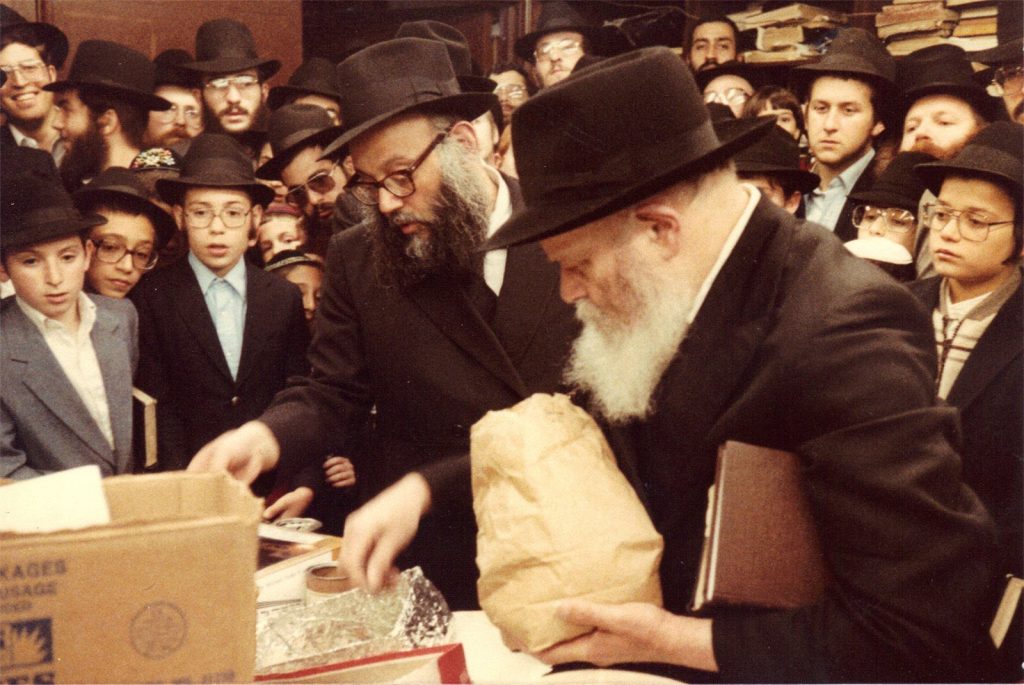
The Rebbe once told R’ Groner: R’ Quint is a baki b’Shas. If you need to ask something in Shas, ask him.
R’ Quint once told R’ Groner, after an explanation in Nigleh that the Rebbe gave at a Simchas Beis HaShoeiva farbrengen: The Rebbe clarified a topic in Nigleh from Brachos until Nida (from the beginning until the end of Shas).
So That You Feel What A Yechidus Is Like
There was someone who entered for yechidus whenever he wanted to, not only on those nights dedicated to receiving people for yechidus. The Rebbe once told R’ Groner that this person should only be allowed in during official yechidus times. When the person wanted to see the Rebbe, R’ Groner told him that the Rebbe was busy and that he couldn’t go in except for the appointed time he would tell him. After the man had his yechidus (after everyone had left), he came out with a smile and told R’ Groner that the Rebbe had said: I wanted you to feel at least once, what yechidus is like.
Who Is A Mashpia?
The Rebbe once said: A mashpia is someone who can be asked about his most personal faults, and he can answer.
To Hear The Kol Torah
The secretaries’ room, in the time of the Rebbe Rayatz, was the zal of the elementary yeshiva. In 5706 (1946), the Rebbe Rayatz said they should close the room and move the zal elsewhere. Why? “Because my pen fell three times as I wrote. Once, when a boy screamed and I was afraid something had happened; once, when a table fell, etc. (the window which starts in the office continued up the Rebbe Rayatz’s room on the 2nd floor, and you were able to hear everything that went on on the first floor).
The Rebbe asked the Rebbe Rayatz whether they should also close the zal of the large yeshiva and move it elsewhere. The Rebbe Rayatz said that he wanted to hear the kol Torah.
What Is A Rebbe?
Generally, on 13 Tishrei, the Rebbe spoke about Rebbe’stve (matters pertaining to leadership). Once, a director of a school in Eretz Yisrael came, who hadn’t been in New York for Rosh Hashana or Yom Kippur. He first came for Sukkos, and the Rebbe got word that because this person had gone abroad, things were amiss at the school.
At the farbrengen the Rebbe said: What is a Rebbe? Einer vos ken zein Chassid durch un durch (one who knows his Chassid through and through). Otherwise, he’s not a Rebbe. What is meant by “through and through?” That he knows everything that’s going on with the Chassid, with all the details. Therefore, when someone comes here and wants to play tricks and say that his coming here doesn’t harm anything over there, he should know that he harmed his mosdos, and his coming here is not desirable, and is the opposite of the kavana and ratzon. Therefore, he cannot be here. He has to sacrifice and worry about his mosdos.
“You Don’t Need To Tell Me”
There was a time when the Rebbe didn’t want the shluchim to Eretz Yisrael (who were sent there in 5736) to come to 770, but they strongly desired to come. When R’ Groner went to Eretz Yisrael, the Rebbe told him to tell them: Each of you certainly wants to do what I want. Nobody is, ch”v, interested in doing the opposite of what I want. It’s just that there are those who want to teach me what I want. Tell them that they don’t need to tell me what I want, and if they want to do my ratzon, they should tzuheren (listen and understand) what I want.
A few days later, two of these families came to the Rebbe. R’ Chodakov asked them whether they heard what R’ Groner had said, and they said they had heard but presumably the Rebbe meant so and so, and so and so, but not them.
R’ Chodakov told them they would not have yechidus. He went on to say, “I would order you to return home for Pesach, except I don’t know whether you can make Pesach at home, so stay here but it’s doubtful whether you’ll have a yechidus.”
Then they came to R’ Groner to ask for a yechidus. R’ Groner tried to persuade R’ Chodakov to let them in, but it didn’t help, and they did not have a yechidus. It was considered as though they hadn’t come.
L’chaim And Yechidus
The Rebbe said, “Saying l’chaim at a farbrengen is greater than a bracha at a yechidus.”
Someone wrote to the Rebbe, saying that he had spent a lot of money to have a yechidus, and in the end he didn’t have a yechidus. The Rebbe said: You were at a number of farbrengens and also said l’chaim – what more do you want?
A Pity
Once, when the Rebbe wrote notes on a maamar, he put down the pen, looked up, and said to R’ Groner: Tell me, who am I writing these notes for? Does anybody look at them? It’s a pity that I take the time to sit and write, and a pity for the reader who won’t look them up anyway.
That’s My Lot
The Rebbe once demanded something at a farbrengen. When R’ Groner saw the Rebbe on Sunday, the Rebbe asked whether a report could be given in about what had been spoken about the day before.
R’ Groner said a report would be written up the next day. The Rebbe said: It says, “His word runs swiftly,” but I have Chassidim who have time; everything is slow, and the inyan of “His word runs swiftly” doesn’t apply to them. That is my lot.
Everything In Good Time
In the early years, the Rebbe didn’t want tapes made of his sichos, and he told R’ Groner that if he finds a tape he should take it away.
Even in the early years, the secretary R’ Moshe Leib Rodstein wanted to arrange for farbrengens to be heard on short wave radio, and he went to Washington to arrange it (because the short wave frequencies belonged to the military. It’s interesting to note that R’ Rodstein’s room in 770 later became the broadcasting room). However, the Rebbe told him the time wasn’t right yet, and he explained:
It is told that the Mitteler Rebbe once said (in a maamar), “Better is one hour in the World to Come than all of life in the World to Come,” and the Chassidim didn’t understand what he meant. Somebody asked the Mitteler Rebbe who answered: I meant the famous Mishna, “Better is one hour in this world than all of life in the World to Come” …
However, you must understand, why did the Mitteler Rebbe say “World to Come” twice in the maamar? Because this is “nevias ha’mochin” (flooding of the intellect), and from the aspect of nevias ha’mochin there can be a plitas peh (a slip of the tongue) and the like. But since I don’t have this level, darf zein genoi vos ich redt (what I say must be precise). Therefore, no communications media should be brought in, lest I say… – and the Rebbe refused to allow taping.
The Clock
Before 5710, the Rebbe’s room didn’t have the royal appearance it came to have. After the Rebbe accepted the Chabad leadership, they wanted to change the room to reflect his new role, and so they removed some items from the room, and the Rebbe didn’t say a word. Among the things they removed was an old clock which had been on the Rebbe’s desk since he arrived in New York until this day. When they removed this clock and replaced it with a new and much fancier clock, at first the Rebbe didn’t say anything, but then he asked why they had switched clocks.
When they answered that it had to look “malchus’dik,” the Rebbe said: What is kabbalas ol? Is it only when you tear someone else’s nose off? [i.e., one-upmanship] Tearing off a nose may be a great thing … When you do something different than what is wanted, this is a lack in kabbalas ol. And the Rebbe said they should put back the old clock.
Beis Moshiach #1454 • pp. 24-29
© 2026 Beis Moshiach Magazine. All rights reserved.
This article originally appeared in Beis Moshiach #1454. You are welcome to share it with friends and family by email or in print, provided that you do not change, add to or omit any part of it, you credit the author and Beis Moshiach, and you include a link to archive.bmoshiach.org (written out in full in printed copies).
To republish this article in a newspaper, magazine, book or website, please request permission in advance at [email protected].