The Day Everything Fell into Place
The afternoon sun warmed the streets of Livorno, Italy. A group of boys walked home from cheder, their voices mixing with the sound of the waves. They were talking excitedly about someone very special.
“Do you know who lives near the port?” whispered one boy.
“Of course!” said Eliyahu. “The great Rabbi Chaim Yosef Dovid Azulay! My father calls him the Chida.”
“The Chida?” another boy asked. “The one who wrote so many sefarim?”
Eliyahu nodded eagerly. “Yes! My father says he was born in Yerushalayim and learned from the biggest rabbis there. Even as a boy, he studied all day and all night!”
“My uncle told me,” said another boy, “that he’s not just a rabbi – he’s a traveler! He went to Egypt, France, Morocco, and so many places to help Jewish families.”
“And he looked for old Torah books wherever he went,” whispered a third boy. “He searches in tiny shuls, dusty attics, and old libraries. If he finds a Torah book no one remembers, he copies it and writes who the rabbi was – so no one forgets their Torah or their names ever again.”
The boys slowed their steps, amazed. “So he’s kind of like a walking library!” Eliyahu said. His friend nodded. “Yeah, a walking library who remembers everything! Can you imagine knowing about every rabbi and every book?”
The boys peeked toward the Beis Medrash at the end of the street. Inside, a warm light glowed from the windows. It was quiet, except for the soft scratching of a quill.
* * *
That evening, Eliyahu ran home, his mind full of questions. When his father sat down for supper, Eliyahu blurted out, “Tatti, everyone talks about the Chida! Who is he really?”
His father smiled. “Ah, the Chida. He’s one of the greatest rabbis of our time. He was born in Yerushalayim, but he’s lived in many places. You know, Italy wasn’t always easy for Jews. Some people treated us kindly, but others made life hard. Still, Livorno is different. Here, Jews can learn and work freely. We have printing houses, schools, and shuls. That’s why the Chida came here – so he could write and print his sefarim without worry.”
Eliyahu listened carefully. “So he helps all Jews, not just the ones here?”
“Yes,” said his father. “He traveled to many lands – Egypt, France, and Morocco – to teach Torah and raise money for the poor in Eretz Yisrael. Even kings wanted to meet him because he was so wise. One time, his travels took him to France, to the grand palace of King Louis the Sixteenth. When the king saw him, before the Chida could even say a word, the king asked, ‘What country do you come from, sir?’ He thought Chida was an ambassador, because he looked so noble and full of wisdom! The king had never seen a rabbi who carried himself with such grace and dignity.”
Eliyahu’s eyes widened. “So that’s why everyone respects him!”
His father nodded. “Exactly. A true tzaddik. Even though he’s respected everywhere, he never forgets where he came from – Yerushalayim. When he was a little boy there, he already loved learning Torah more than anything else. While other kids were playing outside, he would sit by a small candle and learn. By the time he was eight, people say he already knew many pages of Gemara by heart! When he was sixteen, he wrote his first book, fixing little mistakes he found in other Torah books. The next year, he wrote another one, explaining parts of the Gemara. He was still a teenager, but everyone could see how wise he was. That love for Torah stayed in his heart forever, and he always loved Yerushalayim.”
Eliyahu smiled softly. “He must miss it very much.”
“Yes,” said his father. “Every Jew does.”
* * *
Many years later, after traveling through so many countries, the Chida spent time in Egypt.
The Jews there loved him dearly. They came from far and wide to hear his shiurim and ask him questions in halacha and Kabbalah. The Chida would walk through the narrow Cairo streets, his tall frame and gentle smile making him easy to recognize.
But even in Egypt, his heart never left Yerushalayim. Often, late at night, his students would hear him whisper, “How my soul longs for the Holy Land…”
One evening, a group of merchants came from Livorno, Italy, bringing wagons full of Hebrew books. The Chida ran his hands lovingly over the bindings. “Such beautiful printing,” he said. “The Torah shines brighter when written with care.”
The merchants smiled. “Rebbi, come back Livorno. Our printers will publish all your sefarim! Jews everywhere will be able to learn from you.”
The Chida hesitated, then nodded. “If this will help more Jews learn Torah, I will go.”
So, even though his heart longed for Yerushalayim, he set sail once more – this time to Italy. The journey was long, but when he arrived, the Jews of Livorno greeted him with honor. The great printing presses began working day and night to bring his sefarim to the world.
Years passed, and the Chida became loved by everyone in Livorno – rabbis, students, even the city’s leaders. Despite the respect and comfort he found there, he often gazed toward the east and whispered, “One day, I will return to the Holy Land.”
But that day never came.
The Chida grew older and weaker. His students begged him to rest, but he continued writing, saying, “As long as Hashem gives me strength, the Torah must flow.”
One peaceful afternoon, as the sea breeze brushed through the open window, the Chida finished his last words on the page. He looked up at his students and smiled.
“My children,” he said softly, “I have written what I was sent to write.”
On the 11th day of Adar, in the year 5566 (1806), the Chida’s holy neshama returned to Heaven.
The people of Livorno mourned deeply. They built him a kever in their ancient cemetery by the sea and buried him with great kavod, singing Tehillim through their tears.
Though he had always dreamed of returning to Yerushalayim, his body rested far away, in the land of Italy.
* * *
In the mid-1950s, almost two hundred years after the Chida passed away, a special idea began to take shape. Rabbi Yitzchak Nissim, the Chief Rabbi of Israel, had always felt a deep connection to the Chida’s Torah and holiness. One morning, he looked up from the sefer open on his desk and said softly, “The Chida belongs in Yerushalayim – in the land he loved. Let’s bring him home.”
His aides exchanged glances. “You mean… to move his kever?” one asked quietly.
“With full kavod,” Rabbi Nissim nodded. “We will follow halacha in every step.”
In addition at the time, word spread that the Italian government planned to expand a road near the old Jewish cemetery. The Jewish community was worried that the kevarim, including the Chida’s, might be affected. It was another sign from Heaven — time to bring the Chida home.
* * *
Back in Italy, the community board met in their old shul. The elders sat around a wooden table that had heard generations of Torah discussions.
Rabbi Shabtai Toaff, spoke first. “It is a mitzva,” he said softly, “to return the Chida to his homeland. But it must be done with absolute kavod.”
The others nodded. “for sure – with great honor,” they agreed. A decision was made: the Livorno community would help fund and supervise the holy task.
* * *
Back in Yerushalayim, Rabbi Nissim worked to find the perfect place for the Chida’s new kever. He wanted it right at the entrance of Har HaMenuchos, where every visitor could see it and remember his greatness. But the city replied, “There is no space there.”
So Rabbi Nissim turned to Israel’s President Yitzchak Ben‑Zvi for help. The president listened thoughtfully and then smiled. “The Chida is a treasure of our people. We’ll find him the place he deserves.” He said, “Just like Yosef HaTzaddik’s bones were brought from Egypt, we will bring our Yosef – Rabbi Chaim Yosef Dovid – back to his homeland.’
Together they chose a special area and planned an ohel – with a dome like the one built over Kever Rochel – so people could visit and daven there.
Word spread across Israel. Posters appeared announcing “Shabbat HaChida.”
Children learned about the great rabbi who wrote more than seventy sefarim. Shuls gave drashos about his Torah. A stamp and even a street were planned in his honor. Everyone felt that Am Yisrael was preparing to welcome the Chida home.
* * *
After four years of planning and writing letters between Yerushalayim and Italy, the big day finally came – 20 Iyar 5720, or May 17 1960. That was the day the Chida would finally begin his journey home.
Meanwhile in Italy, R. Shlomo Umberto Nahon, who had grown up in Livorno near the Chida’s kever, helped organize everything. He spoke with local rabbis and community leaders, explaining the plans with care. “We will do everything according to halacha,” he assured them. “Every step with respect.”
On a quiet morning in 1960, the old Jewish cemetery of Livorno filled with hushed voices. Members of the Chevra Kadisha washed their hands, whispered Tehillim, and began their sacred work.
Parents stood back with their children. One boy tugged at his father’s sleeve. “Tatti,” he whispered, “is this really the tzaddik who wrote so many sefarim?”
“Yes,” said his father softly. “And now we are helping him go home.”
Slowly, the workers lifted the stones and brushed the soil aside. They carefully worked for hours, pausing often to say more Tehillim. Finally, they uncovered a small sealed box. The rabbis recited another perek, then wrapped it carefully in white linen and placed it on a stretcher.
The box was carried through the narrow streets of Livorno toward the waiting car. People peeked from windows, whispering prayers. Dr. Nahon walked beside it, his hand on the stretcher. Before it was loaded, he whispered, “We’ll see you soon, Rav Chida.”
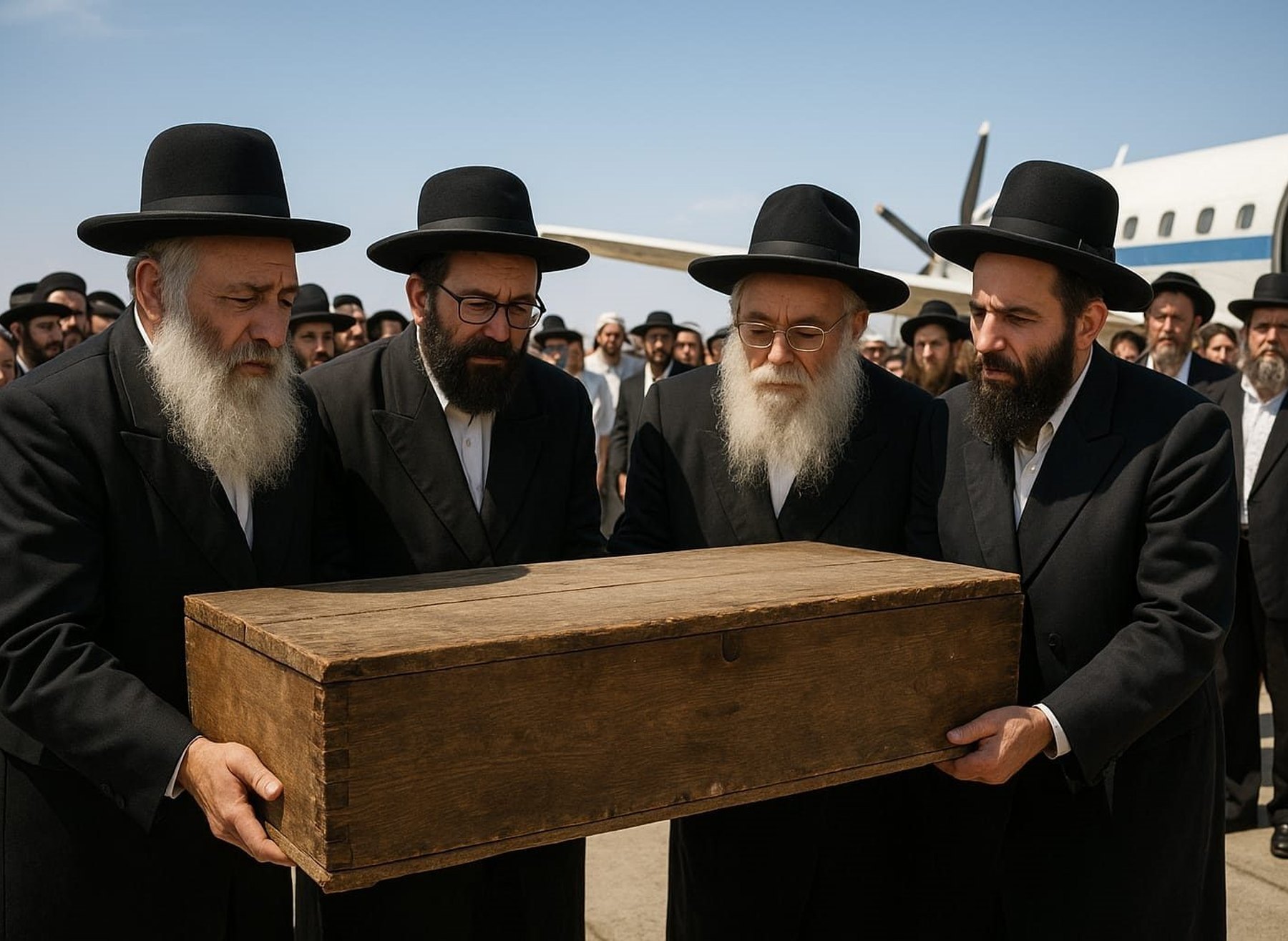
At the airport, the small wooden box was lifted gently onto the plane – a simple box holding centuries of Torah and holiness. The engines roared to life. Dr. Nahon and the others stood watching as the plane rose into the orange Italian sky, carrying the Chida on his final journey home to Eretz Yisrael.
* * *
The plane touched down in Eretz Yisrael, its wheels screeching softly on the runway. A group of rabbis waited on the hot tarmac, their black coats swaying in the wind. Among them was a young Rabbi Mordechai Eliyahu, his heart pounding.
“At last,” he whispered, “the Chida has come home.”
The pilot stepped out and waved. “Are you the ones waiting for the rabbi’s remains?”
“Yes,” said Rabbi Eliyahu, stepping forward. “Where is the coffin?”
The pilot pointed behind him. “There,” he said, motioning toward a small wooden box. “That’s it.”
Rabbi Eliyahu blinked. “That box? It’s so small… it can’t be.” The other rabbis gathered around, murmuring in confusion. One of them asked the pilot, “Are you sure there isn’t another box?”
The pilot shook his head. “This is all they sent.”
The group lifted the small box carefully, as if it were made of glass. They placed it into a larger wooden coffin that had been prepared for the Chida. Rabbi Eliyahu bent down beside it. “Where is the head? The feet?” he asked quietly.
The pilot shrugged. “I don’t know,” he said. “But there’s a small mark here. That’s where we opened it before the flight.”
Rabbi Eliyahu’s eyes filled with tears. “Ribono Shel Olam,” he whispered, “how can we know what to do?”
He placed his hands gently on both ends of the box and closed his eyes.
“Rav Chida, holy tzaddik… we don’t know how to arrange you. Please, arrange yourself with honor.”
Then – a quiet sound.
At first, it was like the ground taking a deep breath. Then came a soft flutter, like the beating of wings inside the box.
The rabbis froze.
The small box began to move by itself.
Slowly, carefully – as though invisible hands were at work – the Chida’s holy bones began to come together.
The head turned gently to its place. The ribs slid into a perfect row. The hands rested beside the body. The legs stretched out just as they once had. Every part moved into its spot, until everything fit together again – whole and peaceful.
The rumbling grew louder – then stopped.
The air became still. Sunlight streamed through the window, landing softly on the box.
For a long moment, no one moved. Then Rabbi Eliyahu opened his eyes and whispered,
“Nisei nissim… miracles upon miracles.”
He looked at the others, his voice trembling.
“Hashem Himself helped the Chida return with honor.”
The other rabbis slowly stood, their faces pale with awe. Some were crying. They knew they had witnessed something no one would ever forget.
The box was sealed gently and carried to the Chevra Kadisha office in Yerushalayim. Word of the miracle spread through the city like light. Soon, the streets filled with people – men, women, and children – coming to honor the great rabbi.
* * *
When they reached Har HaMenuchos, the air was quiet and golden.
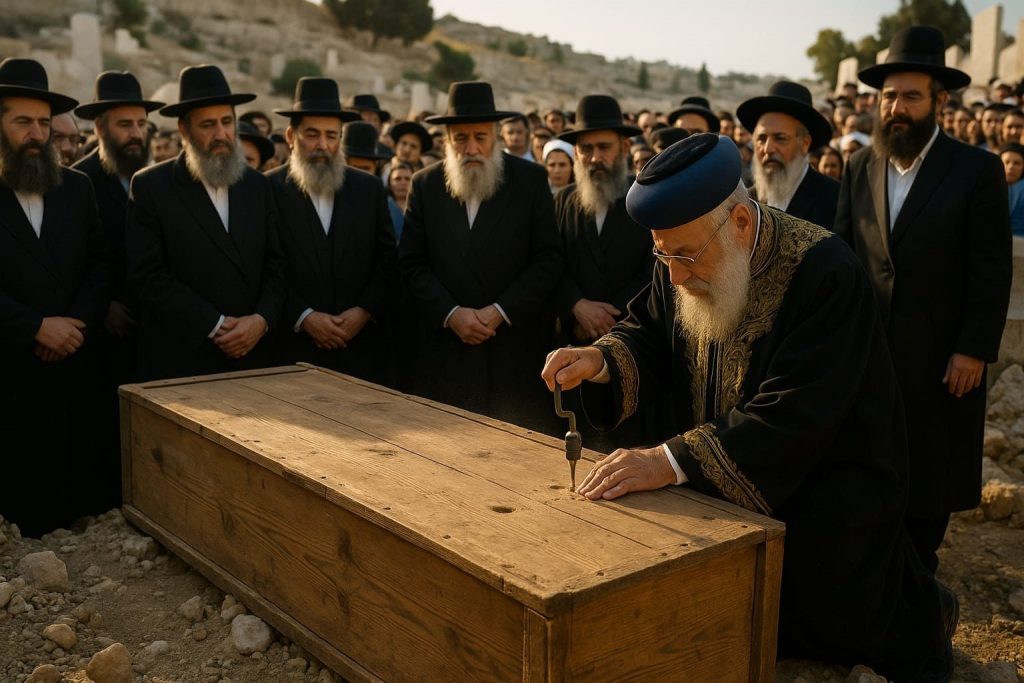
Before the burial, Rabbi Mordechai Eliyahu bent down beside the coffin, holding a small drill in his hands.
The crowd watched in silence.
“In Eretz Yisrael,” he said gently, “we don’t usually bury people inside a box. We let them rest right in the holy ground, as the Torah says, ‘From dust you came, and to dust you shall return.’
But because the Chida came from far away, we cannot open his coffin. So I will make three small holes, so the holy earth can touch his bones.”
He drilled slowly – one, two, three – and the soft wind carried the sound over the hill.
Some whispered that the three holes stood for Torah, tefillah, and acts of kindness – the three things the Chida taught with his life.
When he finished, Rabbi Eliyahu placed his hand on the coffin and whispered, “Welcome home, Rav Chida.”
And the people answered, “Amen!”
Beis Moshiach #1481 • pp. 54-58
© 2026 Beis Moshiach Magazine. All rights reserved.
This article originally appeared in Beis Moshiach #1481. You are welcome to share it with friends and family by email or in print, provided that you do not change, add to or omit any part of it, you credit the author and Beis Moshiach, and you include a link to archive.bmoshiach.org (written out in full in printed copies).
To republish this article in a newspaper, magazine, book or website, please request permission in advance at [email protected].