WD-8 For the Soul
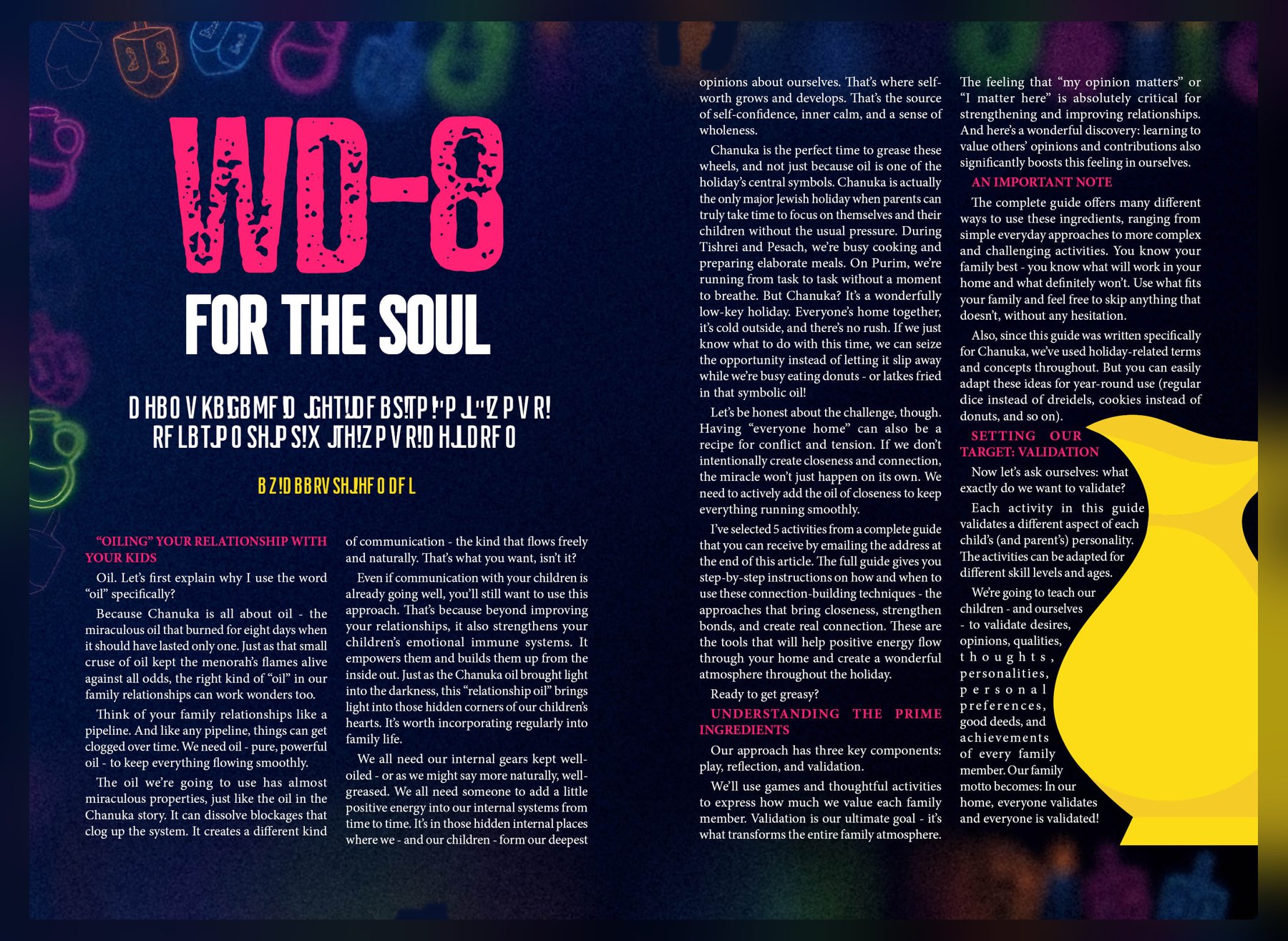
“Oiling” Your Relationship With Your Kids
Oil. Let’s first explain why I use the word “oil” specifically?
Because Chanuka is all about oil – the miraculous oil that burned for eight days when it should have lasted only one. Just as that small cruse of oil kept the menorah’s flames alive against all odds, the right kind of “oil” in our family relationships can work wonders too.
Think of your family relationships like a pipeline. And like any pipeline, things can get clogged over time. We need oil – pure, powerful oil – to keep everything flowing smoothly.
The oil we’re going to use has almost miraculous properties, just like the oil in the Chanuka story. It can dissolve blockages that clog up the system. It creates a different kind of communication – the kind that flows freely and naturally. That’s what you want, isn’t it?
Even if communication with your children is already going well, you’ll still want to use this approach. That’s because beyond improving your relationships, it also strengthens your children’s emotional immune systems. It empowers them and builds them up from the inside out. Just as the Chanuka oil brought light into the darkness, this “relationship oil” brings light into those hidden corners of our children’s hearts. It’s worth incorporating regularly into family life.
We all need our internal gears kept well-oiled – or as we might say more naturally, well-greased. We all need someone to add a little positive energy into our internal systems from time to time. It’s in those hidden internal places where we – and our children – form our deepest opinions about ourselves. That’s where self-worth grows and develops. That’s the source of self-confidence, inner calm, and a sense of wholeness.
Chanuka is the perfect time to grease these wheels, and not just because oil is one of the holiday’s central symbols. Chanuka is actually the only major Jewish holiday when parents can truly take time to focus on themselves and their children without the usual pressure. During Tishrei and Pesach, we’re busy cooking and preparing elaborate meals. On Purim, we’re running from task to task without a moment to breathe. But Chanuka? It’s a wonderfully low-key holiday. Everyone’s home together, it’s cold outside, and there’s no rush. If we just know what to do with this time, we can seize the opportunity instead of letting it slip away while we’re busy eating donuts – or latkes fried in that symbolic oil!
Let’s be honest about the challenge, though. Having “everyone home” can also be a recipe for conflict and tension. If we don’t intentionally create closeness and connection, the miracle won’t just happen on its own. We need to actively add the oil of closeness to keep everything running smoothly.
I’ve selected 5 activities from a complete guide that you can receive by emailing the address at the end of this article. The full guide gives you step-by-step instructions on how and when to use these connection-building techniques – the approaches that bring closeness, strengthen bonds, and create real connection. These are the tools that will help positive energy flow through your home and create a wonderful atmosphere throughout the holiday.
Ready to get greasy?
UNDERSTANDING THE PRIME INGREDIENTS
Our approach has three key components: play, reflection, and validation.
We’ll use games and thoughtful activities to express how much we value each family member. Validation is our ultimate goal – it’s what transforms the entire family atmosphere. The feeling that “my opinion matters” or “I matter here” is absolutely critical for strengthening and improving relationships. And here’s a wonderful discovery: learning to value others’ opinions and contributions also significantly boosts this feeling in ourselves.
AN IMPORTANT NOTE
The complete guide offers many different ways to use these ingredients, ranging from simple everyday approaches to more complex and challenging activities. You know your family best – you know what will work in your home and what definitely won’t. Use what fits your family and feel free to skip anything that doesn’t, without any hesitation.
Also, since this guide was written specifically for Chanuka, we’ve used holiday-related terms and concepts throughout. But you can easily adapt these ideas for year-round use (regular dice instead of dreidels, cookies instead of donuts, and so on).
SETTING OUR TARGET: VALIDATION
Now let’s ask ourselves: what exactly do we want to validate?
Each activity in this guide validates a different aspect of each child’s (and parent’s) personality. The activities can be adapted for different skill levels and ages.
We’re going to teach our children – and ourselves – to validate desires, opinions, qualities, thoughts, personalities, personal preferences, good deeds, and achievements of every family member. Our family motto becomes: In our home, everyone validates and everyone is validated!
SPINNING DESIRES
The Validation Concept
Children’s desires can’t always be fulfilled in practical ways. Daily schedules and house rules don’t allow for setting up a camping tent in the middle of the living room, for example. We can’t serve french fries at every supper either. But here’s the key: we can validate the desire itself even without acting on it. We can always do that.
In this activity, we’re not preparing to fulfill anyone’s wishes – at least not right now. Instead, we’re creating important, meaningful space for children’s hopes and dreams. Why? Because desire reflects the soul, and a person’s deepest wishes reveal their true dignity and worth.
What We’ll Need
Two dreidels and sticky notes or labels
Advance Preparation
Dreidel #1 – Attach labels to each of the four sides with these phrases:
• Side 1: “I wish I had…”
• Side 2: “I wish there was less…”
• Side 3: “I wish I could change…”
• Side 4: “I wish I could keep…”
Dreidel #2 – Attach labels to each of the four sides with these phrases:
• Side 1: “At home”
• Side 2: “At school”
• Side 3: “About myself”
• Side 4: “In our family”
How to Play
Each child takes a turn spinning both dreidels, then answers based on the combination that comes up. For example, they might spin “I wish I had…” and “At school,” leading them to complete the thought.
The Golden Rule: Every desire is legitimate and valid. Don’t dismiss or criticize any wish. Everything can be said here!
Taking It Further
When a child expresses a wish, ask how many other family members want the same thing. The child receives candies or chocolate coins equal to the number of people who share their wish.
If nobody else shares their particular wish, that’s a sign it’s especially unique and original – so that child gets six candies or coins as a reward for their creative thinking!
A CANDLE TO ILLUMINATE
The Validation Concept
Every person has positive qualities and strengths. We all know this intellectually, but here’s the real question: Are we truly aware of our children’s good qualities on a deep level? Are the children themselves aware of their own positive traits?
These are excellent questions, and today we’re going to do something that helps us answer “yes” to both.
Recognizing and actively validating our children’s positive qualities is one of the fastest and most powerful ways to strengthen both your relationship with them and their own emotional foundation.
What We’ll Need
• One large candle for each family member
• Poster board or cardstock
• Scissors
• Markers
Advance Preparation
On the poster board, write out many different positive qualities. Think broadly: kindness, creativity, determination, helpfulness, sense of humor, thoughtfulness, patience, courage, curiosity, generosity, etc.
Cut these into individual strips.
Label each candle with one family member’s name.
How to Play
Step 1: Each child receives another family member’s candle (not their own). Using melted wax as glue, they attach quality strips that they believe describe that person. Each candle should have at least three quality strips, but more is definitely encouraged!
Step 2: The Candle Presentation Ceremony
Gather everyone together for this special moment. Here are several ways to make it meaningful (feel free to use any or all of these):
• Sharing examples: The child who decorated the candle picks one quality they attached and shares a specific example or story that demonstrates when they saw this quality in action.
• Personal reflection: The child receiving the candle shares which quality they definitely agree they have, and mentions if any of the qualities surprised them to hear.
• Choosing favorites: The child receiving the candle selects the quality they value most about themselves from among those listed.
• Aspiring to grow: Each child can choose one quality from someone else’s candle that they’d like to develop more in themselves. This allows them to express how important and valuable they find that particular strength.
Remember: A quality is like candlelight – you can share it and give it away endlessly, and you’ll always have more to give.
FINDING LIGHT IN OUR CHALLENGES
The Validation Concept
Personality is everything. It includes our qualities, our talents, and our desires. And yes – it also includes our weaknesses and challenges.
Here’s something important to understand: our personalities are actually shaped more by our challenges than by our natural talents. Talents are gifts we receive automatically, but challenges are something we have to work on. And that work – that effort to improve and grow – creates real character and builds genuine personality.
A person develops true depth and becomes a real “personality” when they work on themselves and address their challenges, much more than when they simply coast on the abilities they were born with.
In this game, your children will discover something powerful: even weaknesses and challenges bring their own kind of light and positive potential. They won’t necessarily be thinking about their own specific challenges – we’re looking at this concept in a more general, universal way.
What We’ll Need
Two sets of cards (you can use index cards or cardstock)
Advance Preparation
Card Set #1 – Challenges (write each on a separate card):
• Stubbornness
• Pride
• Impulsiveness
• Irresponsibility
• Putting too much pressure on oneself
• Mischievousness
• Being overly frugal/stingy
• Shyness
Card Set #2 – Hidden Strengths (write each on a separate card):
• The ability to achieve goals without giving up on what matters
• The ability to feel tremendous joy when overcoming obstacles or accomplishing something good
• The ability to get many good things done quickly
• The ability to stay calmer when things don’t go according to plan
• The ability to think ahead and prepare backup solutions in case of problems
• The ability to enjoy and appreciate every moment
• The ability to manage money and resources wisely without waste
• The ability to truly listen to and understand others
Hide the cards from Set #2 throughout your home—in drawers, behind picture frames, under cushions, etc. Write yourself a list of hints about where you hid each one so you can guide the children later if needed.
Keep Set #1 with you to distribute during the game.
How to Play
Phase 1: The Search (5 minutes)
Turn on some upbeat Chassidishe music. For five minutes, children search throughout the house for the hidden cards. Important rule: they can look at the cards when they find them, but they can’t touch or move them – only remember where they are.
Phase 2: Making Connections
After the five-minute search ends, give each child one card from Set #1 (the challenges). Depending on how many children you have, some might receive two cards.
Now each child tries to match their challenge card with one of the hidden strength cards they found. They should think: “How could this challenge actually become a strength?”
When they think they’ve found a match, they go retrieve that hidden card.
Scoring:
• Found a good match? They earn points and receive another challenge card to work with.
• If not all the hidden cards were found, children can suggest what might be written on the missing cards based on the challenges that haven’t been matched yet.
Give hints to help them locate any remaining cards. When they find a card and discover what it says:
• If their guess was right, they earn one chocolate coin
• If their guess was different, they earn TWO chocolate coins – because now they have two different ideas about how that challenge could become a strength!
For Advanced Players
For each challenge card from Set #1, have children suggest one specific, practical action that someone with that challenge could take to work on improving it.
The key word here is practical. “Set an alarm clock to wake up five minutes earlier each day” is a practical idea. “Stop being lazy” is not practical – it’s too vague and doesn’t give anyone actual steps to follow.
Beis Moshiach #1487 • pp. 42-47
© 2026 Beis Moshiach Magazine. All rights reserved.
This article originally appeared in Beis Moshiach #1487. You are welcome to share it with friends and family by email or in print, provided that you do not change, add to or omit any part of it, you credit the author and Beis Moshiach, and you include a link to archive.bmoshiach.org (written out in full in printed copies).
To republish this article in a newspaper, magazine, book or website, please request permission in advance at [email protected].