Category 5 Mesirus Nefesh
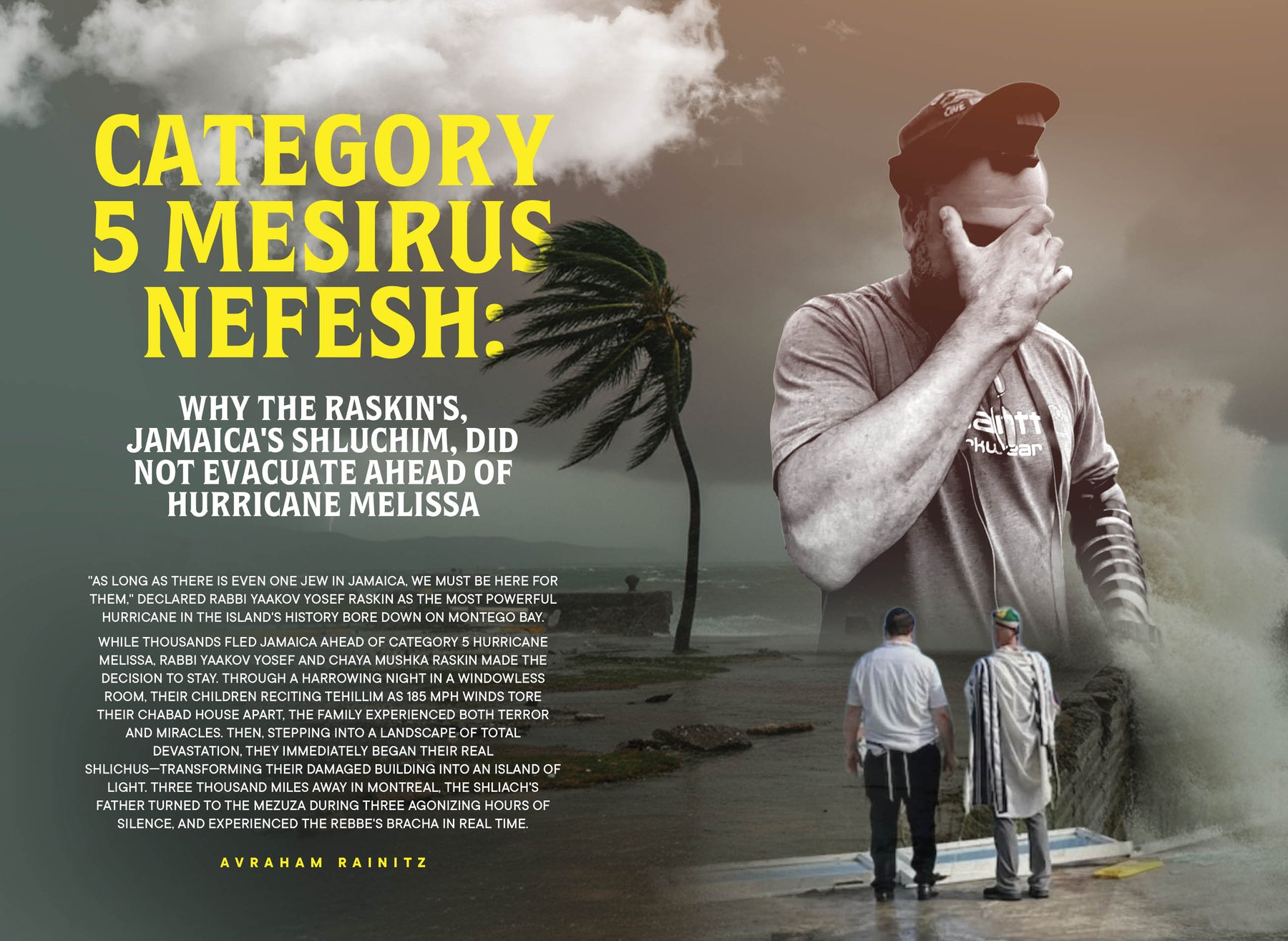
“As long as there is even one Jew in Jamaica, we must be here for them,” declared Rabbi Yaakov Yosef Raskin as the most powerful hurricane in the island’s history bore down on Montego Bay. While thousands fled Jamaica ahead of Category 5 Hurricane Melissa, Rabbi Yaakov Yosef and Chaya Mushka Raskin made the decision to stay. Through a harrowing night in a windowless room, their children reciting Tehillim as 185 mph winds tore their Chabad House apart, the family experienced both terror and miracles. Then, stepping into a landscape of total devastation, they immediately began their real shlichus – transforming their damaged building into an island of light. Three thousand miles away in Montreal, the shliach’s father turned to the mezuza during three agonizing hours of silence, and experienced the Rebbe’s bracha in real time.
At the end of this past October, the Raskin family gathered in a small, windowless room. Outside the trembling walls, Hurricane Melissa raged – a Category 5 hurricane, the strongest in the island’s history. Winds of approximately 300 kmh (185 mph) shrieked around them, tropical rains dumped a meter of water onto the island, and infrastructure collapsed one after another.
Inside the improvised safe room huddled the Rebbe’s shluchim in Montego Bay, Jamaica – Rabbi Yaakov Yosef and his wife Chaya Mushka Raskin and their children – praying for a miracle. “When the windows shattered and the doors broke – water penetrated every corner,” describes R’ Yaakov Raskin. “Our children sat and davened that nothing would happen to us. It was genuine mortal danger.” Long hours of deafening winds and tremors passed over them in the small bunker.
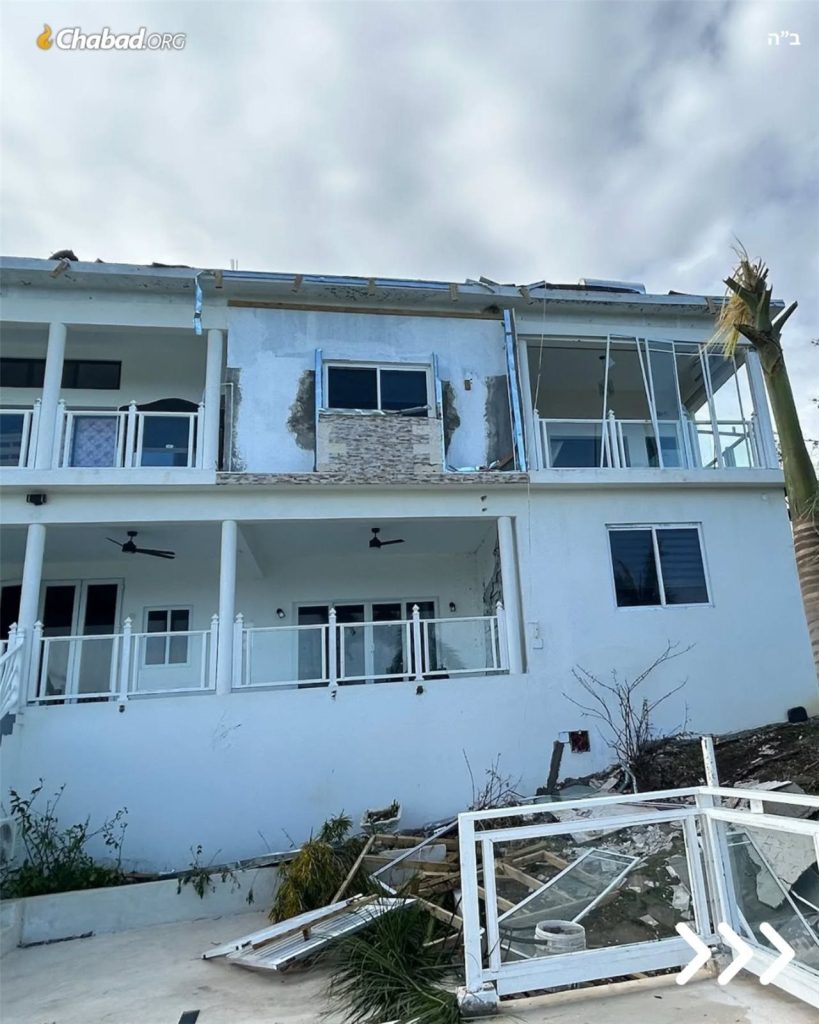
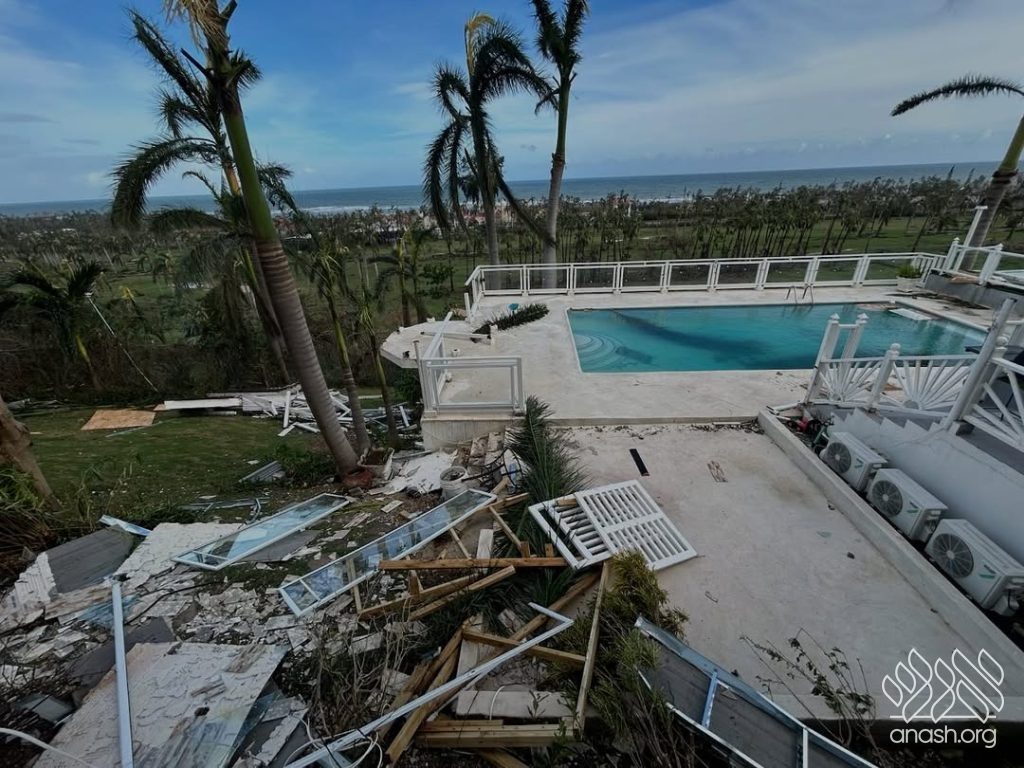
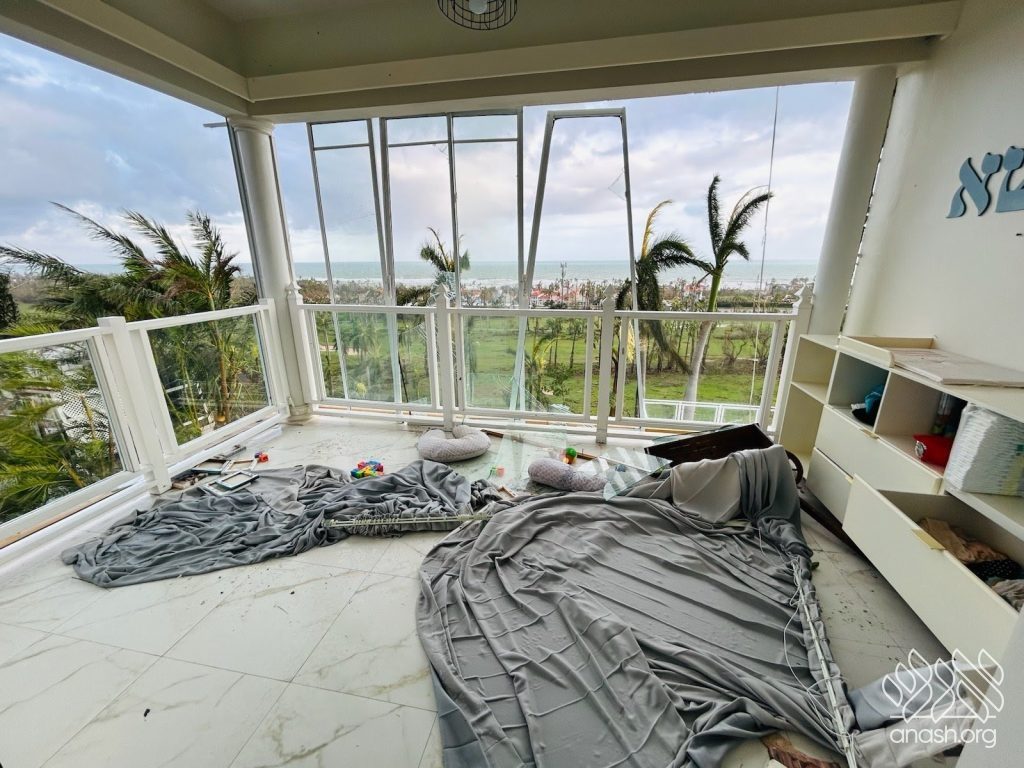
The morning after, the family members emerged to a new and bitter reality: large parts of their Chabad House had been destroyed. Windows were shattered, doors torn from their hinges, and an electrical pole had collapsed at the building’s entrance. Even the stock of kosher food they had stored in refrigerators – food intended for the community after the storm – was completely destroyed. “This is a severe blow not only to the structure, but also to the ongoing activities that provide spiritual and material support to Jewish tourists and local Jews,” R’ Raskin explained sadly. But in that moment of total destruction, a new chapter of their shlichus began – a shlichus under storm, filled with emuna, determination, and chesed.
The First Chabad House in Jamaica
Years before it became a lifeboat in the storm, that apartment in Montego Bay was the first Chabad House on the island of Jamaica. In 2014, Rabbi Yaakov Raskin and his wife Chaya Mushka set out on their shlichus to the Caribbean island nation, establishing Chabad House in Montego Bay, Jamaica. For the first time in history, Jamaican Jews had a permanent Jewish address year-round. The young couple quickly became the central anchor of the tiny Jewish community in the country. They established a Jewish center in the heart of the tourist area and built the island’s first-ever Jewish mikva, a significant milestone in local Jewish life.
Since its establishment, the Chabad House in Jamaica has served as a magnet for Jews of all types – locals, business people, and thousands of travelers and tourists who visit Jamaica on vacations and backpacking trips. The center is open year-round and serves as a “home away from home.” There, travelers can daven, put on tefillin, light Shabbos candles, eat kosher food, and even immerse in the mikva – things that once didn’t exist on the isolated island.
The Chabad House became a one-stop address for every Jewish need, material or spiritual, for the Jewish tourist and for the few Jewish residents scattered across the island. Inspired by the Rebbe’s sichos about the Seven Noahide Laws, R’ Raskin publishes opinion columns in the local press and gains recognition even among non-Jews.
The Storm of the Century
Worrying weather reports began arriving; a tropical storm named “Melissa” was forming in the eastern Caribbean and gaining momentum. Reports spoke of a storm that could break strength records, but it was difficult to predict its severity. R’ Raskin and his family members, who had gained experience dealing with natural forces, followed closely. Just a year earlier, in Elul 5784, Hurricane “Beryl” (Category 4) struck the island, caused damage to the Chabad House, and R’ Raskin then led an extensive aid operation that included distributing generators, water, and food to hundreds of victims in Jamaica.
“We suffered $30,000 in damage to the Chabad House then, but that was a rich person’s problem compared to the people who lost their homes,” R’ Raskin said, referring to the previous storm. Now, forecasts spoke of something much more severe: Melissa was classified as a Category 5 hurricane – maximum strength – and could be Jamaica’s ‘storm of the century.’ While local authorities called on citizens to evacuate from disaster-prone areas and many travelers rushed to the last flights before the airport’s closure, the Raskin shluchim made a courageous decision: they would stay on the island, at any cost. “As long as there is even one Jew in Jamaica, we must be here for them,” said R’ Raskin on the eve of the storm, making clear he would not abandon the place in an emergency.
In the days before the storm, the Raskin couple worked to turn the Chabad House into a ‘fortress,’ protected as much as possible. They filled the building with essential supplies: thousands of liters of drinking water, large quantities of dry and canned food products, mattresses and beds, and even sandbags to seal openings. In wonderful hashgacha pratis, three food shipments ordered before Rosh Hashana that hadn’t arrived on time – arrived at the Chabad House’s warehouse just days before the storm. “This is nothing less than a miracle,” R’ Raskin said about the “delivery from Heaven” that helped in the preparation.
The shluchim sent an email to a mailing list of contacts worldwide, asking everyone to pray for their safety and the safety of other Jews in Jamaica. Simultaneously, many volunteers were recruited from the community and among travelers still in the area to help fortify the structure: they sealed windows and doors with wooden boards, reinforced walls, and added protective layers wherever possible. An emergency generator was prepared for use, 500 gallons of diesel fuel were stored on site, as well as satellite phones and backup batteries in case of complete communication breakdown.
“We are the Rebbe’s shluchim here in Jamaica,” R’ Raskin emphasized on the eve of the storm, while making final preparations. “Our responsibility is for every Jew on the island. We’re preparing for the worst and hoping for the best – G-d runs the world, and our job is to prepare as best we can and trust that He will do the rest.”
Then it happened. Hurricane Melissa intensified at a frightening speed – from tropical storm status it became a Category 5 monster within 36 hours, as Montego Bay airport closed and the last planes took off at the last moment. The Raskin family could no longer evacuate from the island, nor did they want to. To save others, they even brought into their home a family of Jewish tourists who were staying in a vulnerable area near the coast, inviting them to stay with them at the Chabad House where the structure was built strong on a high hill.
In the evening, Melissa struck Jamaica’s shores with full force – winds of 185 miles per hour and torrential rains dumping over 40 inches of precipitation. The sound was unmistakable – a roar rising from the sea and rolling across the land. Electricity went out at once, darkness fell over most parts of the country, and in its place came the terrifying sounds of the wind whistling and objects and trees crashing.
A Stormy Night, and Miracles Unfold
In those fateful hours, the Raskin family gathered in the protected space they had chosen – an interior room on the ground floor, without windows. They piled mattresses, beds, and closets against the walls and door to reinforce them from inside. Rabbi Yaakov Raskin himself stood and pushed with his body a metal bed frame against the entrance door, trying to block it from the winds that were about to tear it from its place. His wife Chaya embraced their young children in the safest corner – and together they began reciting Tehillim. “We kept davening the whole time,” they recounted later.
While one family prays in isolation inside a sealed room, another family – that family of Israeli tourists evacuated to Chabad House – davens in the adjacent room. A protected place had also been prepared for them inside the building.
At a relatively early stage of the storm, when rainwater began leaking into the shul on the lower floor, R’ Raskin ran to rescue the Sifrei Torah from the aron kodesh and moved them to the mikva room – a small room without windows, the only one in the building that remained completely dry. Thus the Sifrei Torah were saved from damage.
The giant storm didn’t skip the Chabad House. Although the building had been renovated two years earlier and equipped with ‘hurricane-resistant’ doors and windows, Melissa’s force was exceptional, beyond any known standard. Within minutes the main glass door flew from its place, the shutters collapsed with a deafening noise, and most windows shattered to pieces. Giant air conditioners installed on the roof were torn from their places, large solar panels were blown away as if they were leaves in the wind. The emergency generator that had been prepared – failed and didn’t activate at all after the electrical system went out.
Within minutes, parts of the building were flooded with water. The bedrooms on the upper floor were completely destroyed; “Our daughters’ room simply disappeared,” R’ Raskin reported later in shock. In that room stood freezers full of all the kosher meat and poultry prepared for distribution after the storm – all were lost with the wall’s collapse in that wing. Communication with the outside world was almost completely cut off: telephone lines collapsed, the internet went down, and even the satellite system (Starlink) that provided the Chabad House with backup – stopped working at the storm’s peak. Only one cell phone remained with some battery and occasionally caught weak cellular reception – through it family members tried to send short text messages when possible.
In the sealed room inside the house, the noise was more muffled but still frightening. “We heard the windows shattering one by one, doors warping, the roof coming apart above us from the wind’s force,” the shluchim described. Through the gap under the door they saw water flowing inside to the hallway. In the darkness, the children gathered together and continued reciting Tehillim.
“Throughout the entire storm our children davened to Hashem to end this terrible situation and watch over us,” R’ Raskin related. The parents tried to calm them, while they themselves wondered in their hearts how long the house could hold out. At the storm’s peak, when the winds howled and the water level rose, a miracle occurred: the water that reached the threshold of the room where they stayed – stopped.
While the Raskin family remained in isolation, in the world outside – and even in the virtual world – a broad spiritual operation was unfolding in support of them. Members of Jamaica’s small Jewish community who couldn’t leave their homes, organized a joint virtual prayer with R’ Raskin via Zoom during the storm. Jews from across the island, and even acquaintances from afar, sent to the Chabad House’s WhatsApp pictures of themselves putting on tefillin and praying for the family’s and island’s safety.
Simultaneously, thousands of Chabad shluchim worldwide received a request to pray immediately for the safety of Jamaica’s Jews and the shluchim. “A powerful hurricane is raging at this moment in Jamaica, destroying homes and causing severe damage,” was written in the online letter sent that night, “Chabad’s shluchim on site, together with their family members, are currently staying in a secure room, disconnected from the world, wrapped only in emuna and tefilla… We ask each and every one of you to stop for a moment, open your heart, and say a chapter of Tehillim for the safety and security of Jamaica’s Jews and for the protection and salvation of the shluchim.” This spiritual support strengthened the isolated family; “We knew many good people were davening for us, and that gave us strength,” R’ Raskin said afterward.
Despite the raging storm, R’ Raskin didn’t stop thinking about other people who might be in danger. Between wind gusts he managed to catch moments of cellular reception and sent messages to several Israeli travelers he knew remained on the island in various locations. He wanted to ensure that they too had found shelter. Indeed, some of those backpackers were stuck in hotels without electricity or in disconnected resort villages, and he guided them remotely in how to stay safe and what to do during critical hours. They obviously couldn’t reach the Chabad House, but knowing someone was thinking about them from afar gave them encouragement.
From Destruction to Building
When morning came and it became clear that Melissa was moving away northward (toward Cuba and Haiti), the Raskin family finally emerged from their small shelter to see what had happened. The rising sun revealed an unprecedented landscape of destruction. Montego Bay streets were filled with ruins, palm trunks and torn trees blocking roads, electrical and telephone poles lying on the ground. Entire neighborhoods near the coast were flooded, many houses damaged or destroyed, and over 100,000 residents across Jamaica were left without electricity and water. “Like after a bombing,” the media described it.
The Jamaican government declared a national state of emergency and requested urgent assistance from the international community in rehabilitating the country. Prime Minister Andrew Holness said emotionally: “We have no electricity, no water, roads are blocked – this is a national disaster.”
In the Chabad House area, a chaotic scene was revealed: the Raskin family’s street was completely blocked by fallen trees and fences blown from their places. The family’s car was crushed under a giant tree, and it was impossible to drive it anywhere.
“To leave the neighborhood we had to walk; there’s no way to pass with a vehicle,” R’ Raskin recounted. Family members walked carefully among exposed tree branches and electrical cables, navigating their way out. Along the way they passed houses whose condition wasn’t much better: missing roofs, broken windows, furniture and items scattered in yards, and stunned people trying to digest what had happened. Many residents, including the Raskins themselves, were shocked but also full of gratitude for having survived.
Just as they decided before the storm not to leave, so the shluchim decided immediately after not to sink into mourning but to mobilize for help. Although their own Chabad House was flooded and without electricity and water, it immediately became a makeshift aid base. “Our place took a hard hit, but thank G-d we’re alive – and now we need to care for those left with nothing,” R’ Raskin said. Several Israeli tourists and even local Jews whose homes were destroyed sought and found shelter at the Chabad House with the Raskin family.
Within the destruction, the Chabad House itself – despite the damage – was still a relatively safe place: it’s built on a high hill, protected from deadly floods, and its thick walls partially survived.
The Raskin family opened what remained of their infrastructure to help neighbors. The Chabad House’s generator was started thanks to the fuel reserve that was saved, and provided electricity for several essential needs. “Our neighbors come to use our generator to charge their phones and contact their family members.” In the first days after the storm, when the entire island was shrouded in darkness, the Chabad House became a community ‘charging station.’
Additionally, the shluchim distributed mineral water and dry food from their surviving stock to the homeless in the area. Already on Wednesday, less than 24 hours after the winds subsided, R’ Raskin and several volunteers from the community and travelers organized a tour among nearby houses. They knocked door to door (in cases where there was still a door), checked on residents’ welfare, and provided bottles of water and canned goods to those in need. “Just yesterday people here went through two days of apocalyptic weather, so they’re a bit in shock,” R’ Raskin related. “Sometimes all a person needs is for someone to knock on their door, give them a hug, a short conversation, a hot meal and something to drink – and that already makes a huge difference.”
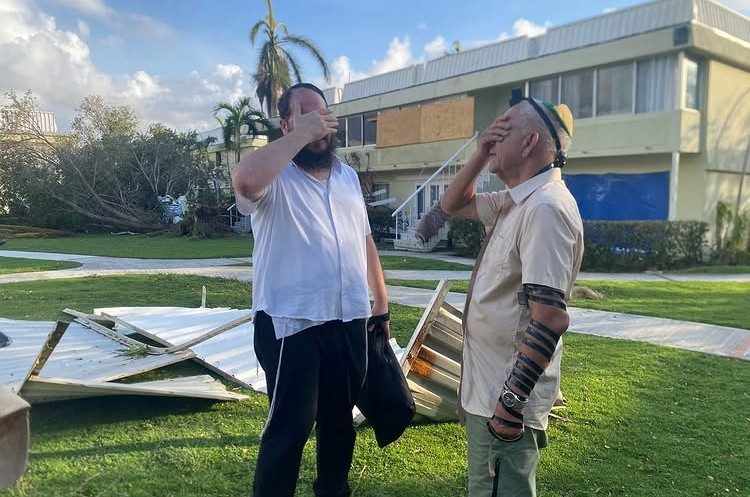
Family members and volunteers also dedicated effort to cleaning and removing hazards. During Wednesday and Thursday they labored to clear the ruins around the Chabad House: shattered glass, broken solar panels, tree branches and trunks blocking the entrance, and debris scattered everywhere. “We cleaned most of the debris around the building,” R’ Raskin reported on Thursday evening. “There’s still a mess outside, but you can already see the floor.”
Light at the End of the Tunnel
Thanks to connections the shluchim forged during their years of activity, Jewish aid networks from outside the country were immediately activated. On Friday after the storm, a small private plane landed in Montego Bay that departed from South Florida carrying emergency shipments for Jamaica, coordinated with Florida’s Hatzolah organization and supporters from around the world. The plane brought kosher food, water, medicines and medical equipment, baby food, flashlights, batteries, and other essential items for thousands of families in distress.
On Friday night after the storm, despite broken windows and darkness, an unusual group gathered around the Chabad House table: the Rebbe’s shluchim and their children with several young travelers from Israel – all dining together from what they had, thanking Hashem for coming out alive and trying to draw strength from each other. There was no electricity and no lights – only candlelight – but hearts were filled with the light of gratitude.
In the following days, additional aid and shipments continued to arrive. Within less than three days since opening the emergency campaign, the shluchim succeeded in raising over one hundred thousand dollars from donors worldwide. “We estimate the damage to us amounts to over $100,000,” R’ Raskin said. “We need this money to rebuild our place from scratch, which provides medicine, housing, and food to the Jewish community and anyone who needs help.”
The campaign, posted on the Jamaica Chabad House website and social media, emphasized to the public the center’s importance: it’s not just ‘another building,’ but a place that is the life center of a small, isolated community. Indeed, the mobilization was impressive, and many of those who were helped by the Chabad House over the years – now returned the favor with support.
As part of the rehabilitation plan, the shluchim organized a shipment of a giant container full of donated equipment that would depart by sea from the U.S. Among the items to be sent: additional generators, solar chargers, water purifiers, tents, blankets, clothes, and more. Even a special item was promised: an “atmospheric water generator” – a device capable of producing clean water from air moisture – that would be donated and installed in village areas where public water infrastructure completely collapsed.
On one of the neighborhood tours a few days after the storm, R’ Raskin had a nice surprise. He met an elderly Jew, a local resident, whose existence no one at the Chabad House knew about. The man, who lived alone and wasn’t connected to the community, was moved by the rabbi’s knock on his door. After telling the rabbi his story, R’ Raskin offered him to put on tefillin – and the man agreed. For the first time in his life, that local Jew put on tefillin, in the middle of a destroyed street in Jamaica. “It was an emotional conclusion, for precisely from within the destruction we met a new Jewish neshama and brought to it the light of a mitzva.” For that Jew, and also for the shluchim, this moment illustrated that even in the greatest darkness – it’s possible to light a light of hope.
Three Hours of Disconnection, the Story of the Mezuza, and the Rebbe’s Bracha
The shliach’s father, Rabbi Menachem Mendel Raskin, one of the Rebbe’s shluchim in Montreal, relates:
“Throughout all the hours while the storm raged, we maintained constant contact with our children and grandchildren. But suddenly, at the most critical moments, contact was lost, and we couldn’t reach them by phone. It’s impossible to describe the anxiety we had in those moments. We tried to strengthen ourselves in emuna and bitachon in Hashem but it wasn’t easy. An hour, and another hour, and almost three hours passed. We tried calling them every few minutes, and we couldn’t get through.
“In those moments I remembered a story I heard from my father-in-law Rabbi Mordechai Gurary, in the name of Rabbi Nachman Yosef Twersky:
“Rabbi Moshe Yitzchok from the city of Iasi in Romania was among the young Chassidim of the Alter Rebbe. On one of his visits to the Rebbe, he told of persecutions suffered by Chabad Chassidim in Iasi, and in response the Rebbe instructed that the Chassidim in Iasi organize as a separate community. On that occasion, R’ Moshe Yitzchok asked the Rebbe what he should do if he urgently needed the Rebbe’s bracha, since the distance between Iasi and Liozna was great. The Rebbe told him: in time of need, approach the mezuza, say my name and my mother’s name, and I will hear your request.
“When R’ Moshe Yitzchok returned to Iasi, he established the community as the Rebbe instructed, and one of the town’s wealthy men took upon himself to finance the expenses of the new community. A short time later, the wealthy man fell seriously ill, and his life was in danger. When R’ Moshe Yitzchok came to visit him, he heard some whispering that this was the wealthy man’s punishment for helping the Chabad community…
“He entered the wealthy man’s room, and when he saw the severe condition, he turned to those present and asked them to leave the room. Only one Chassid hid in curiosity to see what would happen. R’ Moshe Yitzchok approached the mezuza, said the Alter Rebbe’s name and his mother’s name, and began pleading in prayer for the wealthy man’s recovery. Within a short time the wealthy man awakened from his illness until he recovered completely.
“This story, I heard b’hashgacha pratis on the morning of the storm. After almost three hours passed without any contact with the children, I approached the mezuza and spoke with the Rebbe. I simply asked with all my heart for the children, his shluchim.
“Not even one minute passed and the phone rang. On the line were the kids with a reassuring update, that everything was fine, and the storm was moving away from them! This isn’t a story that happened two hundred years ago, but a story that happened this week, b’didi hava uvda!”
Beis Moshiach #1485 • pp. 20-29
© 2026 Beis Moshiach Magazine. All rights reserved.
This article originally appeared in Beis Moshiach #1485. You are welcome to share it with friends and family by email or in print, provided that you do not change, add to or omit any part of it, you credit the author and Beis Moshiach, and you include a link to archive.bmoshiach.org (written out in full in printed copies).
To republish this article in a newspaper, magazine, book or website, please request permission in advance at [email protected].