Sad To See The Money Back
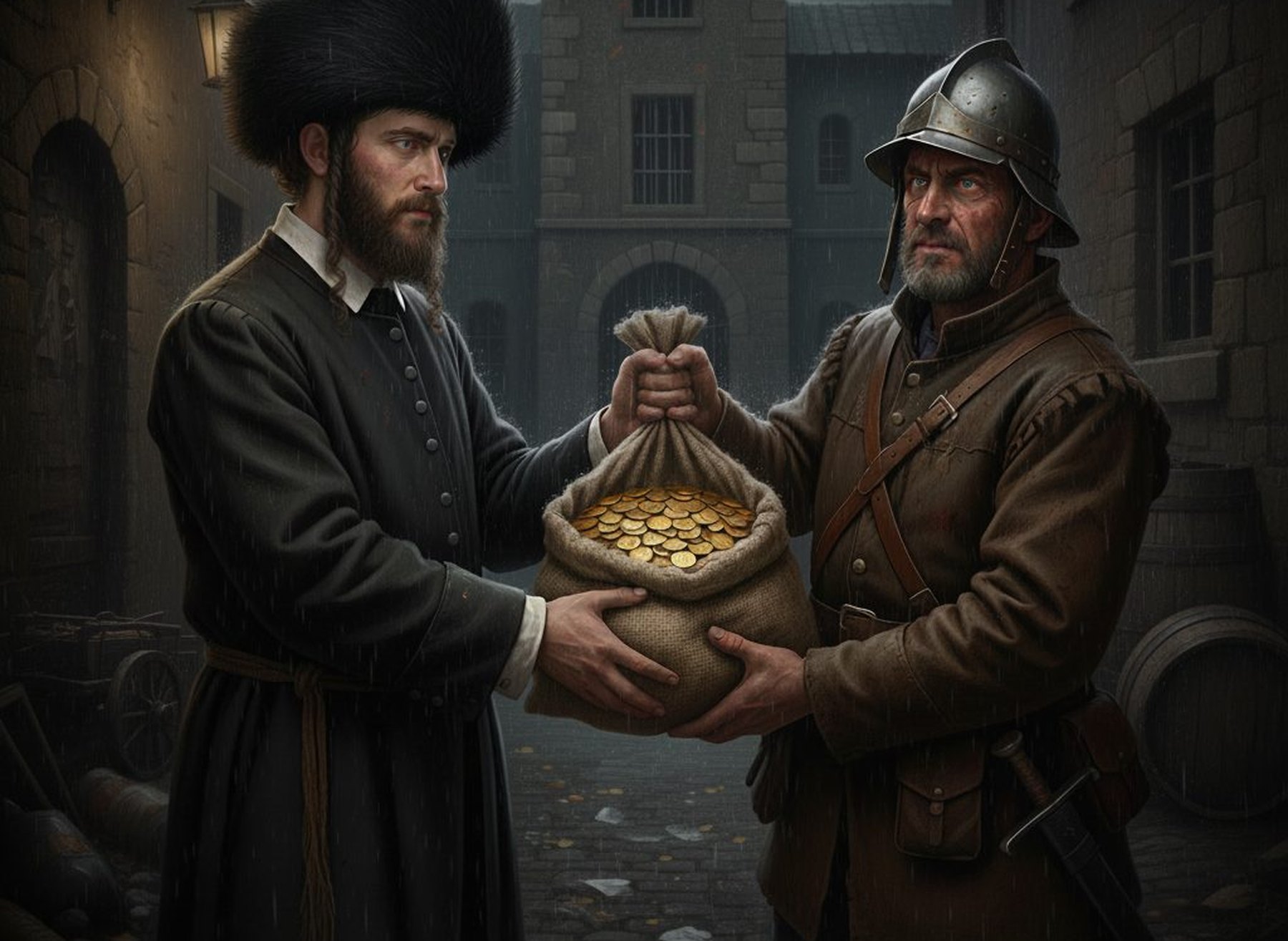
Previously: The goyim in Hamburg build a tumah near the shul to spite the Yidden. Reb Yonasan Eibeshutz’s chavrusa takes matters into his own hands and saws off the avoda zara symbol from the roof. He gets caught and faces execution. The prison guards offers the community leaders to release him for a bribe of 3,000 gold coins.
Rav Yonasan ran home. Elke, his wife, had a dowry, a special gift, she got from her father at her wedding – three thousand gold coins. They had not used it yet. To save a life, he thought.
He moved a small chest, lifted a floorboard, and took out a sack of coins. He hid it under his coat and went to the empty lot behind the old tavern. There was hard dirt, some weeds, and a little chicken coop. The moon came and went behind clouds.
Thomas appeared, looking around. Rav Yonasan handed him the sack. Thomas opened it and let the coins slide through his fingers. The gold made a soft, heavy sound.
“My friend?” Rav Yonasan asked.
“Go to the area behind the church,” Thomas said. “Wait by the small back door. I will use the guard’s passage.” He hurried away.
Rav Yonasan waited by the hedge. It felt like forever. Then, the door opened a little. A shape came out.
“Shimon,” he whispered. “Pssst – here!”
Reb Shimon limped to the hedge and slipped through. They ran to his house. There were hugs and tears. But it wasn’t safe to stay. The church would look for him.
“Not the main road,” Rav Yonasan said. “Too many eyes. Guards stand at the big gate at dawn.”
Before dawn, a small cart came to the narrow alley behind the houses. The driver laid soft cloth sacks on the cart floor. Then, he put some small logs and sticks on top. He added two bags of grain for bread and an old flour bag tied shut with string. Now, the cart looked like a normal delivery.
“Quick!” he whispered.
Reb Shimon lay flat between the sacks. Rav Yonasan covered him, so the cart looked like it carried wood and grain, not a person. The cart smelled like smoke and flour.
They went on quiet side streets and crossed a small bridge, where no guard watched.
At the river, a little fishing boat waited. The boatman was a friend. He gave a small nod and said nothing. They got in. The boat moved through the morning fog toward Altona, a nearby town with a different ruler.
On the other side, friends were waiting with a covered wagon. “We will take him the rest of the way,” they said.
When the boat looked tiny, Rav Yonasan let out a long breath. His job for that night was done.
* * *
Early the next morning, as Rav Yonasan and his wife sat down to share a bite of breakfast, there was urgent pounding on the door.
Rav Yonasan froze. Did the pounding have anything to do with his late-night meeting with the church guard? His wife, Elke, couldn’t know about this!
“I wonder who that could be, so early in the morning,” Rebbetzin Elke said, starting for the door.
“That’s alright – I’ll get it,” Rav Yonasan said.
But he was too late; Elke had already opened the door. Two young men stood there, very serious.
“Yaakov and Shmuel! How can we help you?” Rav Yonasan asked.
“You may have heard about the imprisonment of our dear friend, Reb Shimon Rosen,” Yaakov began. “We’ve been sent to collect funds to free him from a terrible fate. It’s extremely urgent.”
Rav Yonasan remembered. He called them into his study and closed the door tightly.
“There’s no need to worry,” he said softly. “It’s over! He’s free!”
“What’s over? How can he be free…? What are you talking about, Rav Yonasan?”
“Reb Shimon. He is free. I paid the full amount.”
“What do you mean?” they asked. “We’ve been collecting all of last night and this morning. We have over a thousand gold coins already. What are we supposed to do with all this money?”
“Why is that a problem? The main thing is that Reb Shimon is free!”
“We worked hard for this mitzva, and we don’t want to give it up!” the collectors said. “All the people who gave money also want a part in the mitzva! Here – take the money we’ve collected so far, so at least everyone will have a share in the great mitzva of pidyon shevuyim.”
Rav Yonasan considered this. He had given away a tremendous sum of money, and it had been meant to pay for food and clothes for his family for many years…
“No!” he said firmly. “Hashem granted me the opportunity to do the mitzva, and I won’t sell it for a few coins! You can return all the money; I’m not selling even a small part of this mitzva.”
The argument continued for a while, and, eventually, the three went to the leaders of the kehillah. Everyone begged Rav Yonasan to accept the tzedaka money in exchange for part of the amount he’d given the church guard, but he ignored them.
On his way home, Rav Yonasan worried about a different problem. Elke would soon discover that the money was missing – what would he do then? She would probably be upset. How would he explain what he’d done?
He pondered his options, and finally decided the best thing was to travel out of town for a few days. Meanwhile, Elke would likely discover the money was missing and assume there had been a break-in while her husband was away. Even if she realized what had happened, she would come to terms with it. And whatever was going on within the church walls would probably blow over by then; their people would stop searching for the source of Reb Shimon’s freedom, and Elke would get over their loss.
“Something came up,” Rav Yonasan told his rebbetzin that evening. “I must travel to a nearby town for about a week.”
He packed a small bag and set out, praying to Hashem that he was doing the right thing for his family.
* * *
In the quiet halls with church offices, people were angry. The Jewish prisoner was gone. It felt like an “inside job.” Everyone pointed at someone else.
Thomas, the night guard, tried to blame other people too. But the leaders said, “We checked every angle. Only one person knew the cell and had the key. It was him.”
Thomas was hiding by the stairs. He held his breath. They meant him.
Now his life was in danger. He had to run.
Thomas ran to his small room. He threw a few things into a bag, and was about to leave – then he froze.
His treasure! For forty years, he had taken little things. And now, he also had 3,000 gold coins! He couldn’t leave it. People would find it and take it back. But he couldn’t carry it all and still run fast… It was too heavy.
He needed a hiding place, fast.
Thomas grabbed a big bag. He stuffed it with jewels, gold jewelry, and coins. He snapped it shut. He knew just the place to hide it.
He slipped into the hallway and hurried away.
* * *
Rebbetzin Elke made tea and began to say Tehillim. Bang! Bang! Bang! Someone pounded on the door. She jumped.
“Who is it…?” she called.

“Please open! I’m a friend of your husband! I need help!” a voice answered.
Elke peeked through the curtain. A man was outside. His clothes were strange. He looked scared.
“Where is Rabbiner Eibshutz?” the man whispered. “Please – I must speak to him now.”
“He’s not home,” said Elke. “He’s out of town. Can I help you?”
The man looked around the street, then back at her. “Listen. I have to return your 3,000 gold coins – the money your husband gave me.”
Elke’s eyes widened. “He… gave you our dowry?”
“Yes,” the man said. “I… guess I didn’t know it was your dowry, but… yes. He asked me to free your friend, Reb Shimon. I took the money and did it. I snuck him out of the cell and helped him run.”
“So that’s where he went,” Elke thought. “Baruch Hashem.” Aloud, she asked, “Why are you bringing the money back…?”
“They’re after me,” he said. “I can’t carry it and still run. Your family should have it back.” He bent, lifted a heavy case, and set it inside the doorway. “Please also keep this suitcase for him.”
“What’s inside?” Elke asked.
“Jewels. Gold and silver coins,” the man said. “Hundreds. I have no time. I trust Rabbiner Eibshutz more than anyone else in this town. He’s an honest man. He’ll keep it safe. If I don’t come back… this is the best place for it.”
Elke looked at the case, then at the stranger. “What’s your name?”
He swallowed. “Thomas.”
“Thomas,” Elke said gently, “Hashem should protect you.”
Thomas gave a quick nod. “Thank you,” he said. “Tell your husband… I returned it.”
He hurried down the steps and ran into the night. The street went quiet again. Elke closed the door softly and stood still, listening to her heartbeat.
She whispered a kapitel of Tehillim and thanked Hashem for His kindness.
* * *
The suitcase sat by the door. Elke waited until the street was quiet, then pulled the heavy case inside. Click. She locked the door again.
She knelt on the floor. Snap. Snap. She opened the latches. Inside was a tied bag on the very top. It was heavy and round. She loosened the string and peeped inside. Coins. A lot of coins.
“A bag with 3,000 thaler,” she whispered.
Under the bag lay shining things – bright red stones, deep blue stones, clear ones that flashed. There were gold rings, little silver coins, and tiny trinkets shaped like leaves and flowers. The colors danced in the light from the window.
* * *
After a few days, Elke went to the market for bread and fish. By the water pump, she heard two priests talking in low voices.
“Thomas,” one said. “The one who freed the Jew.”
“Yea,” the other whispered. “He ran.”
“He was taken care of,” the first said. “He got what he deserved.” He snorted a little laugh and tapped his stick.
The other man smirked. “Rivers don’t talk,” he said, like a joke.
They looked around, still smiling, and walked away. Elke watched them go and understood: Thomas would not be coming back.
Elke stood very still. She put her hand on the case. “Hashem gave this back to us,” she said softly. “Maybe because we helped Reb Shimon.”
She closed the case and set it by the wall. Then, she made tea and waited by the window for her husband to come home.
* * *
A few days later, Rav Yonasan walked home slowly. He was worried. How will I tell Elke…? he thought. We used all the wedding money.
He saw their house. Elke came outside. She looked happy.
“I already know,” she said in a soft voice.
“How do you know? Are you alright…?”
“Baruch Hashem, I am fine,” she said. “Don’t worry – Hashem sent it all back!”
She told him everything: the loud knocking, Thomas at the door, the 3,000 thaler, and the suitcase filled with jewels. She also told him what she heard at the market – two church men whispering that Thomas had been “taken care of.”
“So you see,” Elke said, smiling, “Hashem paid us back much more than we ever thought. Now you can learn Torah for a long time!”
She felt like dancing.
But Rav Yonasan covered his face and began to cry. Elke was shocked. “Why aren’t you happy…?”
“Because,” he said, “the big reward for a mitzva is saved for above. Down here, our job is to make Hashem happy by giving, even when it’s hard. My mitzva was to give up the money to save a Yid. That was my gift. I didn’t want it to turn back into coins.”
Tears ran down his cheeks. He couldn’t stop crying.
* * *
For many days, Rav Yonasan felt a deep tug in his heart. He davened, said Tehillim, and even fasted. One night, after he finished praying, he had a clear dream – a message from Shamayim.
In the morning, he told Elke quietly, “I understand now. Hashem let the reward come back to us here because I didn’t share the mitzva. The people of Hamburg wanted a part, and I held it all to myself. That’s why we got the payment here instead of a reward from above.”
Elke asked, “So… what do we do now?”
He smiled a little. “We learn. A mitzva isn’t just for one person to keep like a secret treasure. Hashem wants us to share it, so the light spreads, and more Yidden can have a part.”
* * *
And that’s the lesson: When you have a mitzva – whether it’s building a sukka, giving tzedakah, or helping someone in need – don’t hold it tight all by yourself. Hashem wants us to share that opportunity. Let your friends and neighbors join in. Let a child add a coin to the pushka. Let someone else bring a piece of bread when you bring the soup. Share the mitzva, and you’ll see how it brings everyone closer together.
A mitzva is like a candle.
When you light someone else’s candle from your flame, it doesn’t get smaller.
It just makes the whole room brighter.
Beis Moshiach #1485 • pp. 54-59
© 2026 Beis Moshiach Magazine. All rights reserved.
This article originally appeared in Beis Moshiach #1485. You are welcome to share it with friends and family by email or in print, provided that you do not change, add to or omit any part of it, you credit the author and Beis Moshiach, and you include a link to archive.bmoshiach.org (written out in full in printed copies).
To republish this article in a newspaper, magazine, book or website, please request permission in advance at [email protected].