When Children Are Your Co-Hosts
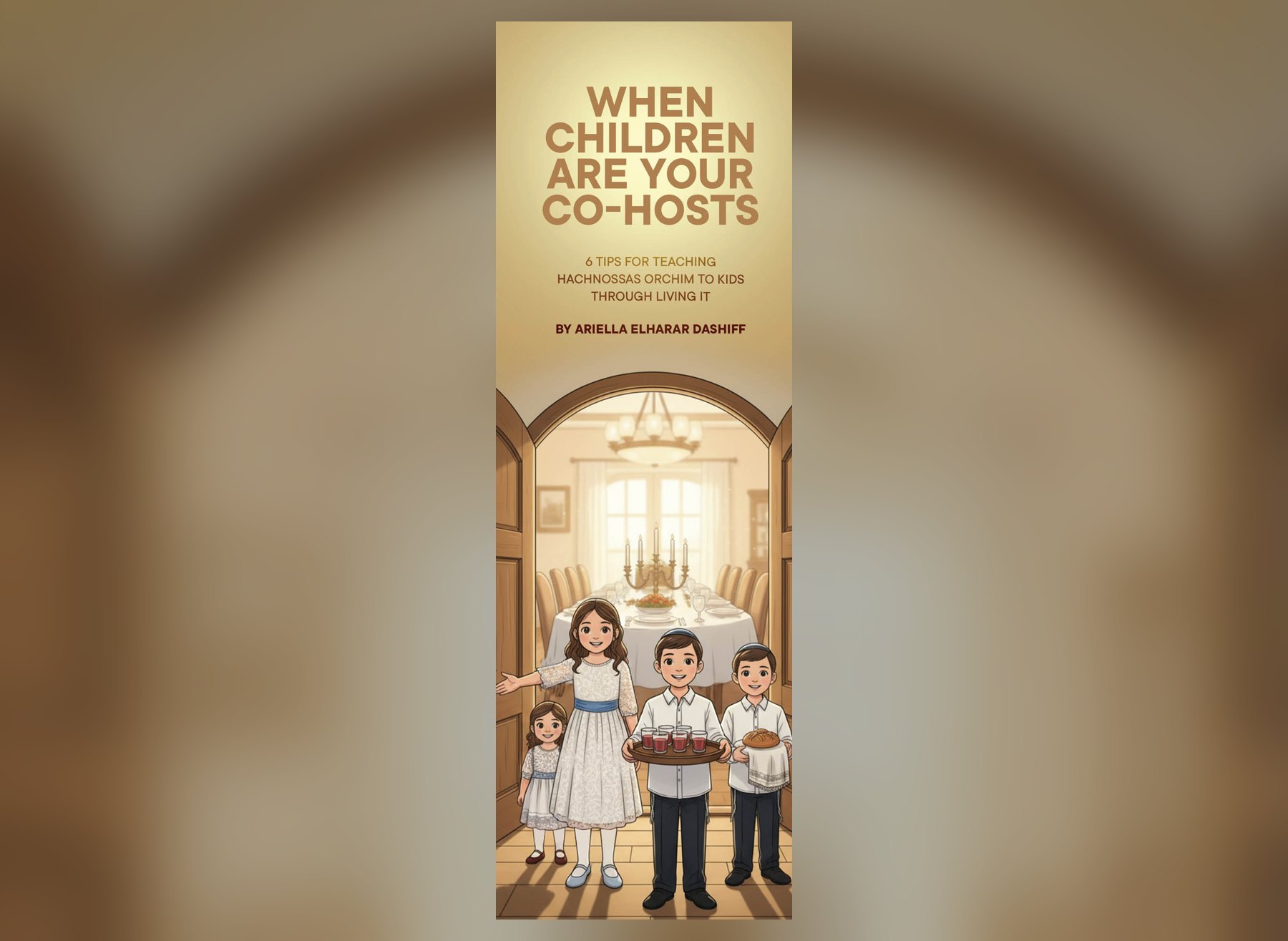
The connection between the mitzva of hachnossas orchim and raising children is very strong. Avrohom Avinu receives the news of Yitzchok’s birth precisely when he fulfills the mitzva of hachnossas orchim, hosting the three angels. And not only him. Throughout our history, people have been blessed with children through the zechus of the mitzva of hachnosas orchim: Manoach, Shimshon’s father; the Shunamite woman; the mother of the Navi, Chavakuk; the father of the Baal Shem Tov; the Alter Rebbe, and many others. Indeed, this is a segula that people adopt in order to merit having children.
Well, now there are children, and one must repay good with good and educate them in hachnossas orchim. The mitzva of hachnossas orchim is different from every other mitzva because it enters into the person’s inner sanctum. A person open’s his private home to guests, give them of their own – food, drink, perhaps even accommodations, lend them an attentive ear, welcome them with a true panim yafos, and give them the most comfortable feeling possible. This is avoda; this is Ahavas Yisrael in the full sense of the term.
In visiting the sick, hachnossas kalla, accompanying the dead, or giving tzedaka, a person does not give their entire being. The mitzva usually does not encompass all aspects of one’s life. He can fulfill it and then return home to his privacy, to the place where he feels most comfortable, because only he and his household are there. We don’t bring the sick person or the kalla into our home, into the most personal space, the only place where we are masters. When a guest comes, we bring another person into our special place… and this is a real challenge: to give the guest the feeling that our home is their home, as they say – “Make yourself at home!”
Hosting Not by Choice
As someone who has hosted guests for many years and has seen the reactions of my children and guests (and also heard and seen how others host guests), I wish to emphasize several points that are important from my experience: One must remember that when parents host guests, they do so by choice. When children live in a hachnossas orchim home, they are involved in fulfilling the mitzva not by their choice – and this must be taken into account. When I give tzedaka, the children are not involved, unlike hosting, which affects them as well. While we are not supposed to ask their permission or consult their opinion about whether to host guests or not, we certainly need to take the children’s needs into account.
Here are several points for consideration:
1. A Relaxed Atmosphere at Home
A relaxed atmosphere at home is seen when household members live in tranquility and peace with one another. This seems obvious and apparently needs no explanation. But only apparently. Do you think that when children fight – the atmosphere is relaxed? From personal experience, when children fight – it may be noisy, but it doesn’t create a troubled atmosphere, because children’s quarrels are natural and understandable. But when parents begin to fight among themselves because of the children’s quarrel, or try to restrain the children and turn them instantly into soldiers of the Queen’s Guard (and not necessarily through pleasant means), because they are embarrassed by their behavior – this already muddies the atmosphere and gives the child and guests the feeling that we are ashamed of him, chas v’shalom…
2. Mutual Respect
A child needs to feel comfortable with the fact that we host guests. Therefore, we must make a great effort and be aware that we treat children with respect. If a child spilled, made a mess, or didn’t want to get up to bring something – we shouldn’t “come down on them,” and certainly not in front of strangers.
3. Attention
Children will wait and look forward to the Shabbos table with guests if we don’t forget to give them proper attention as well. Not to forget them. To seat them on our lap, give compliments for helping their mother, another cookie from the dessert, etc.
4. Preserving Children’s Privacy
Often guest children arrive as well. It’s proper to encourage sharing toys and books, but not to allow the guest to intrude on the child’s privacy – to take without permission, touch personal items, and so forth. The child is not public property for guests. Just as we and the guests understand not to intrude on the parents’ privacy, so we should behave with the children.
5. Protecting the Child from Various Comments by Guests
The guest should only say positive things to household members. However, certain guests are not aware of this rule and allow themselves to comment to children about inappropriate behaviors. Parents can explain to children that there might be guests who behave this way, and they should try not to take it too much to heart. But if a guest makes an unpleasant comment or raises an inappropriate topic, it’s advisable for parents to have an agreed-upon signal between them and a repertoire of topics to immediately divert the conversation to another matter.
Hachnosas Orchim with Ratzon and Simcha
Up to this point, we’ve laid the groundwork so children won’t be opposed and will go along with hachnossas orchim. From here on, some advice for making them love this mitzva:
1. Prepare the Child for the Expected Order of Events and Give Them a Place of Honor
Tell children what will happen around the table: Kiddush, salads and fish, father’s dvar Torah, children’s sheets (in a way that won’t embarrass the children. Remember that these sheets are meant to strengthen connection and not put them on trial). Second course, light conversation with guests, final course, Birkas HaMazon.
And of course, give children a place of honor as well. If it’s difficult for them to answer questions on the sheet, let them tell a story or say anything they want. And if they don’t want to speak, fine! Let the parent find something beautiful the child did and tell about it.
2. Teach Children Respectful Behavior
It’s good to prepare the child: “Moishy, tonight guests will come to our home. I’ll be very proud of you if you notice on your own, without being told, what the guest needs, and fulfill their need. What do you think? I’m keeping a good eye on you! I’ll ‘catch you red-handed’ hosting guests like Avrohom Avinu!” And to older children, we’ll convey the same idea in a way that suits them.
In the same way, we’ll encourage them to speak respectfully: “May I take your plate?”, “Would you like another portion?”, “Excuse me, can you pass the water?” (instead of lying across the table over the bewildered guest’s plate to be first to reach the Coca-Cola…).
3. Praise the Children
Praise not only after the meal, but also during the meal, in front of father, mother, and guests. By the way, it would be very nice to thank the guests for the positive feedback they gave the child when we praised them in front of them. We’ll explain to them how much their praise engraves good middos in the child’s heart.
4. Occasionally Consult with the Children
Ask them what can be improved in our hachnossas orchim. This will give them a sense of belonging to the mitzva and a better desire to fulfill it.
5. Addition of Special Foods and Participation in Preparations
Add special foods to the menu when there are guests, if possible. Maybe buy, if you can’t cook (maybe it’s good for the children to choose what to add). And involve the children in preparation, in setting the table, in arranging guest rooms, and so forth.
6. Everything That Works in Chinuch for Other Mitzvos Too
Personal example, sippurei tzaddikim, praise and encouragement, lots of appreciation.
Happy hachnossas orchim!
Beis Moshiach #1480 • pp. 38-39, 47
© 2026 Beis Moshiach Magazine. All rights reserved.
This article originally appeared in Beis Moshiach #1480. You are welcome to share it with friends and family by email or in print, provided that you do not change, add to or omit any part of it, you credit the author and Beis Moshiach, and you include a link to archive.bmoshiach.org (written out in full in printed copies).
To republish this article in a newspaper, magazine, book or website, please request permission in advance at [email protected].