Dealing With An Adolescent’s Moodiness
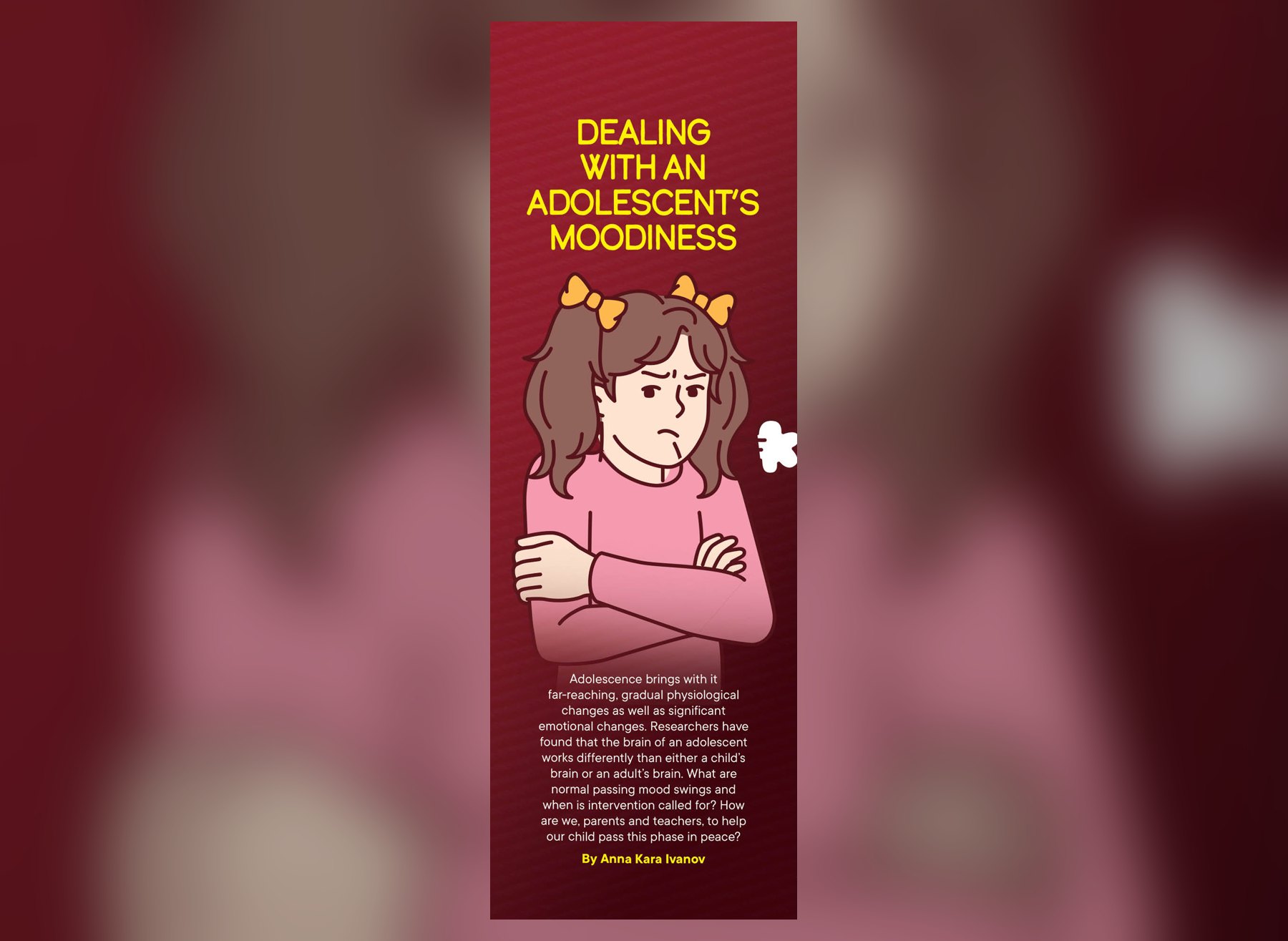
Adolescence brings with it far-reaching, gradual physiological changes as well as significant emotional changes. Researchers have found that the brain of an adolescent works differently than either a child’s brain or an adult’s brain. What are normal passing mood swings and when is intervention called for? How are we, parents and teachers, to help our child pass this phase in peace?
Adolescence is the time when a child stops being a child but is still not yet an adult. In the distant past, this phase may not have existed. Childhood was over quickly and it led immediately to adult responsibilities in the form of marriage, children and running a home. But in our generation, not only is there this transitional time between childhood and adulthood, it continues to grow longer; it starts earlier and ends later.
Adolescence brings with it far-reaching, gradual physiological changes as well as significant emotional changes. Researchers have found that the brain of an adolescent works differently than either a child’s brain or an adult’s brain. There is even research that shows that an adolescent is more like himself as a child than himself as an adult. In other words, in adolescence the psyche enters into an intermediary stage (some would call it the kaf ha’kela).
The reasons for this are hormonal, neurological and also based on external reasons. It’s not easy to stop being a child. It’s not easy to go through a phase in which more is demanded of you, you expect more of yourself, and at the same time you understand various truths about the world which are sometimes difficult or disappointing. And it’s even more challenging to do this while your body is changing, your appearance is changing when you look in the mirror and you still need to function within your family, at school, with friends, etc.
Emotional Regulation: Underdeveloped Skill
One of the things that is particularly affected by this process is regulation, emotional regulation.
A bit about emotional regulation – it sounds like something simple, on the face of it, but significant, ongoing difficulties in emotional regulation are the basis for so many disturbances that there is no recourse except to say it’s not at all simple. Emotional regulation is the ability to control one’s emotions, to extinguish fears that arise, to deal with sadness or anger, and even to handle joy or spiritual highs.
Unregulated emotions which are strong and continuous, are not healthy for our emotional system even when they are positive! The human psyche needs balance; it needs to be able to get back to some reasonable level of evenness, and needs to be able to bear, yes to simply bear, a variety of emotional states. Much of human suffering, in general derives from the fact that people are unable to bear their own range of various emotional states, and mainly to bear their own pain. Meaning, our ability to enable ourselves to feel what we’re feeling anyways is not a given and sometimes requires some work.
Does this sound familiar? Right, moach shalit al ha’lev (the mind rules the heart). In Tanya it says that the mind ruling the heart is an integral part of human nature but it’s important to remember that in adolescence this ability is underdeveloped.
Although we said that emotional regulation is not a given and is not always easy for everyone at all ages, in adolescence it’s that much more so. Adolescents are more impulsive. (One of the differences between adolescents and others is risk-taking. Adolescents, by nature, don’t always stop to think at times when adults or even children would stop to think.)
Adolescents are also more emotionally stormy – people are different from one another in their emotional intensity like colors on a palette; there are those who tend more to pastel, tranquil colors and those who are full of dramatic and intense colors. Adolescents, for the most part, lean toward the dramatic and intense. Everything is experienced intensely, everything is a matter of life and death, and it’s all larger than life. (Whoever has seen an adolescent make a ponytail for half an hour when time is of the essence in the morning rush, knows how momentous the exact shape and avoidance of stray curls is for her.) And all this intensity needs to be contained, digested and acted on accordingly.
It’s Natural!
As a result of all this, the adolescent’s inner world is often chaotic (of course, not always. Nothing in G-d’s world is always. There are people who experienced adolescence in a relatively calm and relaxed way, and that says nothing about anything and anyone.) This, in turn leads to shifting moods, ups and downs and often the ups and downs are extreme.
These moods are not because of problematic personality traits or bad disposition; it’s simply typical of adolescence. The adolescent will often exchange the element of sadness, which is characteristic of adults, for anger; i.e. for an adolescent, depression will be expressed less in sadness and despondency and more with irritability. There’s a big difference between sadness and nerves. Sadness remains within while irritability is expressed outward, usually at other people. Of course, the ones who suffer the most from this are the people closest to the adolescent.
Using People As a Punching Bag
A few words on why the closest relatives get it the most… First, they are on the receiving end because they’re there, all the time. An adolescent is still mostly in the home setting and in large families, like ours, he or she can’t quite manage to be alone most of the time. And the one who is closest is also the one who will get it over the head.
But it’s not just that. The fact that our adolescents lash out at us, at home, and not in the outside world (school, social settings) is a badge of honor for us. People let loose at home because they feel more secure there, for the most part. In the home setting are people who won’t take revenge on us if we say disgusting things, nor will they reject us. When our adolescent allows herself to say nasty things to us, this show that she feels confident and depends on our continuing to love her and accept her even at her lowest points. (Or, she’s testing our boundaries to see whether she can really rely on us, if we can be relied upon.)
It’s important to say that this is all fine and well but it really doesn’t cancel the difficulties in dealing with a moody adolescent who blasts us with harsh words at times. It’s particularly difficult when she was just a sweet little girl who brought us pictures from preschool and wrote, “Mommy” on them with misspellings. Even if I know that this is normal for her age, and even if I know that it means she relies on me and is confident in my love for her, I can still feel insulted, treated with ingratitude, disappointed, and betrayed. Mothers have feelings too and they also have to put in work to regulate them.
This is where the mind ruling the heart comes in, and how. Even if at the time, I reacted emotionally and not in the most pleasant way to the adolescent outburst (it happens, it’s normal, and it happens, more or less, in all of your friends’ homes), I can sit down afterward and ponder what happened and try to understand it in a calmer way. It will help me not be angry at her and not be angry at myself, and simply bear the feelings that we both have.
In the experienced version, I will also be able to say something compassionate to my daughter afterward, something that will get us out of the cycle of mutual anger. In the more advanced version, I will be able to go on to address what got the adolescent to say those mean things. (Hint: It’s never really the tone in which I said something or the fact that I didn’t iron her blouse which she wanted to wear. It’s always something deeper.)
In the super-advanced version, I will be able to say this in real time… (“Sweetie, listen. What you said really hurt me, but I have a feeling that you said it not because of the blouse but because you’re going through something. Is there something bothering you?”)
When I’m able to do all this, I am teaching my daughter a number of important things: 1) not to take revenge or bear a grudge; 2) self-compassion – it’s okay that I’m not perfect as long as I’m working on myself and trying to do better the next time; 3) beneath the words and the anger there are underlying emotions. Addressing them directly will reduce the fear, anger and torment.
To Sum Up
The emotional world of the adolescent is stormy and their ability to regulate their emotions isn’t that great which often leads to changing moods with an inclination for the extreme. Irritability can be an expression of sadness, and a child’s outburst is often an unsuccessful (and mostly unconscious) attempt to convey to her mother that she’s having a hard time. Instead of (or in addition to) the effort to listen to her, it pays to ask how she is and try to understand what lies behind her outburst. At the same time, it’s also okay for you, as a mother, to feel irritability, anger or hurt. All this does not mean you are a bad mother as long as you don’t remain exclusively in those domains, but rather mobilize those feelings to help your daughter (and maybe yourself too).
With all that said, there are situation in which a mother’s concern is not enough. If the outbursts exceed your tolerance level or significantly hurts other family members, if they are expressed outside the home, and mainly, if your daughter feels a significant, consistent anguish which doesn’t pass in two to three weeks, and certainly if this translates into impulsive behaviors with a potential for harm, consult with a licensed professional (if possible, work with the school and draw upon their resources).
Beis Moshiach #1410 • pp. 46-47, 48
© 2026 Beis Moshiach Magazine. All rights reserved.
This article originally appeared in Beis Moshiach #1410. You are welcome to share it with friends and family by email or in print, provided that you do not change, add to or omit any part of it, you credit the author and Beis Moshiach, and you include a link to archive.bmoshiach.org (written out in full in printed copies).
To republish this article in a newspaper, magazine, book or website, please request permission in advance at [email protected].