Marrying Off Your First Child

A practical guide from mothers who’ve been there: what to expect, how to prepare, and real stories from mothers who know.
As a new exciting and stressful stage begins, countless question marks hover: How much effort is required in checking things out? How do we properly support our children as they deliberate? How do we properly prepare a budget for the event? And how do we welcome a new son-in-law or daughter-in-law into our existing family framework?
Suddenly it happens.
That little boy who tore his pants every other day, that little girl who cried so much when her doll got lost, are ready for a shidduch. They’re grown up and opinionated, know what they want, and most stressfully, are being invited to weddings of friends who just yesterday were running wild with them in the park.
How do you even marry off your first child? Who teaches mothers who only yesterday got married themselves how to marry off children? What should I tell him when he’s so uncertain? Who can help her decide? And where is that valley where you collect gold coins to cover all the wedding expenses? Wow, a new son-in-law comes every other Shabbos, a polite daughter-in-law sits at our Shabbos table – how much does this affect us?
Women who have already married off their first child share their experiences:
Let Go and Know That I Am G-d | Tehilla
If you ask me, the first thing a mother who is going to marry off children needs to do is let go. Really surrender and know that it’s all Hashem. The truth is you need to do this much earlier, already in the delivery room… but for me it only happened at this stage, and boruch Hashem it happened in the end, because it’s critical.
I’m a very responsible mother. Before I put a child in a school, I do research. Every family that wants to host my children also goes through a vetting process… With everything related to my children, I don’t leave anything to chance.
When we started hearing shidduch ideas for our oldest daughter, I felt unfamiliar levels of stress. This isn’t about buying a high-end sheitel and not even about medical treatment. This is the most important decision of her life. How can I say “yes” to a suggestion? How can I say “no”?
Suddenly, more than anything else, I wanted an ‘urim v’tumim.’ A clear divine message that would tell me: “This is the chassan!” We conducted very comprehensive checks on every suggestion, and only the fifth one received our approval, while all along I was full of doubts. Maybe I rejected a wonderful idea about a bachur who would bring my daughter only happiness? Maybe I had agreed to hear about a bachur who doesn’t suit her for some reason?
They started dating. In my heart I prayed that she would notice the right details, that she wouldn’t get too excited about someone unsuitable, that she wouldn’t reject a wonderful bachur because of nonsense. When she shared with me, I tried not to transmit my hysteria to her, I listened attentively, encouraged her that we trust her. The truth? I lied a little. There were nights I didn’t sleep.
By hashgacha pratis, a non-Chabad newsletter arrived at our house. I leafed through it while drinking coffee on motzoei Shabbos, just before the new week bursts in. They quoted a Medrash (Introduction to Medrash Tanchuma, Buber edition page 136) describing how King Shlomo’s daughter got married. I didn’t know this Medrash. When I asked friends they smiled; seems it’s well-known.
Shlomo checked with ruach ha’kodesh who would be his daughter’s chassan, and it turned out to be a poor and undistinguished young man. Shlomo chose to take his daughter to a secluded island, locked her in a large tower with seventy elderly Torah scholars and plenty of provisions. The elders were supposed to ensure her wellbeing.
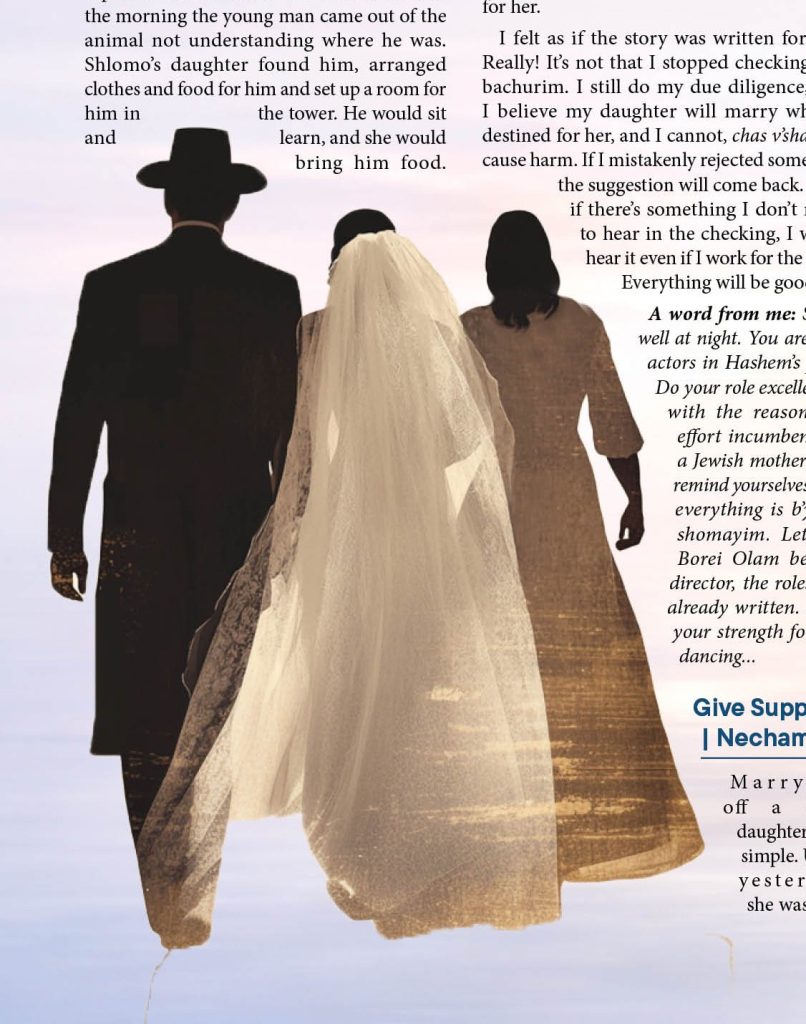
One day a poor young man in Akko went out to earn his bread. He couldn’t find even a penny, and as night fell, tired, hungry and frozen, he looked for shelter. With no choice he entered the carcass of an ox that was lying in a field, huddling in it. A giant predatory eagle grabbed the carcass and took it to the top of the tower on the secluded island. In the morning the young man came out of the animal not understanding where he was. Shlomo’s daughter found him, arranged clothes and food for him and set up a room for him in the tower. He would sit and learn, and she would bring him food. When she saw he was a talmid chacham with good middos, they decided to marry.
The chachamim discovered this only when it was noticeable that she was pregnant. Alarmed, they summoned King Shlomo. When the king saw the young man and heard his story, he discovered this was exactly the young man from whom he had sought to distance his daughter, and understood there was no way to escape from what Hashem had designated for her.
I felt as if the story was written for me. Really! It’s not that I stopped checking out bachurim. I still do my due diligence, but I believe my daughter will marry who is destined for her, and I cannot, chas v’shalom, cause harm. If I mistakenly rejected someone, the suggestion will come back. And if there’s something I don’t need to hear in the checking, I won’t hear it even if I work for the CIA. Everything will be good…
A word from me: Sleep well at night. You are just actors in Hashem’s play. Do your role excellently, with the reasonable effort incumbent on a Jewish mother. But remind yourselves that everything is b’yidei shomayim. Let the Borei Olam be the director, the roles are already written. Save your strength for the dancing…
Give Support | Nechama
Marrying off a first daughter isn’t simple. Until yesterday she was still so small and she looked up to us. We taught her everything! To get dressed and say the Pesukim, how to manage with a teacher you don’t like, and how important it is to count the change at the grocery store. Suddenly she’s going on dates and needs to choose her chassan herself.
When my Sarah started shidduchim, she seemed so mature to me. But on the night of the first date I was filled with anxiety. Mature, mature, she’s only twenty years old, how will she know what’s good for her? She can get excited by charisma and a great sense of humor, and not notice all kinds of small worrying signals.
Suddenly I wanted to go back two hundred years, to days when parents simply chose the chassan themselves and informed their daughter she was a kalla. Who allows such young children to make such decisions on their own?
It took me time to understand that I finished my role after the checking. Now the choice is only in Sarah’s hands (and Shimi’s, of course…).
She would come back from dates. Sometimes glowing with a tiny question mark on her lips, sometimes agitated and confused. Always trembling from the magnitude of the responsibility. I would sit and listen. Restraining myself very much from interfering, from telling her: “Don’t you see yourself that this is a sign that…” or: “Nonsense, don’t pay attention, it’s nothing.” Just to give her chizuk, to tell her she has the power to choose and decide, that we’re with her in every choice, that she’s allowed to continue deliberating, this is the choice of her life. And the truth is it’s right. No matter how young she is, Hashem brought her to this age, and gave her the intellect and emotion to know better than anyone what’s right for her.
When she finally decided yes (it makes no difference after how many dates), she was happy and relieved. Today she and Shimi are very happy together, and we’re happy with them, boruch Hashem.
A word from me: Give your daughter support, but don’t decide for her!
What’s Necessary and What’s Superfluous | Esther
Before the first wedding we made, we had no idea how we would even begin to obtain all the funds for the wedding. Hall, clothes, sheitel, furniture, gifts… Until that day our events consisted of a bris and bar mitzva, no more. They told me marrying off sons is easier, I started with a daughter, what can you do.
Two things comforted me then:
First, everyone does it, so apparently it’s possible. Couples we know closely who don’t have much money have already married off several children, boruch Hashem.
Second, in our community it’s not customary to promise an apartment…
In the end, Hashem helped me and we had to contend with Covid. Still we had to arrange for a dress and sheitel, furniture and apartment, but I was spared the excessive expenses of a hall, music, flower arrangements etc. There was a beautiful and tiny wedding in an open area at a nice shul, with never more than fifty people in the space at a time.
I prayed that these beautiful weddings would stay like this, but it didn’t happen. As soon as it was possible, they went back to celebrating with hundreds of people.
When our son reached this stage, we decided not to get dragged into “that’s how everyone does it.” We’ll arrange for our son a beautiful and respectable wedding that has what’s needed. Good food in abundance, music and a nice hall. All the other additions, that just pokes people’s eyes out and whose entire purpose is to impress, will stay off the menu. No flower and candle arrangements, no impressive bar.
The wedding can be so beautiful and moving even without them. I would even say: especially without them. When the parents from both sides and also the couple are busy with what’s truly important, the home is built on solid foundations.
A word from me: Before every expense ask yourself honestly: necessary or superfluous? Can we have a normal and respectable wedding without this? If the answer is yes, give it up. You’ll be surprised how much you’ll save, how few people will notice it’s missing altogether…
Reorganizing | Rivka Nechama
Meir burst all at once into our family. As his name, so is he, truly illuminating. At first he was just a name. Lots of details that sounded excellent and enthusiastic responses from the friends we checked with about him. Our Chaya is an excellent girl, and from the moment she finished 12th grade I allowed myself to start imagining her chuppa. After several suggestions that didn’t really fit our style and raised my concern that the shadchan doesn’t understand at all what we’re looking for, came the idea of Meir and it made me breathe easily. The family, the style, the middos, everything sounded superb.
Then the dating began. Quite a few dates until Chaya felt confident. I felt I already knew the bachur just from her deliberations and the parts she shared with me. We have an excellent relationship. But all those late-night conversations didn’t prepare me for the moment I saw him. A real person before my eyes, beaming at the l’chaim. I felt how my heart filled. Such a good and calming feeling that I’m leaving my girl in safe hands.
And then came the first year.
It’s one thing to meet the chassan at the glittering events of the beginning of life, vort and wedding, sheva brachos. Another thing is to bring him into our daily life. Everything was so strange to me. Suddenly a young and strange man is walking around our house, opening our refrigerator, laughing at the table at dinner. He also brought with him all kinds of different habits from his home like washing for bread at every meal. I always have to remember to take out several slices from the freezer, to thaw for him. Looking for carbonated soft drinks which at our home we serve only on Shabbos.
At the Shabbos meal my husband starts singing Shalom Aleichem by the table, Meir meanwhile sits on the couch, leafing through albums, chatting with Chaya. At our home? Like soldiers they always stand, everyone sings with my husband. The children look at me anxiously, also move to the couch. We remain alone by the table; since he arrived I can’t even join my husband and sing with him… To be angry? What is there to be angry about if that’s how it is at their home? Not for a moment do I think he came to annoy us on purpose, such a sweet young man.
A month and a half after the wedding, at two in the morning, when the little one woke up to eat, and my husband returned from a farbrengen, I shared my feelings with him, about the privacy that disappeared, about the chaos that happened in our lives. He wasn’t alarmed. “What do you want?” he asked with a smile. “A new child joined our family, that’s how it is, you explained it to me…”
I smiled, suddenly peace filled me.
After every birth I felt as if our house was shaking. The firstborn suddenly became bigger, the previous youngest was suddenly pushed up, the middle one felt more neglected than ever. Everyone would react with lots of emotional outbursts, crying, fighting. As if they put us all in a closed box and shook it. Slowly everyone positioned themselves in their new place, finding themselves in the family hierarchy, filling up with confidence again. The feeling of familiarity returns, providing peace.
He’s so right, my husband. We received a new child who suddenly became an inseparable part of the family. He’s not a small wrapped package of seven pounds, but a young man who’s taller than me and my husband, but still, like after a birth, the joy and excitement are enormous, and we all need to reposition ourselves… Soon a familiar routine will form again, safe, pleasant and family-like, until the next wedding…
A word from me: Don’t panic by the family changes. Take a deep breath and give yourself and the children time to adjust.
Love Gently | Rochela
My sweet daughter-in-law entered my life and what a relief it was. My eldest son is an impressive and serious young man, and we receive positive feedback from everywhere: from rabbis, from friends, from parents of students. Only thing, he’s a very closed and distant type. As a mother I never managed to create a close connection with him. I love him and he’s a respectful and polite son.
Approaching the shidduch period I was very worried: How will he go through the period without sharing with anyone? His father is even more closed than him… With whom will he consult? How will I even talk to him about what he’s looking for?
Somehow we managed to have that initial conversation. He didn’t elaborate much. Said it’s important to him that she be Chassidish and was relying on me on that point. That I should check first of all that she’s willing to go on shlichus a year or two after the wedding. He added that he doesn’t want someone wasteful who thinks about money and shopping all day. I tried to probe regarding personality and middos and his patience ran out. That he’ll already check when they meet…
Two days later he wrote me a letter in which he asked that I also pay attention to external appearance. Really embarrassing.
During the checking period he listened patiently to everything they said about her. Nodded.
The dating began. He would come back, and it was impossible to see anything on him. Say it was fine, boruch Hashem. He’s ready to continue. I was eating myself up. With whom will he consult? With whom will he share? How will he go through this stressful period alone? I didn’t know how to approach this subject at all. One evening I discovered him on the balcony, talking on the phone. From a few words that I managed to hear, I understood he was sharing with someone something said on a date. From the style of speech, so deferential, respectful, he was talking with some rav. Maybe his mashpia? Not my business. The main thing is he’s not on his own. I relaxed.
Suddenly we reached the l’chaim. I couldn’t know a day before because he didn’t share anything, not even sparkles in his eyes. I met the princess, perfect. Modest and beautiful, serious and Chassidish, and most important from my perspective – warm and loving. I felt how my heart thawed all at once, filled, overflowed. She laughed with friends excitedly and hugged. Got excited and also wiped a tear. I didn’t check this in the background checks, but what would I have done with a cold and reserved girl?
In the first days after the vort, when my son was already on his way to the Rebbe, I was ready to call her every day, talk to her and share everything with her. Tell her how much I love her and how happy I am she joined our lives. Slowly, I noticed she was a bit reserved. I panicked. The last thing I wanted was to distance my only daughter-in-law so far. On my mashpia’s advice I took a step back. I was pleasant and warm, but not getting too close. This sweet girl needs her time to develop a warm and loving relationship.
After the wedding I pampered them with love. I announced the house is open, and asked them to invite themselves, because I don’t want to pressure them. They came more and more, and I was pleasant, and all the hugs and kisses I exchanged for more cake and another container of meatballs. Today we have a really warm and loving relationship. I would say that thanks to her I also gained my son; suddenly he also talks more and smiles more.
A word from me: Love gently, daughters-in-law need time to adjust to the new mother-in-law.
Beis Moshiach #1490B • pp. 42-47
© 2026 Beis Moshiach Magazine. All rights reserved.
This article originally appeared in Beis Moshiach #1490B. You are welcome to share it with friends and family by email or in print, provided that you do not change, add to or omit any part of it, you credit the author and Beis Moshiach, and you include a link to archive.bmoshiach.org (written out in full in printed copies).
To republish this article in a newspaper, magazine, book or website, please request permission in advance at [email protected].