To Move & Move Again
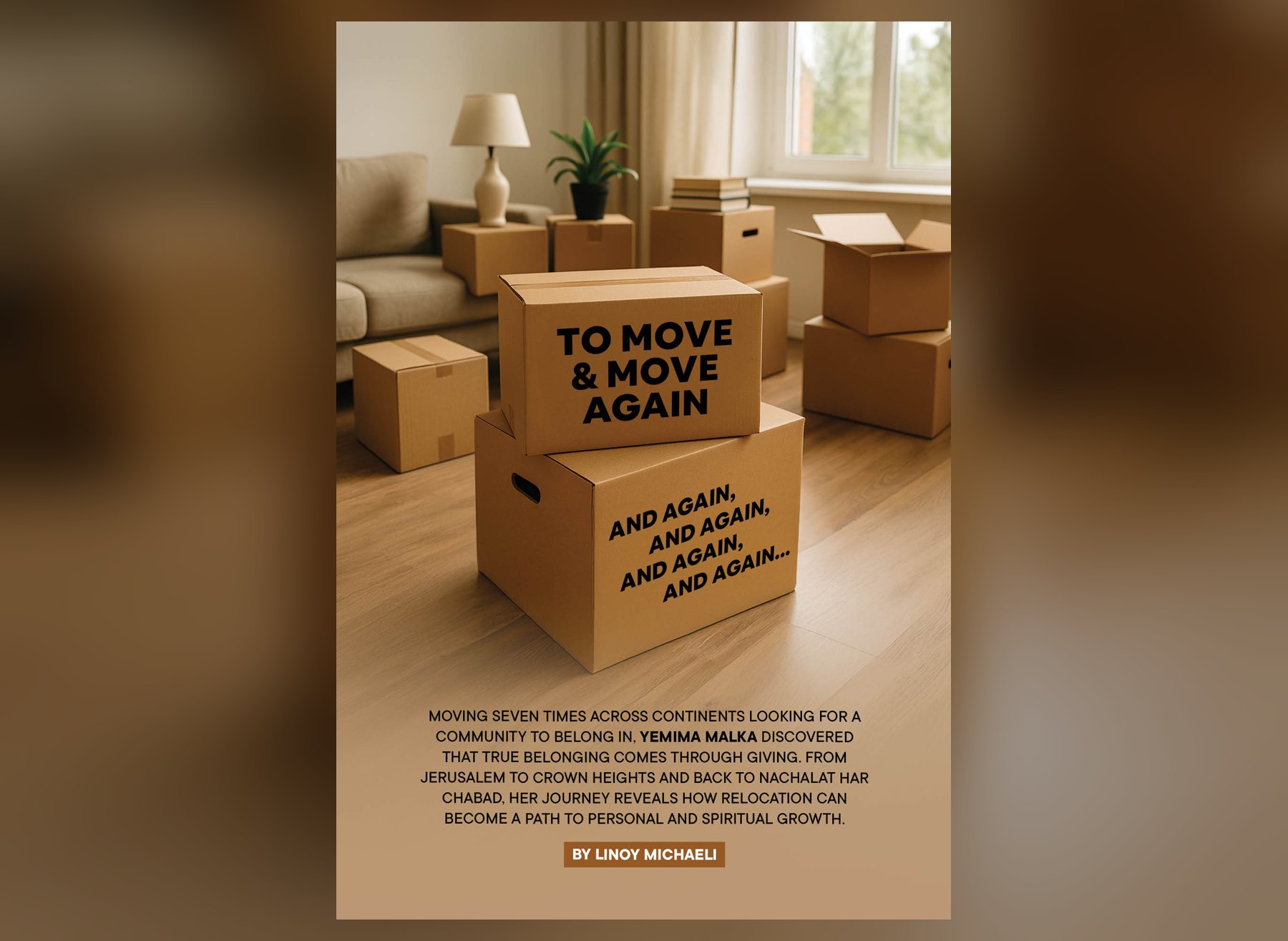
Moving seven times across continents looking for a community to belong in, Yemima Malka discovered that true belonging comes through giving. From Yerushalayim to Crown Heights and back to Nachalat Har Chabad, her journey reveals how relocation can become a path to personal and spiritual growth.
Three years ago, I moved to ‘Nachala’ (Nachalat Har Chabad), wandering the city streets, forming opinions, confirming and freeing myself from preexisting biases. My feet had never stepped in this city before our search for an apartment.
Moving to a new place involved many upheavals, both physical and emotional, with less-than pleasant feelings. I felt challenged adapting. But then I met Yemima, one of the women in the neighborhood. The meeting happened at one of the shiurim I attended, and she – being knowledgeable and experienced – quickly identified my struggle.
When she told me her story, I felt like I needed to catch my breath..
How I Found My Place
Yemima Malka is a mother of five, works as a cashier, and because of this role, she knows everyone around her.
You’ve moved through several apartments. Shall we start from the beginning?
Yemima: I’m originally from Beit El. After our wedding, we lived in Yerushalayim, a technical choice in order to live close to work and studies. We quickly realized we couldn’t afford an apartment there and considered moving to Rechovot, where my sister lived. The idea was approved by majority vote. In retrospect, we realized we had rented an apartment far from the Chabad concentration, which made adjusting difficult.
Although I lived near my sister, I was looking to meet more people, to connect to vibrant community life, and couldn’t find what I was seeking. I didn’t know who to approach or where to start. I found myself in a fixed routine of work-home-work; I was very lonely. On Simchas Torah, when we went to a half-empty shul and the hakafos ended quickly, we understood this wasn’t where we wanted to raise children in the future. We missed shiurim, farbrengens, and community spirit that we didn’t know how to find at that time.
We packed the few possessions we had as a young couple and moved to Nachala. We didn’t know anyone there, but we connected rather quickly. It’s such a large community in such a small city, so on every street there are families from Anash, and getting to know people is easy.
I gathered courage and went alone to a shiur held near my home, attended shul every Shabbos, and became familiar with my surroundings. I hoped we had reached our desired destination and indeed we had, but not for long. At some point, we received an offer to go on shlichus. We packed excitedly, a bit more boxes than the previous time.
To our great surprise, two days before we left the apartment, when we were already ‘living out of boxes’ – the offer fell through, and so we were left with nothing from all directions. We had to vacate the apartment from one day to the next.
With no choice, we headed south to Mitzpeh Rimon. My husband, who was the sole provider at the time, worked in the area and easily found an apartment there. It technically suited him to be close to his workplace, and he didn’t need to waste time on the roads. But again, the same tune returns – I’m lonely, and the sadness takes its toll.
I left the house and met a Yael – not the friend, the animal (an ibex)… sand and ibexes everywhere. The situation made me sad; what to do? Write to the Rebbe.
In pretty clear terms, the Rebbe spoke about the importance of a happy wife. My husband didn’t hesitate, and we packed again. Returning to Nachala! I felt my lungs fill with air again. I informed friends with whom I had maintained contact that we were coming back. The moment we arrived, we continued from where we left off…
By the way, one of the things that proved to be most correct was maintaining contact even after we left the apartment. This proved itself more than once, especially when we returned to Nachala.
I quickly found my place, as if we had never left. I didn’t get lazy, and despite the fatigue, I attended classes, farbrengens, participated in kinusim and every social gathering. I was giddy from vibrant life with supportive friends, encouraging organizations from which I benefited as a giving and receiving volunteer. I found what my soul was seeking.
And yet, you moved again…
“True.” Yemima’s voice saddened for a moment:
Following several difficult family events, we decided to leave the country, without family support. Emigrating is a significant step that doesn’t come easily. It’s much more frightening; unlike moving within the country, when you know you always have the option to return and change more easily. Moving to another country requires acceptance and understanding that this will be a very long period; after all, we wouldn’t make such a step for just a few months.
It was a heavy decision, accompanied by deliberations and conjuring up scenarios of difficulties we might encounter and how we would cope. (Which eventually proved unnecessary since nothing was as we thought.)I checked and assessed advantages against disadvantages; the distance, the language, navigation, mosdos, and in general, I feared getting spiritually lost when not in my safe space; I was afraid of American permissiveness and ‘freedom.’ And most importantly – I was at the end of my third pregnancy without family and without my friends around me.
And of course, questions on a technical level: How is this going to happen? Who will be with me? Who will watch the children?
But despite all the difficulties and disadvantages, the single advantage won: getting a new start.
We landed in New York and I didn’t know a word of English, but that was the least of it. We couldn’t find an apartment. We had enough money for only one week in a hotel. On Friday night, we were hosted by a dear family, and as in miracle stories, we met a wealthy man who owned an apartment that he rarely used. He simply handed us the key…
Shock.
To my surprise, we acclimated relatively quickly and simply started living.
Leaving Israel isn’t simple. What difficulties did you encounter?
Not easy at all, but at that time it suited us very much. We certainly weren’t prepared enough for the difficulties that came our way.
As I said, I was approaching my third birth without support. Hatzalah members, tzaddikim, took me to the hospital and helped with all the technical matters, but yes, I gave birth completely alone.
There too, I experienced difficulty finding friends. I’m not naturally shy, not at all, and despite everything, I didn’t find myself among the Israelis and certainly not among the locals. Just before despair, I took myself in hand and decided that a change would happen here. It would be good for me!
As you said, you’re not shy and still experienced difficulty in integrating socially. From your vast experience: how can someone who is shy or introverted integrate into a new community?
Excellent question! In my opinion, in order to receive, you first need to give.
In every new place we reached, one of the first things I would do was volunteer for ‘Shifra and Puah’ [a volunteer organization helping new mothers]. That’s how I created connections with those in charge, the movers and shakers, and even with the new mothers. On the one hand – it didn’t require me to leave home or step out of my comfort zone. On the other hand – I managed to get to know my surroundings moderately, and when I connected with a particular person, I already inquired about shiurim, and we went to them together.
Let’s return to Crown Heights. How did you cope with the great difficulty there?
As I said, to receive you need to give.
We started hosting bachurim from ‘Kevutza’ for Shabbos meals, which brought me great joy. I simply lived from Shabbos to Shabbos. My entire being revolved around the meals I prepared for them. On Sunday I wrote a menu, on Monday and Tuesday I did shopping, and on Wednesday I already started cooking. Singing and dancing all the way to the refrigerator, chopping, frying, baking, all from pure happiness. All the difficulty diminished; the effort was worth it for the honor of the Shabbos table for the boys.
Those tzaddikim would come to help from time to time, and when they saw me kneading almost ten kilo of dough by hand, they bought me a mixer that served me faithfully until recently, and it produced the best challas. The group celebrated joyous occasions with us like the upsherin for our firstborn and the bris for our third. They wrapped us in love. The bachurim became our family.
I see tears of joy gleaming in your eyes when you talk about that period; it’s obvious that you finally enjoyed some nachas.
Absolutely. But the tears are also from intense longing for a good period that ended.
The COVID pandemic broke out, 770 closed. Most of the boys returned to Eretz Yisrael, and hospitality ceased. No hosting and no being hosted. Again, loneliness took over and the danger was immense.
And again, we packed and went to a new place – to Florida, where COVID restrictions and infection rates were lighter. There too, boruch Hashem, we found ourselves very quickly. We connected to the community easily, were drawn into one big family; we were there for each other. A good neighbor is better than a distant brother, literally.
While I still hadn’t acquired the language, my eldest son was already communicating almost exclusively in English. And in general, over time I noticed that he was adopting an American character and losing his Israeli identity. I felt that he became more reserved and less happy. At the same time, we were looking for an apartment near the community. When it was found and we almost moved, complications arose and the apartment was taken. I felt this was a sign from Hashem. I remembered that when we arrived in Crown Heights, Hashem handed us an apartment on a silver platter, and now an apartment was taken from us with the same ease…
With no choice, we decided to return to Eretz Yisrael. We headed north to cool Tzfas. Like the weather, that’s how my heart felt… cold and disconnected. We decided to pack again and move back to Nachala. Why didn’t we go there in the first place? I have no answer…
If the move depended only on me, I wouldn’t mind moving again and again. But when it comes to children, it’s a completely different story. The natural anxiety is magnified; it’s impossible to know how the move will affect them. Sometimes they haven’t yet had time to acclimate and are already uprooted again from their place. Feelings of guilt bubble up.
When we arrived in Tzfas and I realized this wasn’t our place, I preferred to remove the band-aid quickly. To move immediately the moment we felt this wasn’t it.
In Nachala, the children flourished in school, and I returned to my place in fascinating shiurim, farbrengens, and women’s evenings. I was hosted and did hosting – which is another successful tip for easy acquaintance for those who find it difficult to go to a stranger’s house – host a shiur! You’ll bring bracha into your home, and you’ll also meet new friends in the safest environment for you.
Meanwhile, I found a job as a cashier in a supermarket in the center of the neighborhood, where I’ve met almost every family in the community. I formed social connections that are very dear to me, and boruch Hashem, on the family side, things were also patched up. Everything I dreamed for succeeded.
Are there any positives to so many moves?
By nature, I’m a person who manages well with change, but I don’t think I would recommend it to everyone. It’s not simple, physically and mentally. It’s not just packing clothes in boxes. It’s folding up entire lives for an unknown journey. It’s saying goodbye again and again to friends, to a home you’ve nurtured and invested in. It’s those small moments when you’re celebrating an event and don’t know who to invite… Friends from the past? No longer relevant. New friends? You’re not close enough yet…
On the other hand, I know many places, and from each place, I have wonderful women I keep in touch with. I’ve learned to be focused. To distinguish between essential and trivial, what’s important for me to keep and what I happily pass on.
What tip can you give to a ‘beginner mover’?
Plan! Don’t leave things to the last minute. Lists, lists, and more lists. Managing the move in an organized way is the recipe for peace of mind.
MOVING FROM A COUPLE’S PERSPECTIVE
By Nechama Galinsky
Is moving challenging for a couple or does it strengthen their relationship?
Moving is one of most significant changes in life. It impacts not only on the logistic front but also on the relationship. Moving entails complicated decisions, emotional overload and stress that can lead to conflict. At the same time, it can strengthen the relationship and deepen the partnership.
Many couples experience tension when moving which is generated by:
-Making joint decisions, choosing a location, the type of property and design require collaboration and agreement. Sometimes, differences in style, needs and preferences lead to differences of opinion.
-Financial stress – moving costs a lot of money which increases the tension and can bring to the surface differences in financial approaches between the couple.
-Environmental Changes – moving to a new place can make one feel unstable, especially when one of the couple is moving far from family, friends or familiar work environment.
How can upheaval lead to strengthening the relationship?
Despite the difficulties, moving can become an opportunity for the couple to grow:
Aligning expectations and improving communication – when a couple learns to listen to one another and conduct respectful discussion about decisions, they develop better communication skills that will serve them well in the future.
Strengthening the sense of partnership – working together on a move, arranging the house and making joint decisions can create a stronger feeling of togetherness.
Creating a new beginning – a move can be an opportunity to breathe new life into the relationship, developing a joint vision for the home and a renewed order of priorities.
How can people succeed in moving to a new home without harming the relationship?
-Plan together – sit and discuss expectations, budget and division of labor.
-Allow room for emotions – enable each one to express his and her fears without judgment
-Find moments of connection – within the stressful times, stop to make ‘couples time’ even if it’s just to eat a meal together or take a short walk.
Despite the challenges, moving can be an empowering stage in relationship development – if approached with a sense of sharing, tolerance and mutual understanding.
So yes, moving requires investment and planning but as we know, “change your location, change your mazal, for good and blessing.” With a positive approach and the right preparations it’s possible to turn the change into an opportunity for growth, a new and promising chapter in life.
The author is a relationship expert and a personal and couples’ coach.
MOVING, FROM A PERSONAL PERSPECTIVE
When I was a girl I also experienced moving between cities. We moved to a religious-chareidi neighborhood in Petach Tikva, to a Chabad community. To be honest, I didn’t see eye to eye with my parents regarding the move; I was vehemently opposed. I wasn’t willing to leave my familiar community and friends. My parents’ repeated explanations about my continuing to learn with the same girls in the same school fell on deaf ears. I did everything I could not to sign on and refused to see the good around me. It certainly wasn’t easy for my parents but they were at peace with the move and hoped for significant spiritual advancement.
With time, I saw how beneficial the move was. We were then in the final stretch to becoming a full-fledged Chabad family. My mother began wearing a wig regularly and my brothers were sent to a yeshiva. Those who did not know us previously could not guess what a journey we traveled and I thank Hashem for the blessed change. Previously, it wasn’t a given that my brother would go to yeshiva. When it was time to go up to shiur alef in yeshiva ketana (mesivta) Rabbi Yitzchok Aharon Akselrod’s yeshiva opened right downstairs. My brother learned there, did well, and that was another sign from Hashem that we were in the right place.
I became responsible for programming for the young girls of the community on Shabbos and this filled the emptiness I felt. I learned and taught, strengthened and was strengthened in order to be a fitting role model for the girls who today have grown up and have already become young married women. Some of them call occasionally to consult with me.
So true, I didn’t sign on to the move at first, but today I can say that it was the best thing that happened to me. I learned to see the good, to find my place in the new social environment and even merited to do a shidduch through the fellowship of the community! “Change your location, change your mazal, for good and blessing, with visible, revealed good!
Beis Moshiach #1459 • pp. 44-49
© 2026 Beis Moshiach Magazine. All rights reserved.
This article originally appeared in Beis Moshiach #1459. You are welcome to share it with friends and family by email or in print, provided that you do not change, add to or omit any part of it, you credit the author and Beis Moshiach, and you include a link to archive.bmoshiach.org (written out in full in printed copies).
To republish this article in a newspaper, magazine, book or website, please request permission in advance at [email protected].