“Grow Out Your Beard & Peyos”
Squawwwkkkk!
The sound stopped Mr. Rosenberg in the middle of the road, like someone had shouted his name.
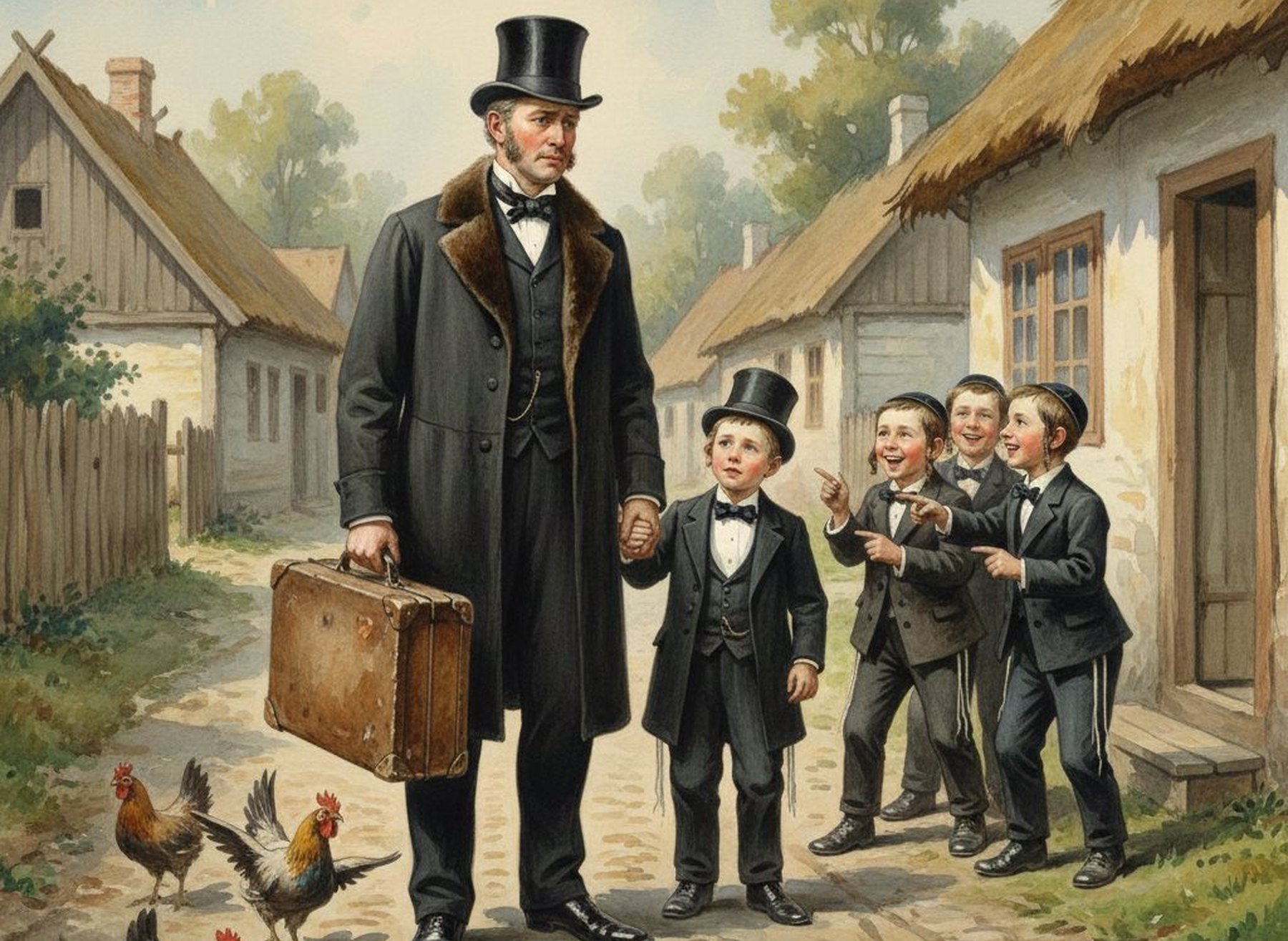
He turned so quickly, dust flew up around his shoes, and he almost slipped. Right behind him, a flock of chickens were running wild, flapping and squawking and chasing him, as if this was their street, and he was the one who didn’t belong.
“Squawk! Squawk!”
A bunch of boys pointed and laughed.
“Look at him!” one called.
“He’s running from chickens!” another said.
Some little girls covered their mouths and giggled. To them, it was funny. To Mr. Rosenberg, it was confusing and embarrassing.
He covered his head, like most Jews of this town. But everything else about him looked different. His face was clean-shaven. If he had peyos, they were trimmed so short, you could barely see them.
His clothes were neat and fancy, like he’d stepped out of a city, not a dusty village. His scarf looked expensive, and his suit was perfectly fitted. In Radoshitz, where the roads were dirt and the houses were simple, his polished look made him stand out even more.
He looked right, then left, trying to make sense of where he was and how he’d found himself in this strange situation, surrounded by chickens and laughing children.
“The Rabbiner,” he said, speaking loudly, trying to be understood. “The Rabbiner… please. Point me to his house.”
The children stared at him with wide eyes. His words sounded strange to them. He wasn’t speaking Yiddish. He was speaking German.
Mr. Rosenberg tried again. “The Rabbi,” he repeated, now using his hands, too, pointing and asking, hoping someone would understand.
The boys just laughed more.
Squawk!
The chickens ran past him again, and Mr. Rosenberg quickly jumped back, almost bumping into someone.
That was when a few mothers on their way to the market noticed him. They weren’t laughing. They looked at him like they could tell he was lost.
One of the women tilted her head. “He’s a Jew,” she said softly. “Look at his hat.”
“And look at his boy,” another answered.
One of the mothers walked a little closer. “You’re looking for the Rebbe…?” she asked, speaking slowly and clearly, hoping she got the message across.
Mr. Rosenberg’s face lit up. “Yes!” he said. “Yes, the Rabbi, the Rebbe. Please.”
She pointed down the road. “That way,” she said. “To the Rebbe.”
Mr. Rosenberg nodded again and again. “Thank you!” he said, unsure if she even understood him. Then he turned and hurried onward, pulling his son gently along with him.
Chanoch held tight to his father’s hand.
He was twelve years old, dressed in a tall cap, a bow tie, short pants, and shiny shoes. He did not look like the boys of Radoshitz. He clearly wasn’t from here.
Chanoch’s eyes glanced from the chickens to the children to the dusty homes. He didn’t say a word. He didn’t ask any questions. He just held on, like he didn’t want to get separated for even a moment.
Mr. Rosenberg kept walking, as if moving quickly would make all the staring stop.
Who was this man, the townspeople wondered? He looked like a Jew in one small way, but in every other way, he didn’t.
And why would a man like this travel so far, just to see the Rebbe of Radoshitz…?
* * *
Soon, another visitor was walking up the path toward the Rebbe’s shul.
This visitor did not look strange in Radoshitz. In fact, everyone recognized him right away.
Rabbi Shlomo Hakohen of Radomsk.
He was a famous tzaddik, and also one of the top students of the Rebbe of Radoshitz. When he appeared, people stood up straighter. Even the air felt more serious.
Rabbi Shlomo looked toward the entrance and quietly checked if there was a long line. Some nights, many people came to ask questions, request brachos, or simply pour out their soul. Other nights were calmer. It depended who’d arrived, and how many hearts were waiting.
Before Rabbi Shlomo could take another step…
* * *
“Ah!!”
The inner door burst open.
The Saba Kadisha of Radoshitz himself appeared, his face bright, eyes shining like he’d been waiting.
“Just the person I was hoping to see,” the Rebbe said happily. “Come, come. I need your help. Let’s make a kiddush Hashem together.”
Rabbi Shlomo didn’t need to be asked twice. When the Rebbe asked, you go. Rabbi Shlomo followed him into the room.
Not long after that, the shammash opened the door and called the next visitor.
“Mr. Rosenberg.”
Mr. Rosenberg entered, holding Chanoch’s hand; he was careful taking every step, like he didn’t even know which floor tiles were safe to touch. The room felt holy. The people looked different than everyone back home. Long beards, serious faces, simple clothing. It was like stepping into a world he’d only heard stories about.
Rabbi Shlomo stood at the Rebbe’s side.
The Rebbe looked at Mr. Rosenberg, then at Chanoch, then back at Mr. Rosenberg.
“So please,” the Rebbe said in a calm voice, “tell us your story.”
Mr. Rosenberg cleared his throat. He looked down at his son. He opened his mouth.
At first the words came out slowly, unsure.
Then his face tightened.
And suddenly he began to cry.
“My son,” he said, and his voice shook, “my beloved son… he doesn’t speak.”
He wiped his eyes with his hand, but it didn’t help. The tears kept coming.
“He doesn’t hear,” Mr. Rosenberg said. “He never did. Not once. Since birth. We’ve taken him to doctors, specialists. We traveled. We’ve tried everything.” He swallowed hard. “Every doctor in all of Germany told us the same thing. There’s nothing they can do.”
He shook his head quickly, as if saying it out loud made it worse.
“But parents don’t stop hoping,” he said, almost angrily now. “Parents don’t stop wishing. We would do anything – anything – for our son, Chanoch. I want him to get to hear music and laughter. Please, if there’s any way we can change this… please.”
Rabbi Shlomo leaned forward. His voice was kind. “We understand your pain,” he said.
Mr. Rosenberg looked up sharply, almost offended.
“No,” he said. “Rabbi… I don’t think you do understand. Do you know who I am? Do you know what people think of me?”
He was crying, but there was something proud in his voice too.
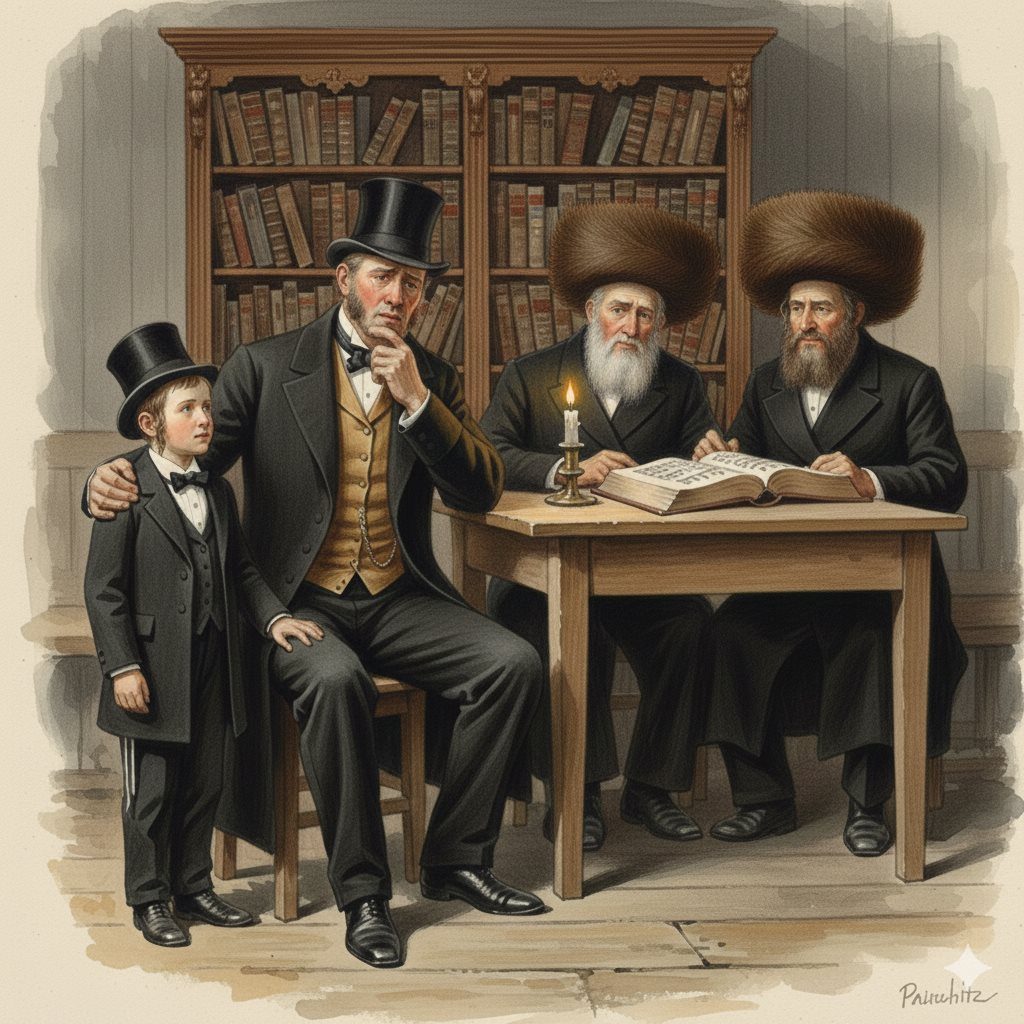
“My wife and I are very well-known,” he said. “We are wealthy. We are important. We live in Germany.” He pointed at his chest. “People respect us. People listen to us.”
Then he struck the wooden table, hard enough to make it rattle.
“But none of that matters to us!” he cried. “None! If you tell me to empty out every bank account we have and give you everything right now – right now! – I’ll do it!”
He leaned forward.
“Rabbiner,” he begged, looking from Rabbi Shlomo to the Rebbe, “it’s all yours. Just help my son. Let him hear. Let him speak. Please.”
Rabbi Shlomo spoke gently. “Your distress is our distress,” he said. “Your sadness is our sadness.”
Mr. Rosenberg nodded fast. “Wonderful,” he said. “I heard the Rebbe can do miracles. It’s hard to believe… where I come from, we don’t see these things – but please. Do it. Do it right away. For my son.”
The Rebbe listened quietly. He didn’t rush. He didn’t argue. He let Mr. Rosenberg’s words fill the room.
Then the Rebbe spoke.
“Mr. Rosenberg,” he said, “we’re going to ask something from you.”
Mr. Rosenberg’s eyes widened. “Yes, Rebbe,” he said quickly. “Anything. Anything at all.”
“But something much smaller,” the Rebbe added.
“Smaller?” Mr. Rosenberg repeated, distracted as he tucked his gold watch chain back into his vest. “What might that be…?”
The Rebbe said it clearly.
“A beard and peyos.”
For a moment, it was like the air itself froze around them.
Mr. Rosenberg blinked. “…What?” he whispered, rubbing his clean-shaven chin, as if he needed to make sure it was still smooth, like the Rebbe could just command the hair to grow in a flash.
Rabbi Shlomo clarified. “The Rebbe is asking you to grow out your beard,” he said, “and stop trimming your peyos.”
Mr. Rosenberg’s mouth opened, but no words came out at first. Then, he laughed a strange little laugh, like he hoped it was a joke.
“Rebbiner,” he said quickly, “please… no.”
“It’s all I ask for,” the Rebbe answered.
“But surely – Rebbe, you don’t understand. I can’t do that.” He spoke faster now. “I would… rather give up my money, my business, my house – anything, and I mean anything else – but… not this. Not this.”
The Rebbe did not move.
“Nothing less,” the Sabba Kadisha said calmly. “Not your money. This.”
Mr. Rosenberg stared. He couldn’t believe what he was hearing.
“Two weeks,” he begged suddenly. “Can I have… two weeks? I’ll do everything you ask. I promise. I just need time. I have my niece’s wedding. The entire city will be there.” His voice shook. “I have to be back home in Germany. Everyone will see me. Everyone will stare. They will laugh. They’ll think I’ve gone crazy.”
He shook his head again and again.
“In Germany,” he said, “we’re neat and orderly. From tip to toe. No hair out of place. We do everything… in a specific way. Style matters. Fashion matters.” He swallowed. “Rebbe… I can’t.”
The Rebbe leaned forward slightly.
“Mr. Rosenberg,” he said, “your son Chanoch is twelve years old. He hasn’t heard a sound or spoken a word since birth.”
Mr. Rosenberg’s eyes filled with tears again.
“And this upsets you, and I’m guessing he feels the same?” the Rebbe continued.
“Yes,” Mr. Rosenberg whispered. “Yes, Rebbe.”
The Rebbe nodded once.
“It’s your choice,” he said. “You either begin growing your beard and peyos, right now, today, or I cannot help you.”
Mr. Rosenberg’s legs went weak.
He sank to his knees. His hat almost fell off.
This was the biggest decision of his life.
He sat there for a long moment, shaking. Everyone waited. Rabbi Shlomo didn’t speak. The Rebbe didn’t rush him.
Finally, Mr. Rosenberg looked up, crying.
“Okay,” he said, his voice breaking. “Rebbe… I’ll do it. I’ll do it!”
“Very well,” said the Rebbe, showing only a little emotion. “Your son will soon hear. Please come to our Shabbos tish.”
Mr. Rosenberg stood up slowly. He held Chanoch’s hand. He walked out of the shul.
The world looked the same – dirt, houses, cold air – but Mr. Rosenberg felt like something huge had changed.
They needed a place to sleep and prepare for Shabbos.
A kind man invited them to stay in his modest home. On the way, the Chassid tried speaking in his best Yiddish, and Mr. Rosenberg answered in German. They didn’t understand every word, but it was enough to communicate.
By the next morning, half the town had heard the news.
The Rebbe promised the boy would hear and speak.
Shabbos came to the little village of Radoshitz.
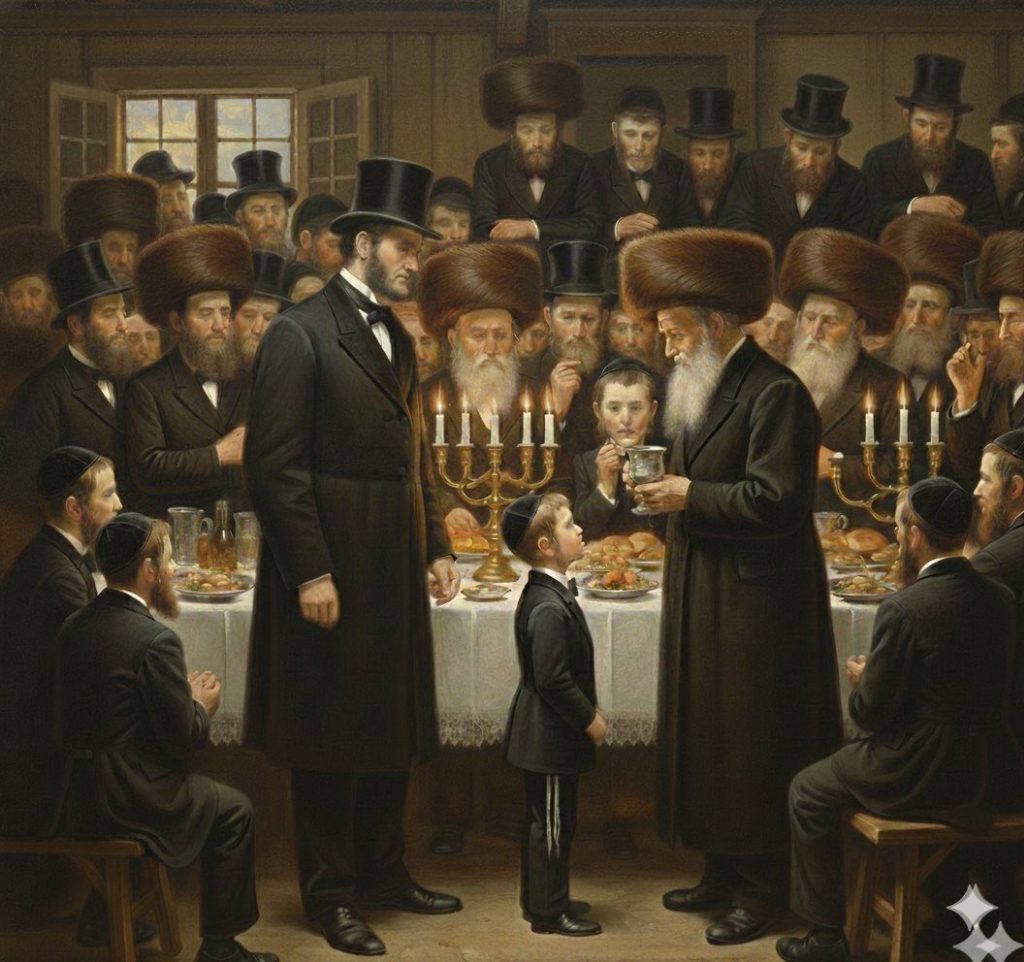
The men crowded into the shul. Boys stood on benches. People squeezed into every corner, hoping to see the miracle with their own eyes.
When the Saba Kadisha walked in, the room fell silent.
On the table were cakes and kugel and a big bottle of wine. The closest Chassidim stood near the Rebbe. Rabbi Shlomo was at his side. Mr. Rosenberg stood there too, holding Chanoch close.
As the Rebbe was about to begin kiddush, the pushing started again. People wanted to get closer. Everyone wanted to see the boy.
“Nu!” the Rebbe said firmly. “Give them space.”
The crowd stepped back.
The Rebbe lifted his silver becher, made kiddush, and drank.
Then he turned to Mr. Rosenberg and Chanoch.
He called Rabbi Shlomo to come closer. Together, they held the cup of wine. Together, they brought it close to Chanoch’s lips.
The Rebbe looked right at the boy.
“Zog,” he commanded.
Then the Rebbe began the bracha.
“Boruch…”
For a moment, nothing happened.
The shul was so quiet you could hear someone breathe.
And then, in a thin, high voice, Chanoch said, “Boruch.”
A gasp spread through the crowd.
The Rebbe continued, steady as ever.
“Ato,” said the Rebbe.
“Ato,” Chanoch repeated – soft, but clear.
It was Chanoch. There was no question.
“Hashem… Elokeinu… Melech…”
Word after word, Chanoch followed the Rebbe, all the way to “Hagofen.”
The first bracha of his life.
Mr. Rosenberg laughed. Then he cried. Then he laughed again. Tears poured down his face.
Twelve years.
Twelve years of waiting and wishing and begging doctors, who just shook their heads.
And now – here – his son was speaking.
Mr. Rosenberg looked at the Rebbe. He didn’t say anything. He couldn’t. But inside, he knew something.
He had come to Radoshitz for his son, and he was leaving with a new life for both of them.
The next time he came back, it wouldn’t be with a silent boy tightly squeezing his hand.
It would be with a confident Chanoch, talking and chatting at his side, as a Chassid of Radishitz.
And Mr. Rosenberg himself would look different, too – because the Rebbe had not asked him for something easy.
He had asked him for the hardest thing.
* * *
Mr. Rosenberg was used to giving money. That part was easy for him. When someone asked for help, he gave. When there was a problem, he paid. He probably gave tzedaka without even thinking twice. For him, writing out a big number wasn’t the hard part.
But the Rebbe didn’t want his money.
The Rebbe asked him to change.
And for Mr. Rosenberg, that was much harder than giving away gold and silver.
Where he came from, everyone looked a certain way. Everyone dressed neat. Everyone fit in. If you stood out, people stared. If you did something different, people laughed. And Mr. Rosenberg cared a lot about what people thought. Not because he was a bad person, but because that was the world he lived in.
So, when the Rebbe said, “Grow out your beard and peyos,” it sounded like the hardest thing in the world.
And that’s exactly the point.
Sometimes, we think the way to get help is to do something easy – something we’re already good at. But sometimes, Hashem wants us to work on the one thing we keep avoiding. The one thing that pushes us the most out of our comfort zone. The thing to which we keep saying, “No, no, no – anything but that.”
When Mr. Rosenberg finally said yes, he didn’t only earn a miracle for his son.
He took a real step. A big step. And sometimes, that first big step is what opens the door for the most wonderful miracles.
Beis Moshiach #1491 • pp. 54-59
© 2026 Beis Moshiach Magazine. All rights reserved.
This article originally appeared in Beis Moshiach #1491. You are welcome to share it with friends and family by email or in print, provided that you do not change, add to or omit any part of it, you credit the author and Beis Moshiach, and you include a link to archive.bmoshiach.org (written out in full in printed copies).
To republish this article in a newspaper, magazine, book or website, please request permission in advance at [email protected].