The Art & Power of Storytelling
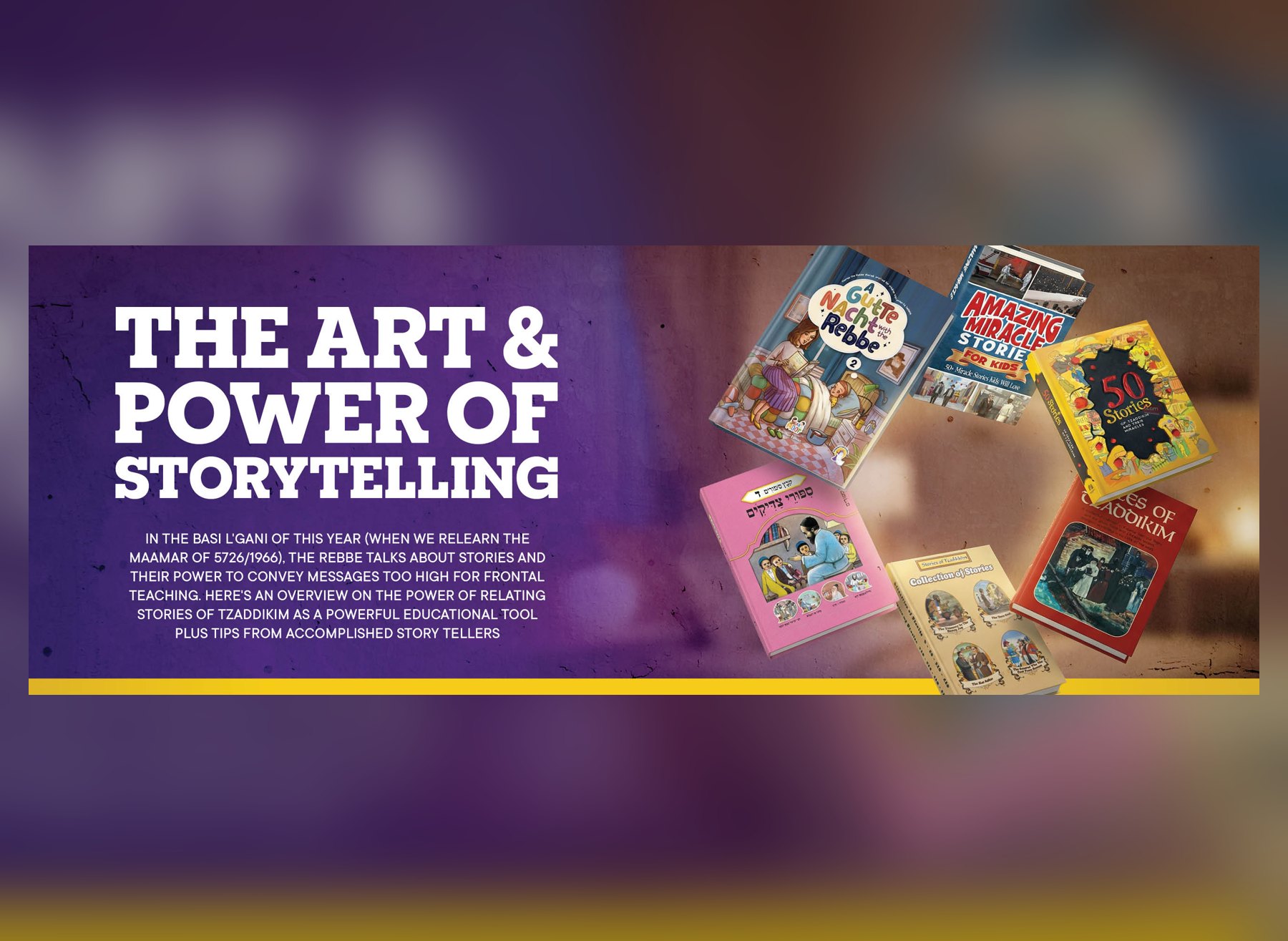
In the Basi L’Gani of this year (when we relearn the maamar of 5726/1966), the Rebbe talks about stories and their power to convey messages too high for frontal teaching. Here’s an overview on the power of relating stories of tzaddikim as a powerful educational tool, plus tips from accomplished story tellers.
In Chassidic teachings and practice, storytelling occupies a place of honor. Our Rebbeim have gone so far as to say that stories of tzaddikim are like the “Written Torah” of Chassidus. Do we truly appreciate how profound their value is?
Perhaps something in the article before you will inspire us to add a Chassidishe story to our evening meal or bedtime routine, or any other time too…
The Precious Value of the Chassidishe Story
The Alter Rebbe said that stories of tzaddikim told at farbrengens are a form of revival. In avodas Hashem, “when they heard Torah from the Maggid, it was considered like Torah she’b’al peh (Oral Torah), but when they heard a story, it was like Torah she’b’ksav (Written Torah).”
The Tzemach Tzedek compared the significance of a Chassidishe story to the mitzvah of recounting Yetzias Mitzrayim (the Exodus from Egypt). This is the story’s power and virtue – to take the Chassid out of the “mitzrayim” (constraints) in which he finds himself.
Here’s the quote as brought by the Rebbe Rayatz in a sicha on the night of the Chag HaGeula, 20 Kislev 5702:
“We are commanded to tell of the Yetzias Mitrzayim: even if we are all wise, all understanding, and all know the Torah – our Chabad – we are commanded to tell. We must tell a Chassidishe story, and through the story itself we leave mitzrayim.”
In HaYom Yom for 26 Menachem Av, the Rebbe MH’M brings the words of the Rebbe Rashab, who also connects the Chassidishe story to the Exodus from Egypt, but emphasizes that the story alone isn’t enough. We must learn a practical lesson from it and apply it. This is what’s written there:
My father, the Rebbe, said: “In the ‘Yetzias Mitzrayim’ of Chassidus, there’s the mitzva of recounting the story of the Exodus – to tell Chassidishe stories and decode the story into life lessons. We need to know that every story is instruction for living. Every story should bring good character traits and inner vitality in beautifying mitzvos and convey the pleasant ways of Chassidus.”
The Rebbe Rayatz relates that once, when he brought his father, the Rebbe Rashab, a book of stories, the Rebbe Rashab was extremely pleased and expressed: “I value this more than if you had brought me a Rebbe’s manuscript [of Chassidus].”
The Rebbe Rayatz himself writes in Likkutei Dibburim (vol. 3-4, p. 618): “A worthy Chassidishe saying and a worthy Chassidishe story are essential!
“We need to know that every Chassidishe story is instruction for living. Every story should bring good character traits and inner vitality in beautifying mitzvos and convey the pleasant ways of Chassidus.”
Elsewhere the Rebbe Rayatz writes: “[Relating] stories of Chassidim are a general obligation incumbent upon a person of good character who serves Hashem. After the obligation of study comes the turn of the illuminating light.”
Reb Hillel of Paritch said that the first two books of the Five Books of Torah are Bereishis and Shemos, most of which are narrative stories, for only after introducing these stories can one properly learn Torah.
There’s also a well-known story of two authors who came to Reb Yisroel of Ruzhin to receive his haskama (approbation). One had written chiddushei Torah and the other had written stories of tzaddikim. Reb Yisroel of Ruzhin gave his haskama first to the author of the stories, saying this is Hashem’s way in the Torah – stories of tzaddikim before the laws. Therefore, Sefer Bereishis is also called Sefer HaYashar (the Book of the Upright), because through the stories of tzaddikim in it, it straightens the heart and mind.
The Importance of Precision in Telling a Chassidishe Story
Our Rebbeim demanded that we tell precisely both the general background and the situation of the era when the narrated event occurred, along with all other relevant details. This ensures the story stands vividly before the listener’s eyes and penetrates deeply within them.
“It’s well known and publicized in the name of our holy Rebbeim – that every story of tzaddikim or Chassidim – regardless of group, for even a story that at first glance seems to have no content actually has much content – must be told with great precision, and even a segment of a story must be told in exact order.”
The elder Chassidim placed special emphasis on students reviewing the stories they heard, repeating them again and again until they knew them well, with all their details and precision.
The Story as a Tool of Chassidishe Education
Chassidishe stories are an integral part of Chabad education. In a letter to R’ Eliyahu Chaim Lipsker, the Rebbe writes: “I was pleased to read in your letter about your efforts to instill Chassidishe stories in your students… and surely you’ll add strength in this, for this is the whole person.”
In the Igros Kodesh of the Rebbe Rayatz, he writes that a major principle in educating children is training them to read stories of tzaddikim. Reading alone isn’t sufficient; they must also be tested on retelling what they read, and we must explain to them the moral lesson and point of each story. These are the holy words of the Rebbe Rayatz:
“A major principle in guiding young children is to give them good stories about the conduct of tzaddikim… to supervise that they read with attention, and to test whether they know what they read, and to accustom them to repeat everything they read in order. After each story – it’s necessary to explain to them the moral lesson in fear of Heaven that emerges from that story.”
In a sicha on Parshas Eikev, in Likkutei Sichos (vol. 19, p. 91), the Rebbe relates that the Rebbe Rashab, once hired a melamed to teach his daughters. This melamed believed that children shouldn’t be told miraculous stories that aren’t understood by the intellect. When the Rebbe Rashab learned of this view, he ordered his immediate dismissal.
The Rebbe explains that the reason is because “we must begin specifically with emunah and kabbalas ol, not with intellect. Even matters understood by intellect must be done with kabbalas ol, etc. This is also the matter of education. Children must be told about miracles, which are beyond intellect, and this plants emuna in them. The fact that it isn’t measured, and afterward it’s still necessary to begin with matters that develop thinking and intelligence – that’s the way. But first one must plant in children emuna peshuta and kabbalas ol.”
Each of us can surely share at least one Chassidishe story that strengthened us, touched us, gave us strength to advance in avodas Hashem. Sometimes there are stories we read or heard long ago that accompany us to this day. Pass it forward…
When Stories Change Lives
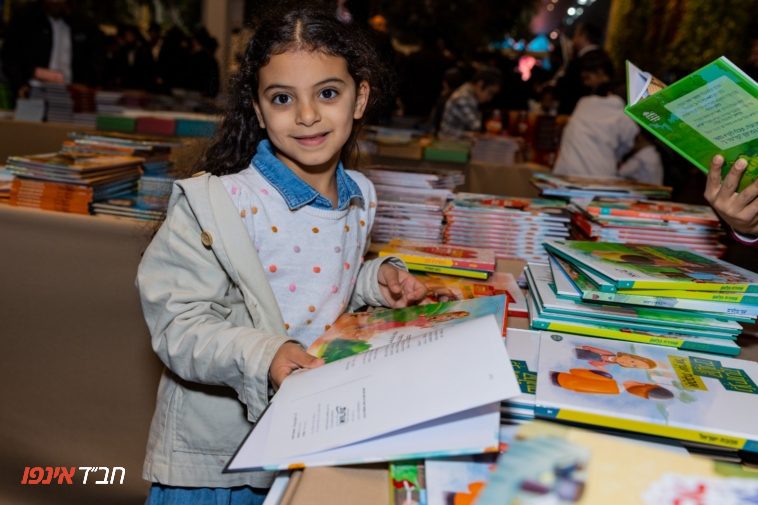
Mrs. Shoshi Levin runs a project (“Kan Sippur”) that has brought Chassidishe stories to hundreds of families through audio recordings. But the real story isn’t about the mechanics – it’s about what happens to children who hear these tales of tzaddikim. We sat down with her to learn more.
How did this all begin?
From a very young age, I loved listening to stories of tzaddikim. My mother a’h passed away when I was nine, and I have this beautiful memory – my father sitting with me every night until I was about twelve, telling me stories of the Baal Shem Tov. It’s deeply etched in my mind, heart, and soul.
That’s why when I became a mother myself, it was so important to me to tell my children a Chassidishe story before bed. For us, it became this precious quality time that has no substitute. But at a certain point, I realized I wasn’t managing to do it every single evening. I went looking for recorded stories – audio only, so the kids wouldn’t be stuck to a screen – but I couldn’t find anything that matched what I wanted to give my children.
At that time, I was working as a preschool teacher and activity leader, also doing parental guidance. I thought, why not just record the stories myself? I tried it, and it worked. So I did another one, and another… At first it was just for my own family, but slowly the circle grew.
What does the project look like today?
Baruch Hashem, we now have almost 200 stories – about our Rebbeim, special dates on the Chabad calendar, tzaddikim throughout history, and even stories about Tannaim and Amoraim from the Gemara. Every week I release a new story.
We have listeners from all kinds of backgrounds – Chabad families, general Chassidishe, chareidi, religious Zionist. Children everywhere respond to these stories. They can access them through the website, email, or WhatsApp, and I’m working on setting up a phone line for families without internet.
Can you share some of the feedback you’ve received?
This is the part that keeps me going. A mother reached out about her son who has severe attention disorders. He typically experiences constant restlessness – but when he listens to these stories, he becomes completely calm. Completely. The transformation she described was remarkable.
Another mother told me what happened after her daughter heard a story about tzedaka. That very same day, a collector came to their door asking for tzedaka. Her daughter – totally on her own – ran to her room, opened her drawer, and brought out money for tzedaka. She internalized the message immediately and acted on it. No one told her to do it. The story did that.
What makes stories so powerful for children?
There’s something about a story that bypasses all the resistance. You can lecture a child about tzedaka and they’ll forget it by morning. But tell them a story about how a tzaddik gave away his last coin? They see it, they feel it, they want to live it.
This is exactly what the Rebbe Rashab insisted about when it comes education. Children need stories of miracles, things beyond logic. These stories plant emuna in them. The intellectual explanations can come later – first comes that deep impression that shapes who they become.
At the end of each story, I do give a brief explanation of the practical lesson. But honestly, the story itself does most of the work. When a child hears about mesiras nefesh, they start understanding that doing what’s right even when it’s hard – like listening to Mommy even when you don’t feel like it – that’s its own kind of heroism.
Many children deal with fears, especially about bedtime. They’re scared of being alone in the dark, worried the fears will overwhelm them. A Chassidishe story transforms that vulnerable moment. Instead of lying down with churning worries, they fall asleep with images of tzaddikim, acts of kindness, Hashem’s protection filling their minds. Parents have told me it’s made all the difference.
Whenever I felt overwhelmed or doubted whether I should continue, I would open the Igros Kodesh and receive clear guidance to continue this holy work of educating Jewish children. It’s my shlichus. The siyata d’shmaya has been incredible.
What advice would you give mothers who want to tell stories at home?
First, paint the background for them. Describe the era, the place, the people. This is what makes it vivid and real for children – they need to see it in their minds.
Second, don’t just read monotone. Share the emotions! Let your voice show excitement, wonder, concern. Your engagement is what brings the story to life for them.
You can add a niggun if it fits the story, or have them close their eyes and imagine the scene unfolding. And if they’re still awake afterward, ask gentle questions: “What do you think about that?” “What would you have done?”
But here’s the key – make it a nightly ritual. The magic isn’t from one story. It’s from a childhood filled with stories of tzaddikim. These become the lens through which children see the world. They become the inner voice guiding them when they face challenges. They become the foundation of who they are as Jews.
Any final thoughts?
Stories are how we pass on our mesorah. They’re how emuna gets planted in young hearts. Every parent has the ability to do this – you don’t need special equipment or training. Just your voice, a good story, and a child ready to listen.
May we merit to fill our children’s minds and hearts with these eternal stories, and awaken together from the dream of galus.
Beis Moshiach #1492B • pp. 44-47, 50
© 2026 Beis Moshiach Magazine. All rights reserved.
This article originally appeared in Beis Moshiach #1492B. You are welcome to share it with friends and family by email or in print, provided that you do not change, add to or omit any part of it, you credit the author and Beis Moshiach, and you include a link to archive.bmoshiach.org (written out in full in printed copies).
To republish this article in a newspaper, magazine, book or website, please request permission in advance at [email protected].