Rabbi Nissan Telushkin & the Question That Vanished 3 Times
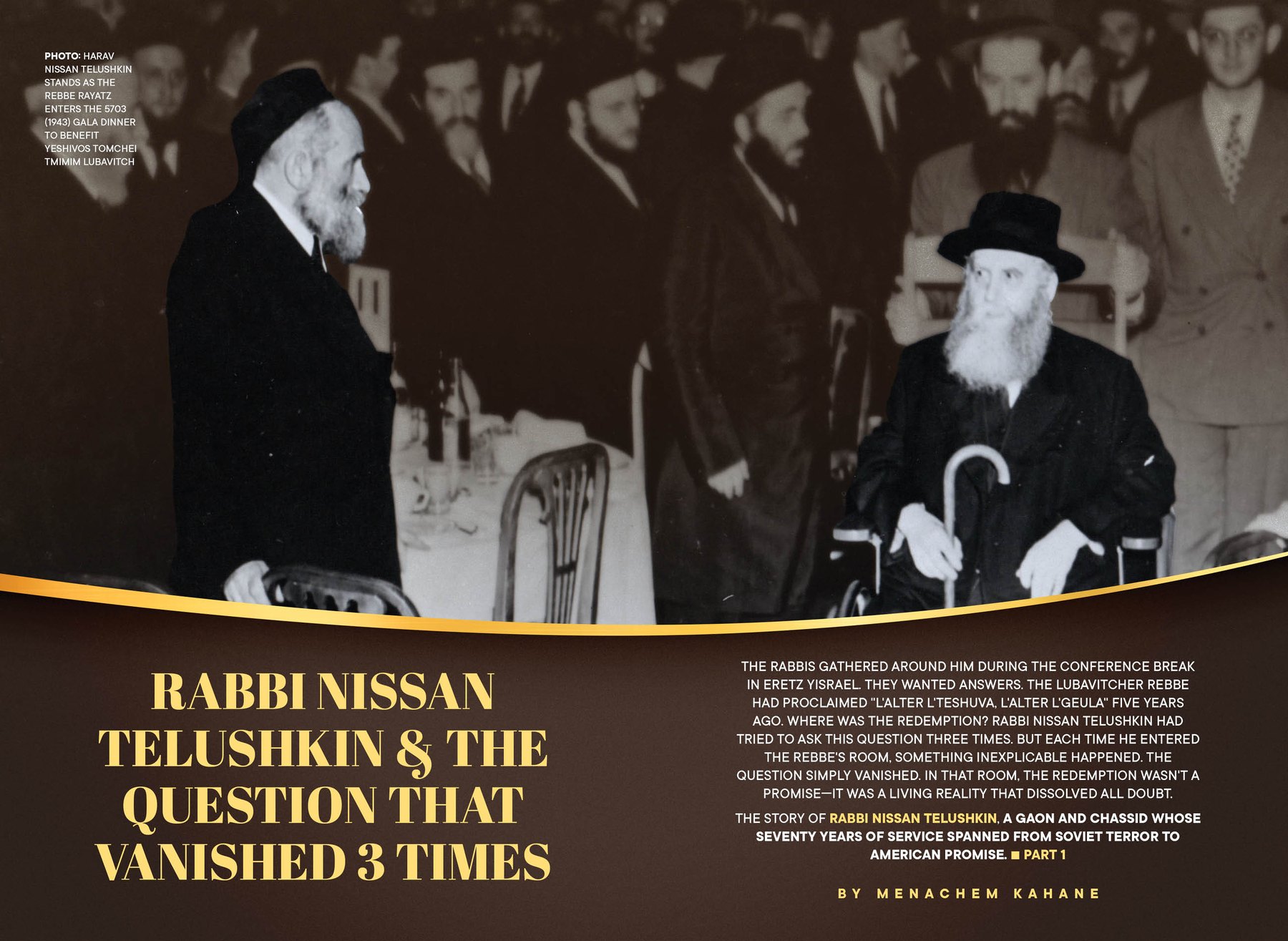
The rabbis gathered around him during the conference break in Eretz Yisrael. They wanted answers. The Lubavitcher Rebbe had proclaimed “L’alter l’teshuva, l’alter l’Geula” five years ago. Where was the Redemption? Rabbi Nissan Telushkin had tried to ask this question three times. But each time he entered the Rebbe’s room, something inexplicable happened. The question simply vanished. In that room, the Redemption wasn’t a promise – it was a living reality that dissolved all doubt. The story of Rabbi Nissan Telushkin, a gaon and Chassid whose seventy years of service spanned from Soviet terror to American promise. Part 1.
A Midnight Encounter
“Midnight, and there was knocking on my door. I was then a rabbi in Pokhovich, Minsk province. A terrible fear fell upon me, for I was certain they had already sent someone from the government to arrest me, like my other colleagues. I opened the door with trembling hands, and behold, a young scholar with a beard and peyos entered (a messenger of the Rebbe Rayatz). He led me to an inner room, handed me a bundle of money in a substantial sum, and said to me: ‘Here, to support the teachers of young children.’
“We had no Talmud Torah or chadarim, only teachers who would go around among the houses to teach two or three children who gathered there. To maintain the mikva and support poor workers so they wouldn’t be forced to be mechalel Shabbos. The messenger spoke no further. He hurried to leave my city for other cities.
“This was the practice from time to time, to bring secret aid to rabbanim, including for their own sustenance, for the sustenance of shochtim who shechted in secret; for Torah, for mikva, and for shomer Shabbos workers.”
This midnight memory was recorded and recounted by the Gaon and Chassid Rabbi Nissan Telushkin z’l, who served in many important positions in Chabad Chassidus in the United States: ‘Honorary President’ of Agudas Chabad USA, member of the Torah Council of ‘Adeinu,’ member of ‘Machne Israel’ and ‘Merkos L’Inyanei Chinuch,’ editor of ‘Chabad Bulletin,’ member of the vaad ha’ruchni of Beis Rivkah in the United States, Av Beis Din of the Vaad Rabbanei Lubavitch, and many other positions.
After approximately seventy years of rabbinical service and teaching, a tremendous life journey of spreading Torah and Chassidus, Rabbi Telushkin passed away at a ripe old age on the 20 Adar II 5730 [1970], about fifty-five years ago, and he is buried in New York.
Rabbi Telushkin merited an unusual connection and fascinating kiruvim with our Rebbeim, the Rebbe Rayatz and with the Rebbe MH’M, as will be told further.
Learning from Great Scholars
Rabbi Nissan Telushkin was born in the city of Babruisk, Russia, in the year 5641 [1881], to a Chabad family whose soul was immersed in the sea of Torah and Chassidus.
He received his initial chinuch from his parents Rabbi and Mrs. Moshe Yitzchok and Chasia, who planted in him the seeds of pure Yiddishkeit. In his youth, he studied in the city of Slutsk, where he was learned Torah from the famous Geonim: the city rav, Rabbi Yaakov Dovid Wilovsky, author of the Ridvaz on the Yerushalmi, and Rabbi Isser Zalman Meltzer, author of the Even HaEzel on the Rambam, both lions of the group who left their mark on him. He received semicha from both of them at a young age. He also was eagerly mekabel from Rabbi Hirsh Shlez and from the renowned Gaon Rabbi Boruch Ber Leibowitz, and even merited a special connection with the author of the Chofetz Chaim, a relationship that was wondrous to many.
R’ Nissan was exceptionally diligent and immersed himself in Shas and poskim and sifrei Chassidus. Thus, he merged within himself the lomdus of the Lithuanian Geonim with Chabad Chassidus.
When he came of age, his heart full of Torah and yiras shomayim, he married Sarah Fruma, daughter of Rabbi Moshe Tcharny, rabbi of the town of Dukor in the Minsk province. R’ Nissan settled there after his wedding and studied Torah day and night.
In the year 5662 [1902], a shocking event changed his life. His father-in-law suddenly passed away. At that time, while still a young man, he was given semicha by three of the greatest of the generation: the rabbi of Bobruisk, Rabbi Moshe Shmuel Shapira, Rabbi Yosef Bakst, and the Admor Rabbi Shmarya Noach Schneersohn. Thanks to this, he was appointed as rabbi in Dukor in place of his father-in-law, when he was only in his twenties.
About that period he later related that the essence of his study was learning that leads to action. He toiled greatly in works of halachic responsa, wanting to know and be able to rule on practical halacha.
Endangering Their Lives for Yiddishkeit
When the Communists cast a heavy shadow over Russian Jewry and threatened rabbis and klei kodesh not to dare engage in matters of kedusha, the Rebbe Rayatz established a secret aid system to support rabbis who survived in Soviet Russia, including R’ Telushkin.
About this vital connection, he himself testified: “We did not lack means of money; the Rebbe Rayatz of Lubavitch took care of this, sending us special secret messengers with monetary donations for underground chadarim for Torah study and for building mikvas.” Through this, the Rebbe Rayatz ensured the continuation of Jewish life through an underground money-smuggling system.
“Both the Admor of blessed memory and his messengers,” R’ Nissan later wrote, “put themselves in actual mortal danger. Had they been discovered in their actions, their sentence would have been death, but they did their work without considering the danger.”
His own mesirus nefesh was expressed in the continuation of his chilling testimony: “And there were times I risked being sent to Siberia, as my fellow rabbis were sent for their involvement in such activities.” In these words lies the documented heroism of a Chassidishe Rav who knew well the fate of his colleagues who were sent to Siberia or the Gulag for their religious activity, yet continued in his holy work.
He also sacrificed himself for maintaining the mikvas. About the quality of the mikvas and their construction method, he related: “They (the Communists) decreed harsh decrees against Torah study and observance of mitzvos, closed the mikvas, and we had to seek various stratagems on how to fulfill this mitzva with special halachic ingenuity that would be kosher according to law and hidden from the eyes of those persecuting religious observance.”
R’ Nissan invested great toil and sweat together with two talmidei chachamim from his city to prepare a suitable plan adapted to the decrees of the time. They put their lives on the line for the mikvas.
New Life in Free America
For nineteen years R’ Telushkin served as a replacement for his father-in-law, and afterward moved to serve as rabbi in the city of Pokhovich.
In the year 5684 [1924], he succeeded through great miracles to leave Soviet Russia and emigrate to America, the land of freedom. The terror and fear became history. From here onward he began a new life in a completely different mode.
Upon his arrival in the USA, he was chosen as rabbi of the congregation ‘Bnei Yitzchok Nusach HaAri,’ and devoted himself to public Torah activism. He was later appointed to be a member in the leadership of various Torah organizations, beginning with ‘Agudas HaRabbonim’ and ‘Vaad HaRabbonim’ of greater New York, Honorary President of ‘Agudas Chassidei Chabad,’ continuing with the ‘Executive Committee of Mizrachi,’ and also chairman of the education committee at Yeshivas Toras Chaim in Brooklyn.
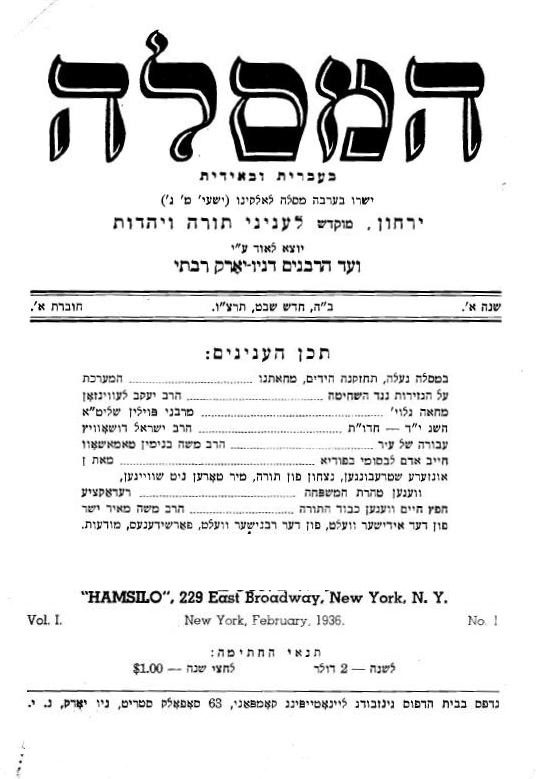
He edited the journal ‘HaMesilah’ with rare skill. It was the publication of the Vaad HaRabbonim, in which he published important halachic cases in light of contemporary problems, alongside passionate calls for an awakening for the spreading of Torah and strengthening those who learned it. Thus he became a gadol b’Torah, blessed with talent, an extraordinary speaker whose words shook people up, and among the important rabbanim in America of those years.
R’ Telushkin was a true gentleman and exceedingly wise. He was a good speaker and knew how to use his words to navigate the intricacies of life while being alert to the problems of the hour and generation. Being pleasant to people and endowed with folksy simplicity, he acquired not only the trust of the common people but also of his fellow rabbanim, who greatly honored him. He was not the type of rabbi rigidly insisting ‘accept my view,’ but he was firm in his thinking not to be thrown off course from what truly mattered.
His main concern at that time was regarding the chinuch of Jewish children, an issue that burned in his bones. At every gathering he would speak with an aching heart and tearful eyes about the great neglect in the field of Jewish chinuch in America. R’ Nissan did not settle for words alone but helped in founding many yeshivos and institutions that provided an oasis in the spiritual desert.
In East New York, the neighborhood where he lived, he toiled day and night to improve the state of Yiddishkeit. He founded a group of shomrei Shabbos and would walk every Friday evening to the doors of Jewish-owned stores, speaking warmly and lovingly to the sellers’ hearts to close their businesses on Shabbos. His regal appearance in the neighborhood streets made a great impression.
Kiruv Anash and Chassidic Influence
There was a close and special connection between the Rebbe Rayatz and R’ Nissan. In one of his letters, the Rebbe described him as “my mighty friend, the renowned Gaon, whose name is for praise and glory among the geonei Yaakov, possessor of lofty characteristics and G-d-fearing man, our teacher Rabbi Nissan may he live.” When R’ Nissan was in America, the Rebbe Rayatz was assisted by him many times, both in caring for Chassidim (such as for itinerant fundraisers, ‘shadars,’ etc.), in matters of strengthening Torah and mitzvos, help in diplomatic matters, as well as assistance in his escape from the burning front during the Holocaust.
The earliest letter we have was sent from the Rebbe Rayatz to R’ Nissan at the end of Tammuz 5688 [1928]. In the letter, the Rebbe expresses great appreciation for his efforts to draw close Anash and gather with them. The Rebbe wishes him success and a good shidduch for his daughter:
“It is very dear to me the kiruv that you are mekarev Anash, for in every farbrengen of Anash there is double and triple benefit, and it is clear that farbrengens in general and active outreach in particular do not return empty… And may the Almighty help him materially and spiritually and may the Almighty soon arrange for him a good shidduch, materially and spiritually, for his daughter may she live.”
A glimpse of his great influence among Anash in New York can be learned from the memoirs of Rabbi Yisroel Jacobson, Simchas Torah 5694 [1933]: “As we walked in the street we would meet acquaintances and just plain Jews and honor them with dancing, until in the evening we came to the house of R’ Nissan Telushkin. RaNaT would invite rabbis from the neighborhood to participate in the joy, and once he also invited Rav Moshe Feinstein, who then lived in East New York.
“RaNaT requested that they sing in his house the niggun of the Alter Rebbe, the Dalet Bavos, and I said that this niggun must be sung seriously and with kabbolas ol, and therefore they should wear their hats and not sit there just with yarmulkes. One of the distinguished participants objected to this and said sharp words against it, and I said that if so, we will not sing the niggun. In the end, he too put on his hat and we sang.”
The Mikva Revolution in America
R’ Nissan did not rest on his laurels and brought about a broad change to improve the state of mikvas in New York. He was zoche and saw great success in this area. In his neighborhood he built a magnificent mikva; he did not rest until he saw the mikva in its glory.
He had to go through a real obstacle course to realize this dream. Every night he knocked on the houses of generous donors and asked them to contribute money for building the mikva. Despite being elderly, he worked tirelessly for taharas ha’mishpacha, a heart-stirring sight of mesirus nefesh for the mitzva of tahara.
While working on establishing and repairing mikvas, he clarified many practical halachic questions in the field. He concentrated all the questions in dinei mikva in the sefer Taharas Mayim (first edition – 5707). This sefer did not leave the tables of the great rabbanim dealing with inyanei mikvaos.
After he sent his sefer to the Rebbe Rayatz, the Rebbe blessed him: “May the Almighty make him successful in his work and to be mechadesh chiddushim in Torah, with harchavas ha’daas in gashmiyus and ruchniyus. He who seeks his welfare and blesses him.”
The Rebbe also encouraged him to publish the sefer, and even urged him to issue another edition, saying about the author that he had proven himself to be expert in these matters.
He also published another wonderful sefer called HaTorah V’HaOlam in three volumes, in which he compiled his drashos and articles that he delivered and published – a rich spiritual heritage for many of his readers and hearers of his teaching.
Bittul to the Rebbe Rayatz
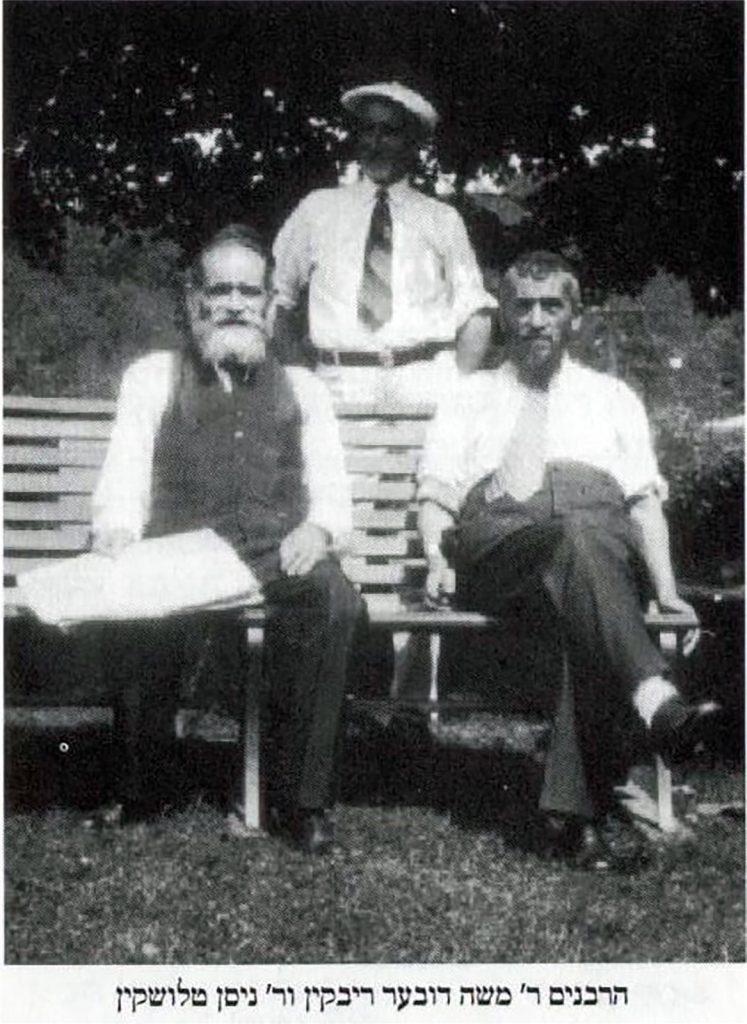
R’ Nissan, being a Chassid and mekushar, was a partner and active in all matters of Beis Rebbi.
After the Rebbe Rayatz’s visit to Eretz Yisrael in 5689 [1929], he traveled for a special visit to the United States at the request of the Chassidim there. The visit began on the 12th of Elul. The news about the reception of the Rebbe Rayatz occupied a prominent place in the American Jewish press and was covered extensively. In the following weeks, articles and opinion columns about the visit were published, among which stood out the article by Rabbi Nissan Telushkin published in HaPardes of Tishrei, by virtue of his being one of the heads of Aguch.
In his article he wrote about the privilege of American Jews to host the Rebbe, and the tremendous spiritual boost resulting from the visit:
“It is a great privilege for this land of our exile abutting the Atlantic Ocean to welcome the great man who is considered, justly, as the hero of our nation in this generation, who is devoted with all his life and soul to the battle of Torah and emuna, and has nothing in his world except the exclusive work for ‘Kudsha brich Hu, Torah and Yisrael that are bound to each other,’ he is his honor and holiness the Admor Rabbi Yosef Yitzchok shlita Schneersohn of Lubavitch.”
At the conclusion of his inspiring article, R’ Nissan wrote:
“Not in vain has joy grown so much among the circles of Chassidim, but among all sectors of our people on the occasion of the arrival of the Admor shlita, and there is no person who cares about the fate of our Torah and our faith who did not rejoice with complete joy. Our people in all its sectors is thirsty, it yearns for a drop of dew of revival, for a spark of light that warms and inspires, the people yearned to see one of its great heroes, a hero of its spirit. And when its beloved for whom it so hoped appeared, the people in all its sectors blessed his appearance with the blessing of blessed be your coming in peace!”
During the Rebbe’s travels, R’ Nissan accompanied him as a faithful Chassid with utter bittul. R’ Nissan also arranged financial assistance for the Rebbe Rayatz (see extensively in his Igros Kodesh vol. 13 p. 215-6).
About the visit, R’ Nissan related (‘Chabad Bulletin’ Iyar 5696 [1936]): “I remember once when we merited to sit together with the Rebbe shlita during his stay in this country, after a magnificent reception they arranged for him in New York, thousands of people who came to see him and hear him, and after the enthusiastic excitement shown to him by those who saw him and heard his words when he spoke before them for a long time, he said to us in these words: ‘Indeed I cannot complain. I found enthusiasts and enthusiasm here (as we know, he did not want to enjoy and did not enjoy the great honor given to him, and would fast on the first day of his arrival in a city, saying ‘honor, one must fast away’), but if only this enthusiasm would be at least like a wood fire that leaves coals after it, and not like gasoline that leaves nothing after it.’”
The Rebbe’s visit ended on 21 Tammuz 5690 [1930], when the Rebbe returned to Europe.
Before his departure from the US, an awakening began among Anash to ask the Rebbe Rayatz to remain in the US. For this purpose, a special committee was chosen, including R’ Nissan Telushkin, who worked energetically to bring the idea to fruition. They also inspired additional balabatim who even collected money for the purpose.
Nevertheless, in a letter written by the Rebbe Rayatz at the beginning of the year 5691 he announced that he did not intend to settle permanently in the US – which changed with the outbreak of World War II, when the Rebbe arrived in the United States, with R’ Nissan greatly assisting with this.
R’ Nissan’s help to the Rebbe was also expressed in concern for a permanent place for the Rebbe. Upon his arrival in the United States, the Rebbe moved from place to place temporarily, without having a permanent home. For this purpose, a special committee was established “Committee for Building Beis Chayeinu, by Agudas Chabad, members of the Committee of Agudas Chabad,” in which Rabbi Nissan Telushkin was a member. After various searches, the building at 770 became the Rebbe’s residence and was purchased under the direction of the special committee that was established.
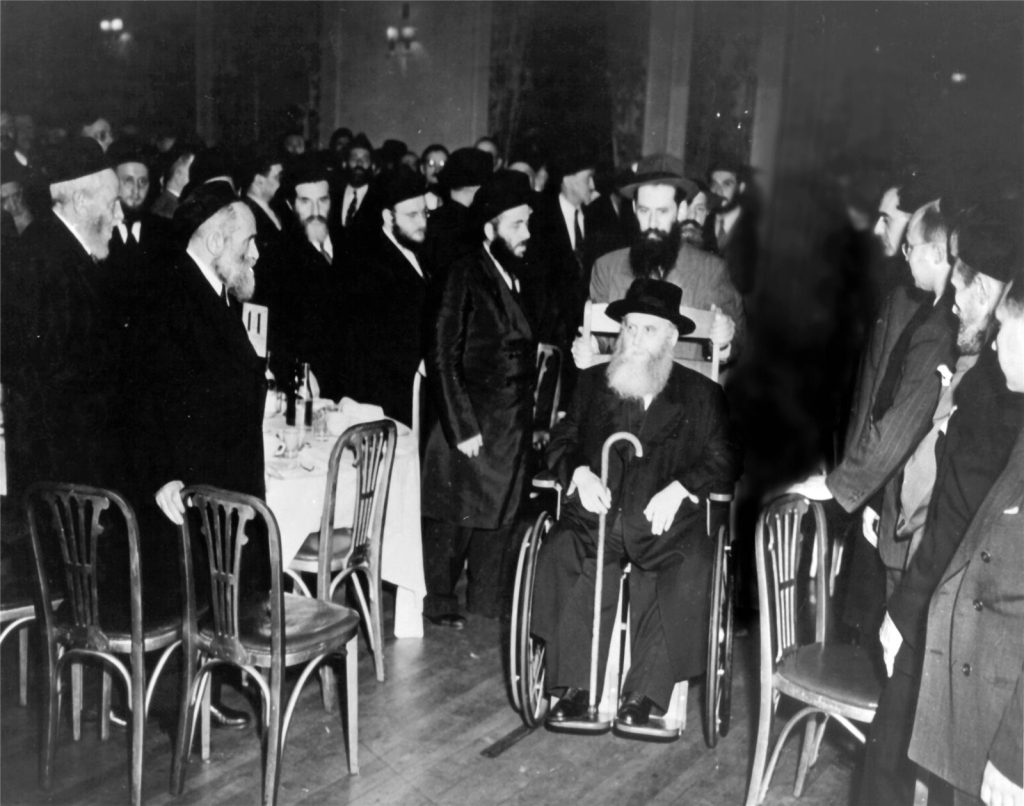
With the Rebbe Rayatz’s settlement in the United States, R’ Nissan was one of his great mekuravim who stood at his right hand in spreading Torah and Yiddishkeit. He dedicated much of his time and energy for the benefit of the Central Tomchei Tmimim Yeshiva in New York and its many branches around the country. He was also very helpful to the Chabad families who immigrated to the US.
If I Had a Million Dollars…
When the Rebbe Rayatz arrived in the US, he declared that ‘America is no different’ from the shtetl in Europe.
A wonderful story that expresses the Rebbe’s commitment to realizing this ideal occurred with R’ Nissan. And this is what happened: Once he entered for a yechidus with the Rebbe Rayatz and found the Rebbe sitting and crying. R’ Nissan dared to ask “Why is the Rebbe crying?” The Rebbe answered him that he cries because he doesn’t have a million dollars. He recoiled a bit and asked, “For this the Rebbe cries?” The Rebbe answered him: “I need the million dollars to place a yungerman in every city. If I could do this, we would thus transform all of America…”
Reb Shlomo Freifeld related it differently, as he heard from R’ Nissan himself:
“Rabbi Telushkin,” the Rebbe asked, “if you had a million dollars, what would you do for the Jewish people?”
“When R’ Telushkin continued to speak,” R’ Shlomo described, “tears flowed from his eyes. Do you believe me that I never thought about the question, that I had nothing to answer the Rebbe? Why didn’t I ever think about the question?!…”
The Rebbe Rayatz as Moshiach
In the midst of the terrible Holocaust, the Rebbe Rayatz pushed for the need for teshuva and strengthening faith in the coming of Moshiach with the slogan “l’alter l’teshuva, l’alter l’Geula (immediately to repentance, immediately to redemption).” As a result, the Chassidic world went into high gear of anticipation and expectancy for the coming of Moshiach, while strengthening the feeling that the Rebbe Rayatz is the Melech HaMoshiach.
The situation led to R’ Nissan finding himself dealing with complex questions from members of his community.
Matters came to a head on Erev Rosh Hashana 5703 [1942], when the Chassidim entered the Rebbe’s room and gave him a collective pidyon nefesh for his health.
R’ Nissan mustered the courage and asked the Rebbe directly: Does the Rebbe indeed truly believe that now is the time of Geula, that Moshiach will come immediately? The Rebbe answered: “It is written ‘the sprout of David Your servant shall You speedily cause to sprout,’ the nature of sprouting is that first the grass grows, then the shoot is formed, and over time a tree bearing fruit sprouts. And indeed, the sprouting already exists now, yes!”
Reb Zalman Gurary related that when R’ Telushkin asked the Rebbe “the Rebbe constantly shouts that today Moshiach is coming, and if Moshiach doesn’t come, the public will be very disappointed…” The Rebbe answered: “What do you think, that I don’t know about that?…”
An interesting anecdote in connection with this: In 5708 [1948] R’ Telushkin asked the Rebbe Rayatz whether perhaps there is in the aliyah of Jews now to Eretz Yisrael, with the establishment of the State, a sign of the approaching Geula? The Rebbe Rayatz answered him: “One may think, one may not say.”
I See America Through My Window
“Famous Jewish writers, from among those who began in recent years to preach repentance, to return to the source, and they are descendants of Chabad lineage, came before the Rebbe Rayatz Schneersohn of blessed memory of Lubavitch,” R’ Nissan related in one of his drashos.
“And in order to give him satisfaction, they presented him with the good news that a luminous period has come to the world, Jewish writers are calling for repentance.
“But the Admor answered them,” R’ Nissan continued, “that repentance in its simple meaning is uprooting from the place where one stands now, and returning to the place where one stood previously. ‘If I saw you taking steps in body and deed to move from the place you are standing on with the intention of drawing close to the source, I would receive satisfaction from you. But I see that you indeed speak well and write well, but you have not yet moved even one step from your place. You preach to return to the heritage of your fathers, but the deeds of your fathers are not in your hands; you have not yet tasted the taste of observing the Torah of your fathers and its commandments, and all your deeds and way of life are still as yesterday and the day before. What repentance is there here?!’”
Interestingly, the content of these words is found in a long and fascinating letter that the Rebbe Rayatz wrote to R’ Nissan. In the letter, the Rebbe sketches the depth and essence of the soul of the Jewish heart, analyzes the spiritual state of the Jews at that time, and more. Among other things, the Rebbe tells him the story about the boy who shouted ‘koo-koo-riku’ during the time of the Baal Shem Tov, as part of explaining the virtue of the Jewish soul (printed in Igros Kodesh vol. 5 p. 430 and on).
Another fascinating point that R’ Nissan merited to hear from the Rebbe Rayatz about American youth:
“The Rebbe Rayatz of Lubavitch of blessed memory once said to me: I do not go outside because of my weakness and I do not see America except through my window, and when I open my window, a terrible coldness like ice penetrates the house; but I know the American youth who deep down are truly innocent and upright, except that their hearts are frozen like ice, and fortunate are the shepherds in Israel who strive and succeed in warming the ice and we will have streams of living water gushing forth in holiness and purity, and we will atone for ‘the sin we sinned [before You] with hard-heartedness!’”
The Visit to the Holy Land
R’ Nissan had special affection for Eretz Yisrael. In the year 5707 [1947] he fulfilled his dream and went there to visit, a visit that lasted about three months. During those months he visited the holy places and Chabad centers, and also participated in a special rabbinical conference.
Before his arrival (8th of Sivan 5707), the Rebbe Rayatz wrote to Anash in Eretz Yisrael about his expected visit:
“And since my friend the renowned Gaon, whose name is for praise and glory and G-d-fearing man, our teacher Rabbi Nissan, may he live, Telushkin is preparing to ascend, G-d willing successfully, to our Holy Land may it be rebuilt and established, I requested him to convey to you words of regards from me, from our friends Anash may they live, and our dear students beloved of my soul, attached to my heart, the Tmimim may they live, from the Central Yeshivas Tomchei Tmimim and the institutions Achei Tmimim, from the Merkos L’Inyonei Chinuch and the schools Beis Rivkah and Beis Sarah and so forth. And hereby I request of them to welcome my friend the aforementioned Gaon with all the honor befitting him, and his words of regards that you will hear from his mouth will most assuredly bring with G-d’s help awakening and strengthening in your work in organizing [Torah] classes for the many.”
Rabbi Tzvi Hirsh Gansburg, who was a bachur at the time, relates in his memoirs about the reception they arranged for R’ Nissan, and what he told them during the visit: “20th of Sivan on Friday morning, Rabbi Nissan Telushkin from New York arrived at the port of Haifa. R’ Telushkin is one of the assistants in the holy work of the Rebbe may he live. He is staying with his hometown acquaintance R’ Yeshaya Ginsburg; today he was at Y.G.
“The latter arranged a kiddush in honor of the honored guest, during which the latter told several stories from the Rebbe [Rayatz] and among them the following:
“A. When the Rebbe arrived in the US, at the reception arranged in his honor, he said: ‘Regarding Moshe when he returned from Yisro to Mitzrayim, Hashem said to him about Aharon “and he will see you and rejoice in his heart.” And the explanation is that Aharon’s joy at seeing his brother’s face is only in his heart, but on his face it is not visible, for Aharon was broken and crushed by the suffering of Yisrael in Mitzrayim, so too I, despite the fact that I am happy to see the faces of my brothers in America – I am broken and crushed by the suffering of Yisrael overseas.’
“B. The Rebbe shlita said to me in yechidus about the difference in the spiritual state of our Jewish brethren in America, to their state overseas, and it is: both have fire within them, and the difference is like the difference between fire that catches in wood, to fire that catches in gasoline; fire that catches in wood, even after all the fire burns – coals will remain. And in gasoline, after the gasoline burns – nothing will remain… And the counsel for this is that the fire should burn always.’
“In accordance with the letter of the Rebbe [brought above], Rabbi Shmuel Zalmanov and the director of our yeshiva [Yeshivas Achei Tmimim Tel Aviv] Rabbi Moshe Axelrod traveled to Haifa to welcome him.”
In the Rebbe’s Room, the Question Simply Doesn’t Exist!…
During his visit, R’ Nissan participated in a conference of rabbis and halachic rulers. He was warmly received by the conference organizers. During one of the breaks, Rabbi Unterman (later the Chief Rabbi of Israel) and several other rabbis approached him and asked him:
“You are in fact a Chassid of the Lubavitcher Rebbe, Rabbi Yosef Yitzchok Schneersohn. You surely heard his call ‘l’alter l’teshuva, l’alter l’Geula,’ he said this more than five years ago, and during the last five years the Jewish people surely did teshuva. So where is the Geula?”
Rabbi Telushkin answered them: “Before I left New York, I also had that same question. I decided to ask the Rebbe himself. I asked one of his secretaries to be allowed to enter to the Rebbe, and he informed me when I could enter.
“This was the only question I planned to ask. However, the moment I entered the Rebbe’s room and looked at him, the question slipped from my mind; it simply disappeared… I stood there without anything to ask. The Rebbe looked at me and asked, ‘Why did you come? What did you want to ask?’ Since I didn’t know what to answer, I simply said, ‘I came to see how the Rebbe feels…’
“The moment I left the room, I remembered my question and felt embarrassed. But the question truly troubled me, so I requested that they let me enter the Rebbe’s room again. The secretary refused, but I insisted. I went to Rabbi Eliyahu Simpson, also one of the Rebbe’s secretaries, and told him about my dilemma. He said, ‘Nissan, I will allow you to enter again.’
“I entered the Rebbe’s room a second time, and again, the moment I entered, the question slipped from my mind and I stood there without words. I entered a third time, and yes, the same thing happened again…
“So gentlemen,” Rabbi Telushkin concluded, “what is the answer to your question – this I do not know. But this I can say with certainty: in the Rebbe’s room, the question simply does not exist at all!…” (Rabbi Shalom Avtzon heard this story from Rabbi Nissan Mangel who related that Rabbi Telushkin shared this anecdote at one of his sheva brachos).
R’ Nissan wrote his impressions of his visit to Eretz Yisrael:
“I merited to taste the taste of Israel’s suffering under foreign rule, but I was also satisfied and enjoyed seeing the settlement and flourishing of Israel’s cities and villages that were built by the sweat of our brethren’s brow, and the rule of Torah and fear of Heaven among most of the Land’s inhabitants.
“I breathed from the spirit of Ahavas Yisrael that rules in every corner of Israel, and I breathed from the ziv ha’Shechina that prevails within it and from the spirit of the holiness of Yerushalayim that has no equal in all the world… and blessed be the Omnipresent that I merited this.”
Beis Moshiach #1494 • pp. 12-23, 22
© 2026 Beis Moshiach Magazine. All rights reserved.
This article originally appeared in Beis Moshiach #1494. You are welcome to share it with friends and family by email or in print, provided that you do not change, add to or omit any part of it, you credit the author and Beis Moshiach, and you include a link to archive.bmoshiach.org (written out in full in printed copies).
To republish this article in a newspaper, magazine, book or website, please request permission in advance at [email protected].