Now That We’ve Taken the Masks Off…
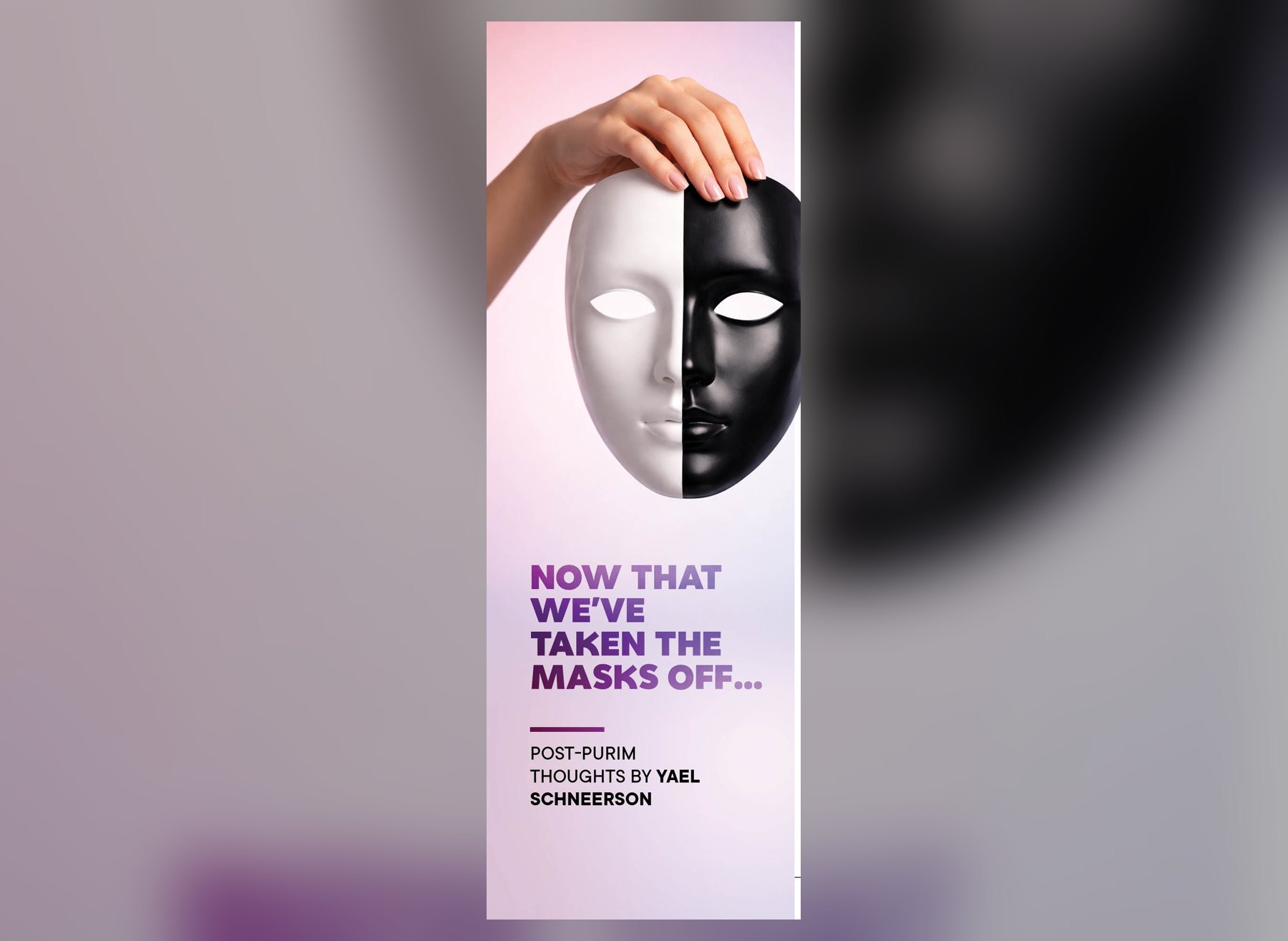
A popular saying claims that “masks are not only for Purim.” There are many types of masks, and each of us finds herself using them throughout the year.
These kinds of masks are usually perceived as something negative. But is that really so? When is a mask right for us, and when is it not? And who is our true self among all the masks we wear – often without even noticing?
Bowing “As If”
One of the reasons given for dressing up on Purim (brought in the sefer Otzar Kol Minhagei Yeshurun) is to show that although outwardly we may sometimes appear similar in behavior to the nations of the world, inwardly a Jew is good and pure. A source for this appears in the Gemara Megillah 12a:
The students asked Rabi Shimon bar Yochai: “Why did the enemies of Israel in that generation deserve destruction?”
He said to them: “You tell me.”
They replied: “Because they enjoyed the feast of that wicked man.”
He said: “If so, only those in Shushan should have been killed, not those throughout the entire world.”
They said to him: “You tell us.”
He replied: “Because they bowed to the idol.”
They asked: “Does Hashem show favoritism?”
He answered: “They acted only outwardly; therefore the Holy One, blessed be He, acted with them only outwardly.”
In other words, even those Jews who bowed to the idol in the days of Nevuchadnetzar did so only externally, because of the decree. Therefore, Hashem’s decree of destruction was also only “external,” and when they repented, it was annulled.
It’s Only a Costume
It seems that the very idea of a costume comes to remind us of how we conduct ourselves throughout the year. At times we put on different masks – impatience, harshness, cynicism, disdain, and more. But in truth, our inner essence as Jews is always good. The Divine spark within us is whole and pure.
The masks we wear stem from other causes: experiences we have gone through, life’s challenges, personality traits, the yetzer and the animal soul within us. But once I understand that these masks are not my true inner essence – that my essence is far more genuine, elevated, and refined – it helps me remove them, at least partially.
This awareness helps me overcome and reconnect with my deeper inner place – with the higher part within me, and from there to draw strength.
“They Fulfilled and Accepted” — For Real
This is the inner point of the miracle of Purim – the awakening of the Jews to actual mesirus nefesh. The revelation of their true inner identity went beyond the masks of Jews seeking closeness to the nations and enjoying the fleeting pleasure of Achashveirosh’s feast.
As the Rebbe explains in his maamar, “V’Kibel HaYehudim 5711”: the decree of Purim was aimed at the body – “to destroy, to kill, and to annihilate all the Jews.” Had they, G-d forbid, denied their faith and presented themselves as non-Jews, they could have been saved. Yet despite that possibility, they stood with mesirus nefesh for their Jewish identity.
Therefore, specifically regarding the miracle of Purim it says, “They fulfilled and accepted” – which brought to the shleimus of Mattan Torah at Sinai which they accepted under compulsion (“He held the mountain over them like a barrel”), and now they accepted it willingly.
Haman’s decree exposed the inner essence behind the mask – the eternal, unshakable bond between a Jew and the Creator.
Removing the Masks
From this place, we can do inner work – reflecting on the masks we wear in daily life, understanding that no external behavior stemming from the animal soul truly defines us. It is only a mask covering our real face.
This understanding also empowers us in our relationships – with a spouse, children, friends, and the people we meet daily. We can try to look behind the mask and discover that inner, pure, unchanging G-dly soul that truly wants to be connected to Hashem and His Torah. The world causes it to wear various costumes and masks, not always pleasant ones. Recognizing this helps us see others differently – and naturally respond from an inner connection of soul to soul, a connection that skips over the masks.
The Positive Side of a Costume
However, before labeling masks as something negative, it is worthwhile to consider the positive side of certain masks we sometimes wear.
It is told that someone once complained to the Alter Rebbe that Chassidim are hypocrites – behaving with piety externally while internally they are not such tzaddikim. He responded by citing a teaching of the Mishna: one who imitates a handicapped person will not leave this world without becoming such.
In other words, even if their behavior does not yet reflect their true spiritual level, in the end they will not leave this world without actually becoming true Chassidim.
This idea is also reflected in the well-known statement of the author of Sefer HaChinuch: “Hearts are drawn after actions.”
Sometimes you find yourself in a state of difficulty, challenge, pain, or inner sadness, with no desire to do anything. That is precisely the time to use positive masks.
Put on a mask of a smile, of interest in another person – even if you feel the opposite. Put on a mask of patience with your child, even if you feel you have none. Place in your mind a mask of positive thoughts, even if your automatic response keeps producing negative ones.
It works.
In the end, you will find that this mask becomes an inseparable part of you. Eventually it will no longer be a mask – it will become your true, positive reality.
And perhaps… perhaps to begin with it was never a mask at all. For we have already concluded that the negative and lowly places within the soul are themselves the mask – concealing our good G-dly soul that longs for full expression.
Beis Moshiach #1496 • pp. 48-49
© 2026 Beis Moshiach Magazine. All rights reserved.
This article originally appeared in Beis Moshiach #1496. You are welcome to share it with friends and family by email or in print, provided that you do not change, add to or omit any part of it, you credit the author and Beis Moshiach, and you include a link to archive.bmoshiach.org (written out in full in printed copies).
To republish this article in a newspaper, magazine, book or website, please request permission in advance at [email protected].