“The Rebbe Is Waving at You!”
Mrs. Leah Povarsky from Crown Heights, is a woman who lives with a sense of shlichus, teaches women’s classes in Brooklyn, and has many women who use her services in reading and deciphering the Rebbe’s Igros Kodesh for guidance and direction. In Crown Heights, her main influence is in strengthening the youth and hosting the tmimim of the Kevutza – her home is open to them throughout the entire year. Leah “discovered” the Nasi HaDor and merits special closeness from him. She tells us about her connection with the Rebbe:
“When I was twenty-one, after military service, I flew to New York. I did not keep Torah and mitzvos – I was adventurous and loved people as they were. After about seven years, in 5747 (1987), when I was twenty-eight, I had everything – a family, children, a successful business in the fashion industry. I knew hundreds of Israelis with businesses in the US. Despite all the success and goodness, I felt an emptiness, and sensed there was something greater for which we come into the world. I had questions and thoughts that sounded strange to those around me.
By Divine Providence, while I was in one of the stores I supplied with merchandise, I met Rabbi Shraga Zalmanov, who served as the Rebbe’s shliach to Hebrew speakers in New York. He ignited the Jewish spark within me and spoke the language I had been searching for. I understood that I wasn’t so strange – there were people who thought like me, on a deeper, more spiritual level. From that day until today, Rabbi Zalmanov is my rabbi.”
The First Encounter
Lag B’Omer 5747 fell on a Sunday. Rabbi Zalmanov suggested that the entire Beis Chabad Queens community travel to the Rebbe, to the parade held in front of 770.
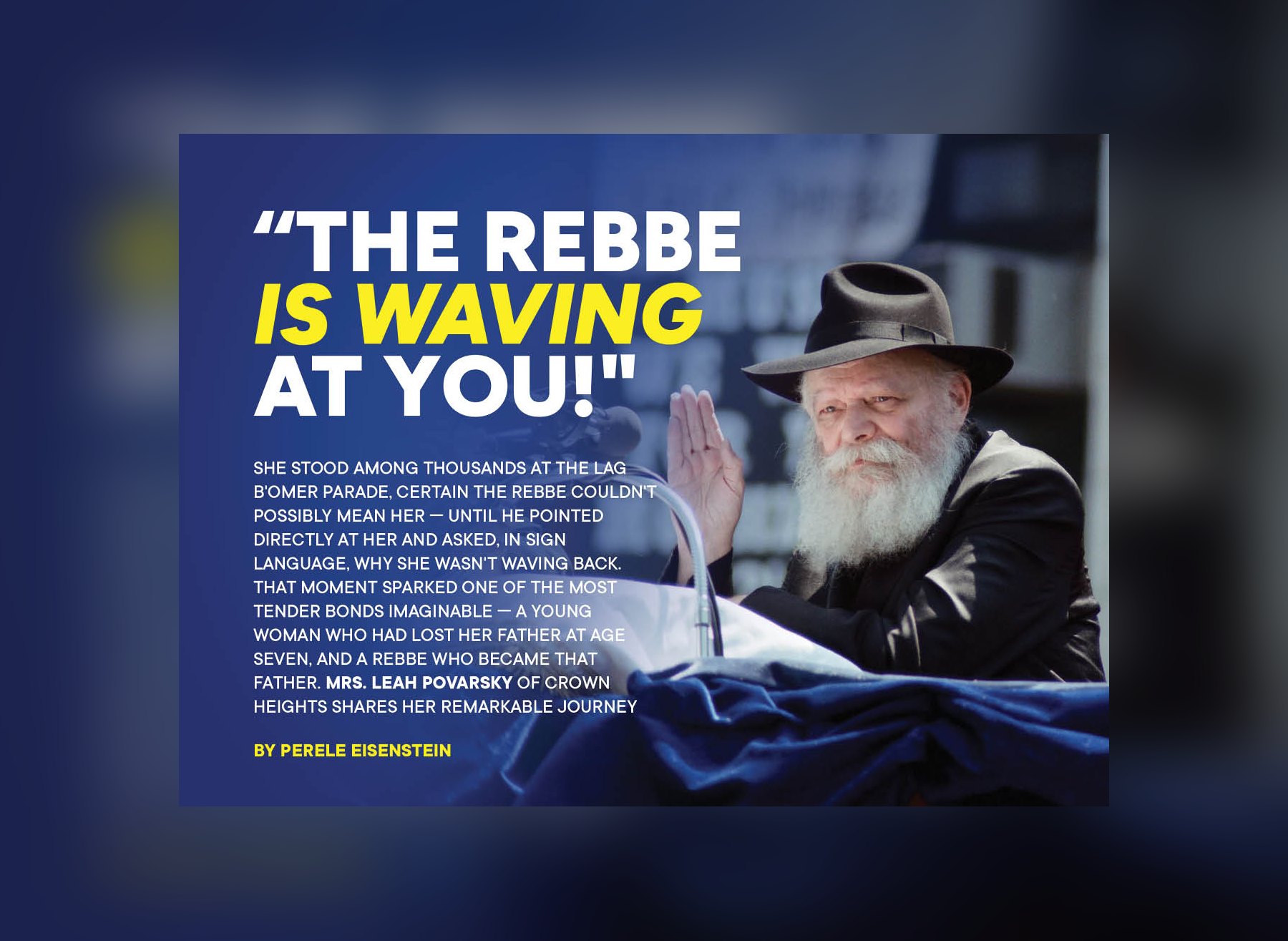
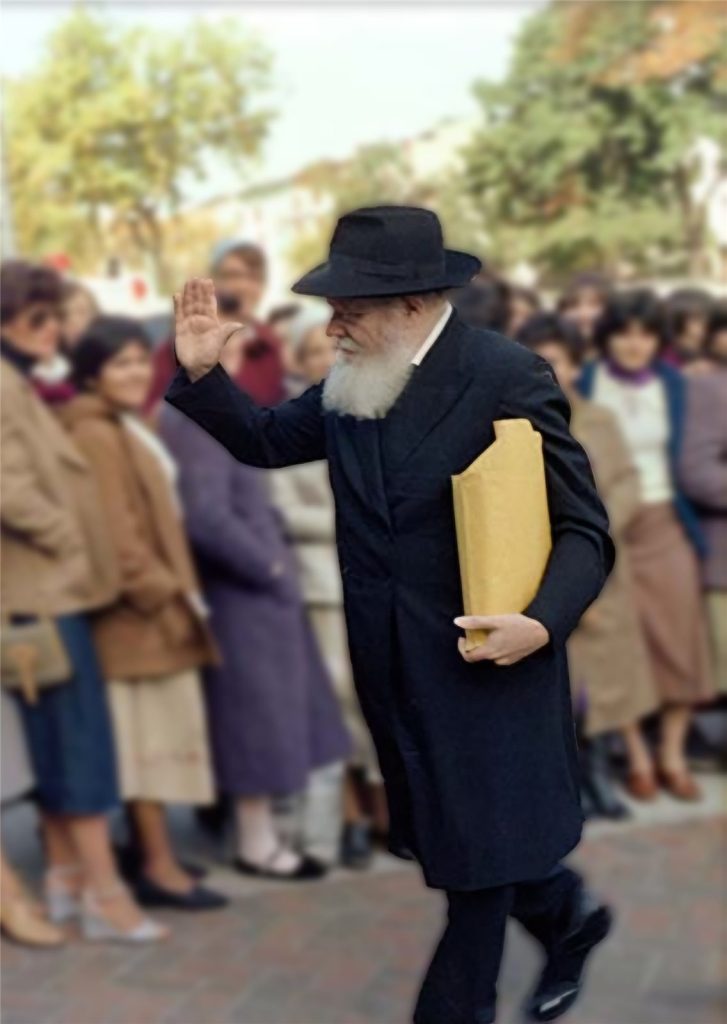
We went. I stood next to my older friend Margalit a’h, on the avenue facing the Rebbe’s platform – and to my great amazement, the Rebbe waved his holy hand to me in greeting. There were thousands of people there, and I couldn’t believe the Rebbe was waving directly at me. The Rebbe waved again, and I thought, ‘Something must be wrong with me, thinking the Rebbe means me’ – and again I did not respond. Then the Rebbe pointed directly at me from the platform. I was astonished and asked in sign language, “Me?” The Rebbe responded affirmatively and asked through gestures why I wasn’t responding to his greeting. My friend said, “The Rebbe is talking to you!” and sent him a wave. At that moment I said to her, “What are you doing? That’s not modest” – she had blown the Rebbe a kiss.
My daughter Dafna and my son Adam were also at the parade. Everyone received a bag of candies with a dime for tzedaka, but my son Adam received an extra dime in his bag. When I noticed this, I asked Rabbi Zalmanov what the extra coin meant. He said: “The Rebbe sent the ten cents through him – for you.”
That night I returned home filled with amazement and wrote to the Rebbe about my life story. I began with ‘bracha v’shalom,’ having seen that this was the Rebbe’s own phrasing when writing to women. I told him that my father had passed away when I was seven years old and that I felt this was the greatest void in my life. I asked the Rebbe: “Since the Rebbe pointed at me today, among a crowd of a hundred thousand people, there must be something special here. Is the Rebbe willing to be my father?” I promised that if so, I wanted to feel and know what a father is – and that I would do whatever the Rebbe instructed me.
A Channel for Help
From that day until today, I have received and continue to receive special treatment from the Rebbe. This expressed itself, among other things, in many remarkable kiruvim. I took advantage of this close connection and would bring the Rebbe lists of people who needed a bracha, and the Rebbe would bless them – as in the following story:
The younger sister of a family friend, living in Israel, needed to undergo brain surgery due to a tumor, may we be spared. Her brother, who lived in England, asked me to request a bracha for her from the Rebbe. When I passed by during the dollar distribution, I told the Rebbe about it and mentioned that the following day – Monday – she was scheduled for surgery. The Rebbe made a kind of sweeping gesture with his holy hand and said: “It will be as if it never was.” The next day, before the surgery, they took a scan – and behold, a miracle: the tumor had disappeared, by the merit of the Rebbe’s bracha.
There was another wondrous case that began on Sukkos 5748, involving a woman named Nira who had not been blessed with children for eleven years since her wedding. We were standing in the Sukka in line to receive lekach, and I said to her: “Don’t worry, Hashem will bless you with children.” Just as she passed by the Rebbe – with me right behind her – he said “Amen” and gave her lekach. She began to walk away, but the Rebbe wanted to give her an additional piece. I called out to her: “Come back – the Rebbe is giving you an additional bracha.” That same year she was blessed with a child and named him Matan.
Daughter or Chassid?
As I said, I saw the Rebbe as a father. A father will continue to love us even if we did not fulfill his request perfectly, and naturally it is difficult to comply with every detail. The relationship between a parent and child is different from that of a servant and master. A servant carries out his master’s instructions with complete submission. Today I understand that despite the close and fatherly relationship, our true mission is to carry out the Rebbe’s instructions like a servant who fulfills his master’s commands – with no independent agenda, obligated to do as told – and not like a child who can sometimes be lax.
Once I went to dollars, and when my turn came to receive the dollar, I lowered my gaze in shame. I waited to receive the dollar but didn’t see it. The Rebbe held the dollar up so that I would raise my eyes. I understood that he wanted to convey a life message: no matter how much others try to bring me down, I should always look upward and know who I am.
Let me share another story. One day I went to the Rebbe crying, saying I had many problems. The Rebbe took a dollar, made a circular motion with his holy hand, and said that this was the dollar with the good solution to all the problems. The Rebbe did not dismiss the problems, but gave me the strength to find the solutions and cope with them.
In 5748, after the passing of the Rebbetzin, I thought about the fact that I had no Jewish name. When I was born, my mother called me Liza, and my nickname was Lizette. I approached the Rebbe and asked him what Jewish name to take. In response, he asked me what Jewish name I thought was mine. I said “Leah” – and he said: “That is correct.” And from then on I am called Leah Liza Lizette.
As in that instance, in many other cases the Rebbe would ask my opinion and what I thought – and only then would he confirm it or not. I understood that he wanted the decision and the desire to come from within the person themselves; that with all the bittul, we should still emerge as ourselves, in our own form and light.
The special connection with the Rebbe was also expressed in the fact that when I spoke with the Rebbe, I was never moved aside to make way for those waiting behind me. Once someone tried to move me along, and the Rebbe would not allow it – he signaled to the attendant with his hand to stop, and continued conversing with me.
My Message
We must be Chassidim of the Rebbe, and be in complete bittul before him. On one hand, love; on the other, nullification. And we must blend love and nullification together. This can be called “kabbolas ol mitoch simcha.”
In galus we undergo much suffering and many unclear things. We must fulfill the Rebbe’s ratzon with joy – and the very fact that we merit to fulfill his holy will should itself bring us joy.
May we merit the true and complete Geula immediately, without delay, and may we see the Rebbe below ten handbreadths, and may he redeem us – Amen.
Beis Moshiach #1499 • pp. 48-49, 50
© 2026 Beis Moshiach Magazine. All rights reserved.
This article originally appeared in Beis Moshiach #1499. You are welcome to share it with friends and family by email or in print, provided that you do not change, add to or omit any part of it, you credit the author and Beis Moshiach, and you include a link to archive.bmoshiach.org (written out in full in printed copies).
To republish this article in a newspaper, magazine, book or website, please request permission in advance at [email protected].