5 Years in Egypt:
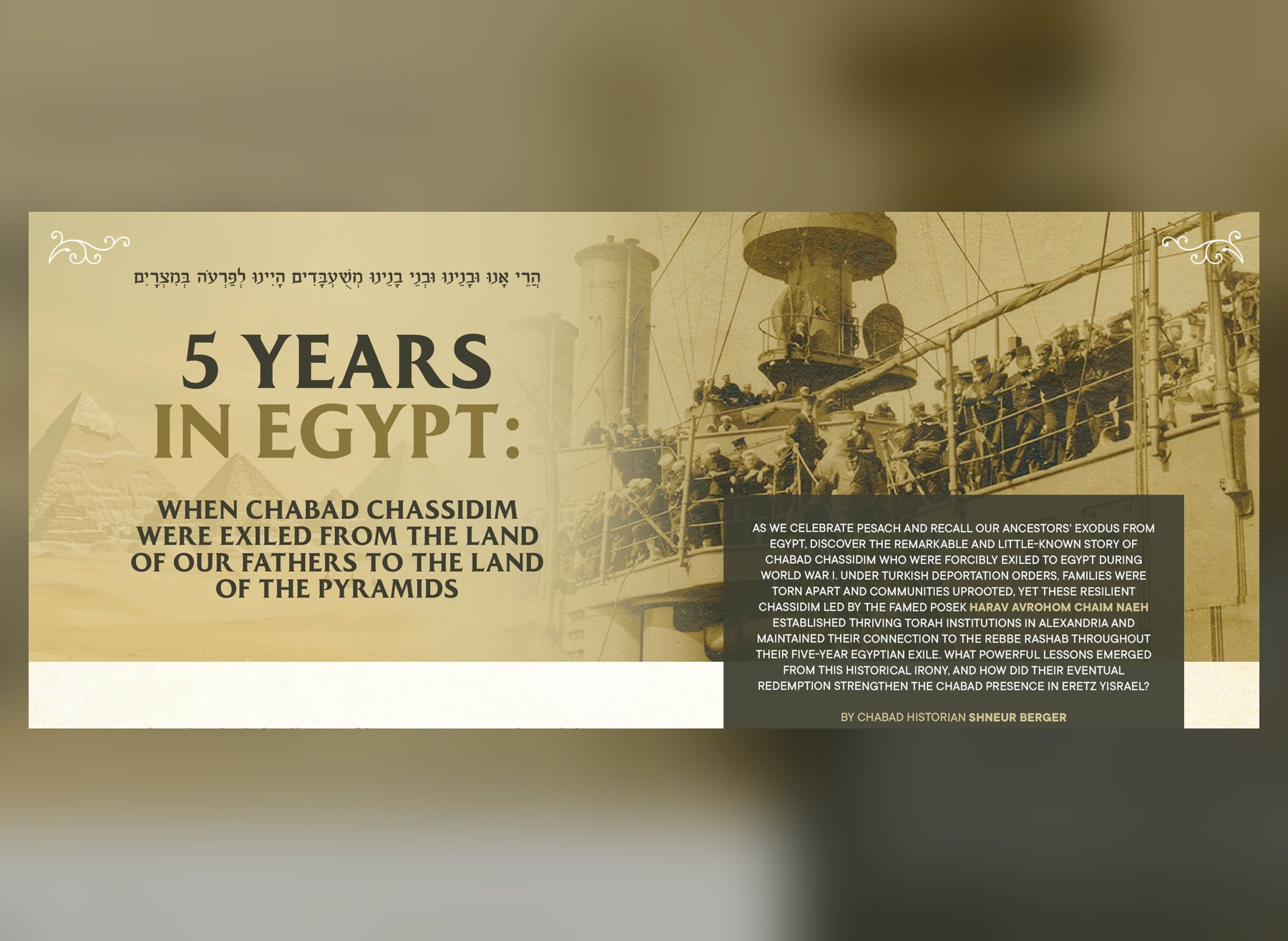
As we celebrate Pesach and recall our ancestors’ exodus from Egypt, discover the remarkable and little-known story of Chabad Chassidim who were forcibly exiled to Egypt during World War I. Under Turkish deportation orders, families were torn apart and communities uprooted, yet these resilient Chassidim led by the famed posek Harav Avrohom Chaim Naeh established thriving Torah institutions in Alexandria and maintained their connection to the Rebbe Rashab throughout their five-year Egyptian exile. What powerful lessons emerged from this historical irony, and how did their eventual redemption strengthen the Chabad presence in Eretz Yisrael?
It was during the outbreak of World War I. The central Chabad community in Eretz Yisrael was in Chevron. Several years earlier, the Rebbe Rashab had established the yeshiva “Toras Emes’ in the city, headed by Rabbi Shlomo Zalman Havlin who served as the menahel and mashpia in the yeshiva. The yeshiva was run by prominent Chabad Chassidim – Rabbi Shlomo Yehuda Leib Eliezerov and his brother-in-law Rabbi Menachem Mendel Naeh. The yeshiva and the community alongside it flourished in those years.
Alongside the community in Chevron, there was also a large Chabad community in Yerushalayim, and there too, a branch of Toras Emes was opened. However, the flourishing of these communities was cut short with the outbreak of WWI, on the 9th of Av 1914.
With Turkey’s entry into the war in the month of Cheshvan 5675 (1914), Eretz Yisrael was disconnected from the countries of the region, as it was under Turkish rule. As a result of the disconnect, a severe food shortage developed. The donations that came from abroad for talmidei chachamim and rabbanim also ceased to arrive. In addition, the Turkish government took harsh measures against the Jews, either by imposing heavy taxes or by confiscating animals, tools, and food.
If all these troubles were not enough, natural disasters occurred during that period, such as a locust plague that severely damaged agriculture. The economic chaos caused the banks to close, which led to a major financial crisis. Public life was decimated, hunger was great, diseases spread to epidemic proportions, and death rates increased. This situation lasted for nearly four years.
Initially, the authorities announced the cancellation of immunity for foreign citizens, and as a result, all those who came from “enemy” countries, including immigrants from Russia and Poland – many of them Chabad Chassidim – were now considered enemy subjects.
The authorities continued to repeatedly clamp down on the liberty rights of Jews. They did not allow carrying weapons, prohibited writing letters in Yiddish and Hebrew, and imposed a requirement to learn Turkish in school. The culmination was the requirement for all those without citizenship to register as Turkish citizens, thereby enlisting in the Turkish army. Alternatively, there was an option to leave the country.
It was clear to all that anyone who would be recruited was in mortal danger. Many Jews who were recruited were sent to the front and never returned; for some – even their burial place was not known.
Chassidim and tmimim from Chevron and Yerushalayim refused to accept Ottoman citizenship, and because of that, they were sentenced to exile to Egypt.
Families Torn Apart
It was on ‘Black Thursday,’ the 29th of Kislev 5675 (1914). That day, the deportation order of Russian subjects from Eretz Yisrael was issued. Among those deported from Yerushalayim was the renowned posek, Rabbi Chaim Naeh.
The journey from Yerushalayim to the port of Jaffa, where the deportation ship was anchored, was made by a deportation train. The train traveled at an irritatingly slow pace that lasted many hours. Upon arrival at the port of Jaffa, the deportees were cruelly loaded onto the Italian ship “Florio,” amid shouts and whip lashes. Within a short time, more than 700 people were crammed onto the ship.
When the ship was no longer able to accommodate additional passengers, the Turks prevented the people who remained crowded on the pier from boarding the ship. As a result, many families were involuntarily split. Some were on the ship’s deck and some remained on the pier. Great confusion broke out on the spot; calls, cries of despair, pleadings and requests to the Turkish soldiers to unite family members; but all these calls were answered with an indifferent shrug.
This also happened to the Naeh family. Rebbetzin Devorah was then in her eighth month of pregnancy when she was about to board the deportation ship. Due to her caution against the pushing, her husband boarded the ship first with their meager bundle. When the Turkish soldiers prevented additional passengers from boarding the ship, his wife remained behind on the pier alone.
The Rebbetzin could not bear it and burst into unrestrained tears. Later she returned crying to her parents’ home in “Batei Varsha” in Jaffa, where she later gave birth to her son Baruch. He had his bris without his father’s presence. Three weeks later, the Rebbetzin traveled on one of the ships that transferred exiles to Egypt, with her tender infant in her arms.
Among the Chabad deportees were also the Eliezerov, Havlin, Schneersohn families and more. Unfortunately, R’ Shlomo Yehuda Leib Eliezerov as well as R’ Shlomo Zalman Havlin were in Russia during those days. Their family members were therefore exiled to Egypt while the heads of the families were far away from them. Thus, many families were torn apart. Students of Toras Emes who came from Lubavitch to study at the yeshiva were also exiled to Egypt.
The yeshiva in Chevron was left with few students. Its economic situation was dire, since even the donation funds that the president of the yeshiva, the Rebbe Rashab, and his son the Rayatz took care to send for its maintenance, were delayed in arriving due to the war.
About these days, Rabbi Eliezer Krasik, chairman of Agudas Chassidei Chabad in Eretz Yisrael, writes in his memoirs: “During a period of eight years that R’ Shlomo Zalman Havlin was not in Eretz Yisrael and support from Russia was also stopped because of the war, the Rebbe Rashab and his son the Rayatz organized that the yeshiva in Chevron and the branch in Yerushalayim would receive support from the United States and from other countries that had a connection with Eretz Yisrael.”
Bread Of Poverty
About the condition of the exiles upon their arrival in Egypt, one can learn from a special report written in 1916 by the Aid Committee for the Exiles of Eretz Yisrael and Syria:
“The appearance of the exiles as they disembarked from the ships was very depressing, among them were such that were arrested in the middle of the street by officials of the authority and forcibly placed on the ships without being able to take with them the most necessary things; others were taken out of the prisons where they had been imprisoned for several weeks as subjects of enemy countries and brought to the ships. There were also those on whom the deportation decree did not actually fall, but the difficult struggle for existence exhausted them and forced them to leave the country.
“The heart contracted with pain at the sight of this crowd that exuded endless sorrow and despair, men searched for their wives, parents for their children and children demanded their mothers. The deportation separated between members of individual families.”
In Egypt, a group of Chabad Chassidim lived in the exile camp “Small Shuni.” This camp was established near the city of Alexandria (Na-Amon), in a remote alley inside buildings that previously served as cotton warehouses. This camp was distinguished by the fact that its population was chareidi, with many rabbanim and talmidei chachamim.
Regarding the number of exiles from Eretz Yisrael to Egypt, we do not have an exact number, but we are talking about approximately 12,000 people, thousands of whom left over time to other countries. According to an estimate, the number of exiles who stayed in Egypt at any given time did not exceed five thousand souls.
The exile to Egypt that was forced upon the exiles brought with it many troubles. In addition to the poor economic situation, various regulations were also enacted that restricted the way of life of the exiles.
In the Zionist Archive there is a list of rules of the exile neighborhoods in Egypt, from which one can learn about the disturbing restrictions:
-The neighborhood gate is open from five in the morning until nine in the evening.
-It is forbidden to leave or enter without written permission from the supervisor.
-The bread ration is distributed once a day. The rest of the food, three times a day. Without a listing card, no one will be able to claim their ration.
There are additional regulations, various and peculiar, with the last regulation announcing that “violation of these regulations or disobeying the supervisor will result in expulsion from the neighborhood.”
At first, the exiles were confident that the war in the region would end within a few months, and they would be able to return to their homes, but as time passed they realized that they had to organize for a prolonged stay in Egypt.
With the help of local Jews, they established committees that waited at the port and welcomed the new exiles upon their arrival in Egypt. Other committees were appointed to assist in organization on site, and others established schools, but unfortunately, they did not educate in the way of Torah and mitzvos.
The exiles received additional assistance from the local government and foreign embassies located in Egypt. Indeed, as time passed, their situation improved. To some extent, the conditions became better than in Eretz Yisrael, where they suffered from the horrors of war, natural disasters, diseases, and hunger. However, the economic situation of the exiles was still difficult. Many of them arrived in Egypt with only the clothes on their backs, and they needed assistance for their material and spiritual welfare, as well as morale.
The Sound Of Torah Echoing In Egyptian Exile
R’ Mendel Naeh, who was one of the heads of Kollel Chabad and one of the important Chabad rabbis in Chevron and Yerushalayim, was appointed as the head of the exile community, and was also the chief dayan for five years. The Jewish community treated him with great respect, and his family was regularly hosted by one of the local families. The authorities designated a special building for the Beis Din under his leadership, and a policeman was constantly standing at the entrance of the Beis Din, ready for R’ Mendel Naeh’s command.
His son, R’ Avrohom Chaim, was then a young married man, but had already garnered experience in the realms of communal and educational activism. He put his rich experience to work upon seeing before him a holy mission to strengthen broken hearts. He even established a special yeshiva in Alexandria for the children of the exiles called “Yeshivas Eretz Yisrael.” More than two hundred students studied in this yeshiva, some of them heads of families for whom he took care of their sustenance and livelihood. Not only them, but many of the Jewish citizens of Egypt would join them at the yeshiva, and eagerly take in his teachings. He housed the yeshiva in a building of an empty cinema, and gold coins that he shrewdly brought with him for times of trouble were transferred to the landlord.
“When my father arrived in Egypt, he had a little money in his pocket, and he rented a large building, divided it into rooms and opened the yeshiva,” said his daughter, Mrs. Chana Kozlovsky. “He took upon himself both its material and spiritual management, and succeeded in this mission, with my mother serving as a great help to him.”
In this yeshiva, students of Toras Emes also studied, as well as Chabad married men who were exiled from Chevron and Yerushalayim. In the yeshiva’s account book, we find the names of several Chabad students:
“Moshe Aryeh Azulai” – Rabbi Moshe Aryeh Leib Shapira, who was sometimes called “Azulai” according to his mother’s family name (descendant of the Chida). Rabbi Shapira studied at Toras Emes in Chevron, and after his return from Egypt was appointed as the head of the yeshiva Toras Emes in Yerushalayim.
Yuda Azulai – Rabbi Yehuda Zerachya Shapira-Azulai, brother of R’ Moshe Leib Shapira. He too studied at Toras Emes in Chevron, and later was among the Nigleh students at the Tzemach Tzedek yeshiva.
Yosef Naeh – Rabbi Yosef Yitzchok Naeh, brother of R’ Chaim Naeh, formerly a student of Toras Emes in Chevron.
Nissan Horowitz – The Yerushalayim mashpia, Rabbi Nissan Horowitz.
Asher Zelig Margalios – The well-known mekubal, Rabbi Asher Zelig Margalios. Studied at Toras Emes Chevron, and later one of the important rabbis and mekubalim in Yerushalayim.
Shimon Glitzenstein – Studied at Toras Emes in Chevron. After a period of studies in Egypt, he managed in an unconventional way to reach England with the help of his uncle Rabbi Oved Glitzenstein who lived in London. In the next period, he was appointed as the personal secretary of Rabbi Avrohom Yitzchok Kook, the Chief Rabbi of Israel, who was in London at that time .
Years Of Life
During his stay in Egypt, R’ Chaim Naeh noticed the lack of sifrei halacha for Sefardim translated into Arabic, in a style that would be understood by the people of the Jewish community in Egypt. He therefore initiated the composition of a halacha sefer adapted for Sefardim and called it “Shenot Chaim.” The sefer includes necessary dinim and customs around the year cycle according to the rulings of the Arizal and Maran the Beis Yosef and the Chida, in accordance with Sefardic customs. In order to make it easier for those who do not read Hebrew, the sefer was printed with facing pages – with the right side of the page written in Hebrew and opposite it a translation into Arabic in Hebrew letters. The translation was done by Rabbi Moshe Ashkenazi, a shochet in the city of Alexandria.
Jewish philanthropists, residents of Egypt, who recognized the greatness of Rabbi Naeh donated sums of money to publish the sefer.
While in Egypt, R’ Chaim Naeh found important manuscripts, one of which contained Chassidic writings in Yiddish by an unknown author. The second is a booklet containing a debate between Rabbi Yaakov Shimshon of Shepetovka with the Gaon, the Noda BiYehuda. In this debate, the Rebbe of Shepetovka strongly defends his teacher Rabbi Yaakov Yosef of Polonya, author of Toldos Yaakov Yosef. R’ Chaim Naeh printed the booklet in 1932 and called it “Divrei Tzedek.”
Funding Cut
Before the outbreak of the war, R’ Shlomo Yehuda Leib Eliezerov and R’ Mendel Naeh ran Kollel Chabad – the central organization of Chabad in Eretz Yisrael that greatly helped with material support for all Chassidim.
The war caused the two to be cut off from each other, and so, R’ Eliezerov found himself in Russia while R’ Mendel Naeh was exiled to Egypt. Despite this, R’ Naeh continued to act creatively so that support would reach the Chassidim in Eretz Yisrael.
The main problem facing him was the arrival of donations, since most of the support funds came from Russia which had become an enemy of Turkey. R’ Naeh found ways to transfer the funds through a third country, but at some point the Turks discovered the route of the funds, and the flow of donations from Russia ceased. At some point, the activity of Kollel Chabad was stopped due to the paralysis of the war.
On this, the Rebbe Rashab writes to R’ Shlomo Yehuda Leib Eliezerov during that period:
“In the past summer after Pesach, I received a telegram from his brother-in-law [R’ Mendel Naeh], may he live, which was sent to Lubavitch [it is possible that R’ Naeh did not know that they moved to Rostov]. How much effort we made to send money, and we did not succeed. Last winter a telegram was received from Rashag [from R’ Shmuel Gurary, one of the distinguished Chabad philanthropists] saying that it is possible to send through Zlatopol [the city of Zlatopol in Ukraine], and then he did not travel. They say that Rashag is now in Kan’ [= the intention is not known], if he can he will send to him” (Igros Kodesh Admor HaRashab Volume 2 Letter 509).
When The Exiles Left Egypt
Two years after the exiles arrived in Egypt, they were informed that the British General Allenby had captured Yerushalayim from the Turks. A year later, the entire Eretz Yisrael was conquered by the British. Despite this, the exiles were not allowed to return to their homes. Only after the peace conference held in Paris in the month of Teves 5679 (1919), were the exiles allowed to return to Eretz Yisrael. However, many of the Chabad Chassidim who were residents of Chevron moved to live in Yerushalayim and did not return to their city as before.
59 Chabad families lived in Chevron with the outbreak of the war, and after it only nine families remained in the city.
One of the exiles, Rabbi Dovid Tzvi Aryeh Schneerson, chose to continue living in Alexandria, Egypt. A decade later, he and his sons had the merit to be among the escorts of the Rebbe Rayatz who arrived in Alexandria on his way to Eretz Yisrael.
The Chassidim who arrived in Yerushalayim came with renewed strength, and began establishing institutions. First, the Tzemach Tzedek yeshiva was established in the Old City of Yerushalayim by R’ Menachem Mendel Naeh. This yeshiva provided an educational framework for married men and young men who worked for their livelihood, with several hours a day dedicated to learning.
Upon the return of R’ Havlin from Russia to Eretz Yisrael after the roads were reopened, he traveled to Chevron accompanied by some of the distinguished Chassidim to check the possibility of reestablishing Toras Emes in Chevron, but after the visit it was decided that the yeshiva would be reestablished in Yerushalayim. Alongside R’ Havlin, two of his former students who returned from Egypt served: R’ Moshe Aryeh Leib Shapira as the head of the yeshiva, and R’ Shimon Glitzenstein as the secretary of the yeshiva.
The years of exile in Egypt lasted about five years, until “from Egypt He redeemed us” was fulfilled in them…
Sources: Igros Kodesh, History of Chabad in Eretz Yisrael, Reshima of Toras Emes (Karasik), Noda B’Shiurim, M’Mitzrayim Ad Heina, Beis Moshiach, HaTzfira, HaMashpia, Demus Chassidis, Azamer B’shevachin, Otzaros, Kol Yisrael, and more.
If you ever walked into 770 on a special night in the Chabad calendar and found the lights out and and a large crowd sitting quietly, all eyes focused on a big screen watching the Rebbe leading a farbrengen, you know how powerful the experience can be.
It all began with a modest initiative by Rabbi Sholom Charitonov, in collaboration with the gabbaim. What started as a simple idea grew to become one of the deepest expressions of the connection between Chassidim and the Rebbe.
19 Kislev, 10 Shevat, Purim, 13 Nissan, 12 Tammuz, and more – on these special days when the Rebbe used to hold farbrengens on weekdays, the big screen comes down at 770, and the large crowd gathers to watch together a complete farbrengen of the Rebbe. The tradition continues today, under the management of R’ Mordechai Telzner, with the feeling that this is only temporary, and soon we will merit to see the Rebbe with our physical eyes and hear him in person.
Long hours of a “live” farbrengen with the Rebbe. The crowd hears the word of G-d “as given at Sinai,” listening to the explanations in all parts of the Torah. They also see and experience how the Rebbe speaks with special chayus about various topics as discussed in those years: the different mivtzaim, the outcries regarding shleimus ha’aretz, timely matters, current affairs, the Seven Noahide Laws, ‘Moment of Silence,’ and of course, about the imminent Geula and the hisgalus of Moshiach.
The situation is both simple and not-simple at once: in the same place where the Rebbe held farbrengens throughout the years, one can stand again with reverence, hear his voice, see him through the video, and look at the (actual) place just a few yards away, and relive it…
“When you’re at the Rebbe’s farbrengen, especially in the place where the words were said, you feel them in the here-and-now,” one of the participants shares his personal experience with me. “Once I saw a farbrengen where the Rebbe spoke strongly about registering children for a letter in the Sefer Torah of Jewish children. The Rebbe spoke with such enthusiasm about this that I couldn’t remain apathetic. The very next day I went out and registered child after child. How could I do otherwise?! After all, the Rebbe spoke about it so strongly just last night!…”
After the video, one can often see participants discussing various topics raised in the farbrengen, recalling special expressions or details from the Rebbe’s conduct between the talks, and farbrenging about the things they just heard.
This is not just watching a historical video. It’s a living, breathing farbrengen, where every word of the Rebbe penetrates the heart, every niggun elevates the soul. The screen indeed separates the past from the present, but the hearts are connected, beating together with the Rebbe, eagerly awaiting the moment when the screen will no longer be necessary…
It’s Not A Video, It’s Live! The Rebbe Gives Us An Opportunity To Farbreng With Him Directly
Among those regularly present at these ‘projected’ farbrengens, one can always see Rabbi Zalman Liberow, the Rebbe’s shliach in the Flatbush neighborhood of Brooklyn. “I try not to be late, not even by a few minutes,” he says. “Also not to talk to anyone throughout the farbrengen. Right now, this is the Rebbe’s farbrengen! I call it ‘the farbrengen of Yud Kislev 5785,’” he explains passionately. “In essence, the Rebbe is saying the same thing a second and third time.”
“Breaking news,” he says with irony, “is a concept that belongs to journalists. But to live with a farbrengen anew, you can hear it a second and third time with the same chayus. To take it into practical action, you need to review the words again and again.”
For R’ Liberow, this is not just about watching a historical video. “Let’s point out something amazing: over the generations, there is no video of significant events in the history of the Jewish people, or of the tzaddikim and Nesiim throughout the generations. Even of the Previous Rebbe, there is almost no documentation. But from the beginning of the Rebbe’s leadership, there are enormous amounts of recordings and documentation. The reason for this is simple – the Nasi HaDor needs to be ‘seen and heard.’ Of course, we don’t settle for such seeing and hearing, G-d forbid, but for now, this is the ‘seeing and hearing,’ and this is what we live with.
“Another point to consider: in normal times on a day when there was a ‘farbrengen of the Rebbe’ – it was unthinkable to miss it. Every Chassid knew that as long as he was within a hundred miles, he would come. And if he wasn’t in the area, he would listen to the broadcast. What did they do on 11 Nissan? Go to sleep?! They went to the farbrengen! So why shouldn’t we stand now and listen to the Rebbe’s farbrengen? The same applies to the Rebbe Melech HaMoshiach’s Shabbos farbrengen. I am on shlichus, but when I’m in Crown Heights on Shabbos, at 1:30 I’m there, standing and learning a sicha. The Rebbe sacrificed himself, took away the Shabbos meal from so many families, especially in winter.
“Why did the Rebbe do this? Because the Rebbe sacrificed himself to be ‘makhil kehillos.’ So if someone wants to set times for learning, when is the best time to set such a time, to learn a sicha of the Rebbe? 1:30! That’s the most sacred time, in the most sacred place. It’s not the time for cholent, that can come later… For me, it’s understandable in the simplest and most logical way, that this is the time a Chassid should stand there and learn a sicha of the Rebbe. Everyone can conduct themselves in their own way, but there is no time as sacred and place as sacred as this. Even when there was an aufruf of my children, even in the winter, I told everyone: until 3:15 there’s nothing to discuss, I’m at the Rebbe’s farbrengen.”
“All The Video In The World Was Created For This!”
Even those who are in Eretz Yisrael or elsewhere in the world and not near 770 can certainly experience this. “Of course, there are levels to this – in a minyan, in a shul, and so on. It’s really worth organizing in every community to gather together. Just like we used to do with broadcasts. It’s certainly different from watching a video from the couch at home…”
R’ Liberow emphasizes the importance of watching a complete farbrengen: “Two hours, three, four – with all of the maalos that comes with that…”
It pains him that thousands of Chassidim aren’t showing up. “Imagine all of 770 full!” He wonders how people are at 770 and don’t come to stand and watch the video: “This is the Rebbe! Turn around and listen! Maybe they simply don’t understand that it’s a living thing. One needs to understand that it’s not a video, it’s alive, the Rebbe is giving us an opportunity to farbreng with him directly.
“Even for someone who doesn’t feel that this is a farbrengen with the Rebbe now, but rather a video, what could be better than hearing a ‘Torah shiur’ from the Rebbe himself! To dedicate an hour or three hours to a (translated) farbrengen seems to me a simple feeling of a Chassid. There is an opportunity here. There is a special day. There is a possibility to hear from the Rebbe himself a farbrengen! This is so obvious.”
For R’ Liberow, all the video technology in the world was created for these moments, so that we can farbreng with the Rebbe in the final moments of exile.
A New Generation Connects
From 770 Beis Moshiach we wander far, to Tzfas. In the first year of the yeshiva ketana in Tzfas, the educators faced a complex challenge. They understood how important and significant it was to get to the point where the students could experience the privilege of participating in the Rebbe’s farbrengen. Two significant obstacles stood in their way: the talmidim’s insufficient familiarity with the Yiddish language, and concerns about the ability of bachurim to sit for long hours in front of the screen and participate in the farbrengen.
“I make sure to use the term ‘participate in the farbrengen’ and not ‘watch the farbrengen,’” emphasizes Rabbi Levi Nisselevich, mashpia and member of the yeshiva’s hanhala. “There is no doubt that when you hear the words again even decades later, the actual teacher [of the teachings one learns in sefarim] is before him, especially when it involves the visual image of the Rebbe’s face.”
To illustrate this point, R’ Nisselevich tells a story he heard from Rabbi Pesachia Korf about his grandfather, Rabbi Yehoshua Korf, a’h: “In his later years, R’ Korf would insert a tape with the Rebbe’s farbrengen into his home tape player, and listen to the farbrengen from beginning to end. Even when he had a need to leave in the middle, he would not agree to stop under any circumstances, ‘because it’s in the middle of a farbrengen…’ Let’s not forget that this was an elderly man who was approaching 100.”
This is the feeling he sought to convey to the students in Tzfas. Before Yud Shevat of that year, they decided to try a special approach at the yeshiva. They invested time in cutting the video into parts, combining segments from the farbrengen, mainly from the times between the sichos, along with short clips from the sichos themselves – about half a minute of the beginning and end of each sicha.
To connect the talmidim to the atmosphere of the farbrengen and its progress, they prepared a detailed sheet describing every detail seen in the video: from Rabbi Mentlick pouring the wine cup, through presenting the cup to the Rebbe, the Rebbe’s nodding as a sign of gratitude to R’ Mentlick, the bracha of ‘borei pri hagafen’ and so on. The same with the names of people who approached the Rebbe between the sichos, and a transcript of their conversations with the Rebbe.
The success surprised even the initiators themselves. The bachurim sat riveted to the video from beginning to end, despite it lasting close to two hours.
But this was just the beginning. Rabbi Binyamin Meiri, one of the yeshiva’s mashpiim, took up the challenge and invested considerable effort so that on every special occasion, a ‘farbrengen with the Rebbe’ would take place, where the students would sit for several consecutive hours and participate in the farbrengen from beginning to end.
“At first we did this with real trepidation,” admits R’ Nissilevich, “but we quickly saw that the boys were capable of much more than we thought.” Despite the fact that participation in the evening is left to the free choice of each student, most of the talmidim stay. “It’s a sight that anyone who sees it cannot help but be impressed,” he describes. “To see dozens upon dozens of talmidim sitting or standing with profound seriousness, even when the clock shows after midnight, and completely captivated by the farbrengen. Fortunate is the eye that sees this.”
The yeshiva takes care of all the technical details: the farbrengen is projected on two huge screens. The hall is arranged in advance, the tables are covered with a nice tablecloth, and the talmidim are given snacks and drinks, and of course also ‘l’chaim.’
“The internal impact this has on the talmidim is inestimable,” says Rabbi Nissilevich. He quotes the Rebbe’s words from Shabbos Parshas Reeh 5746 about the virtue of ‘seeing the face of the rav’: “Although he studied… in a kuntres, in ‘Likkutei Sichos,’ everything is good and fine, but it is not at all comparable to the avoda in the manner of ‘See, I give before you today.’”
“In our generation, replete with temptations that are so accessible to everyone,” he concludes, “when educators seek ideas and means to protect the youth and give them the strength to cope with various enticements, we who have merited such a wonderful thing certainly need to load up the bachurim with additional hours of seeing the Rebbe’s face.
“It’s also obvious that there is a desire, need, and possibility on the part of each and every one of Anash to seek out these opportunities as well,” emphasizes Rabbi Nissilevich. “As a family man, one doesn’t always have all the possibilities that yeshiva bachurim have, both in terms of mental availability and time, but when it is possible to sit and watch a video of a complete farbrengen with the Rebbe, to be ‘inside the farbrengen,’ to try to feel standing face to face with the Rebbe, one should seize this opportunity with both hands.
“When the father shares with his family members, and describes something from the Rebbe’s movements in the Rebbe’s farbrengen in which he participated this week, or just from the special experience he had watching the video, this will certainly have a tremendous impact on the entire family.”
Without Knowledge But With Much Desire
Now we go from the substance of the matter to the technical side:
“I had no idea about computers and certainly not about video editing,” recalls R’ Mendel Levin (from Crown Heights) of the early days in the process. “I had no experience. I didn’t even have a cell phone or email…”
But towards 9 Adar 5768, while studying at the yeshiva gedola in Tzfas, he decided to put the initiative into action.
It all started from a desire to show in the yeshiva the special sicha that the Rebbe delivered on 9 Adar 5752 – following the murder of Mrs. Lapine, may Hashem avenge her blood. Together with some fellow tmimim, they decided that subtitles must be added so that it would be easy for everyone to understand and concentrate, both for those who do not know Yiddish and for native Yiddish speakers.
He found in the ‘Daily Sicha’ archive the verbatim transcription of the sicha, and worked for hours at a computer to arrange the video that lasted in total less than ten minutes. “We thought no one would come,” he recalls, “but the hall was completely full.”
Success led to increased demand.
In the Hakhel year 5769, they prepared the farbrengen of Yud Shevat 5740. “The hall was full, almost throughout the entire farbrengen,” he recounts. “Many bachurim who don’t understand Yiddish and weren’t used to sitting at a farbrengen for long hours, listened to it in its entirety. We received feedback from the guys, reactions that surprised even us.”
An emotional moment occurred during the screening of the farbrengen of Yud Kislev 5748. “By Divine Providence, it happened that the time when we saw the farbrengen was exactly the same hour and minute that the Rebbe’s farbrengen started in the original time… we noticed this when the farbrengen ended and the camera focused on the clock as the Rebbe left, the clock at 770 showing 11:25. Next to the screen at the yeshiva in Tzfas was a clock that showed exactly the same time… everyone said ‘wow!’ It gave a sense of connection.”
In the year 5770, the project stepped up. The team worked tirelessly on a series of long farbrengens: 20 Cheshvan 5744, 10 Kislev 5748, 14 Kislev 5748, 19 Kislev 5743, 24 Teves 5741, 9 Adar in an improved edition, and 11 Nissan 5743.
From Tzfas, the idea spread over the years to other yeshivas as well. Today, in almost all yeshivas, the tmimim gather before a Chassidic ‘yoma d’pagra,’ and participate in the Rebbe’s farbrengen, in one format or another.
Distribution expanded beyond the walls of the yeshivas. “We duplicated DVDs extensively. We sold them for just five shekels and sold hundreds and thousands of copies in Anash centers,” Levin recalls.
It is worth mentioning the organization ‘Liros es Malkeinu’ (To See Our King) under the management of Rabbi Shimi Goldstein, which produced three translated farbrengens years earlier, as well as Rabbi Yechiel Yosef Ceitlin from Canada, responsible for ‘The Weekly Sicha’ program, who assisted in the project.
Bringing The Rebbe To Every Yeshiva And Every Chabad House
Today, the organization ‘ATTA HaOlami’ continues the tradition. The tmimim, Dovber Dahan and Chaim Dovid Rachamim invested much in this, and continue to this day, as married men. Over the years, CDs were produced with complete farbrengens of the Rebbe, with full translation into Hebrew, and many families sat and participated in the farbrengen.
Additional work was done in cooperation with ‘Hisachdus HaChassidim’ which caused a great awakening in Anash communities. There were also young couples who chose to produce such a farbrengen CD for their wedding, and distribute it as an original ‘teshura’ to all participants in their celebration.
The ATTA organization raised awareness of the subject also through trailer clips that tell about the farbrengen to be screened. For example, before a screening from the Lag B’Omer 5746 farbrengen, Rabbi Yosef Karasik, who was with the Rebbe that year, was interviewed. He enthusiastically recounted that rare farbrengen where they sang ‘We Want Moshiach Now’ for 1 hour and 45 minutes straight!
In another year, a clip was produced with Rabbi Shaul Moshe Elituv and Rabbi Zalman Berkowitz, who shared memories from Lag B’Omer 5744.
“I am happy to see the growth and development,” says R’ Mendel Levin enthusiastically. “Today everything is also available online, and everyone has access with a click to see and hear and connect to a complete farbrengen with the Rebbe.”
Looking back, he sees that a real revolution has taken place: “Without a team and without knowledge but with a lot of desire and endless siyata d’shmaya. We didn’t ask questions, we didn’t plan, we just took action and with time it improved. I’m happy with the zechus that is mine to bring the Rebbe to so many people. The main thing is that we see and hear the Rebbe MH’M not through a screen, teikef u’miyad mamosh!”
Beis Moshiach #1455 • pp. 24-37, 51
© 2026 Beis Moshiach Magazine. All rights reserved.
This article originally appeared in Beis Moshiach #1455. You are welcome to share it with friends and family by email or in print, provided that you do not change, add to or omit any part of it, you credit the author and Beis Moshiach, and you include a link to archive.bmoshiach.org (written out in full in printed copies).
To republish this article in a newspaper, magazine, book or website, please request permission in advance at [email protected].