G.I. or Yeshiva Boy?
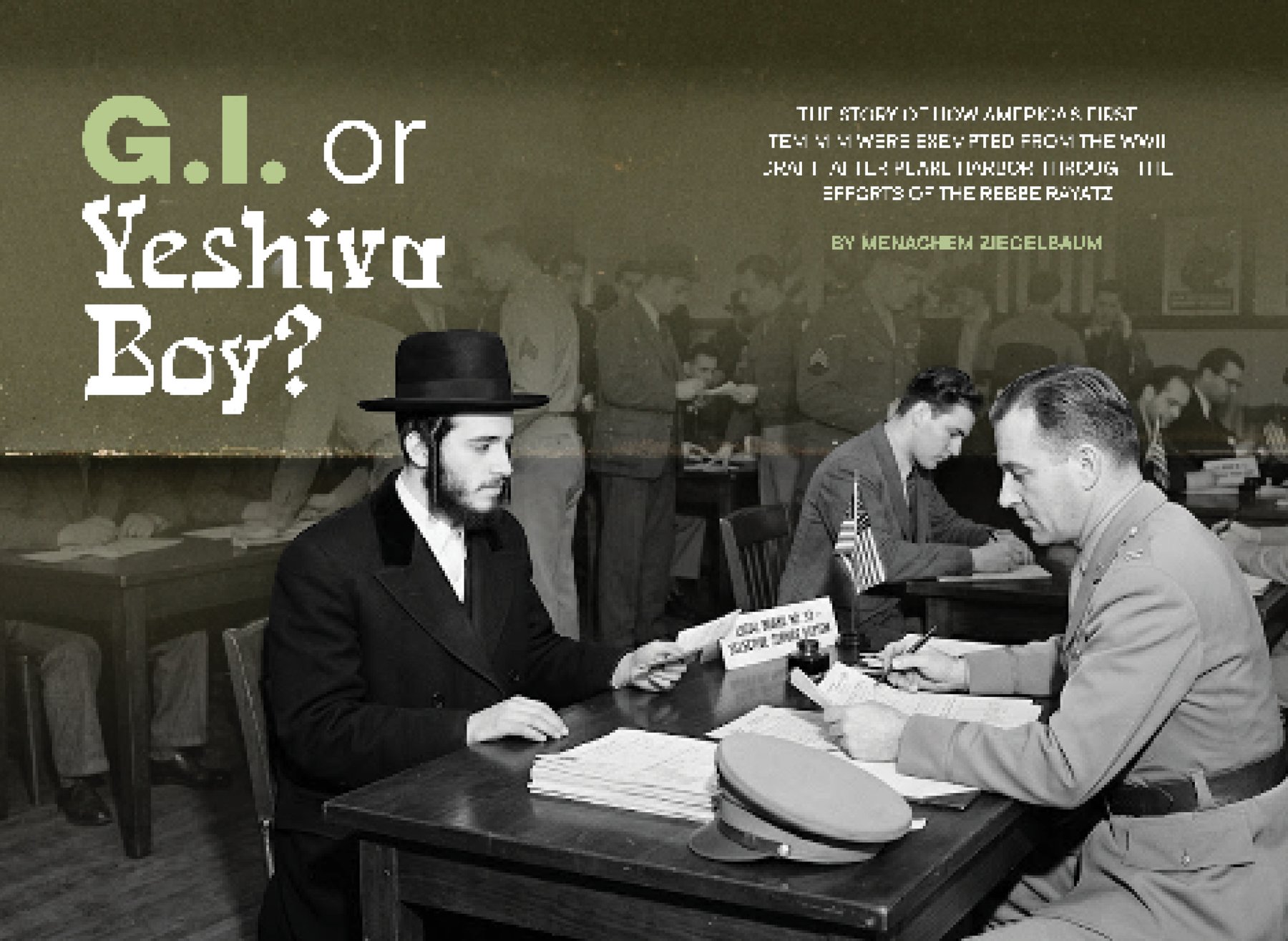
The story of how America’s first Temimim were exempted from the WWII draft after Pearl Harbor through the efforts of the Rebbe Rayatz
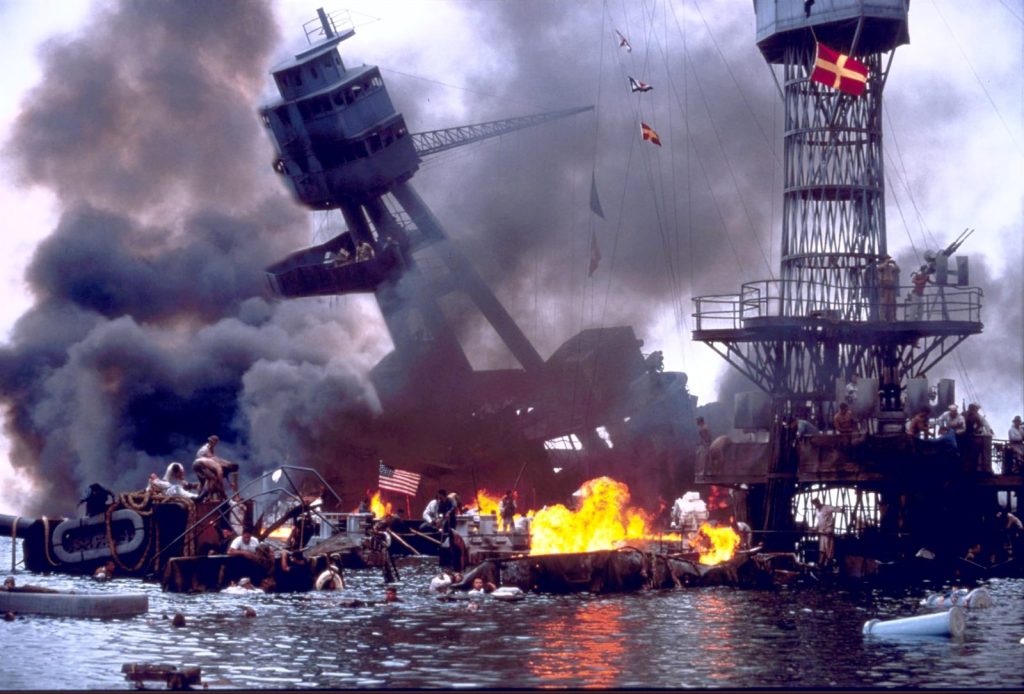
Kislev, 5702. 7:55 in the morning. A morning calm hovered over the waters of Pearl Harbor, Hawaii. The sea was especially tranquil. No one imagined that within a few minutes, hell would descend from above.
Then, in a single moment, planned and timed precisely, 353 planes from the Imperial Japanese Navy suddenly appeared, having taken off from aircraft carriers, and struck a direct and deadly blow against American ships and planes stationed at the great American military base of Pearl Harbor. The deadly attack was led by Mitsuo Fuchida.
The local harbor served at the time as the central base of the United States Navy in the Pacific Ocean. The Japanese planes attacked in two waves, at 7:55 and at 8:55. Within a short time, the Japanese Navy’s planes bombed all the U.S. Air Force bases on the island as well as all the American warships anchored there. Almost all the planes on the ground were destroyed. Only a handful of fighter planes managed to take off in an attempt to intercept the attacking aircraft. Five battleships, one minesweeper, and three destroyers sank. Five more ships were damaged; 188 planes were destroyed. 2,402 American soldiers were killed. The battleship USS Arizona exploded and sank with more than 1,100 sailors aboard, about half of all those killed in the attack. This was a painful humiliation for the American nation, and it was seared into the American consciousness as an event of national disgrace.
A few hours after the attack, Japan declared war on the United States. The very next day, President Franklin Roosevelt delivered his “Day of Infamy” speech, and the United States officially declared war on Japan. Thus America officially entered the whirlwinds of fire and blood of World War II.
In the first two years after the outbreak of the war, the United States had maintained a neutral position and had not intervened. It did supply funds, weapons, and military equipment to the Allied nations, but no more than that. The Japanese attack forced it into the cauldron of war. It was at this moment that the administration declared an emergency draft order for all United States citizens between the ages of 18 and 65. Everyone was called to register with the U.S. Army in preparation for conscription.
This was a moment of challenge for the tmimim who learned in 770 under the leadership of the Rebbe Rayatz. Many of the students were forced to report to the draft board for medical examinations and screening before being sent off on urgent military assignments. Those who had come from Russia already knew what conscription into a gentile army meant. In Russia, where the government and army were openly hostile to Jews, and a Jew’s life was worth as little as a garlic peel, the tmimim had no question that they must do everything to be exempted from the draft. But what about in America, a malchus of chessed?
The Rebbe Rayatz held that even in the United States, a yeshiva bachur’s place was in the yeshiva, and nowhere else.
The draft law posed no simple challenge; nevertheless, it contained many leniencies. For example, the U.S. military authorities announced that yeshiva students studying for the rabbinate (and l’havdil a million havdalos, Christians studying for the ministry) received a deferment called 4-D. This meant deferment from active participation in the U.S. Army. However, the holder of the certificate was required to report periodically to the draft board for renewed examination.
“At first they granted an exemption to anyone who studied in a yeshiva and declared that he was studying for the rabbinate,” recounted the tamim Yechezkel Roth. “but as the number of bachurim registered in yeshivas and studying toward rabbinic ordination, but in practice working various jobs, grew, a special committee of rabbis was established. They would examine the bachurim who reached draft age and declared that they were studying in yeshiva, to determine whether they were truly studying for the rabbinate. If the committee was convinced that they were studying for the rabbinate, they received a 4-D deferment; if not, those young men had to appear before a medical board. If found fit for the army, they were drafted immediately. Those found medically unfit received a 4-F exemption.”
The Pfeffer Twins Receive Exemptions
One of the tmimim who had to report was Rabbi Tzvi Pfeffer, who related in later years:
“When my twin brother Dovid and I finished studying at Yeshivas Rabbeinu Chaim Berlin in Sivan 5701, my brother went out to work to support the family. He did so because our father, Rabbi Chaim Yeshaya had passed away four years earlier, and he needed to support us.
“Some time after the United States entered the war against the Nazis in Kislev 5702, my brother received an order to report for the army in Adar 5702. My mother asked me, since I was studying at 770, to go to the Rebbe Rayatz and request a bracha for him. I did as she asked and wrote a pan (pidyon nefesh), which I handed to the secretary, Rabbi Eliyahu Simpson. The secretary came back to me and said the Rebbe wanted to know the exact date my brother had to report to the draft board. I gave the secretary the date, and the Rebbe instructed Rabbi Simpson that I should come in for a yechidus.
“When I entered the yechidus, I approached the Rebbe’s seat. The Rebbe motioned for me to come closer, and I came as close as I could, with the table separating me from the Rebbe. I leaned in slightly to hear, because of the difficulty in understanding the Rebbe’s speech (in those years, the Rebbe Rayatz’s speech was not clear), but the Rebbe told me to watch his lips so I could understand him. I looked at his lips, and the Rebbe read the pan and said: ‘Er vet tzurikkumen gezunterheit,’ ‘He will return in good health.’
“At first I thought the Rebbe meant that my brother would go into the army and, when the war ended, return home - and honestly, I was disappointed. I had wanted a bracha that my brother wouldn’t go into the army at all. At that moment the Rebbe lowered his gaze, and from that I understood the yechidus had ended.
“When I came out, Rabbi Simpson asked me what the Rebbe had said. I told him the Rebbe’s reply, and added that I was a little disappointed, since I had wanted them not to take my brother into the army at all. Rabbi Simpson reassured me and said everything would work out for the best.
“My brother went to the draft board in Manhattan and reported for a medical examination. It was on a Friday morning. He went through all the medical tests (eyes, nose, ear, throat, and abdomen). Since it was a Friday in winter, a short day, we were worried after several hours passed and he hadn’t come home. Before Shabbos my brother called and said he wouldn’t be coming home for Shabbos since they wanted him to stay for further tests until after Shabbos. We asked him what he would eat, and he said he hoped to find fruits and vegetables.
“When he came home on Motzoei Shabbos, his face was swollen like a pumpkin. I was alarmed and asked him, ‘What happened to you?’ and he didn’t understand what I meant. ‘Look in the mirror,’ I told him. My brother went to the mirror and saw that his face was very swollen. He explained that on Shabbos afternoon they had told him he could go home and should return to the draft board on Monday with all his belongings. Since it was still Shabbos, he chose to stay there until nightfall. During all those hours, a strong wind blew hard against his face.
“On Sunday his face looked even worse, and so he arrived at the draft board on Monday morning. A few hours later he came home happy and cheerful. I looked at his face; all the swelling had gone down and it had returned to normal. He said the doctors had looked at his face and released him, giving him a 4-F, an exemption for medical unfitness…
“Now I understood the meaning of the Rebbe’s blessing when he said: ‘Er vet tzurikkumen gezunterheit.’”
Rabbi Tzvi Pfeffer’s own exemption from the draft was also accompanied by an unusual story, as he related: “When I was called to report for medical examinations, there were several hundred American young men there. I was the only one who studied at a Lubavitch yeshiva. At a certain point we were all told to remove all our clothing and remain only in our shoes. Each of us was given a key to a designated locker to keep our clothes in.
“I announced that I was not prepared to remove my yarmulke and tzitzis, come what may. The other young men who were there did as instructed and stood with only their shoes on their feet.
“When my name was called, I stood before the doctors. None of the doctors or officers present remarked on the fact that I remained wearing my yarmulke and tzitzis. I went from doctor to doctor, each examining me thoroughly in his area. For the final examination, all the other young men were sent in one direction while I was sent in another, to the psychologist’s room. He said to me: ‘I see you study in a yeshiva; which yeshiva do you study in?’ When I told him I studied at Lubavitch, he recognized the yeshiva and said: ‘I see you’re very loyal, and you’d make good soldiers; you’re used to obeying your rabbi.’ He looked over the papers in front of him, and suddenly asked: ‘What would you eat if there were no kosher food available to you?’
“‘I could manage with fruits and vegetables,’ I said. ‘And if there were no fruits or vegetables, would you eat non-kosher meat?’
“‘It’s possible,’ I answered carefully, ‘that I would reach a situation of danger to life, and then I would eat it but I would vomit it up right afterward.’
“Immediately afterward I received a 4-F form…”
“The One for Whom a Miracle Is Performed Does Not Recognize His Own Miracle”
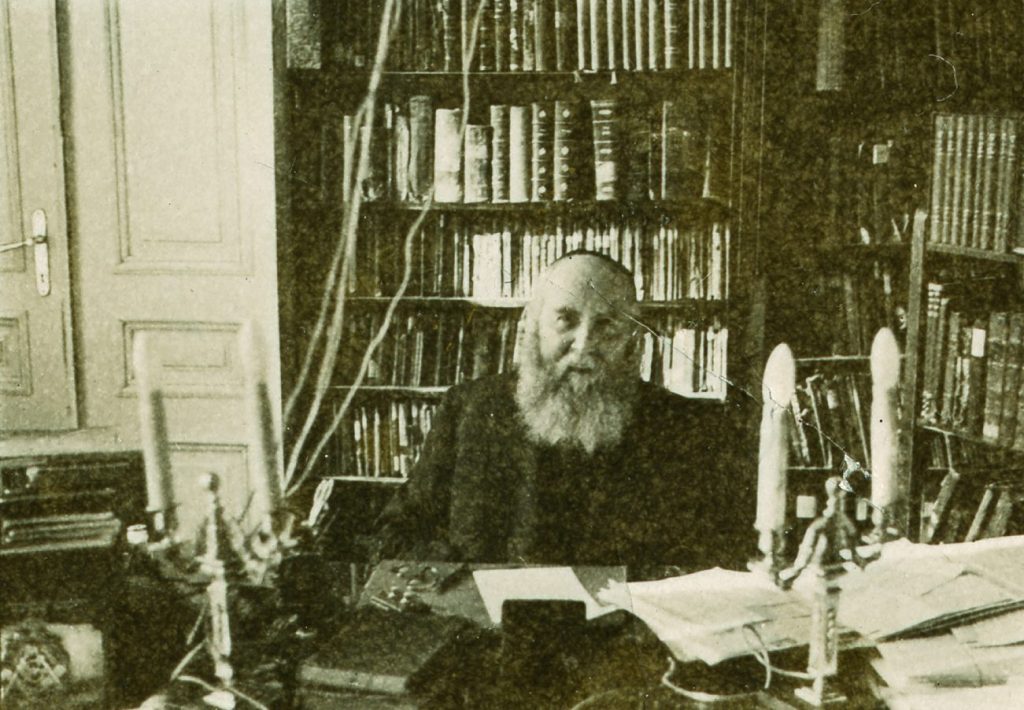
Rabbi Yaakov Yehuda Hecht a’h, a dynamic and well-known activist, one of the prominent figures of the “Seventh Generation,” was a bachur that year, 5702. He had just finished learning in Yeshiva Torah Vodaas in the summer of 5702, and in Elul went to study at 770.
At a certain point the military authorities decided to tighten the regulations, and ordered that even yeshiva students studying for the rabbinate would be required to be drafted. Someone made a firm decision that Yaakov Yehuda Hecht would be the first to prove that yeshiva students could indeed be excellent soldiers…
It turned out that despite letters of recommendation written about him from the yeshivas where he had studied, alongside proof that he was studying for the rabbinate - nothing helped. Someone had decided to draft him at any cost!
On the 28th of Nissan, 5703, he reported before the military authorities. One of the officers who saw him was a religious Jew who had previously studied in yeshiva.
“When did you decide you wanted to study for the rabbinate?” he asked the red-headed young man standing before him.
“Since I was five and a half,” Yaakov Yehuda answered.
“And as you grew older, when was it that you decided this is what you wanted to do with your life?” the man pressed further. Yaakov Yehuda shrugged. “I never stopped to reconsider it,” he answered. “It’s been that way since my childhood, and I’ve always gone with that knowledge.”
“What do you learn?”
“Gemara and poskim.”
“Which tractate?”
“Gittin.”
“And which commentaries do you study?”
“I mainly study the Pnei Yehoshua.”
The man continued to question and probe with endless questions, and in the end ruled that the young man before him was not entitled to a deferment on grounds of religious clerical study, and that he must be drafted.
His father, Reb Yehoshua Hecht, realized the situation was not simple, and he hired the services of a lawyer who traveled to Washington to intercede on his son’s behalf, but these attempts too ended in failure. The army refused to grant him an exemption, and he was summoned to report in the month of Cheshvan 5704 for a pre-induction medical examination.
“Before I reported,” related Rabbi Hecht, “I went in for a yechidus with the Rebbe (Rayatz) and asked for a bracha. I gave the Rebbe the pan, and he looked up and said: ‘Der Oibershter zol helfn, az dein yeshua zol kumen b’derech ha’teva; ober oib es darf zein l’maalah m’derech ha’teva, zol zein azoy’ [May G-d help that your salvation come by natural means; but if it must come in a way above nature, so be it!]. With that the yechidus ended.
When Yaakov Yehuda reported for the medical examination, he was sent from doctor to doctor: the eye doctor, the ear-nose-and-throat doctor, and so on. All the doctors gave him a grade of A (= medically fit). “I was completely healthy, and every time I received an A, I grew more and more worried…” he related in later years. “The doctors’ examination ended and the results were clear: I was medically fit for the draft! Suddenly I was very worried that soon they would arm me and send me to the front… Only one station remained, the psychiatrist’s office. He began asking me questions:
“‘What do you do?’
“‘I’m a yeshiva student, I study Torah,’ I answered.
“‘Do you go out with girls?’
“‘Girls?! What are you talking about! I just told you I’m a yeshiva student.’
“‘Do you go to the movies?’
“‘Movies?! That’s like idol worship, how could I possibly do such a thing?’…
“The psychiatrist continued asking further questions, and I answered all of them. Finally he threw down his papers in frustration and blurted out: ‘You’re completely out of your mind!’… and on the spot he signed a 4-F certificate and I was sent home…
“Together with my father I went back in for a yechidus to thank the Rebbe Rayatz. The Rebbe received us with a broad smile and said: ‘The one for whom a miracle is performed does not recognize his own miracle - du farshteist nit vos far a nes iz dir getrofen, du zolst vissen vos far a nes dos iz geven!’ [You don’t understand what kind of miracle happened to you. You should know what kind of miracle this was!]
“Afterward the Rebbe added in a sing-song: ‘To He who alone performs great wonders - der Oibershter macht groyse nissim, ober zeyer emes’e groyskeit veyst nor Er aleyn’ [Hashem performs great miracles, but only He alone knows their true greatness].
A similar amusing story was told by the Meshulam Zalman Schechter: When we were called to report before the draft board, we were asked about our daily schedule. We described at length how we pray, learn, pray again, and study some more. When they asked us whether we spent time at the movies, at the theater, whether we danced or went out to nightclubs we answered, of course, with a firm no. The military psychiatrist was astonished at our sincerity: “Well, then, what do you do for fun?” One of us answered: “We sit and study with Sholom Ber Gordon. He’s a barrel of laughs!”
[Interesting fact: Yehuda Leib Posner also received an exemption from the army psychiatrist (Form 4F – complete medical failure) since in the psychiatrist’s opinion, someone who doesn’t spend time with girls and instead reads books in his free time is not a sane person. When he reported this to the Rebbe Rayatz, the Rebbe told him to have the 4F form canceled and to try to get a 4D form (deferment) instead, on the grounds that he was studying for the rabbinate…]
A Talmid’s Place Is In The Yeshiva!
Truth be told, there were also bachurim who hadn’t originally intended to go to yeshiva and learn, but since they wanted to get out of military service, they sought admission to the yeshiva and began studying there, fulfilling the Sages’ teaching: “A person should always occupy himself with Torah, even not for its own sake, for out of [study] not for its own sake, one comes to [study] for its own sake,” and “whoever takes upon himself the yoke of Torah is relieved of the yoke of government and worldly concerns.”
During that period, the Rebbe Rayatz issued a call in which he laid out the order of war established by Dovid HaMelech as written in the Book of Shmuel (I, 30:24–25): when part of the people go down to the battlefront while another part remains to guard the equipment, and thus they divide the tasks equally. Accordingly, the yeshiva students are the ones “guarding the equipment,” and through their Torah study they guard and protect the country.
Rabbi Yitzchok Dovid Groner, one of the yeshiva bachurim in those days, related that at a certain point the army faced a shortage of soldiers and began a mass conscription drive. The authorities tightened the examinations and forced masses of young men to join the fighting ranks. As the pressure on yeshiva students increased, the Rebbe Rayatz stated sharply that if they drafted the yeshiva students, “they will lose the war.”
In a letter the Rebbe Rayatz sent (28 Nissan 5704) to several talmidim, he expressed his position decisively: “In response to your letter, may Hashem help you that they recognize the truth that the law exempts you from all [military] work, and that you diligently succeed in learning and yiras shomayim, and become Chassidim, yerei Elokim and lamdanim in the revealed part of Torah, and baalei avoda in the pathways of Chassidus and Chassidim, and settle yourselves in the tent of Torah temima…” (Igros Kodesh of the Rebbe Rayatz, vol. 12, p. 242, letter 4584)
One of the tmimim, Mottel Fisher, came from Chicago to the yeshiva at 770. He related that his mother did not want him to return to the yeshiva. Rabbi Shmuel Levitin told him: “In truth, a non-Jew should have had to walk on all fours like the animals, but only because of the principle of free choice, or for the sake of converts, did Hashem make it so that a non-Jew also walks on two legs. In the same way, regarding the army: it’s true that ‘whoever takes upon himself the yoke of Torah is relieved of the yoke of government and worldly concerns,’ but if only Jews were exempted from the army, that wouldn’t look good. So they made a law that all religious students are exempt.”
He added that if he did not study in the yeshiva, he would have to go to the army.
Afterward, Rabbi Shmuel Levitin went in to the Rebbe and told him what he had said. The Rebbe responded that this was not just a figure of speech; that was exactly the point! (From the notes of the tamim Avrohom Weingarten, Tammuz 5706.)
“I Am Drafting You for a Year”
At the beginning of Sivan 5704, six talmidim of yeshivas Tomchei Tmimim were required to report for a medical examination at the draft office. The tmimim were: Shimon Babroisky, Peretz Hecht, Sholom Ber Gordon, Dovid Eidelman, Shmuel Isaac Popack, and his brother Aharon. Like all the other tmimim, they submitted their names to the Rebbe Rayatz to receive his bracha that they succeed in obtaining an exemption from military service.
The night before they were to report, the six sat in the zal of 770 and learned all night. In the morning, after holding a minyan for Shacharis, they went out to the draft office in Manhattan. As they left 770, they noticed the Rebbe standing by the window above the entrance door of 770, watching them with his lips moving in prayer. It was a heart-stirring sight to see how the Rebbe, like a father to his children, protected them with prayer and endless love.
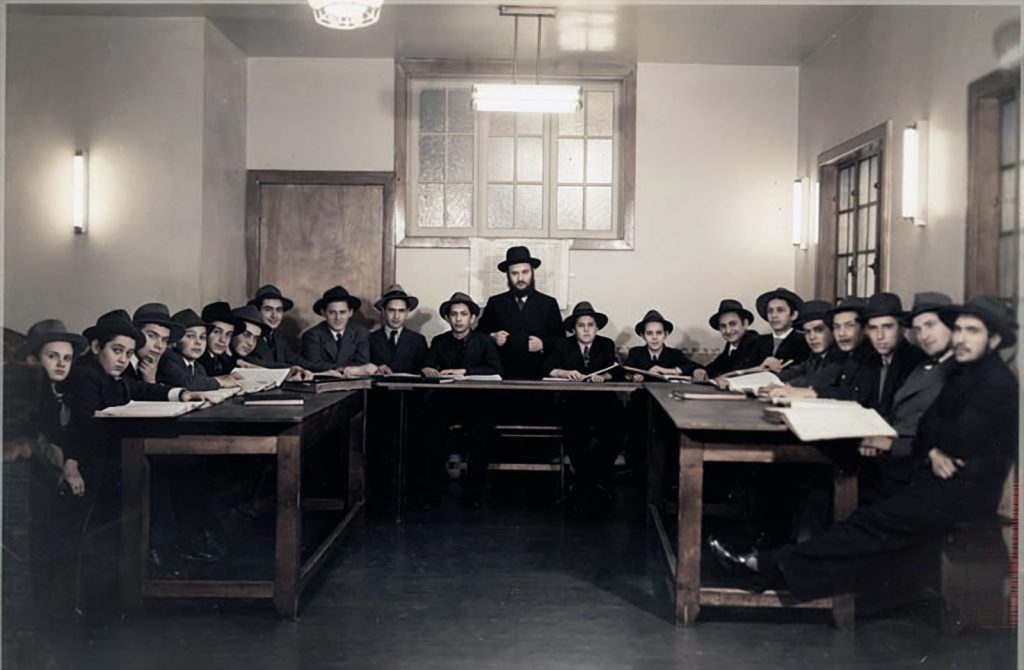
When the bachurim arrived at the draft office, they noticed that one of the officials, Dr. Herbert Goldstein, was Jewish and a former talmid at Yeshivas Rabbeinu Yitzchak Elchanan. This gave them hope. One by one they entered his office, and soon came out with the longed-for exemption. This was, to a certain extent, quite expected, since they looked strange compared to other young men their age, young men with grown beards, dressed in black clothing. Their whole appearance shouted that something was off with them.
During the medical exam they were instructed to undress, but they solemnly announced that they would not remove their tzitzis. Five of them received Form 4F (exemption due to medical unsuitability) instead of Form 4D (a deferment that requires the holder to report again periodically).
The Rebbe Rayatz remained standing at his post for many long hours, saying Tehillim for them. Even when his household members asked him to come in for breakfast, the Rebbe did not heed their request and continued saying Tehillim. The Rebbe asked to be kept updated on what was happening with the talmidim. Indeed, each of the talmidim who received an exemption hurried to call 770 so that the Rebbe would be told that he had been freed from army service…
As mentioned, five received an exemption. The last of the six, Shmuel Isaac Popack, continued waiting his turn to be called in.
When lunchtime came, the Jewish official, Dr. Goldstein, left the office to go eat. Shmuel Isaac, who still had no beard growth and looked like a relatively “normal” young man, knew that if he fell into the hands of the non-Jewish official, he would naturally have no chance of getting an exemption. He began to tremble with fear.
Ahead of him in line stood a strapping non-Jewish young man who apparently wanted with all his heart to enlist. He hurried happily into the examination room. Usually the exam took only a few minutes, but this time it dragged on. Shmuel Isaac stood outside, puzzled as to why he wasn’t being called in. It turned out that the examining official was from the same hometown as the young enlistee, and the two had struck up a long conversation reminiscing about their hometown.
Three-quarters of an hour passed this way, and meanwhile Dr. Goldstein returned from his lunch. When he noticed Shmuel Isaac standing in line, he turned to his non-Jewish colleague: “You have no idea what a wonderful lunch I just had. If you really want to enjoy yourself, go now to the restaurant,” and he named the restaurant and its address. “You only have one more person left in line,” he continued persuading him, “let me handle him, and you go enjoy your meal in peace…”
The non-Jewish official happily accepted his colleague’s suggestion. He quickly finished filling out the forms for the young non-Jewish enlistee and left the office. Shmuel Isaac approached the Jewish official and within two minutes he was outside with a stamp of permanent exemption…
Shmuel Isaac rushed to call 770 to report that he too had received the longed-for exemption. The Rebbe’s household members hurried to update him with the joyful news. Only then did the Rebbe stop saying Tehillim and return to his room…
When Shmuel Isaac returned to 770, his friends excitedly told him that the Rebbe had remained standing by the window saying Tehillim for another 45 minutes just for his sake, sending someone to check every ten minutes whether Shmuel Isaac had received his exemption yet!
Tears welled up in Shmuel Isaac’s eyes. He recalled that a few months earlier the Rebbe had assigned him the task of collecting rent from the residents of 770 (Rashag, who lived on the third floor; the Rebbe Rayatz, who lived on the second floor; and the Ramash, who paid for the office of the “Merkos L’Inyonei Chinuch” and “Machne Israel”).
With the money he collected, he took care of paying the building’s ongoing expenses: gas, electricity, taxes, and so on. When he finished handling all this, the Rebbe Rayatz remarked to him, “I am drafting you for a year”… Now he understood that the Rebbe had provided the cure before the ailment. By “drafting” him for his own affairs, the Rebbe had exempted him from army service.
Misapplied Sharpness
Not everything always went smoothly. At times miracles were needed, and sometimes great miracles, especially in cases where the draft office was staffed by Jews who were former yeshiva students and knew how to argue sharply…
Rabbi Tzvi Yehuda Fogelman a’h served for more than fifty years as the Rebbe’s shliach to Worcester, Massachusetts, and was one of the central figures among the Chassidim of the seventh generation.
As a bachur, Tzvi Yehuda learned in 770 during the lifetime of the Rebbe Rayatz. Like many others, the draft decree affected him too and in the middle of 5702 he received a summons to the draft office.
The army official who received him was Jewish, and apparently also a former yeshiva student; he knew the system well “from the inside.” He conducted a difficult conversation with Tzvi Yehuda. Among other things, he asked him whether he learned lishma (“for its own sake”).
When Tzvi Yehuda answered yes, the official said triumphantly, “In that case, you’re not studying for the rabbinate, since someone who studies ‘for its own sake’ doesn’t study for the sake of a title or position and if you’re not studying for the rabbinate, you must enlist in the army”… He went on to ask further questions about the Tomchei Tmimim institution and about the yeshiva’s students.
“When I came back to 770,” Rabbi Fogelman related in later years, “the Rebbe Rayatz asked me to write down in detail everything he had asked and everything I had answered…”
* * *
Thus, alongside the world-encompassing efforts that the Rebbe Rayatz led in those very days on behalf of the millions of Jews who remained in occupied Europe, along with spiritual efforts and a worldwide outcry, he remained focused on his tmimim “children,” who needed spiritual help.
One by one, the Rebbe Rayatz carried them in his pure heart, with boundless fatherly love, and made sure they could continue learning in the yeshiva with peace of mind, for the place of a yeshiva bachur is next to his sefarim!
Sources: Toldos HaTmimim B’Artzos HaBris (by Rabbi Yosef Yitzchak Keller, 5779). “HaTamim.” Beis Moshiach. Nitzotzei Ohr.
This article is dedicated to the hundreds of tmimim seeking to go out for the year of “Kevutza”: Yehi ratzon that all restrictions and obstacles be removed, and that you may soon see and be seen in our holy courts.
Beis Moshiach #1525 • כ״ח תשרי תשפ״ז • pp. 10-20
© 2026 Beis Moshiach Magazine. All rights reserved.
This article originally appeared in Beis Moshiach #1525. You are welcome to share it with friends and family by email or in print, provided that you do not change, add to or omit any part of it, you credit the author and Beis Moshiach, and you include a link to archive.bmoshiach.org (written out in full in printed copies).
To republish this article in a newspaper, magazine, book or website, please request permission in advance at [email protected].