Turning Over a New Loose-Leaf
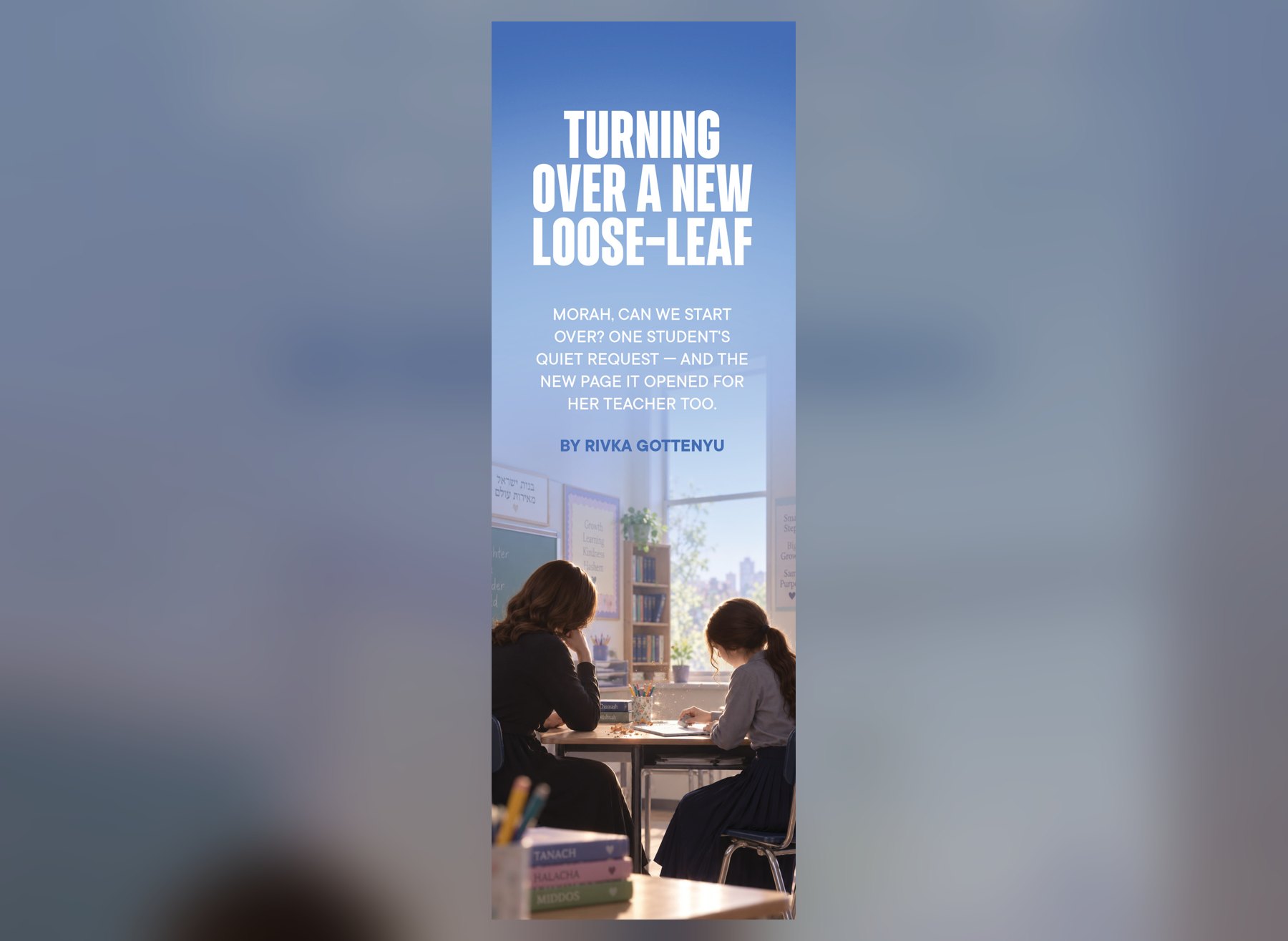
Morah, can we start over? One student’s quiet request - and the new page it opened for her teacher too.
The first days of the school year are wrapped in the fresh scent of beginnings and renewal. At this time, teachers focus on instilling rules, habits, and procedures, alongside listening to and getting to personally know each student.
This was one of those years when I continued with my class for another year. In such a year there’s no need to deal with instilling rules and procedures, since we ostensibly continue from the point where we left off. I invested my energy and strength in creative ideas. I thought about challenges for the students and about variations and innovations that would turn the additional year into an experience.
I sat with the students for personal conversations. We talked about goals, expectations, and experiences from the vacation, and we also had pleasant conversations about this and that to draw hearts closer.
That’s how I expected my conversation with my student Tamar to go as well.
She shyly entered the room where I was sitting. “How are you, Tamar?” I smiled at her. Two months of vacation, and I had truly and sincerely missed my beloved students.
She answered with a shy smile and murmured, “Boruch Hashem.” I tried to draw her out. I asked about the vacation she’d had. And so we talked about the summer break, about fun trips, about her goals for the new year, and about the strengths she had and intended to muster in order to achieve her goals - academically, in her Chassidic life, socially, and personally. And even though the conversation flowed, I sensed that Tamar was more restrained than usual. As if something unspoken lay between us. It was on the tip of her tongue, but she wasn’t able, or didn’t want, to say it.
That was probably why I extended our conversation beyond the time I had allotted for it, and postponed my talk with the next girl on the list until the following day. I tried, in roundabout ways, to draw her out and allow her to open up about what was bothering her, but when that didn’t happen, I decided to let go, to allow her to speak when she chose to.
I said goodbye to her and had already begun putting away my things, when I heard her voice. For a moment I thought I’d imagined it, but when I raised my head she was looking at me and repeated her question: “Teacher, um… can I say something? Um… I don’t know if it’s a request or a question,” she blushed.
“Of course, Tamar. No matter what we call it, what would you like to say?”
“Since this is our second year together… is there a chance to start a new page, as if it were a completely new year? Without remembering the… the less successful things, to give a chance as if… as if it were a new teacher and a new student, or… or is there no chance?” Now I understood why she hadn’t known how to define her words as a request or a question, since they were both.
I looked at her and couldn’t help but smile at her. I was instantly transported back to a conversation I’d had before one school year with another teacher on staff. She had asked me to tell her about the class I had taught before her, which she was about to take over the following year, to share with her the needs of the class and of each individual student. We went through the names on the list and talked about the characteristics of each girl and her needs.
After a long time we finished going through the whole list, and then I said to her: “And now erase everything from your head, everything I shared with you. Remember that they are a new page, blank and white. The information will be stored somewhere, in a distant compartment of the mind, and you’ll know how to retrieve it if needed, but for now, start from the beginning.”
I returned to Tamar, who was looking at me, waiting for an answer with hopeful eyes. “Of course, dear Tamar. Of course there’s a chance. And it’s not only you who wants to start a new page, from the beginning. So do other students, so do teachers. Even me,” I declared, as she watched me, doubt still in her eyes.
“Yes, yes. I also hope to start a new page, a page where I return tests after a week and not after a month.” She smiled, knowing as well as I did that a month was actually a good scenario; sometimes I took even longer… “I also want to start a new page where I manage to talk with all the students and not just once a year…” I saw on her face that she understood. She thanked me and left the classroom with a light step.
I don’t remember how that year unfolded or whether it was different from the other years in which I taught classes, but the tefillos of the Aseres Yemei Teshuva and Yom Kippur took on a different meaning for me. I said the “Avinu Malkeinu” tefilla with all my heart, joining all of Am Yisrael, asking Hashem to forgive and pardon, to remove, to wipe away and erase, to open a new and clean page in the Book of Good Life, forgiveness and pardon, Geula and yeshua.
Beis Moshiach #1525 • כ״ח תשרי תשפ״ז • pp. 48-49
© 2026 Beis Moshiach Magazine. All rights reserved.
This article originally appeared in Beis Moshiach #1525. You are welcome to share it with friends and family by email or in print, provided that you do not change, add to or omit any part of it, you credit the author and Beis Moshiach, and you include a link to archive.bmoshiach.org (written out in full in printed copies).
To republish this article in a newspaper, magazine, book or website, please request permission in advance at [email protected].