My Russian Upbringing
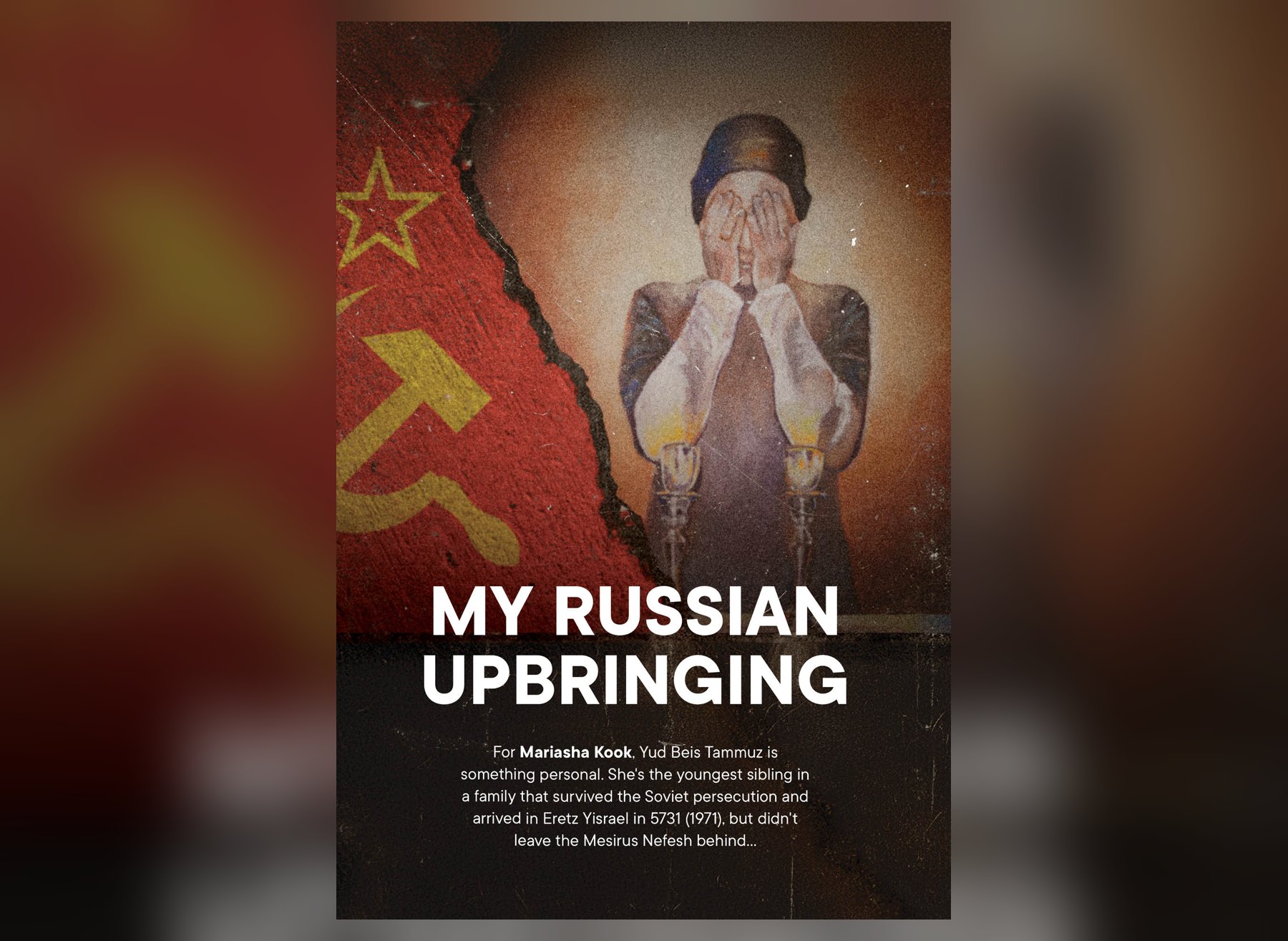
For Mariasha Kook, Yud Beis Tammuz is something personal. She’s the youngest sibling in a family that survived the Soviet persecution and arrived in Eretz Yisrael in 5731 (1971), but didn’t leave the Mesirus Nefesh behind…
As Chabad Chassidim, we heard a lot about the hardships experienced by Chassidim behind the Iron Curtain. We grew up on stories of mesirus nefesh, some hearing them from family members and some from books of memoirs.
Today, more than thirty years since the fall of communism, this article is about the second generation, the children of those outstanding Chabad Chassidim. What do they remember? What did they take with them? How do they view their parents’ lives of mesirus nefesh?
Mariasha Kook is the daughter of Yisrael Shai and Batya Pinsky, Lubavitcher Chassidim in Ramot who moved to Eretz Yisrael in 5737/1977. She very openly shared her memories, feelings and insights.
“I am the youngest daughter in the family. My father is over ninety and my mother passed away 23 years ago. I didn’t do enough to collect their history. As a young girl, there are things that you are not mature enough to understand and you don’t appreciate every detail of information.”
Let us begin with some background about your parents.
My mother was born in Uman and grew up in Malachovka, a suburb of Moscow. Her family was Breslov and her maiden name was Dorfman.
When she was a girl, her father, R’ Michel z’l, was arrested suddenly, with no prior warning, and exiled to Siberia. My grandfather, Rabbi Yechiel Michel Dorfman, left home at the age of sixteen, during the Holocaust, and wandered to many places before arriving in Uman. There, he became a Breslover Chassid. He was separated from the entire family who were killed afterward during the war in a mass grave. He remained alone, without any siblings.
In Uman he met my grandmother and it was a shidduch. My mother was the third daughter in her family. Her childhood was hard but she grew up in Malachovka surrounded by a lot of family and a lot of Yiddishkeit, with a strong Jewish identity. She attended the communist school and something about the youth movement excited her as a girl, but when she grew older she realized the falsehood. She studied to be a lab technician.
My father was born in Moscow to an old-time Lubavitch family, going back to the Tzemach Tzedek. Before being called Pinsky, the family name was Shub (abbrev. of shochet u’bodek).
His father, R’ Shneur Pinsky, was a talmid in Tomchei Tmimim in Lubavitch, mekushar to his Rebbeim. They lived in Moscow, in Malachovka. When the Rebbe Rayatz arrived in Moscow, my grandfather provided him with chalav Yisrael milk. As an adult, my father was a chemical engineer.
My parents represent the smelting pot of Judaism in the Soviet Union. Both lived lives of mesirus nefesh. Over the years, we heard a lot from them about the bad years. Other Chabad Chassidim lived closer to Chassidic towns where there was real mesirus nefesh, while my parents experienced less of the danger and battle, but that also depended on particular eras.
Tell us some memories, stories that you grew up with.
My grandfather, R’ Yechiel Michel, was an active person who was one of the first to develop the tziyun in Uman. He went there even during the years when it was dangerous to go there.
When they wanted to destroy the tziyun and put up an apartment building, he worked tirelessly and also went to the Rebbe who gave him instructions about with whom to meet and what to do. He met with various people and the matter reached the president of the US, and the tziyun in Uman was saved. At the end of his life he was blacklisted from receiving a visa from the Ukrainian government which really broke him.
He would go to Meron a few times a year. Even when he reached his nineties, he was particular about mikva every day and got up for Tikun Chatzos. He was a consummate yerei shomayim.
My grandfather’s home was packed with people who came to bless and be blessed and yet, he never forgot to be a grandfather. I have presents he bought me for the afikoman, dozens of books about tzaddikim that I still have, more than thirty years later. He always took an interest in the grandchildren and great-grandchildren, including those who did not continue in the way of Torah and mitzvos.
World War II broke out when my father was a boy. His father was drafted as was his older brother, Notte Ber, who was sixteen. For a long time, his mother was hospitalized for meningitis. My father, despite being a child, had to look after his youngest sister and visit his mother and look out for her. He would always say that he won’t forget the days he had to take his four-year-old sister to preschool. She would lie down on the snow and wouldn’t get up and he was just three years older. In the morning, he would use coupons to buy bread to bring food home. There were stories that never really gelled for him in his old age, as though deep inside there was a child who still hadn’t recovered from that difficult time.
His parents’ home welcomed guests. It was small and always full of guests and lekach. My father would always say that on Sukkos they would dance, jump in the puddles, in order to rejoice as Chassidim do, to warm their blood and do all they could to get out of themselves; not to wait for joy to come but to create it.
My father was a baal tokeia. There was a man, alone, weak, unfortunate, who could not go to hear the shofar and my father would go to him after the davening, a three-hour walk, while still fasting, in order to blow shofar for him. Then he walked all the way back.
On Simchas Torah too, they would walk great distances in the rain to get to the central Archipova shul, to do hakafos there.
In whatever needed doing, he was active; underground, at farbrengens.
For five years my father was a refusenik. They did not allow him to leave, claiming that as a chemical engineer he had secrets and patents that could not be revealed. My mother did not work because she was home with my younger brothers. They were not sent to school because of the heresy.
In later years, after Stalin, when it was a bit easier but the fear of the communists still prevailed, they had all kinds of trials. For example, the building concierge would knock after candle-lighting, or electricians, asking for signatures. It was frightening. My mother always said, “I am a Jew. I observe Shabbos, and I don’t sign.”
After a bris mila, a government doctor came to examine the baby and she threatened my mother, “Do you know that what you did now is dangerous for the baby?” My mother courageously answered, “I am also a doctor and as a doctor I can tell you that circumcision is the healthiest thing for a baby.”
Another nice story began in Russia and ended in Eretz Yisrael:
There was a Jewish woman by the name of Bertha who lived in my parents’ neighborhood in Moscow. She was a good neighbor and my mother always tried to help her. One Shabbos, she asked my mother to help set up her lamp and my mother got out of it. Another Shabbos, she again asked something that entailed chilul Shabbos and my mother declined. Since this happened several times, Bertha asked my mother, “Tell me, why didn’t you help me today? What happened? Are you Jewish?”
My mother proudly told her, “Yes, I am Jewish.”
Then, to my mother’s astonishment, Bertha burst into tears and revealed that she was also Jewish. When she calmed down, she told my mother with yearning about her grandparents from a small Jewish town in eastern Russia.
Some years after my parents moved to Eretz Yisrael and lived in Ramot, Bertha also moved there and decided to live in Yerushalayim, near my parents. In her old age she became fully involved in a life of Torah and mitzvos. She ate kosher and kept Shabbos.
From your perspective today, do the books that we have that describe what Jews behind the Iron Curtain experienced, describe what you went through?
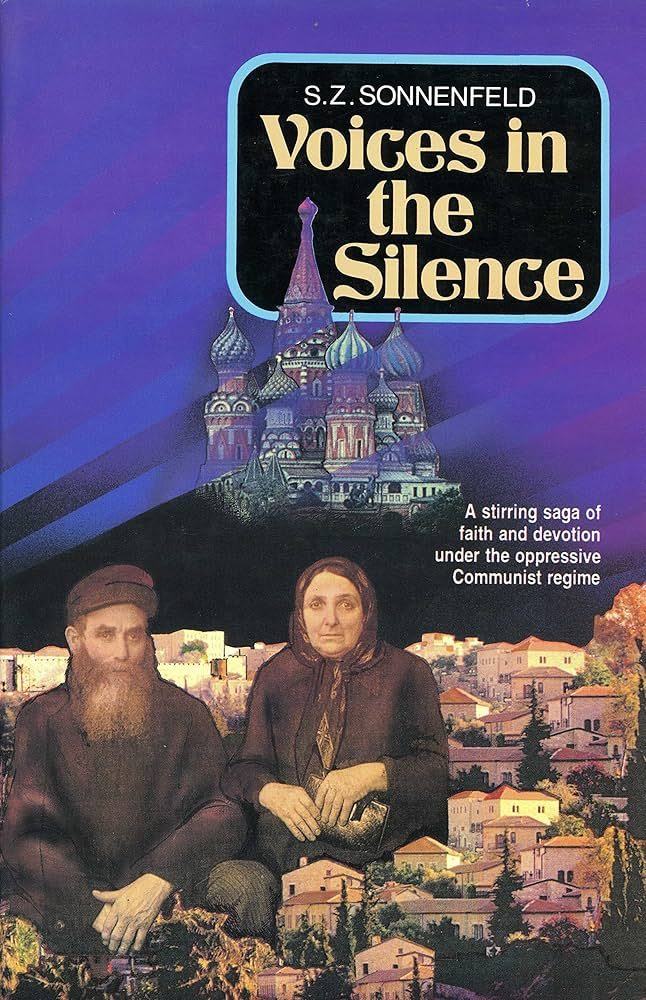
There is authentic literature that describes what it was like. When you read it, you really feel what they went through, books like Voices in the Silence about Basya Barg. It draws you into the complexities of the time and it was crazy complex, an exile like no other. People found their spark and wouldn’t relinquish it.
I think that the best literature is mostly found in Chabad because it’s part of us, it’s our Rebbeim. In the religious sector they don’t know enough about the mesirus nefesh there was there, how we survived there.
When your parents moved to Eretz Yisrael, was this much easier for them after what they went through previously?
My parents moved to Eretz Yisrael around Chanuka time. They had a very difficult time acclimating. First, they went to an immigrant hostel in Kfar Chabad. My mother attended ulpan but my father did not; he sat and learned with my brothers for three months in the Talmud Torah until one brother said, “Abba, that’s it. You don’t need to come anymore.”
My father found a job in Petach Tikva. For my mother it was harder because she had to convert her diplomas from Russia to diplomas recognized by Israel.
A year later, my father traveled to the Rebbe and the Rebbe asked him to live in Nachalat Har Chabad, because they needed personalities like him. My father said he has parents in Yerushalayim and the mitzva of kibud horim was important to him.
The Rebbe agreed because of the importance of kibud horim, and they moved to Ramot in Yerushalayim. For a long time, my father traveled every day to work in Petach Tikva.
My mother had it hard, mainly with the language. While my father was in yechidus, the Rebbe opened his letters and my mother’s letters and looked at the names of the children. He marked them with a pencil and then spoke to him about the situation in Moscow.
The Rebbe told him, “You had five hard years of being refuseniks. Now too, in Eretz Yisrael, there can be more complex years of absorption difficulties.” It seems, the Rebbe said this for my mother. After some time, she went to work at the Health Ministry as a supervisor. It wasn’t easy for her. Over time, she fit in thanks to her good intentions and her willingness. She would give permits to open institutions after they underwent health checks.
The religious schools in Yerushalayim were under her purview. Yeshivos and elementary schools sought out Batya Pinsky so that she would help them with permits. She paved the way for mosdos that eventually became large, established mosdos. She was the right person at the right time to help open mosdos of Torah and chessed.
My father, who was a very active person, did not stop being active when he moved to Eretz Yisrael. He worked tirelessly to open a shul in Ramot and to move it from a shack to a permanent building.
My father made the effort, while barely knowing the language, to convert all the documents and all the permits for the benefits coming to them. They did all they could so they would have a stable income and even thought of how to set up their children in the future even though they still had young children.
As a daughter of parents who moved from communist Russia to Eretz Yisrael, do you feel a difference between how you regard certain things as opposed to women who were born here?
In our home there was always a Russian mentality; we also spoke Russian at home. There was perfectionism and order. It was very important to properly preserve documents, for example. But my parents quickly understood the Israeli approach. My parents were academics, since this is what was important in Russia, but when they came to Eretz Yisrael, they realized that here, when a son finishes yeshiva, he goes on shlichus and it’s not a given that he will learn a profession. They went along with that, even though for them this was a 180 degree concession considering the goals with which they grew up.
I think that we grew up in a demanding yet enabling atmosphere. There was a demand from my parents for yiras shomayim and responsibility, and not from a place of “You must,” “Like this and not otherwise.” We, the three siblings, grew into the field of chinuch, boruch Hashem.
In Russia there is also significance attached to obedience and hierarchy. I don’t know whether it’s communist education or European, or something unique to those from Russia, but there is a clear hierarchy. As an Israeli and someone in chinuch, it’s very hard for me to relate to western culture where you are friends of the children, or a teacher is equal to her students in certain ways. To me, this goes against the proper, natural order. Derech eretz and a culture of respect toward elders is something I’ve taken with me all of my life.
Another element that we were raised with is family ties. For Russian Jews, the grandmother cares for the grandchildren and lives with them. There is a value of respecting parents; family is family. Even a third cousin is a relative with whom we are in touch. We meet and even go on “dacha” together. Perhaps it’s because of the hardships of Judaism that it was important to be more united; maybe because of the understanding that each member of the family is an important part of the puzzle.
One of the characteristics with which we were raised is that even if you have a natural tendency toward pushing limits, retain loyalty to the crown. Remain connected to the official mosdos of Chabad even if, over the years, there is a need to open a new program. For those who came from there, it was a great value to preserve stability, even if changes were necessary and even if we didn’t agree. Always adjust and continue to belong.
I believe that this is also connected with Russian culture which is highly disciplined, but even more because of the lives they lived and the mesirus nefesh they experienced. This strong Jewish identity is more important than any complaint or any personal dissatisfaction.
What do you transmit to your children?
I convey a strong message to my children, not necessarily verbally, that I got over the years from my parents. It doesn’t matter if they say we are a challenged generation or a traumatized generation. There are things that we need to stick with just the same; something which remains rock solid. You can be socially engaged, you can be who you are, but never forget that you must always return to your roots. This is what builds you and this is the basis for your life. I’m talking from a spiritual, Jewish perspective as well as education, habits, family. There are things we don’t concede.
To conclude…
What I have to say is from my personal experience. There could be someone who experienced things differently or they have other interpretations. My in-laws, for example, moved to Eretz Yisrael when the State was founded, when Jews escaped the Soviet Union via Lvov. They also lived with great mesirus nefesh, but their story is different. They are authentic Jews, precious, daring Chassidim, with no advanced academic education, who raised beautiful Chassidishe families.
In contrast, my parents moved in the late seventies and basically lived two eras, the beginning of the Soviet Union and the post-Stalin era which was a bit easier, when there was a little more freedom of expression. There was education for academics and excellence. The challenges were different depending on the era and locale, so there could be a different way of looking at things.
Each one of us belongs and has its own puzzle pieces of Jewish family history from one continent or another. Preserve your uniqueness; it’s in your hands. Take an interest, remember that this is the blood that flows in your veins, and its your privilege and obligation to transmit it to the next generation.
Beis Moshiach #1418 • pp. 44-49
© 2026 Beis Moshiach Magazine. All rights reserved.
This article originally appeared in Beis Moshiach #1418. You are welcome to share it with friends and family by email or in print, provided that you do not change, add to or omit any part of it, you credit the author and Beis Moshiach, and you include a link to archive.bmoshiach.org (written out in full in printed copies).
To republish this article in a newspaper, magazine, book or website, please request permission in advance at [email protected].