Guardian Of The Lubavitcher Embers In South Africa
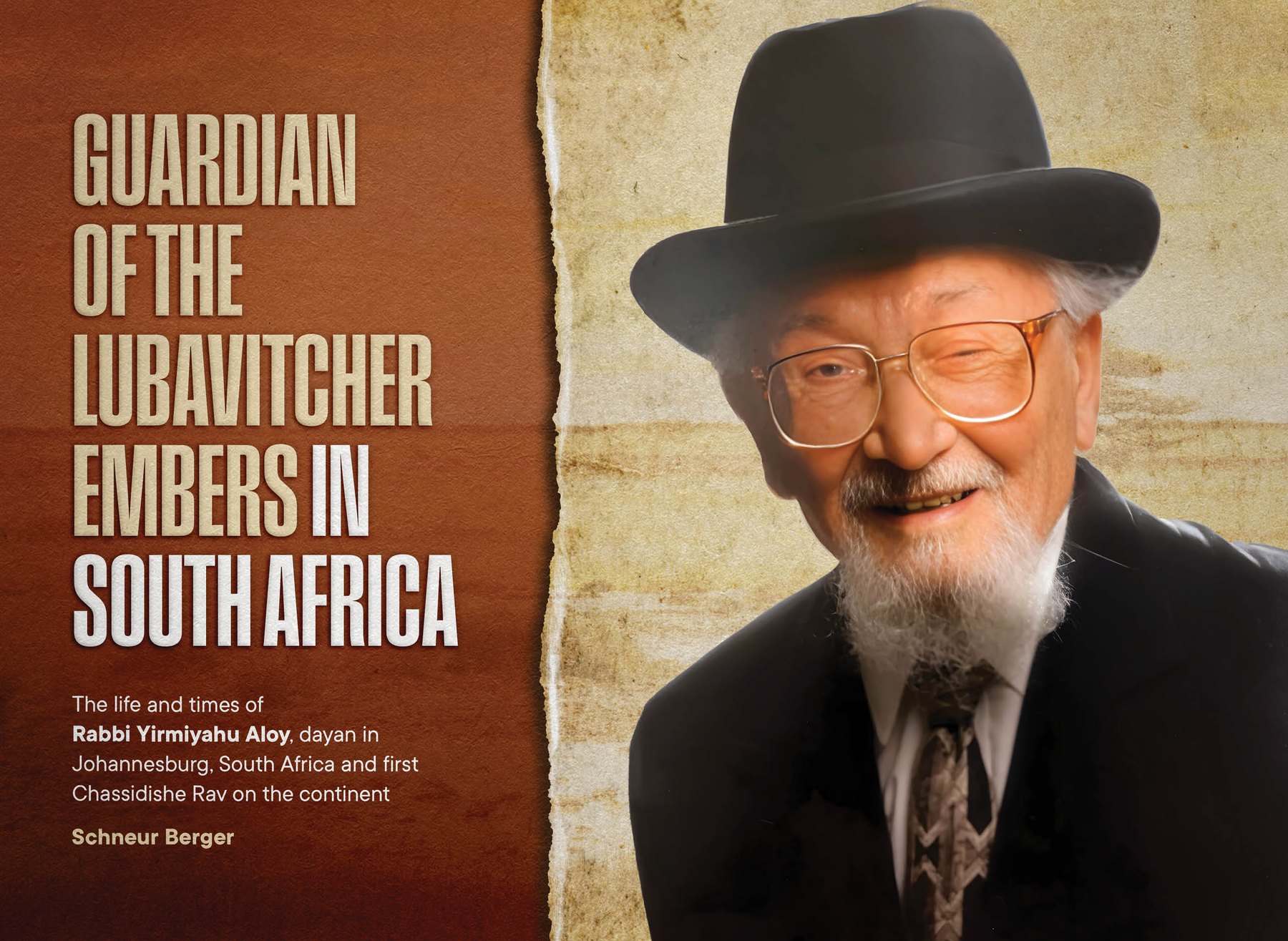
The life and times of Rabbi Yirmiyahu Aloy, dayan in Johannesburg, South Africa and first Chassidishe Rav on the continent
Rabbi Yirmiyahu Aloy was born in Kislev 5671 in Dokshitz, to R’ and Mrs. Avrohom Yaakov, Hy’d, and Basya a’h. His father was a descendant of R’ Zelig of Dokshitz, a Chassid of the Alter Rebbe. His mother passed away when he was a child.
When he was fifteen, he began learning in the Yeshivas Remailles in Vilna. He became close with the Rav of the city and Nasi of the yeshiva, Rabbi Chaim Ozer Grodzinski. His son-in-law, Rabbi Aharon Kurtstag related that once, on Rosh Chodesh, a minyan of talmidim was arranged in the home of Rabbi Grodzinski. Young Yirmiya had a beautiful voice and he was the chazan for Shacharis and then read from the Torah. Because of his good voice, the Rav asked him to be chazan for Mussaf too.
At the end of Mussaf, R’ Chaim Ozer said to him, “You could be a Rav in America.”
In those days, when American Jewry was weak, the main function of a Rav was to read the Torah and lead the tefillos, and this is what R’ Chaim Ozer was jokingly referring to. Years later, R’ Yirmiya said that this “semicha” was the most significant he received, since R’ Chaim Ozer himself said he could be a Rav.
In Nissan 5692, he wanted to learn in Tomchei Tmimim in Warsaw but the Rebbe Rayatz told him that due to the critical financial situation at the yeshiva, he could not accept him and that he would correspond with him in two months.
Rosh Yeshiva In Dokshitz
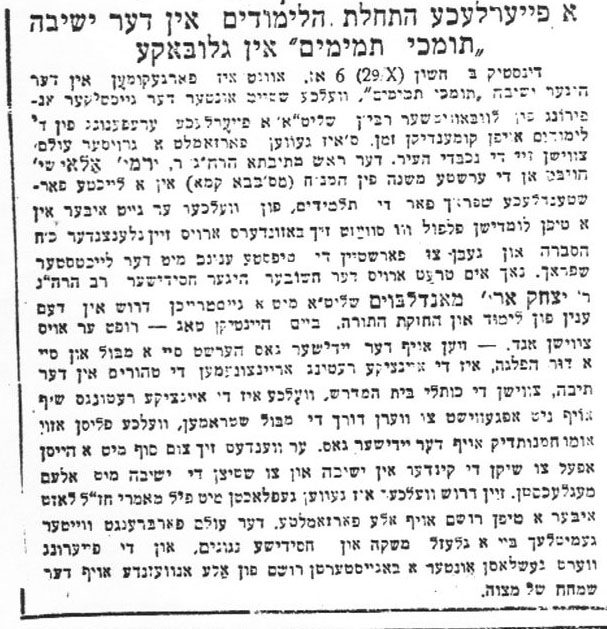
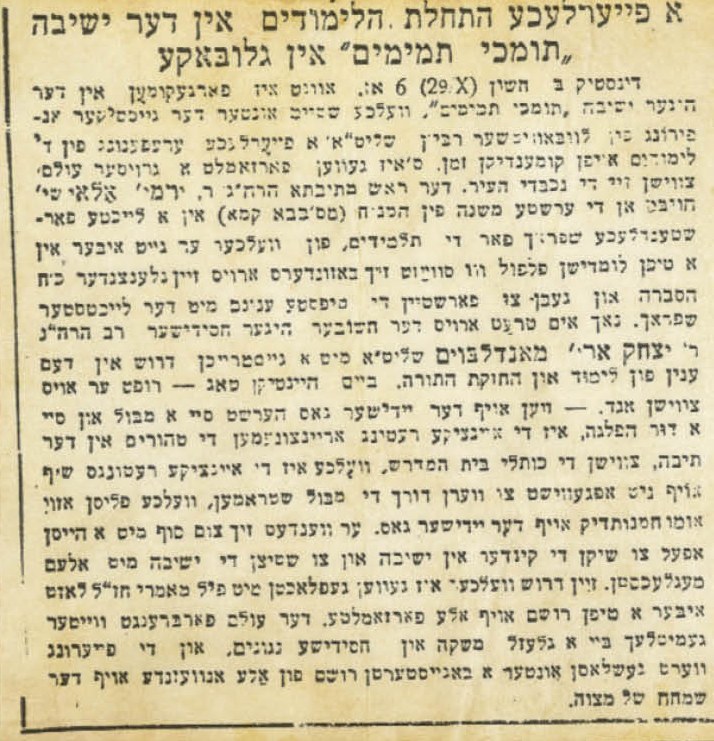
He married Rochel Leah, daughter of R’ Michoel Rivkin, the Chabad melamed in Dokshitz, in 5694. About two years later he was appointed rosh yeshiva of Tomchei Tmimim in Gluboka in Poland (now part of Lithuania). This yeshiva was founded following a visit of the Rebbe Rayatz to the city in the summer of 5694.
The yeshiva was founded in the summer of 5695 and at the beginning of 5696 R’ Aloy was appointed as the rosh yeshiva. He served in this position for only several months. Years later, he wrote the following in a letter:
“The seder ha’limudim and the curriculum are hard to remember forty-three years later. There were about thirty talmidim, some of whom learned all day and some who learned half a day. I was busy with them all day. On Friday night, after the Shabbos meal, we would gather and I learned the parsha with them. We would farbreng a bit with stories of Chassidim and review sichos kodesh of the Rebbe Rayatz.
“I served there only briefly, a few months, and tried to set the yeshiva on its feet until I was suddenly called upon to accept the position of shochet u’bodek in Droya… Naturally, I didn’t leave the yeshiva without permission from the Rebbe. It was only after I found a suitable replacement, my dear friend, Rabbi Binyamin Estrin, Hy’d… also descended from Anash, who learned in Yeshivas Mir with me.”
He did not stay long in Droya either, for after a while he received an offer to emigrate to South Africa.
Leading Jewry In Johannesburg
In those days, more and more Lithuanian Jews were emigrating to South Africa. A yeshiva friend, Rabbi Yitzchok Kossovsky (R’ Chaim Ozer’s brother-in-law) was the Rav of Johannesburg and he convinced R’ Aloy to join him. To make it easier for him to get a visa to South Africa, it was suggested that he say that he would serve as shadar for Yeshivas Toras Chessed in Brisk. Distinguished rabbanim signed on his appointment, including R’ Grodzinski.
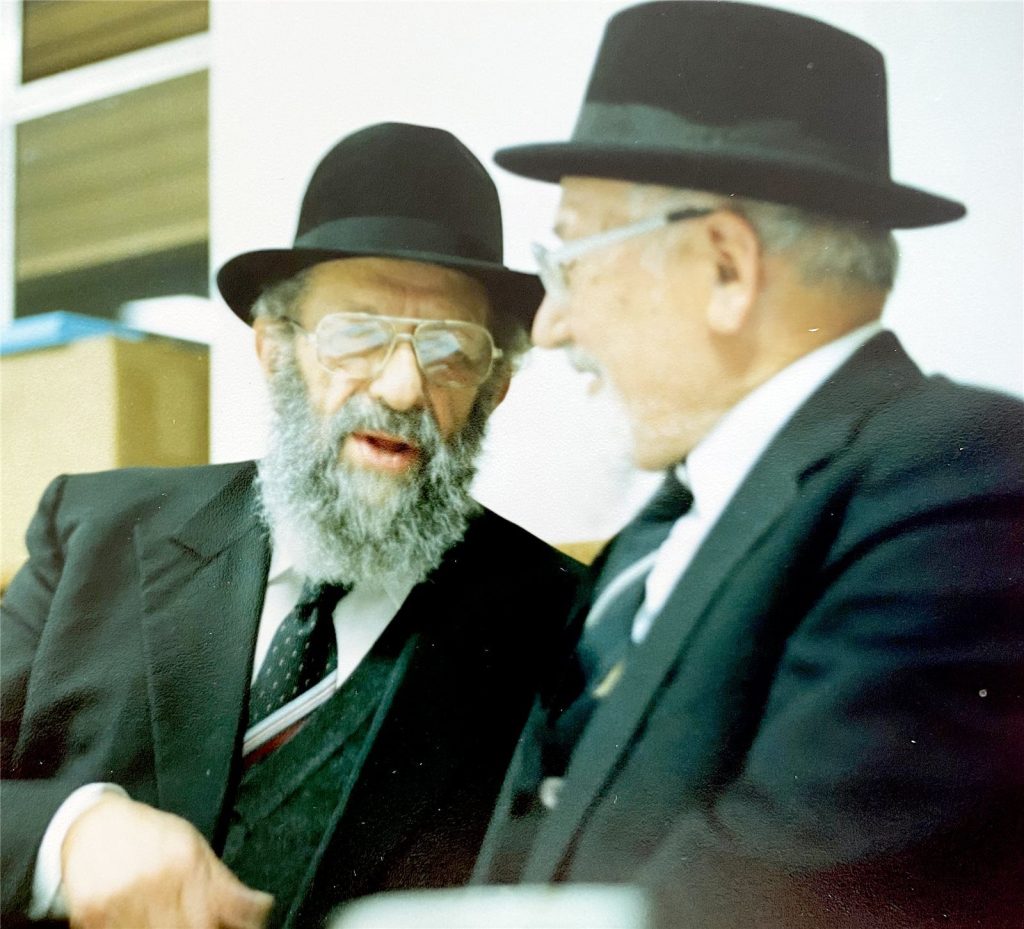
R’ Aloy moved to South Africa in 5697. He initially went alone because of problems with documents and the cost of tickets. His wife and daughter joined him two years later.
Upon arriving in South Africa, R’ Aloy began giving shiurim. During the following years, he served as Rav in a number of small communities until he was finally appointed Rav of the Great Synagogue in Berea, in Johannesburg. He also served as dayan and mazkir of the Beis Din in Johannesburg.
The Beis Din, headed by the chief rabbi of Johannesburg, united all Orthodox communities in Johannesburg. The Beis Din conducted legal proceedings, along with all matters pertaining to marriages and divorces and operated a large-scale kashrus system. In his role as mazkir of the Beis Din, he became a sort of acting administrator of all the legal proceedings and judges, even as he served as a judge on the court.
Johannesburg is the largest city in South Africa, with tens of thousands of Jews, and they have many mosdos chinuch, Torah and chessed. When R’ Aloy first came, the number of shomrei mitzvos wasn’t large. There were a few small communities of shomrei mitzvos, while the big shuls were filled mainly by traditional Jews who were particular about kashrus, Pesach and Yom Kippur but sometimes showed up to shul on Shabbos by car. On the Yomim Noraim, the big shuls were full and additional minyanim had to be arranged. Most Jews were immigrants from Lithuania. Some of them learned a daf Gemara on Shabbos while smoking.
Over the years, the number of mitzva observant families grew.
Few Lubavitcher Chassidim lived in South Africa, though there were many who had Chabad roots or family connections with Chabad. Most of them knew what Yud-Tes Kislev is, but most were not Chassidim.
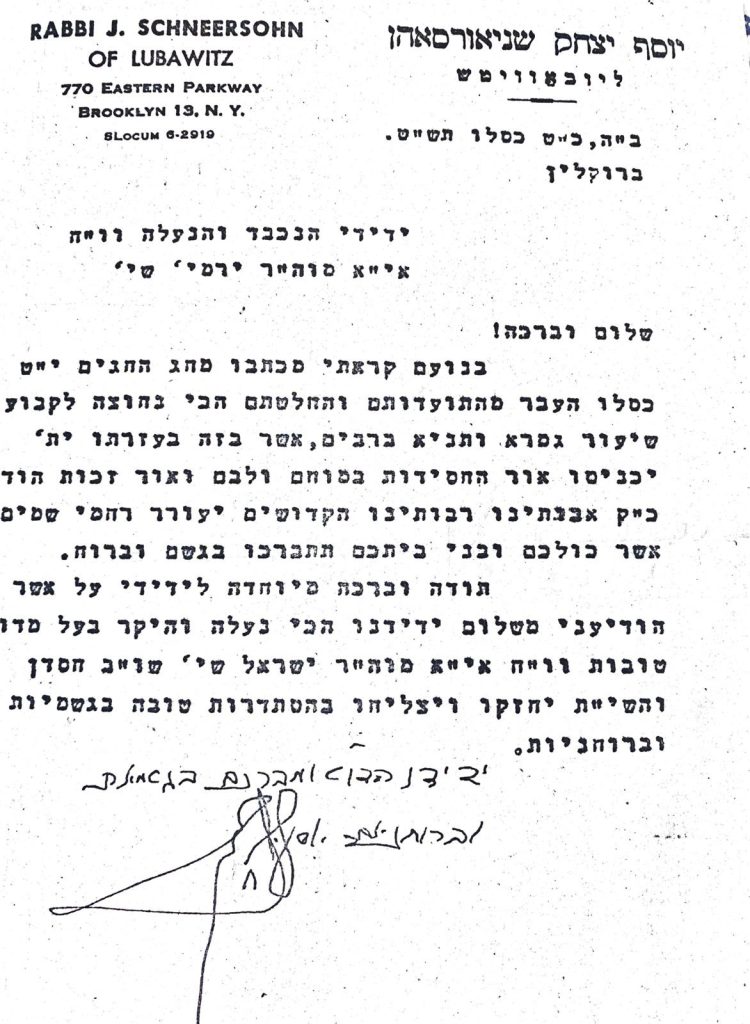
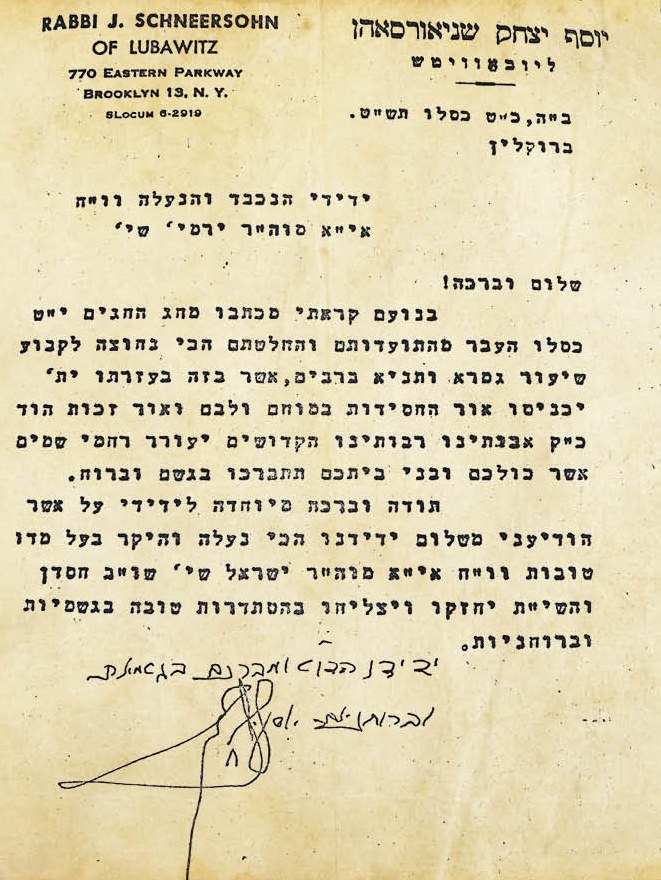
R’ Aloy reported to the Rebbe Rayatz about himself and about the Jews connected to Chabad. The Rebbe was happy to receive these reports and sent him a letter of thanks and even asked that he convey the Rebbe’s blessing to the participants in his shiur.
Here are two examples of the Jews who were close to Chabad and lived in South Africa:
R’ Marim Markman was a cousin of his wife. He had come to South Africa ten years before and settled in Johannesburg. R’ Marim had learned in Tomchei Tmimim in Lubavitch, and in Johannesburg he worked as a mashgiach in a slaughterhouse. For some reason, he was not in touch with the Rebbe Rayatz.
Rabbi Yechezkel Feigin, secretary of the Rebbe Rayatz, sent a long letter to R’ Marim in which he asked him to write to the Rebbe Rayatz and tell about himself. R’ Marim passed away in 5709 and R’ Aloy eulogized him in the local papers.
A few years later, R’ Aloy found another Chabad friend, Rabbi Yisrael Chasdan. He was a Chabad Chassid who emigrated to South Africa. The two had much in common: both grew up in Chabad families, both learned briefly in Tomchei Tmimim and then in non-Chabad yeshivos but remained Chabad Chassidim even if their appearance wasn’t fully Chabad. Both were in touch with the Rebbe Rayatz and received from him instructions and messages to implement among the Jews of South Africa.
When R’ Chasdan arrived in South Africa from Sweden, the Rebbe Rayatz told R’ Aloy to befriend him.
“Through our friend, R’ Yirmiya Aloy, you will receive detailed regards from me, and you will find in him a good friend and a man of spirit to encourage [others] with pure-hearted and heartfelt encouragement,” wrote the Rebbe Rayatz to R’ Chasdan.
In the years to come, telegrams from the Rebbe Rayatz to the Chassidim in South Africa were addressed to R’ Aloy and R’ Chasdan. For example, a telegram that was sent on 12 Tammuz 5708: Tell all of Anash and the tmimim: Gut Yom Tov, to strengthen with an arousal for avoda and establishing shiurei limud in public. With blessings for the Geula shleima. Rabbi Schneerson.
R’ Aloy’s grandson, Rabbi Michoel Gurary, related:
“In general, my grandfather was a great Oheiv Yisrael. The Rebbe Rayatz wrote about him that he is ‘outstanding in Ahavas Yisrael.’ My grandfather really cared about every Jew, he rejoiced in their joys and was sad in their sadness. He had a real heart of gold.”
Ahavas Yisrael was a way of life for him. At a farbrengen, he spoke enthusiastically about the special emphasis that Chassidim have to love one another. “Chassidim emphasized love, especially Chabad Chassidim, both love between one Chassid and another and love to draw others close.”
Over the years, the number of Lubavitcher Chassidim in Johannesburg grew until, in 5732, the first shliach arrived, Rabbi Menachem Mendel Lipskar. He was followed by other shluchim who established a Chabad empire in Johannesburg.
Mobilized For Yeshivos Tomchei Tmimim
About two years went by from when R’ Aloy arrived in South Africa to the outbreak of World War II. During this time, he was among the Chassidim who occasionally received letters from R’ Yechezkel Feigin. He described events in the Rebbe’s court and sent important instructions as well as encouraged the work of the Chassidim. When R’ Feigin was murdered in the Holocaust, that was the end of the letters.
The connection with the Rebbe Rayatz and the Lubavitcher court was renewed in later years, no small thanks to the visits of shadar, Rabbi Yosef Wineberg, who raised money for yeshivas Tomchei Tmimim in New York. The Rebbe Rayatz asked R’ Aloy to support the shadar in his fundraising work.
In 5708, Rabbi Shmarya Gurary (Rashag) arrived in South Africa. He was the chairman of the steering committee (yoshev rosh vaad ha’poel) of yeshivas Tomchei Tmimim and was there to raise funds for the yeshiva. Again, the Rebbe Rayatz asked that his son-in-law be helped in his fundraising.
R’ Aloy, who knew the special qualities of Tomchei Tmimim, went into gear and established a local committee to raise money for Lubavitch yeshivos, under the name, “Committee for the United Lubavitcher Yeshivos.” R’ Aloy was appointed secretary of the committee.
Over the years, he also helped raise funds for Tomchei Tmimim in Eretz Yisrael.
A Rebbe Is Like A Father
R’ Aloy received the news of the passing of the Rebbe Rayatz, to whom he was greatly mekushar, from Rabbi Wineberg who was in South Africa at the time. Twelve years later, at the Yud Shevat farbrengen of 5722 in Johannesburg, R’ Aloy spoke emotionally about the Rebbe Rayatz:
“The Rebbe Rayatz passed away on Shabbos morning. Here, in Johannesburg, we first heard about it on Sunday morning, and Rabbi Yosef Wineberg just happened to be here. He was unable to verbalize the words that the Rebbe had passed away and he started telling me that the ‘vaad ha’mesader’ announced that they would do such-and-such during the ‘shiva,’ and I immediately realized what he meant …
“I started to clarify the details with the local Jewish newspaper offices, maybe they heard something. One after the other said no, until I reached one journalist who said the Rebbe Rayatz did indeed pass away. R’ Wineberg and I deliberated about whether to inform the old Chassid, R’ Shaul Becher, about the histalkus and in the end we decided not to tell him because we knew how mekushar he was. In the end, he found out and he told us that he felt as he did at the passing of his father many years before. This is the reaction of a Chassid and mekushar, a Rebbe is like a father.”
R’ Aloy went on to tell the participants:
“Years ago, I was at the Rebbe’s court, in America, on Yud Shevat. I’ll tell you in brief what happens on a day like this. At least a thousand people came for Maariv. They came to hear the Rebbe daven as chazan. All lit a yahrtzeit candle. After Maariv, the Rebbe went to his office and the crowd sat down to farbreng. The mashpia, Rabbi Shmuel Levitin, farbrenged with the crowd. The next morning, hundreds of people came and heard the Rebbe daven. In the freezing cold, they traveled to the holy Ohel of the Rebbe, removed their shoes and said the maaneh lashon.
“I saw this and it remains deep in my heart, seeing how people are mekusharim to the Rebbe; because to Chassidim, the Rebbe is like a father.”
Preserving The “Ember Of Chabad”
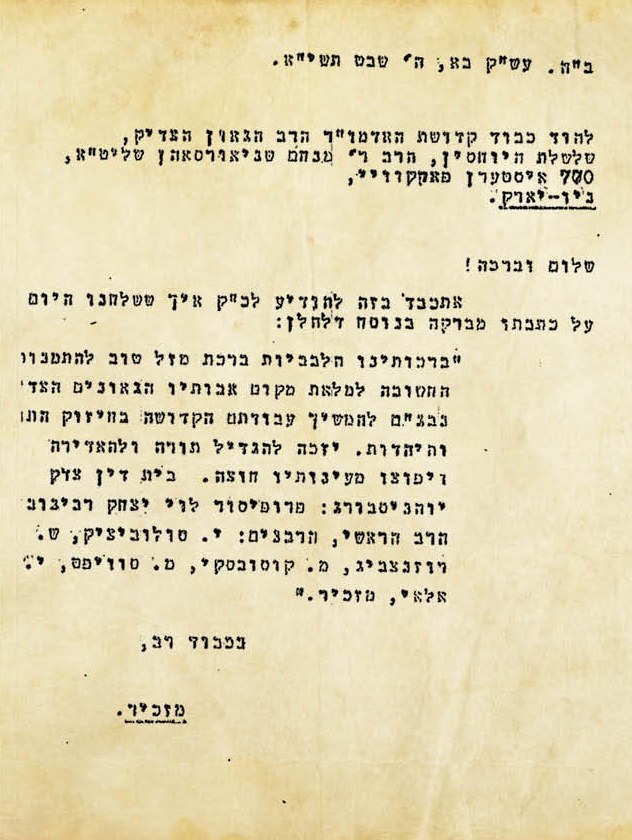
With the Rebbe’s acceptance of the nesius, R’ Aloy sent a letter of blessing to the new Rebbe. He included an official telegram of blessing on behalf of the local Beis Din.
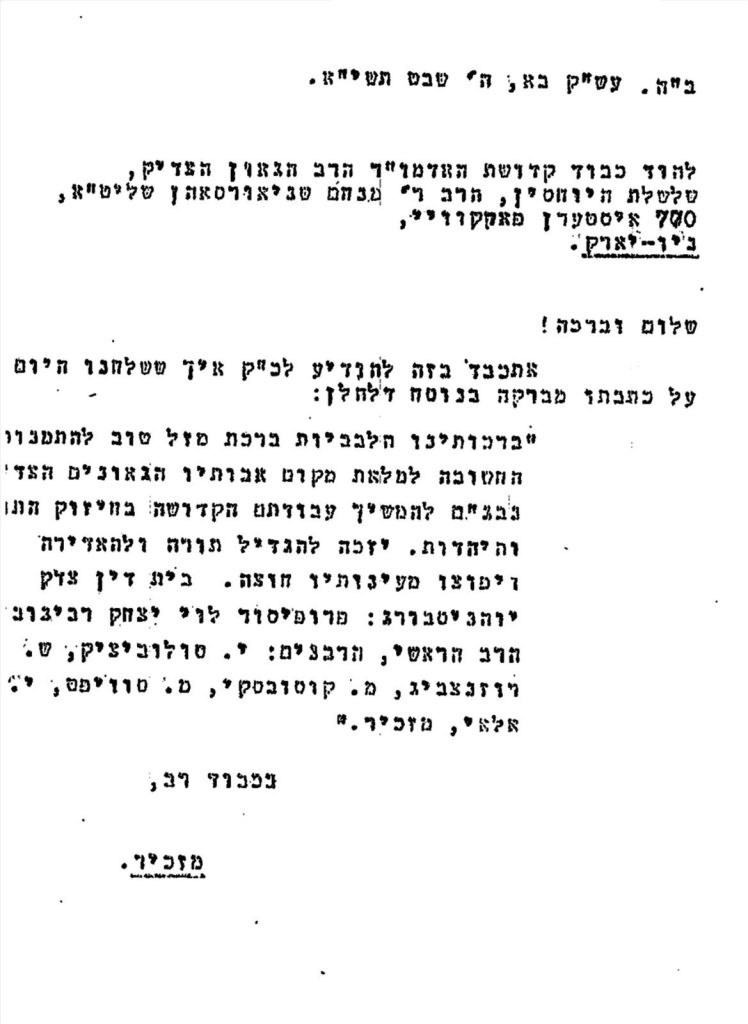
Actually, R’ Aloy’s connection with the Rebbe began even before he accepted the nesius. The Rebbe, as director of Kehot, would send him sifrei kodesh, maamarim and sichos that were printed at that time. These sefarim and booklets were gratefully received by R’ Aloy and Anash in South Africa, who asked that additional shipments be sent to them.
Over the years, the Rebbe sent him many letters in which he referred to him rabbanim and individuals who needed help in various ways, including establishing and reviving mikvaos. The Rebbe also sent him copies of letters that he sent to people in South Africa, so R’ Aloy could explain the contents of the letters to them.
At one point, the Rebbe wanted to send tashmishei kedusha to Jews in South Africa. R’ Wineberg was the one who facilitated this delivery, and later recorded his impressions in American newspapers. R’ Winebeg praised the work of R’ Aloy and crowned him, “The ambassador of Lubavitch in South Africa.”
Rabbi Isser Frankel, a distinguished Rav in Tel Aviv, published his impressions after visiting South Africa and he wrote about R’ Aloy, “He preserves the ‘ember of Chabad’ so that it is not extinguished.”
The Rebbe encouraged him to work among the Jews of Johannesburg. R’ Aloy gave shiurim and farbrenged on Chassidishe holidays. In reports that were publicized over the years in Kovetz Lubavitch, there are reports from Johannesburg in which R’ Aloy’s name stands out as a speaker and one who farbrenged on many Chassidishe occasions.
Over the years, R’ Aloy visited Beis Chayeinu a number of times and had yechiduyos and special kiruvim from the Rebbe. For example, for Chanuka 5731, the Rebbe told Rabbi JJ Hecht to invite R’ Aloy to speak at the children’s rally.
When he visited 770 in Menachem Av 5751, R’ Aloy had various kiruvim. At the farbrengen on Shabbos, 9 Av, the Rebbe told him to say l’chaim. R’ Aloy said l’chaim over a cup and the Rebbe smiled and motioned to say it over a larger cup.
The next day, dollars were given out during the fast. When R’ Aloy passed by the Rebbe, the Rebbe gave him an extra dollar and said, “For all of South Africa.”
On Tuesday, 12 Av, the Rebbe blessed him before his return trip. The Rebbe said, “May he have length of days over his kingdom, you left behind all of the ownership. May we hear good news and great success.”
* * *
R’ Aloy passed away on 19 Menachem Av 5758. He was survived by two daughters, Mrs. Vichna, wife of Rabbi Sholom Dovber Gurary (son of Rabbi Moshe Gurary of Tel Aviv), who served as Rav and shliach in Capetown and Johannesburg, and Mrs. Batya, wife of Rabbi Moshe Aharon Kurtstag, Av Beis Din of the Beis Din in Johannesburg.
A New ‘Gan Eden’ In Johannesburg
At a farbrengen that took place in honor of the aufruf of his son-in-law, Rabbi Sholom Ber Gurary, which took place in Tammuz 5716 in Johannesburg, R’ Aloy announced “a new gan eden.”
“Until now, people wished for themselves a gan eden of children who are doctors or lawyers. The time has come to realize that that is the opposite of gan eden. From now on, the new gan eden needs to be children who are Torah scholars and sons-in-law who are scholars and Chassidim.”
R’ Aloy’s two sons-in-law served as rabbanim in South Africa and are outstanding talmidei chachamim, so he himself merited a new gan eden.
Over a thousand guests attended the wedding, for R’ Aloy was accepted by all. The wedding was conducted with all the practices of Lubavitch. The chassan reviewed a maamar Chassidus at the reception and the wedding went late into the night with dancing and Chassidishe niggunim.
The mechutan, Rabbi Moshe Gurary, who was accustomed to reviewing maamarei Chassidus in Tel Aviv, reviewed maamarei Chassidus throughout his stay in Johannesburg.
Yechidus Tammuz 5737
R’ Aloy was accompanied by his grandson, Rabbi Michoel Gurary, in a yechidus which took place in Tammuz 5737. R’ Gurary related:
“Shortly after my bar mitzva, my grandfather took me to the Rebbe. When my grandfather entered for yechidus, I remained outside, intending to enter after him, for surely he had important matters to discuss as Rav and dayan.”
When he went in, the Rebbe asked where his grandson was. R’ Aloy said he wanted to enter on his own. The Rebbe said, “Correct, he is already a gadol and needs to act as a gadol.”
R’ Aloy wrote notes after his yechidus. Some of the points included how the Rebbe tried to convince him to sit but he refused; the Rebbe’s view about “reform Judaism” that it was literal “shmad” and they only wanted to influence South African Jewry in order to be able to apply pressure on Eretz Yisrael that if they didn’t go along with the reform agenda it would hurt their connections in the diaspora…
Also, regarding the situation in South Africa, to publicize in the Rebbe’s name that the internal situation would improve, and even the connection with the United Nations would improve through the efforts of the United States [this was during international sanctions over apartheid].
Another point he wrote, “When I showed the picture of Chana’le [his 3 year old granddaughter], he asked if she lights Shabbos candles, and I said she certainly does. In passing, I mentioned that this was not something new for us, that [in our family] our daughters lit candles from age two, and he asked that I publicize this and thereby would do him a great favor, since he had many opponents regarding this issue. [At the time that the Rebbe launched Mivtza Neshek, the Rebbe instructed that little girls should also light] and they tried to intimidate him with [citations from] the Chasam Sofer that “Chadash asur min HaTorah” [a play on words meaning that new enactments are forbidden], and I said that for me this was nothing new at all, and he was very happy to hear it and asked numerous times to publicize that.”
His grandson added: In one of the yechiduyos, my grandfather asked about the complicated situation in South Africa and whether it would be good in the country until Moshiach comes, and the Rebbe said yes.
Beis Moshiach #1422 • pp. 28-36
© 2026 Beis Moshiach Magazine. All rights reserved.
This article originally appeared in Beis Moshiach #1422. You are welcome to share it with friends and family by email or in print, provided that you do not change, add to or omit any part of it, you credit the author and Beis Moshiach, and you include a link to archive.bmoshiach.org (written out in full in printed copies).
To republish this article in a newspaper, magazine, book or website, please request permission in advance at [email protected].