The Rebbe’s Color-Blind Yiddishkeit
Confessions Of A Chabad Rabbi Of African-American Descent
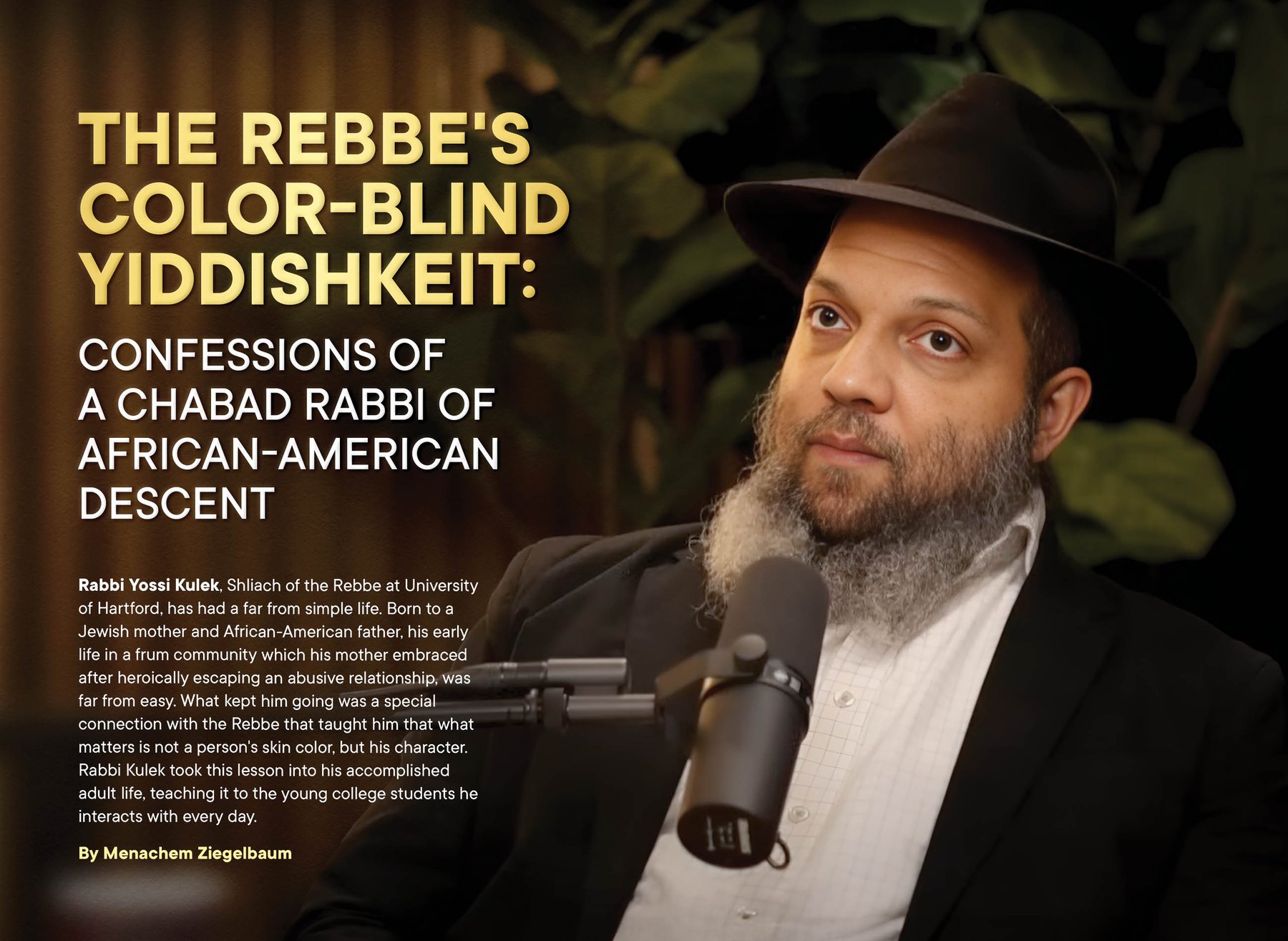
Rabbi Yossi Kulek, Shliach of the Rebbe at University of Hartford, has had a far from simple life. Born to a Jewish mother and African-American father, his early life in a frum community which his mother embraced after heroically escaping an abusive relationship, was far from easy. What kept him going was a special connection with the Rebbe that taught him that what matters is not a person’s skin color, but his character. Rabbi Kulek took this lesson into his accomplished adult life, teaching it to the young college students he interacts with every day.
One morning, Rabbi Yossi Kulek stood in front of the mirror and recalled an incident from his youth. “As a boy, I would look in the mirror and ask G-d, why? Why did I have to be black when all my friends, my community, everyone around me, was white?”
This memory still stings and it symbolizes the beginning of his journey, one in which he struggled with his identity, faith and self-acceptance.
R’ Kulek has been waiting a long time for the right moment to share his most private thoughts and experiences that he went through in life. Conversations he recently had with one of his daughters about her experiences in seminary, underscored the lack of sensitivity, racism, and ignorance that are still widespread in society.
He often wondered about his role as an ambassador of mixed races and mutual acceptance and whether his efforts would make a difference. Still, when he thinks about the Rebbe’s teachings, he is reminded that every action, even the smallest, can make a deep impact and this is what he hopes for.
What the Rebbe said to the former of New York, David Dinkins, in Elul 5749, echoes in his ears, about a future in which we won’t find it necessary to label people by race; rather, we will recognize the common essence which unites us all. “They are no different. All of them are created by the same G-d and were created for the same purpose,” said the Rebbe, and those words are a source of constant inspiration for R’ Kulek.
The Strange Lubavitchers
R’ Kulek’s story begins long before his birth, in the summer of 5735 in Cleveland. His uncle, Moshe, was a colorful personality in the neighborhood. He was known for his love of red clothing from head to toe which drew attention from one and all.
In extraordinary hashgacha pratis, Moshe had an encounter that changed his life and the lives of his family. One day, as he was walking down the street in Cleveland, he noticed a group of Lubavitcher yeshiva bachurim. As someone who took pride in his unusual attire, he related to the bachurim who stood out by wearing yarmulka, tziztzis and hat. He thought, wow, these guys are genuine. They represent their Judaism with pride and bring it the outside.
Beginning Of The Journey
That fateful year, R’ Kulek’s mother, then a teenager full of hopes and dreams, who was from a Jewish-American secular, working class family, met a black fellow by the name of Robert and wanted to marry him. What started as a story with a rosy future, at least to her eyes, quickly deteriorated into a nightmare.
“A few months after their relationship began, as she was waiting for the birth of her first child, he began mistreating her, lying to her, and even acting violently to her. Her life became a hell.”
Despite the problems, his mother continued holding on to her dreams.
“She prayed to G-d, asking for His help. What she wanted was for Robert to be nicer to her.”
But the situation did not improve; on the contrary. The decisive moment occurred when Yossi was six months old.
“One day, my maternal grandmother was holding me and Robert began shouting at her and forbade her from touching me ever again. My mother was sitting there and saw how pained her mother was. She told me that this was the moment that was the turning point for her. She realized there was a difference between her being hurt and her mother, whom she loved dearly, being hurt.”
As believing Jews, we know that Hashem precedes the refuah to the makka. Even before this challenging time, Moshe, her brother had become acquainted with Chabad, and the Chabad House was his second home.
When no battered women’s shelter would accept her since she wasn’t eighteen, R’ Kulek’s grandmother suggested she turn to the Chabad House that Moshe went to.
“The Alevsky family, shluchim, welcomed us to their home. They were young themselves and probably had little children at the time and still they took in my mother and me, thus saving us. That was my first connection with Chabad and it was definitely a defining moment for me.”
R’ Kulek believes with all his heart that from then on, every step in his life was guided from above.
“I feel that the hand of the Rebbe was involved. The Rebbe’s vision, his love for every Jew, are what paved the way for me.”
After a few days in the Chabad House, his mother realized she wanted to raise him as a Jew. Since, for her safety, she had to run away from Robert, the shluchim helped her with a one-way ticket to New York where she was warmly taken in by the Chabad community in Crown Heights.
“Many families opened their homes and their hearts, offering support, Shabbos meals and unconditional love. Rabbi and Rebbetzin Kazen’s daughters, Mrs. Henya Laine and Mrs. Rivka Kotlarsky, hosted us regularly for Shabbos meals. We were also regular guests at the Zarchis. Mrs. Chaya Sarah Zarchi was so proud and happy to see me grow up to be a shliach of the Rebbe.
“Rabbi Yosef Boruch Wircberg, teacher in Machon Chana, and his wife, hosted us often in their small home. R’ Wircberg and I have the same uncommon name, ‘Yosef Boruch,” and he enjoyed putting me on his lap and telling everyone that I was an additional blessing in their life, as my name indicates. Mrs. Nechama Baumgarten became an important influence. The Eckhaus family went above and beyond with their children babysitting for me for a while so my mother could study Torah and Chassidus in the evenings.”
Encounter With The Rebbe
The first five years of his life were in Crown Heights. There, and afterward in Chicago, he had many memories of the Rebbe – receiving coins for tzedaka and passing by for dollars for tzedaka, but one defining moment is etched in his heart forever, yechidus with the Rebbe.
It was 5741 when his mother became engaged to the man who would become the only father Yossi knew. At that time, brides and grooms still had yechidus with the Rebbe and his parents decided to bring him along. The foundational encounter played a key role in shaping young Yossi’s life.
“When I was four, my parents took me to yechidus. I remember a big wooden desk. It was higher than me and the Rebbe sat behind it and looked at me with his famous smile. At a certain point, he asked me about tzitzis, ‘Do you have one string?’ ‘Yes,’ I answered. He went on to ask me, two, three, up to eight strings while I kept on saying yes, yes, yes.”
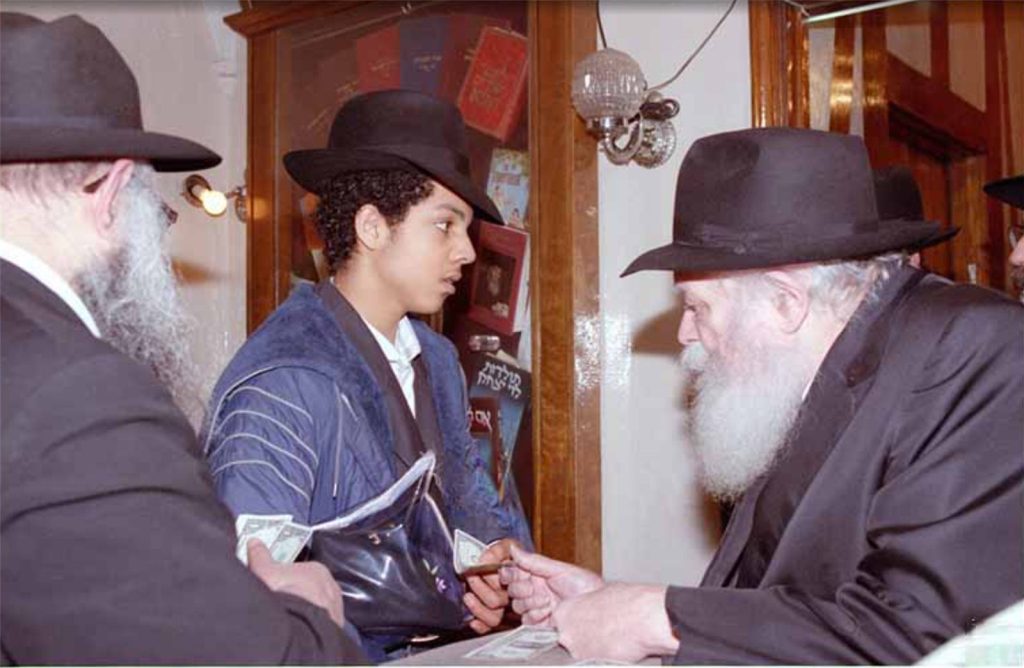
“The Rebbe conveyed a very powerful message to me, that he loves me unconditionally. This message of the Rebbe was very dear to me and I kept it close to my heart.
“Over the years, when I had to contend with difficult experiences, what kept me going was the Rebbe’s loving gaze in yechidus. I repeated to myself: It doesn’t matter what they say to you. Always remember that the Rebbe loves you. The Rebbe believes in you. I’m going in this derech because of the Rebbe!”
He is often nostalgic for the years of his youth, when he was fifteen, sixteen, and standing at the farbrengen on one of the levels of the pyramid.
“I stood there with a cup of wine, raised to the Rebbe and I loved how he looked into our eyes from the distance and smiled and noticed our l’chaim.”
Struggling With Identity And Racism
Despite the love and acceptance he had in the Chabad school and community, he dealt with feeling different because of his color. Growing up as the only black child in an environment of mostly white Ashkenazim was challenging.
“My childhood memories are tarnished with hurtful encounters, like a babysitter that said I was bad and put me in the corner. I suffered from name calling and was given a racist nickname in camp.
“When I was twelve, I was walking with friends in Chicago. A boy called out a racist epithet and I didn’t know how to react. My best friend, Shmueli, immediately jumped up and decked him. That’s when I saw that there are people who will defend me. Despite this, I still found it hard to deal with my feelings.
“Nevertheless, I was a sociable kid, athletic, strong and self-assured, at least on the outside. I was good natured and I had close friends. Nobody really knew what was going on inside of me as I suffered in silence from conflicted feelings. I didn’t let anyone know how deeply what they said affected me.
“When I went to yeshiva, the racist mockery intensified and it diminished only after I told my teacher. Although he stopped the mocking, he warned me about the harsh reality of the world outside our insular community, a prophecy that turned out to be true.
“It took me years to understand that the solution to the problem lies with me.”
He later discovered that when his mother went to Brooklyn, she was advised not to raise her baby but to put him up for adoption. She wouldn’t do this and she always stressed to him that he was the best thing that happened to her. She loved him very much and her love and relationship with him gave him the strength to deal with challenges from the outside.
“My mother always repeated what the Rebbe said that along with every challenge, we get the strength to overcome it. She was able to instill this idea in me.”
His siblings also gave him the strength.
“My family was always a safe refuge for me; the source of my strength. Each of my siblings considers me equal to the others. I am not the half brother. I never thought of myself as the half brother. They never tried to look at me strangely. On the contrary, I was their big brother whom they admired and they consulted with me.”
Finding Strength In Faith
Young Yossi found the strength to deal with his life’s challenges in Chassidus:
“I learned that every neshama, each of us, has infinite value, and we are precious and pure and can affect the entire world. Every kind of Jew is still a Jew. This helped me understand that I am not the problem. If people see me otherwise, it’s their problem!
“When I was able to develop myself by learning a lot of Chassidus and teachings of the Rebbe, it was clear to me that all of the parts of my personality that were pulling me down were apparently out of place. It all came from my personal shame and from the questions and doubts that I had. I realized that even when I fall, that doesn’t mean I’m bad, but that I’m struggling. The moment I realized the greatness of the neshama, I understood how precious I am.
“I learned what the Baal Shem Tov says that if someone sees a fault in another, he is seeing a reflection of himself. I reached the point where I realized that I am not the problem; other people need to work on themselves. Those who still choose to see me as different and strange have a problem and need to deal with it.”
R’ Kulek emphasizes the importance of therapeutic inner work and self-acceptance as part of the process of healing and growth: “Every person has some inner struggle; not only is there no shame in this, but everybody needs a healer.”
He is filled with compassion when he encourages other people to deal with their feelings:
“If you are dealing with feelings of shame, don’t ignore it. If only I had done that when I was younger. Talk to someone. Find the right person for you and start your journey.”
R’ Kulek’s journey toward self acceptance and helping others led him to working with inmates.
“I serve as a chaplain in a prison. I see people, not criminals. All of them are dealing with something and it’s important to me to show them love and acceptance just as the Rebbe taught me. Working with inmates taught me that every person has a story. There are people who went through horrific things in their lives that led them to where they are. This does not justify what they did but it helps me understand them and approach them with empathy.”
The Rebbe Is Always With Us
R’ Kulek continued to feel the Rebbe’s strength all along. A year after Gimmel Tammuz 5754, he studied for semicha in Belgium. At a certain point the yeshiva was suddenly closed and he had to choose whether to return to the US or go and learn in Eretz Yisrael.
“My mashpia taught me that when in doubt about spiritual things, you need to ask your mashpia. If it’s about material matters, then you ask ‘knowledgeable friends.’ This is what the Rebbe said to do, but if you’ve done that and nobody knows what to tell you, then make the proper preparations and write to the Rebbe. That is what I did.
“I put my letter in the Igros Kodesh and when I opened the sefer where I had put the letter, I saw an answer to a bachur that he should learn in Eretz Yisrael. My inclination had been to return to the US which is why, when I closed the sefer and realized it was the Igros Kodesh of the Rebbe Rayatz, I thought maybe the answer didn’t obligate me, because I intended on asking the Rebbe.
“I took the letter and put it again into the Igros Kodesh, this time making sure it was the Rebbe’s. There were English words in bold lettering and the Rebbe wrote: the Rebbe Rayatz already told you very clearly what to do and in order for there to be no doubt, I am writing his message again in English!”
Shlichus And Miracles
R’ Yossi Kulek is a shliach who works with students at the University of Hartford.
“I once came back from a Birthright trip with students and their behavior was very far removed from what I expected. I had a phone conversation with my first student president who became a very close friend. I said to him, ‘I don’t know whether I am successful in creating change in the students; do they want me? Do they appreciate what I do for them?’
“He got annoyed and said, ‘Are you kidding me? Without you, I wouldn’t be religious today. I wouldn’t be shomer Shabbos. What about Brian? What about Evan? What about Bart? Go and ask them, whether you made a change in their lives.’ That was a real defining moment.”
And there are times on shlichus when he feels he’s getting a smile from the Rebbe.
“At one of the Kinus HaShluchos gatherings, my wife called me from New York and asked whether there was money on the bank card to buy kosher products. I was sorry to tell her that the account was completely empty. A short while later she called back and excitedly told me that after our phone conversation, she went into 770 and poured out her heart. ‘Rebbe, we are your shluchim and you surely want only good for us and in an expansive way. Why do we need to deal with this deficit?’
“When she left 770, a local resident approached her and gave her $200 and said, ‘I felt I needed to give this to the first shlucha I see now.’ I completed the story by telling her that just as she was praying in 770, a close friend knocked at our door and without knowing our situation, he gave me a check for $1800. It was a miracle.”
Difficulties And Challenges In Starting A Chabad House
“When we bought our Chabad House, we had big miracles all along the way. From the beginning, we ‘had the privilege’ of receiving a cease and desist order from the courts. It turns out that the neighbors didn’t want us there. They were afraid that a Chabad House would become a place of parties, noise and music, and they tried to shut us down.
“Two years later, on the Chag HaGeula, we received our written ruling that we were free to do with the house as we pleased. This court ruling was issued on Yud-Tes Kislev and we received it on Chof Kislev. I considered it amazing hashgacha pratis.”
For The Future
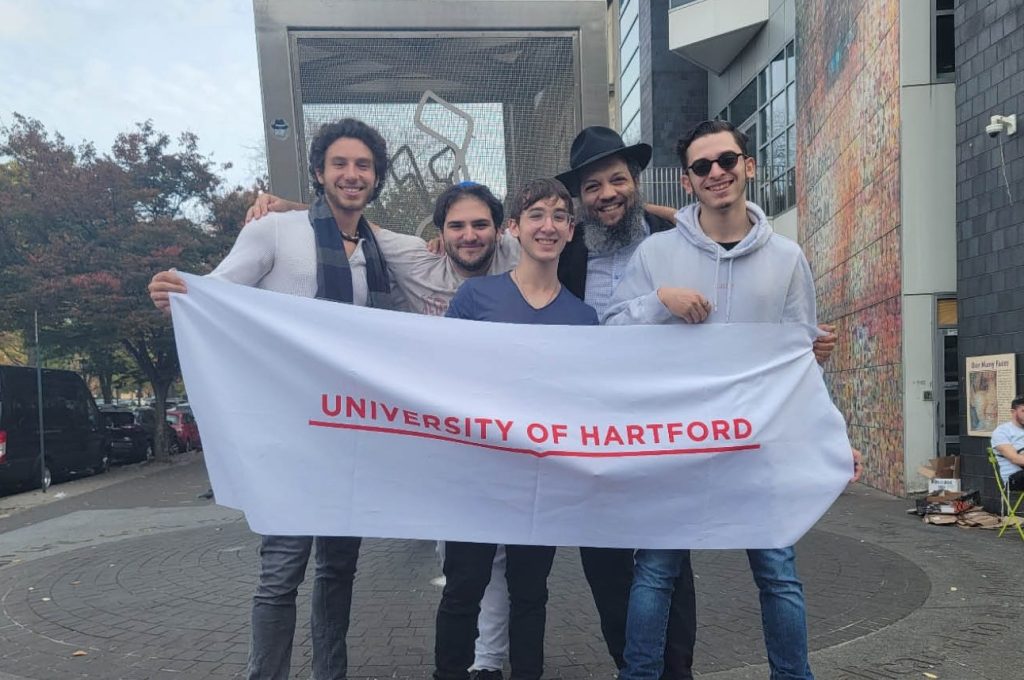
“Every Jew is a precious diamond that needs polishing. This is my job, to help every person find the light within them. I believe that the more we spread love and acceptance, we will bring the world closer to Geula.
“Everyone can make a difference. Spread love, help another, this is our way of fixing the world. Remember, inspiration is everywhere!”
He proudly tells of his children and grandchildren:
“My daughter and her husband run a Chabad House at Syracuse University. I have such nachas when I see the next generation on shlichus. Personally, I am amazed by the young generation going on shlichus and continuing the Rebbe’s task of bringing the Geula even though they never saw the Rebbe.
“When I tell people that I saw the Rebbe, they ask me: If you could meet the Rebbe today and ask him one thing, what would you ask? I tell them one word, why. To elaborate; Rebbe, you taught us how to look at the good in the world, to open our eyes and see how the world is advancing toward the Geula. Indeed, we saw the fall of communism, the beginning of the dismantling of nuclear weapons, and big miracles in Eretz Yisrael. We saw all the signs of the Geula but thirty years have passed since then and I ask: Why are we still in galus? Why don’t we have the Geula already? Rebbe, we all want Moshiach. We want you!”
When R’ Kulek finishes his personal story, he looks in the mirror again and this time, instead of confusion and pain, his eyes are full of understanding and love.
His story is a fascinating journey of overcoming difficulties, finding his identity, and spreading light in the world. From a confused youth he turned into a man who is dedicating his life to helping others and spreading love.
“My message is simple. Copy the Rebbe. Follow an example of unconditional love. Be aware that what we say and do have a deep effect. We need to yearn for a world in which man isn’t judged by his skin color. We need to remember that every person has potential and goodness inborn within him and every person has a unique mission in this world. It is only collectively that we can turn this into a world of beauty and love, full of light.”
Beis Moshiach #1424 • pp. 24-32
© 2026 Beis Moshiach Magazine. All rights reserved.
This article originally appeared in Beis Moshiach #1424. You are welcome to share it with friends and family by email or in print, provided that you do not change, add to or omit any part of it, you credit the author and Beis Moshiach, and you include a link to archive.bmoshiach.org (written out in full in printed copies).
To republish this article in a newspaper, magazine, book or website, please request permission in advance at [email protected].