Rosh Hashanah by the Rebbe, Step by Step
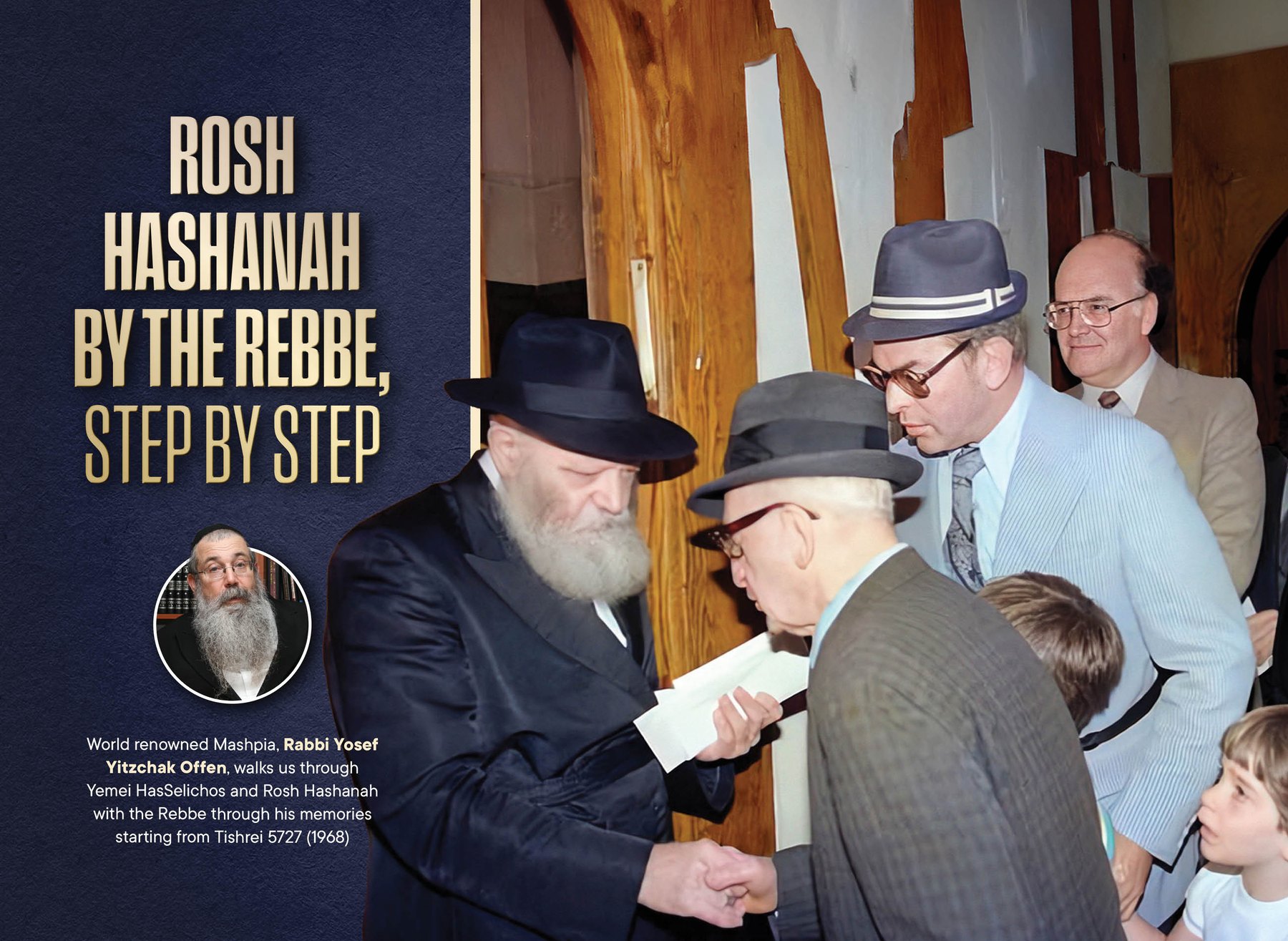
World renowned Mashpia, Rabbi Yosef Yitzchak Offen, walks us through Yemei HasSelichos and Rosh Hashanah with the Rebbe through his memories starting from Tishrei 5727 (1968)
“Rosh Hashana with the Rebbe” is an emotionally laden term that sends shivers through the heart of every Chassid, especially those who had the privilege of seeing with eyes of flesh how this Yom Tov was celebrated in Beis Chayeinu by the Rebbe.
The “Michtav Klali,” Selichos with the Rebbe, the Rebbe receiving panim, tekios, this and more. As the years pass the question only grows stronger, “Why should we miss out?” We want to see our king, our anointed one, and hear him blow the shofar, “Blow the great shofar for our freedom.”
To provide a sense of the experience and feelings we spoke with Rabbi Yosef Yitzchok Offen to get a little of the great light that he saw.
Swift Response To A Young Bachur
He was a young bachur, all of seventeen years old when he went to the Rebbe in 5727. The reason he went was because the army did not allow bachurim over eighteen, draft age, to go. He landed in New York on erev Rosh Hashana 5727.
“I went from the airport straight to the Ohel, taken by those who met my flight. There is where I saw the Rebbe for the first time. He was wearing glasses and reading panim with great seriousness. It was an awe-inspiring sight to see his holy face looking so grave and reading the panim with such careful attention. It made me feel that Rosh Hashana with the Rebbe isn’t just another Jewish holiday the way I celebrated it until then, but a much more serious and holy day.
“Erev Rosh Hashana I submitted a letter to the Rebbe about my being in Beis Chayeinu and I asked what to learn, where to learn, etc. On motzoei Rosh Hashana I received a response, ‘He should immediately enter the sidrei ha’yeshiva.’
“I marveled at how, at such a holy time, the Rebbe answered a young bachur who just arrived from Eretz Yisrael. What did the Rebbe do as soon as the great judgment day was over? He answered a boy’s question about learning. I concluded that we learn from this how important it is to the Rebbe that bachurim learn.
“This is also a lesson for the tmimim who are in 770; it’s exceedingly important to the Rebbe that they sit and learn as much as possible and at least to observe the sidrei ha’yeshiva.”
The Rebbe Said A Special Maamar For The Guests
What were Selichos like with the Rebbe?
The Rebbe said the first Selichos on motzoei Shabbos with the minyan in the big zal downstairs at one a.m. Starting in 5734, they built a platform for the Rebbe so the crowd could see him from all over the shul. They built it close to Rosh Hashana so that on the first night of Selichos, the Rebbe was still standing on the floor.
Throughout the days of Selichos, when the Rebbe left the shul at the end of Selichos they sang, “Rachmana D’anei” which the Rebbe taught on Simchas Torah 5720, and he encouraged the singing with his hand. Until the end of 5741, the Rebbe also encouraged the niggun while standing at his place near the shtender on the first night of Selichos and on erev Rosh Hashana.
At the end of 5738, Chassidim suggested to the Rebbe that they block off the area around the chazan with tables to prevent pushing near the Rebbe and this would give the Rebbe fresh air to breathe.
This concern, as well as other takanos that were made that Tishrei, came from concern for the Rebbe’s health after what happened at the beginning of the year. The Rebbe said to ask a rav whether there was a halachic problem with the chazan standing separately from the minyan.
Do you remember anything in particular about Selichos?
The following incident is not something I remember because I wasn’t there, but I know that on the morning of the second day of Selichos 5720, the first charter flight of guests came to the Rebbe for Tishrei 5721. That night (28 Elul), in their honor, the Rebbe went down to the shul to say a maamar, “Lecha Omar Libi” (which was edited afterward in the Sefer HaMaamarim Melukat vol. 3).
Starting from 5732 and on, the Rebbe would farbreng every erev Rosh Hashana night, the birthday of the Tzemach Tzedek. These farbrengens were also a sort of welcome to the guests.
Erev Rosh Hashana 5749, marked 200 years since the birthday of the Tzemach Tzedek. During the sicha after Maariv (in those years there were no weekday farbrengens) the tzibbur was surprised when the Rebbe announced the distribution of a kuntrus “Kitzurim V’Hearos” (a sefer written by the Tzemach Tzedek on Tanya) to everyone after the sicha.
Receiving Panim
What was the seder for panim over the years?
The morning of erev Rosh Hashana, the Rebbe stood in the doorway of his office and received panim from people passing by on a line. The Rebbe blessed each one who gave him a pidyon nefesh with, “Kesiva v’chasima tova, l’shana tova u’mesuka.” Whenever a big pile of panim accumulated in the Rebbe’s hand, he went into his office to put them on his desk. Interestingly, even erev Rosh Hashana at the end of 5710, when he still hadn’t formally accepted the nesius, the Chassidim brought panim to the Rebbe.
In earlier years, the Rebbe wrote a response to whoever sent him panim. The wording was usually the same and there was a special version for talmidei ha’yeshivos. In the “lameds,” letters were no longer sent.
After everyone gave in their personal pidyon nefesh, some elder Chassidim went to the Rebbe’s office to give him a pidyon nefesh on behalf of all the Chassidim. The Rebbe usually read the pidyon nefesh and when he finished reading it, he would give a general bracha, but there were years that the Rebbe did not read the general pidyon nefesh but immediately gave a bracha.
This practice continued until the early “chofs.”
What changed then?
Erev Rosh Hashana 5724, the Rebbe told Rabbi Groner that he didn’t want the Chassidim to enter his room. R’ Leibel said to the Rebbe that the previous year the Chassidim stood in gan eden ha’tachton, and the Rebbe spoke to them from the doorway of his room. The Rebbe said that if so, they would do the same that year. And that’s how it was from then on.
In general, the Rebbe didn’t want bachurim to be present when the general pidyon nefesh was given to him.
In 5719, before the elder Chassidim gave the pidyon nefesh, the Rebbe made it clear that only married people should be present and no bachurim. The Rebbe said bachurim are supposed to be learning Torah and all the brachos to them come only through being involved in learning. From this too, we learn how important it is to the Rebbe that tmimim sit and learn.
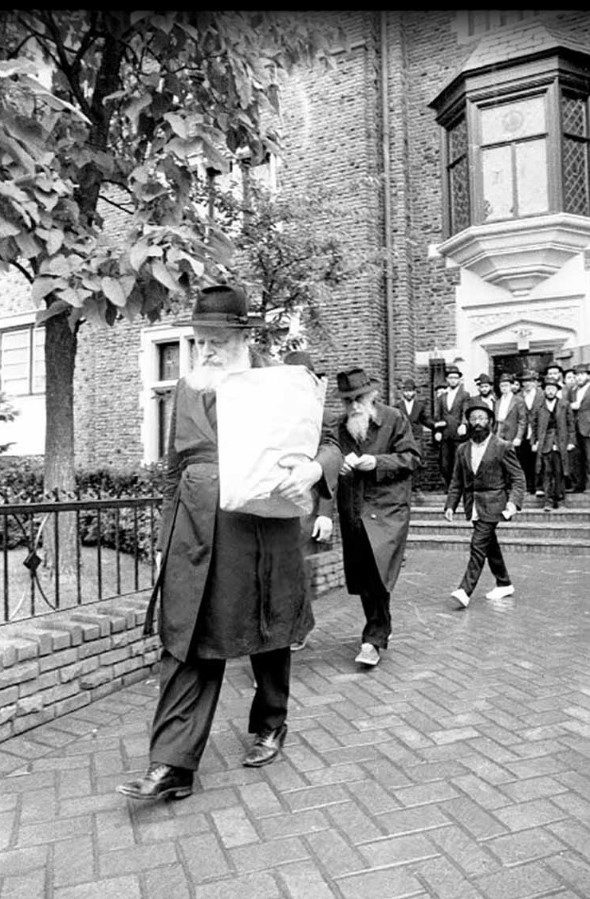
After receiving the general pidyon nefesh, the Rebbe went to the Ohel. When the Rebbe left his office for the car, holding a bag of letters and the general pidyon nefesh, he gave out coins for tzedaka to children. Although the rest of the year, the Rebbe did not like when other people were present at the Ohel when he was there, on erev Rosh Hashana (and Yud Shevat) Chassidim could also be there, as he stood there davening for many hours.
The Rebbe returned to 770 close to Yom Tov with the letters he took with him and the general pidyon nefesh. The general pidyon remained with the Rebbe even during the blowing of the shofar and he brought it with him every time he went to the Ohel throughout the year.
Did anything special ever happen with the Rebbe when he returned from the Ohel?
Erev Rosh Hashana 5745, there was an extremely otherworldly occurrence:
The Rebbe returned from the Ohel to 770 close to six o’clock. After staying a short time in his office, he came out holding a siddur in order to give coins for tzedaka to children and adults. The Rebbe then motioned to those who were getting ready for Mincha in the small zal, to come too, to receive coins. They quickly formed a line and many who came to 770 at that time joined the line.
The Rebbe twice asked what time it was. When it was close to candle lighting time, they closed the main door to stop people from entering but the Rebbe said to let the remaining people continue to pass by.
When the Rebbe left for the library, he continued giving out coins, saying they should give it to tzedaka before Yom Tov. Just a few minutes later, the Rebbe returned from the library to daven the last Mincha of the year.
In 5749 and 5750, the Rebbe returned from the Ohel about an hour before candle lighting and said he wanted to give out dollars! A large crowd quickly formed and each one received two dollars as the Rebbe said, “In honor of 200 years of the Tzemach Tzedek.”
A NEW YEAR BEGAN
After Maariv, the first tefilla of the year, the Rebbe blessed the crowd as is customary, “L’shana tova teichaseiv v’seichaseim.” The Rebbe said one bracha before leaving the shul, one bracha for all.
Starting in 5734 and on, the Rebbe called out three times (from his place near the shtender), “Gut Yom Tov” and “L’shana tova teichaseiv v’seichaseim,” and the crowd responded in kind. When leaving the shul, the Rebbe wished “L’shana tova teichaseiv v’seichaseim” to a few standing along the way.
The second night of Rosh Hashana, the Rebbe only wished “Gut Yom Tov” three times as the Alter Rebbe writes that it’s not proper to say “L’shana tova” after midday of the first day.
It’s interesting to note that in 5711, one of the Chassidim noticed that the Rebbe was wearing an old yarmulka and gartel. Rebbetzin Chana told the Chassidim that they belonged to the Tzemach Tzedek.
What were the meals like?
In the lifetime of the Rebbe Rayatz, the Rebbe would eat the Yom Tov meals with the Rebbe Rayatz. The other members of the household also attended these meals, as well as some elder Chassidim and select individuals. The Rebbe Rayatz would sit at the head of the table and the Rebbe sat to his left and Rashag to his right.
This also took place after the histalkus in 5710. The Rebbe Rayatz’s chair was prepared at the head of the table and two covered challos were put near his place. The Rebbe and Rashag sat in their usual places and the Rebbetzins (Rebbetzin Chaya Mushka, Rebbetzin Chana, and Rebbetzin Nechama Dina, the wife of the Rebbe Rayatz) ate in the nearby kitchen.
The Rebbe wouldn’t begin to eat until the bachurim who helped set up and serve finished serving and sat down. During the meal, Rashag and the elder Chassidim would raise interesting questions in Nigleh, Chassidus, halacha and minhag. Aside from these brief conversations which the other people sitting there sometimes joined, there was a quiet, serious atmosphere during the meals.
With the passing of Rebbetzin Nechama Dina (10 Teves 5731), this practice stopped. After that, the Rebbe no longer ate in the Rebbe Rayatz’s home and he started having the Yom Tov meals in his own home. It’s interesting to note something that occurred in the last year of the communal meals, 5730. For some reason, pomegranates were not put on the table and the Rebbe asked where they were. He waited to eat the apple until they went to bring pomegranates from his office. The Rebbe ate the apple and honey with the peel.
In later years, the Rebbe and Rebbetzin spent Shabbos and Yom Tov in the library building next to 770.
The first night of Rosh Hashana, the Rebbe barely spoke. He also avoided saying l’chaim during the meal as he once explained, “During a farbrengen, one can say l’chaim, but here I don’t want to change from the custom of my father-in-law the Rebbe who refrained from doing so.”
The King Blowing The Shofar
What was it like when the Rebbe blew the shofar?
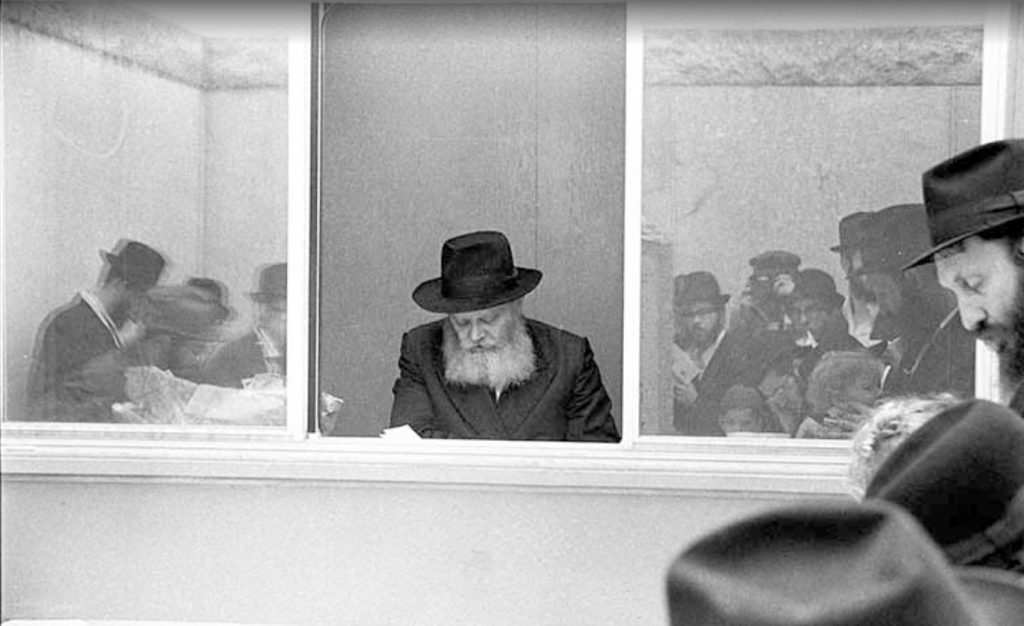
During the tekios, the Rebbe’s face was forbidding; it was frightening to look at his holy face. When the Rebbe finished the brachos after the Haftorah, there was utter silence in 770. Everyone prepared for the blowing of the shofar. The Rebbe uncovered the shofars partway; they were covered with a few handkerchiefs, and he arranged them in a certain way. Every so often he changed the place of the shofars for a reason known only to him.
Certainly, everything the Rebbe does has a deep and lofty intent and at such a lofty time, as it’s explained in Chassidus, that during the tekios Hashem is crowned king over the entire universe, surely every movement has some connection with crowning Hashem as king.
There were all sorts of arrangments done with the panim too. They were usually divided into three bags.
The Rebbe looked at the two Sifrei Torah on his two sides, covered his face with his tallis, and leaned on the bima; at a certain point, he held the atzei chayim of the Sifrei Torah.
In a heart searing voice, he began to say “Lamenatzeich” in a special tune, followed by the crowd. This really drove home to all present that we were moving to a higher stage which demanded great seriousness.
After the seventh recital, there was silence once again and the Rebbe began to say the pesukim in a deep voice that aroused longing, “Min ha’metzar karasi Kah…” with the crowd answering verse by verse. Just hearing the Rebbe’s voice reciting the pesukim in a singsong could make someone do teshuva; in a niggun whose entirety expressed yearning, longing for G-dliness.
The large crowd was poised to hear the tekios. Not a sound was uttered at that time throughout the Beis Medrash even though it was packed.
Sometimes, the Rebbe changed shofars and it also happened that he wiped the shofar with his tallis. Throughout the teikos, the makri stood to the Rebbe’s left, pointing in the siddur to the right place. Sometimes, the tekia didn’t come out nicely. Everyone felt it wasn’t happenstance but a spiritual matter.
Who was the makri?
R’ Shmuel Levitin was the makri until his passing in 5734. In the years that followed, the Rebbe blew without a makri, but in 5739, he asked R’ Mendel Tennenbaum to be the makri which he was until 5752.
After thirty sounds, the Rebbe began saying the pesukim in a special tune and everyone repeated the pesukim after him. Only then did the Rebbe go down from the bima and back to his place, walking behind the Sifrei Torah which were returned to the Aron Kodesh. When he returned to his place, he turned to face the crowd because, according to Kabbalah, there is a special inyan to see the face of the one who blew after the tekios.
Like A Commander Leading His Troops
What was Tashlich like?
The Rebbe went to Tashlich after Mincha on the first day of Rosh Hashana. In the early years, the Chassidim would walk for half an hour to the Botanic Gardens for Tashlich.
They say that on the first Rosh Hashana the Rebbe spent in the United States, in 5702, he saw the Chassidim going to Tashlich in a disorderly way and he announced, “This is not how we go to Tashlich! We go to Tashliach in rows and singing happily!” And that’s what they did.
From that year and on, a procession of Chassidim walked down Eastern Parkway, led by the Rebbe who looked like a king and a commander leading his troops. On the way, they sang Chassidishe niggunim. Every so often, the Rebbe would turn around to encourage the crowd. The procession drew the attention of passersby, made a kiddush Hashem, and inspired many Jews.
In later years, the procession was accompanied by a police escort.
This went on until 5727. Some time before Rosh Hashana, Rebbetzin Chaya Mushka asked Rabbi SZ Gurary, “Why waste so much time walking to Tashlich if it’s possible to find water nearby?”
Indeed, after digging deep in the yard of 770, a well was found from which water was drawn up into a small pool built for Tashliach.
Don’t Be Fazed By The Fools
The custom of the Rebbeim was to say a maamar Chassidus on Rosh Hashana, but not to hold a farbrengen.
Before Rosh Hashana 5712, the first Rosh Hashana after formally accepting the nesius, elder Chassidim asked the Rebbe to say a maamar. To their surprise, the Rebbe said there would be a farbrengen on Rosh Hashana during which he would say a maamar Chassidus.
When the Rebbe went in for the farbrengen, he said it was hard to introduce new practices that were not customary by the Rebbeim, and therefore he wants to eat the Yom Tov meal. The Rebbe washed his hands and ate challa and then gave out challa to the Chassidim and said a maamar.
After the farbrengen, the Rebbe gave out kos shel bracha as he did every motzoei a holiday.
After that, there was a farbrengen every Rosh Hashana. The sichos were usually shorter than the norm; the main part of the farbrengen was the maamar. The Rebbe quoted a saying from each of the Rebbeim in this maamar.
At the farbrengen, the Rebbe said to sing a niggun from each of the Rebbeim. Over the years, the Rebbe said to announce before each niggun the name of the Admor to whom the niggun belongs.
After the farbrengen, the Rebbe gave out kos shel bracha. This event on motzoei Rosh Hashana was different than that of other motzoei holidays in that the Rebbe did not give bottles of mashke and wine to anyone.
In 5741, during kos shel bracha, the Rebbe noticed that the line ended very quickly and realized that someone made sure this happened to spare the Rebbe. The Rebbe announced, “If there are fools who think they’re doing me a favor by not coming for kos shel bracha, they should know that they are fools. And all those who have not yet passed by should not be fazed by the fools and the fools shouldn’t be fazed by their foolishness, and everyone should pass by to receive kos shel bracha.”
When the new line ended, the Rebbe said, “If there are still people who are fazed by the fools, they should come quickly to receive kos shel bracha. In this country, the custom is that everything is done by a raising of hands; whoever did not yet get should raise his hand.”
More people went forward. To some of them the Rebbe said, “You’re also one of those?” or “You also let yourself be convinced?”
* * *
We will end with the wish that we merit the fulfillment of the promise of “joy to Your land, gladness to your city, and the flourishing of power to Dovid, Your servant, and a setting up of the candle of Ben Yishai, Your anointed one, speedily in our days.”
Beis Moshiach #1428 • pp. 10-17
© 2026 Beis Moshiach Magazine. All rights reserved.
This article originally appeared in Beis Moshiach #1428. You are welcome to share it with friends and family by email or in print, provided that you do not change, add to or omit any part of it, you credit the author and Beis Moshiach, and you include a link to archive.bmoshiach.org (written out in full in printed copies).
To republish this article in a newspaper, magazine, book or website, please request permission in advance at [email protected].