He Earned His Olam Haba on a Petersburg Park Bench…
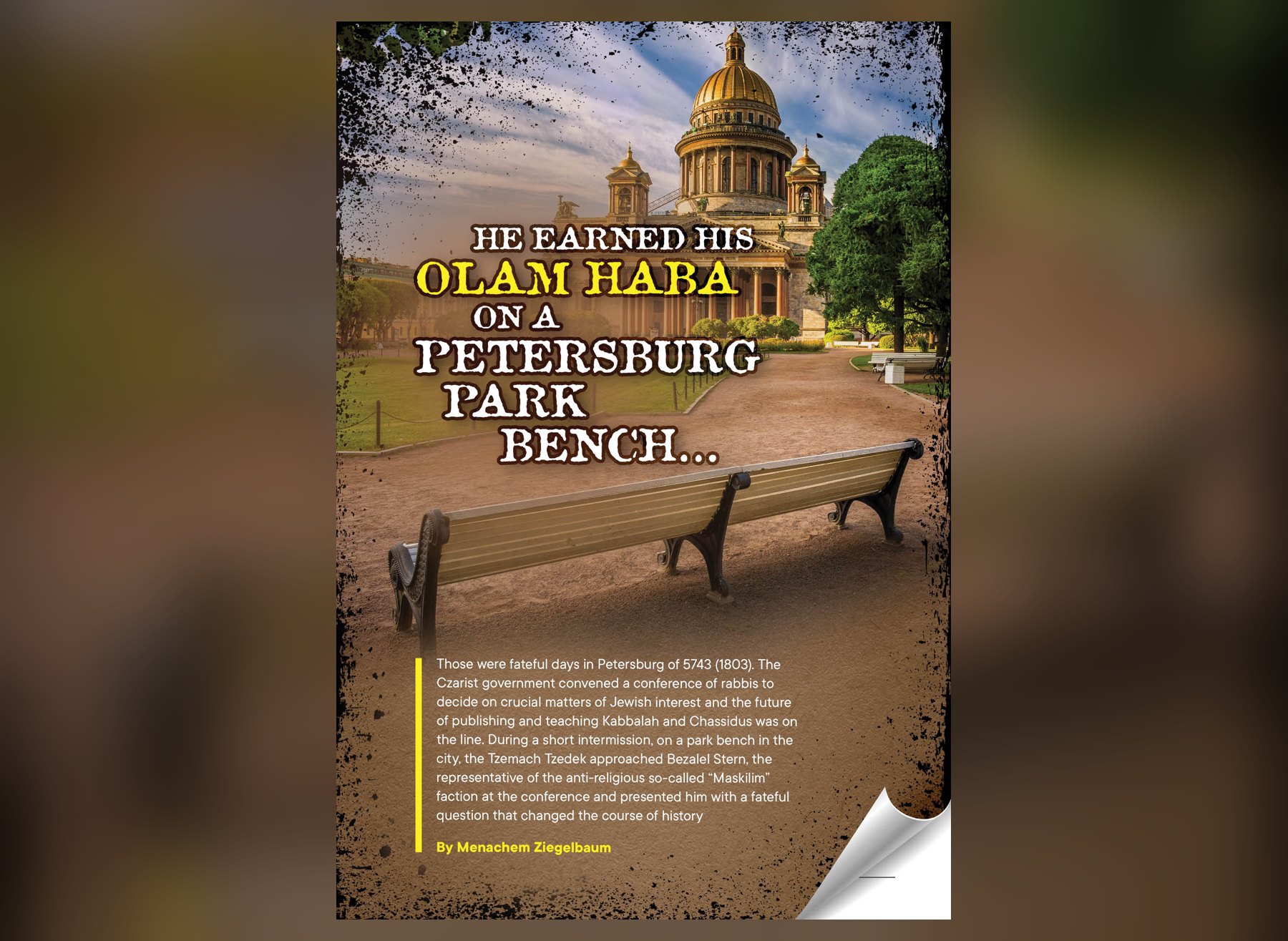
Those were fateful days in Petersburg of 5743 (1803). The Czarist government convened a conference of rabbis to decide on crucial matters of Jewish interest and the future of publishing and teaching Kabbalah and Chassidus was on the line. During a short intermission, on a park bench in the city, the Tzemach Tzedek approached Bezalel Stern, the representative of the anti-religious so-called “Maskilim” faction at the conference and presented him with a fateful question that changed the course of history
I
The year 5601 (1841) was a difficult year during the nesius of the Tzemach Tzedek. The maskilim decided to do everything to uproot traditional Judaism sanctified by our forefathers whose feet stood at the foot of Mount Sinai.
That year, Czar Nicholas decided to establish a governmental ‘Committee of Ministers’ to discuss the Jews of Czarist Russia and “fundamentally reform them”. Since the Czar saw great importance in the matter, he appointed the most senior ministers to be members of the committee, including Interior Minister Stroganov, Education Minister Uvarov, Finance Minister Voronchenkov, Director General of the Ministry of Law, and others.
The section dealing with ‘Jewish education’ was assigned to Minister of Education, Uvarov. The minister’s wickedness fit well with the disgrace of the maskilim. Thus, an alliance of goals was formed between the Minister of Education and the leaders of the maskilim – both craved the same goal: to force Jews to learn secular education, and through this to disconnect as much as possible from the tradition of Toras Moshe.
The wicked maskilim sought to kill two birds with one stone: both to uproot, G-d forbid, pure traditional Jewish education, and to harass and remove from their midst, the torch of light, the Tzemach Tzedek, who was a beacon of light for the Jewish people in Russia, and was for them a teacher, guide, and navigator of the way.
II
Summer of 5603 (1843). One day, the announcement arrived about the government conference in Petersburg that would discuss the issue of Jewish education. Representatives of Jews from all streams were invited to this conference where they were supposed to discuss kosher education. Unofficially, this conference concealed a plot to trap the Tzemach Tzedek in a snare. The maskilim who joined with the Czar’s people knew well that the Rebbe would stand firm to preserve kosher and pure education, and this would cause him to speak against the government or against the Czar. From here, the path would be easy to exile him permanently.
The plan was worked out in detail. The conference organizers even planned to hold the conference quickly, and force the assembled to agree and sign to all the demands of the maskilim. Four Jewish representatives were required to participate in the conference in Petersburg: The representative of the Chassidim, the Tzemach Tzedek, the representative of the ‘misnagdim’ – the Gaon Rabbi Yitzchok (Itzele) of Volozhin. The representative of Polish Chassidim – the wealthy Rabbi Yisroel Halperin, and the maskilim put forward as their representative the maskil Dr. Bezalel Stern, principal of the maskil school in Odessa.
The latter served in Odessa as a ‘rabbi’ on behalf of the authorities. His role was to manage the registration of births and deaths, and the authorities would turn to him in all matters concerning Jews and Judaism. In Odessa, as in other places, the ‘government-appointed rabbi’ was free-thinking in his views and was not observant of Torah and mitzvos. An exception was Mr. Bezalel Stern who was considered a serious man, examining and weighing each issue on its own merits, and not just according to his ‘enlightened’ view.
The main goal of his life was to teach students and influence them with his way of thinking. In addition to his “rabbinical” role, he was also a teacher in a school, and also taught students privately. Not infrequently, when he would meet a talented child who wanted to learn and gain knowledge, but did not have enough money – he would teach him for free and even take care of all his needs, as long as the student would learn and become wise. During the vacation days, when the school was closed, he would travel to different cities to attract people to ‘enlightenment.’
III
The Tzemach Tzedek understood well the magnitude of the trouble brewing and heading his way and against the entire Jewish people. He understood that he needed to prepare properly for the conference. For more than half a year, the Rebbe prepared for the conference. In those days he wrote his sefer Derech Emunah in which he details foundations of faith according to Kabbalah and Chassidus. The sefer was written so that it could serve as an answer to the devious questions expected to arise during the days of the conference.
The great preparation that enveloped the Rebbe’s house did not escape the eyes of the Chassidim. Throughout the winter, hundreds of Chassidim visited the holy court to bid farewell to the Rebbe before the journey. Already on erev Rosh Hashana 5603, the Tzemach Tzedek sent a pidyon nefesh to the grave of his righteous mother, Rebbetzin Devora Leah, in Liozna, where among other things he wrote bitterly: “The Berlinchiks [nickname for maskilim whose stronghold was in Berlin] are strengthening, and I ask to subdue them and humble their power. If I have any merit – let it be the subduing of the maskilim through me.” The Rebbe even visited her holy grave himself before his journey to Petersburg.
Years later, he told what was revealed to him when he was at his mother’s grave: “When I was called to the rabbis’ assembly in Petersburg, I was at the grave of my mother the righteous Rebbetzin in Liozna, and she told me that because of the self-sacrifice she had for Chassidim and Chassidus, she merited to also be in the chamber of the Baal Shem Tov to arouse mercy for me; and she asked the Baal Shem Tov to give her some segula for me so that I could, with G-d’s help, stand against those who oppose the teachings of Chassidus.
“And the Baal Shem Tov said to her: Your son is proficient in the five books of Torah, Tehillim, and Tanya by heart, word by word. It is written ‘And the fear [chitas] of G-d was’ etc.: Chitas is an acronym for Chumash, Tehillim, Tanya, and one who is proficient in their letters breaks all concealment and obstacles.”
Before leaving his home for the conference, the Rebbe left detailed instructions for his wife, Rebbetzin Chaya Mushka, and his holy sons who remained in Lubavitch, to enter his holy room every day, even on Shabbos, and say three chapters of Tehillim there for his success. Besides that, his holy sons took upon themselves to fast every day, and even decreed fasts in many Jewish communities.
In his luggage, the Rebbe put about thirty holy books in which he could meditate during the days of the conference, if it would be prolonged. The Rebbe also packed blank paper sheets to write down his chiddushim as he would think of them during his stay in Petersburg.
While packing the suitcases, Rebbetzin Chaya Mushka turned to her husband and asked whether socks had already been put in the suitcase. The Rebbe replied in a tone of anxiety: “Is now the time to think about socks? G-d knows what we’ll return with from Petersburg!”
When the Rebbetzin heard these words, she burst into bitter weeping that shook the hearts of all the household members. As such, his son, Rabbi Yehuda Leib, turned to his father with a complaint about why he had so distressed his mother the Rebbetzin. The Rebbe replied: “Indeed I want her to know about this and cry about it. After all, she is the daughter of a Torah scholar [the Mitteler Rebbe] and I want her to shed tears for our salvation”. The Rebbe repeated his words: “She is the daughter of a Torah scholar and I want her to know and cry.”
IV
In the month of Sivan 5603, the Tzemach Tzedek arrived in Petersburg to attend the conference. Complete blackout was imposed on the conference and its discussions. Thus, all the details of the topics discussed in it and the sides for and against, the arguments, explanations, contentions – everything remains under a veil of concealment to this day.
Only a little became known over the years, isolated rumors that leaked to the ears of Chassidim, as well as some details from the letters that the Rebbe wrote during that period, and records that were kept for that purpose. As expected and planned in advance – the central topic on which most of the discussions focused dealt with the curriculum taught in Jewish schools. The maskilim, destroyers of religion, tried to introduce foreign spirits, while the Rebbe stood against them like a rock.
It soon became clear that the main plot of the maskilim and their partners in the government was for the entire conference to last a week to ten days, during which they would succeed in forcing the representatives of faithful Judaism to sign to all their desires and come out with a declaration that even the great leaders of loyal Jews answered ‘Amen’ (against their will) to their plots – but the Rebbe was revealed as a flint stone. Without flinching, the Rebbe waged a dangerous war of annihilation against them. “Our Rabbi was the head speaker in everything, and with the spirit of his understanding and his divine wisdom he responded to everything with words that were accepted… and he stood firm in his opinion, the opinion of the Torah, that he would not move from matters of our holy Torah even a tiny bit,” is described in the chronicles of those days.
The conference lasted for nine weeks, during which the Rebbe was arrested twenty-two times. More than once he even stood in mortal danger in the face of the fiery eyes of the Czar and his ministers.
Stern, despite being ‘enlightened’ and free in his views, could not help but be very impressed by the courage of the Rebbe who stood like a lion on guard for the Torah and its commandments, and even for its customs. At one point he stood up and said excitedly: “They tell of a Jewish shtadlan (intercessor), that when he would go to the royal court to work salvation for Jews, he would take with him a small bundle containing shrouds, lest they order his execution. And indeed, many Jewish shtadlanim acted this way throughout the generations. But there were those who took the shrouds with them but left self-sacrifice at home, while the Rebbe from Lubavitch leaves the shrouds at home and takes self-sacrifice with him.”
Mr. Bezalel Stern, although he was one of the scholars and one of the outstanding individuals in the family of progressive maskilim, was at the same time a very serious and emotional man, and despite his personal opinion which was completely opposed to the opinion of the Gaon Rabbi Yitzchok of Volozhin and of R’ Yisroel Halperin, and especially to the view of the Tzemach Tzedek, nevertheless, the strength of the Tzemach Tzedek’s opinion to protect and preserve all Jewish customs, even the smallest ones, won his heart, and in several things he agreed with the Tzemach Tzedek, and sometimes his opinion came down on the side of the G-d-fearing.
V
At one point, a special discussion was opened – whether to allow the study of Chassidus and Kabbalah. The maskilim understood that the study of Chassidus instills power and vitality in the observance of mitzvos and Torah study, and did everything to outlaw it.
Here a real problem arose. The Rebbe, and with him Rabbi Yisroel Halperin who represented all Chassidic groups – expressed their firm opinion in favor of studying Chassidus. The Russian minister and the representative of the maskilim Bezalel Stern – expressed their firm opinion against studying Chassidus. And the Gaon from Volozhin who represented the misnagdim – was silent and did not express his opinion one way or the other.
It was Friday, that day, erev Shabbos. When a tie was cast between the sides, the minister turned to the Rebbe and said to him: “In your Torah it is written: ‘Follow the majority’. So I will do so regarding the question of studying Chassidus. Here two say to prohibit the study of Chasidus. Two say to continue this study, and one is silent, and from his silence it appears that he also agrees with us to prohibit the study of Chassidus. So, I will prohibit the study and spread of the teachings of Chassidus.”
The Rebbe understood the magnitude of the impending disaster, and he cried out, “It shall not be! Whatever happens to me, I will not let go of the demand to continue to allow the study of the sacred teachings of Chassidus.”
The wicked minister, wanting to break the Rebbe’s spirit, ordered the guards who were in the room to lock the Rebbe in a closed room. They quickly approached him, grabbed his hands and put the Rebbe in a side room, and locked it from outside.
Here the Rebbe began to daven Mincha in an emotional turmoil. He began with ‘Hodu’ and then ‘Pasach Eliyahu’. He said the verses word by word as if counting coins, with a Chassidic sweetness and longing not of this world. The outpouring of prayer also broke through the door and reached the ears of the minister who was very moved: “What is he saying?” he asked those present, and they replied to him that he is now saying parts from the holy Zohar, which was discussed earlier.
So the minister sat and listened attentively to the Rebbe’s prayer until its end. When he finished, the minister ordered the Rebbe released, and announced: “Let us follow the law of ‘Follow the majority’. Here two say in favor, and two say against, and one is silent, and from his silence we can learn that he agrees with you in favor of studying Chassidus. I will therefore consider allowing the continued spread of Chassidus.”
Meanwhile, evening fell, the holy Shabbos spread its wings over the capital Petersburg, and the meeting ended. Even so, abundant heavenly mercy was still needed for the minister’s words to enter the protocol, and the study of Chassidus to receive official sanction.
VI
Shortly after, the Rebbe fell ill. The conference discussions had weakened him greatly. As such, the discussions were halted until he would recover somewhat.
One day, when he felt a little better, the Tzemach Tzedek went out to walk in the palace garden, where he met Bezalel Stern who was also sitting on a bench to breathe some fresh air and relax from the stormy discussions. This was the first time the two stood face to face – holiness versus the representative of impurity. Good versus evil.
The Rebbe, seeing this, approached him and emotionally asked him: “Do you believe in reward and punishment?” “Yes, I believe,” Stern nodded in affirmation. “Do you believe in the World to Come?” the Rebbe added and asked. “Yes, I believe,” Stern answered. “Do you want to have a share in the World to Come? If so, agree to my opinion about Chassidus and Kabbalah, and I promise you a share in the World to Come. If you stand to the right of the teachings of Chassidus and Kabbalah, you have the possibility of being a ‘son of the World to Come’. About such a status Rabi Yehuda HaNasi cried and said ‘There is one who acquires his world in one hour’!”
As he said this, the Rebbe extended his holy hand to him. The Rebbe’s words pierced the heart of the maskil, and on the spot he resolved in his soul to assist the Rebbe in his war for the teachings of Chassidus and Kabbalah. He promised that from now on, whatever would be spoken about Chassidus and Kabbalah – he would be on the Rebbe’s side.
Thanks to him and with his help, the teachings of Chassidus received blanket permission for its dissemination. Chassidim said that Stern’s heart never returned to be as it was before. When Bezalel Stern returned to his home, he changed the eating utensils to kosher ones, and began to lead a life of Torah and mitzvos. At some point he even came to visit Lubavitch to get to know the Rebbe and his ways more closely. When he arrived, he was granted great closeness by the Rebbe.
In one of their conversations, Stern told the Rebbe that scientists just discovered that all the growth of a rose is from the dew of heaven. The Rebbe smiled, and without saying a word took out a book of Medrash from the bookcase, opened it and pointed with his finger: “This book was written about two thousand years ago, and see what is written in it: ‘I will be as dew unto Israel’ – just as this rose grows only from dew, so Israel grows only through Torah”…
Stern was surprised and amazed by the words he heard, and when he came to his friends he said to them: “Know, friends, that all our enlightenment is like a garlic peel (i.e. worthless) compared to the knowledge of the Rebbe in Lubavitch.”
At the end of his life he suffered terribly, which atoned for his sins, and he passed away in teshuva and merited the World to Come, as the Rebbe promised.
Beis Moshiach #1429 • pp. 24-29
© 2026 Beis Moshiach Magazine. All rights reserved.
This article originally appeared in Beis Moshiach #1429. You are welcome to share it with friends and family by email or in print, provided that you do not change, add to or omit any part of it, you credit the author and Beis Moshiach, and you include a link to archive.bmoshiach.org (written out in full in printed copies).
To republish this article in a newspaper, magazine, book or website, please request permission in advance at [email protected].