The Beard Under the Helmet
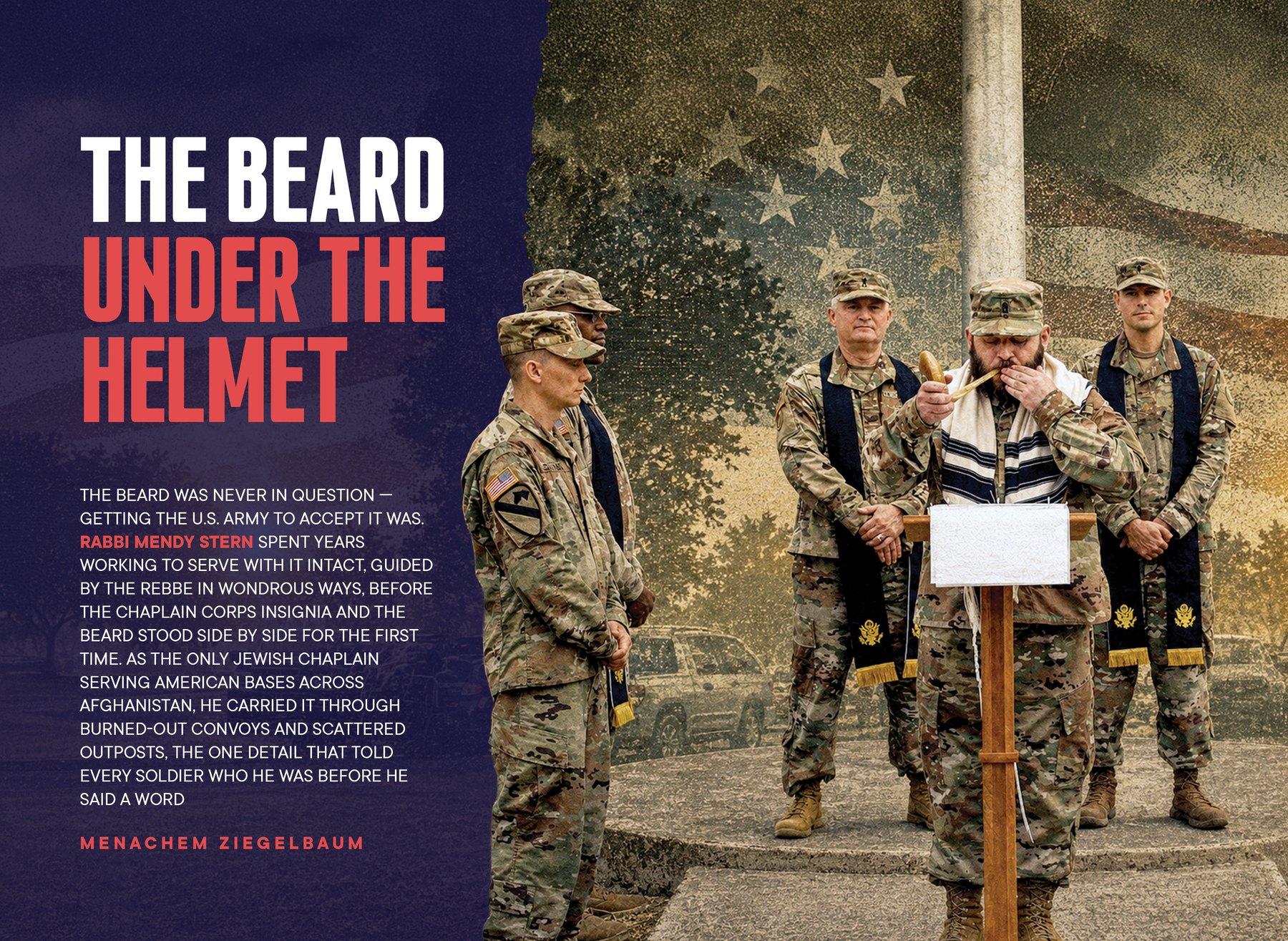
The Story of Chaplain Major Mendy Stern
The beard was never in question - getting the U.S. Army to accept it was. Rabbi Mendy Stern spent years working to serve with it intact, guided by the Rebbe in wondrous ways, before the Chaplain Corps insignia and the beard stood side by side for the first time. As the only Jewish chaplain serving American bases across Afghanistan, he carried it through burned-out convoys and scattered outposts, the one detail that told every soldier who he was before he said a word.
Elul, 5774 (2014). The helicopter landing zone at one of the American bases in Afghanistan is buzzing with activity. Blackhawk helicopters take off and land without pause, in the middle of a military operation.
Among the soldiers boarding a helicopter, one figure stands out: an officer wearing the Chaplain Corps insignia on his collar, and beneath his helmet a full beard, a sight not often seen in the U.S. Army.
Chaplain Major Mendy Stern, the only Jewish chaplain serving in that area, is setting out this morning on a journey between American bases across Afghanistan. The month of Tishrei is approaching, and he is making his way among the scattered installations throughout the country to meet Jewish troops, provide for their religious needs, and prepare them for the Yomim Noraim.
A Marine officer, responsible for the convoys in the area, approaches him by the helicopter. He helps him load his gear, then shows him damage from the field: armored vehicles burned on the side of the road.
“This is the convoy from two days ago,” he says. “This is what it’s like here. Take care of yourself.”
The helicopter flight passes safely, but after landing there remains one more stretch: about a half-hour’s drive from the landing pad to the main base.
“Those were the most intense thirty minutes I had experienced in my life up to that point,” Rabbi Stern recalls. “You sit in the vehicle and you don’t know at what second an explosive device might go off. Every movement on the side of the road grabs your attention. It’s a feeling that’s hard to describe.”
Finally the convoy enters the base’s gates. Rabbi Stern breathes a sigh of relief. The task he came for still lies ahead of him, and he’s already starting to think about the visits and activities awaiting him at the various bases for the Tishrei holidays.
Then the same Marine officer approaches him and says a sentence he will never forget:
“The vehicles I showed you, your name was on them.”
Rabbi Stern looks at him in shock.
“Excuse me, what are you talking about?”
“Two days ago,” the officer explains, “the convoy that was supposed to take you on this trip set out. The vehicles hit an explosive device shortly after leaving the base. Some were destroyed. That was the convoy assigned to you.”
“I hear this,” Rabbi Stern recounts, “and the first thing I say is: Boruch Hashem. And then I think to myself, Rabbi Goldstein was supposed to be here, and I’m just filling in…”
That evening he called Rabbi Goldstein and told him about another instance of “hashgacha pratis and open miracles.”
When we talk about this event today, he tells it with almost surprising matter-of-factness.
“I have dozens more stories like that,” he says.
And the truth is that this story contains within it the entire character of Rabbi Mendy Stern: a Chabad Chassid who entered a war zone by virtue of his shlichus; a Jew whose first reaction upon learning he had survived a disaster was “Boruch Hashem”; and an officer in the U.S. Army who sees the hand of hashgacha accompanying him at every step.
But to understand how a Chassidishe yungerman from Crown Heights, born in Yerushalayim, who was searching for a shlichus and hadn’t found one, ended up at a helicopter landing zone in Afghanistan with officer’s rank and a full beard that drew attention at the highest levels of the Army, we need to go back several years to one phone call that at first sounded rather strange.
A Young Man Searching for a Shlichus
Rabbi Mendy Stern was born in Yerushalayim. At around age 14, his family immigrated to the United States, and he grew up and was educated in Tomchei Tmimim yeshivas. After he married and eventually settled in Crown Heights, he supported his family by working in a financial services company.
But like many young Chabad men, he was searching for a shlichus position. “For years I searched for a shlichus,” he recounts, “but nowhere did it work out for me to find a regular shlichus, i.e. opening a Chabad House and so on.” The attempts didn’t work out and the question of “where” remained open.
One day the phone rang. On the line was an acquaintance with news: they were looking for military chaplains for the United States Army.
“I immediately said: ‘I don’t understand,’” Rabbi Stern recalls. “’Why would the U.S. Army need military rabbis? They already have Rabbi Yaakov Goldstein who has served as a military chaplain for years. What more do they need?’”
Back then he did not yet know the numbers: roughly ten thousand Jewish soldiers and other service members were scattered across American military bases around the world. Most had never met a rabbi in uniform, many had never put on tefillin, and some did not even know what a Pesach Seder was.
After consulting with his wife, it was decided that he would attend a workshop run by the Aleph Institute, the Chabad organization that supports Jews in the U.S. Military, just to hear what it was about.
Just to listen. That’s what he told himself as he sat down in the hall.
“The Rebbe Is Speaking to Me Directly”
At the workshop, people from the Aleph Institute described this special shlichus. A military chaplain in the U.S. Army is not simply a “shul rabbi” in uniform; he supports the spiritual and religious needs of troops within the enormous military system, including those of other faiths and backgrounds. The speakers quoted letters from the Rebbe written decades earlier about the great importance of caring for Jewish soldiers in the American military.
Rabbi Stern sat and listened and felt that the words were directed at him. In the middle of the workshop he sent his wife a message: “I think I found the shlichus we’ve been looking for.”
The reply that came from home was brief: “Before you even get home write a letter to the Rebbe.”
He wrote the note and asked: a shlichus as a military chaplain in the U.S. Army, is this his calling? In his heart a simple resolution formed: I will do what the Rebbe wants.
Only a few minutes passed after he finished writing the note and the Rebbe found a way to answer him. In a video of a farbrengen, he hears and sees the Rebbe explaining that a rav shouldn’t think he has to transform the entire world at once. He must begin by illuminating his own home and the home itself will then illuminate the street. Then the video screen switched, and Rabbi Stern couldn’t believe his eyes. Standing before the Rebbe was an American military chaplain in uniform, and the Rebbe was saying to him the very same words he had heard that same day at the workshop, about the purpose of a chaplain’s shlichus in the U.S. military.
“I’m standing there thinking to myself,” Rabbi Stern recounts, “here, again, the Rebbe is speaking to me, directly to me.”
He got into his car and called his wife: “I received the bracha I was hoping for.”
It turned out that during those same hours his wife had also written to the Rebbe independently and placed her letter among the pages of the Igros Kodesh. In the letter that came up, the Rebbe writes that if one wants to help Jewish soldiers in the U.S. Army, one should connect them with a “chaplain” in the American military. Using that very word: chaplain.
“Well, I couldn’t have expected more than that. I really received a clear answer,” says Rabbi Stern. That very day he called the offices of the Aleph Institute in Florida, the organization authorized to endorse rabbis for military chaplaincy, and announced: “I’m ready to start immediately.”
On the other end of the line, they laughed. “A process like that,” they explained, “takes at least six months.”
Anyone familiar with American government bureaucracy knows that “six months” is an optimistic estimate. The acceptance process for a military chaplain includes piles of paperwork, medical exams, an FBI background check, and security clearances.
They didn’t yet know that when the Rebbe sends someone, all the rigid rules change.
Three Weeks of Miracles and One Phone Call
But here began a chain of hashgacha pratis that Rabbi Stern still recalls today with wonder: “With every phone call I made to move things along, the issue got resolved immediately. I needed to undergo a medical exam ahead of enlistment; they told me people usually wait a month to a month and a half to get an appointment. I pick up the phone, and they tell me: ‘Oh, we have an opening today at ten in the morning’… Later I called the FBI to go through the criminal background check, a process that can take months. The clerk looks at the list in front of her and says: ‘Can you come this week, Friday morning?’… That’s how everything went, even the smallest thing resolved quickly. Within three weeks, instead of half a year or more, all my paperwork was ready, miraculously!”
The documents were sent to the Army and the response that came exceeded expectations: Rabbi Menachem Stern had been approved for full-time active duty service, not a reserve position, but full-time service as a chaplain in uniform.
But not everything flowed smoothly. As with anything holy, there are also difficulties. Days later, the phone rang. On the line was a clerk from the army offices with a message delivered almost in passing: “Everything is approved for you, but you’ll need to shave your beard.”
Under U.S. Army regulations, a soldier is not permitted to grow a beard. It’s a rule dating back to the 1970s, and over the years the army has justified it on grounds of discipline and safety.
But for a Chabad Chassid, the beard is not up for negotiation. “I’ve never shaved,” Rabbi Stern said. “Asking me to shave my beard is like asking me to cut off my right hand”…
The clerk heard the firm answer and responded, “We’ll get back to you.” “After that, no one ever got back to me,” Rabbi Stern recounts. A week passed, a month, two months. The phone was silent. The file of the rabbi from Brooklyn got stuck somewhere in the system and no one knew what to do with it.
Until one day, after several months, a phone call came from the Pentagon.
On the line was none other than the assistant to the Chief of Chaplains of the U.S. Army: a two-star general, a senior officer responsible for all Army clergy, of every faith. The two arranged a meeting at his office in the Pentagon.
Before the meeting, Rabbi Stern received a briefing from the aides about codes of conduct for the meeting with the general. Don’t look at your watch, answer questions and don’t ask questions. In closing they announced: “The meeting is allotted 15 minutes.”
The conversation began. The general asked questions about Judaism, about Jewish law, about the work of a rabbi, and Rabbi Stern answered. Then came the central question: “What would you do if the Army needed to send you to a place like Afghanistan or Iraq, a combat environment where being visibly Jewish could create additional concern?”
“I told him,” Rabbi Stern recounts, “what is written in the Book of Genesis about our forefather Jacob going down to Egypt. Supposedly, his son Joseph should have come to his father out of respect for his father, rather than the father being uprooted to a foreign land to meet his son. In that dignified situation, Jacob could seemingly have chosen to remain in the land of Canaan.
“But our forefather Jacob knew that the prophecy told to Abraham at the Covenant Between the Parts, that his descendants would go down to Egypt, was destined to be fulfilled. He understood this was part of the higher plan and that this was how things were meant to unfold. So he didn’t wait until he’d be forced to go there against his will, but chose on his own to go down to Egypt, in a manner of dignity rather than being dragged there by compulsion.”
Rabbi Stern smiles.
“I told the general, if it’s been decreed from Heaven that I need to go to a place like Afghanistan, I’d rather get there by my own choice than by being forced.”
The allotted 15 minutes had long passed, and no one stopped the conversation. “We spoke for over two hours,” Rabbi Stern recounts. At the end of the conversation the general told him: “When you commission, we’ll station you in a region that hasn’t had a Jewish military chaplain since the 1980s.”
“’When you commission,’ I said to myself: well, I’ve been accepted,” Rabbi Stern recalls. “The beard issue was also resolved.”
But after the meeting, silence returned; no one contacted him. Months passed until one day an official military order arrived in the mail: report for duty. Rabbi Stern began coordinating the swearing-in ceremony with the recruitment office in Manhattan; an officer he knew even offered to help arrange the event. Then, in a coordination call with headquarters, he was told: “No, the order reached you by mistake.”
“How could an official order from the U.S. Army have been issued and then withdrawn?” I asked. “How could one file move back and forth so many times?”
From then on he began calling every week or two to check on the status of the file. Until, in one of these calls, a clerk who answered said a single sentence that would later turn out to be the turning point: “Listen, if you want clearer answers, talk to the Staff Judge Advocate’s office [the military legal counsel].”
The “Didon Notzach” Attorney Enters the Picture
Rabbi Stern realized that he, too, needed legal representation. He turned to the Aleph Institute, where he was connected with attorney Nathan Lewin, the renowned Washington lawyer, one of America’s leading experts on religious liberty and the attorney who represented Chabad in the case over the Rebbe’s sefarim.
In Kislev 5770, a lawsuit was filed in Federal Court in Washington: Rabbi Menachem Stern versus the United States Army. The central claim was that the Army’s application of its grooming policy burdened his religious practice under protections recognized in American law, especially since accommodations had recently been granted to Sikh and Muslim soldiers. Yet for a Jewish rabbi seeking to observe the mitzva, “You shall not destroy the corners of your beard,” the door remained closed.
Three senior senators joined the struggle: Charles Schumer and Kirsten Gillibrand of New York, and Joseph Lieberman of Connecticut, who wrote to the Army leadership on behalf of the rabbi from Brooklyn, and the story began to spread in the media.
While the case was proceeding, Rabbi Stern lived in an uncertain reality that lasted almost two full years. “I was in limbo,” he describes. “On the one hand, I had been selected for military service, so I could not simply move on and seek a regular shlichus; on the other hand, I was not yet serving, not receiving pay, and not working for the Army. I was caught between a rock and a hard place.”
A young married man with a family and small children in Crown Heights, without a settled life and without knowing when or how it would end, all because of one refusal: not to touch his beard.
Then, one day, came the hardest phone call of all.
On the line was a Jewish soldier, crying: “You took the beard issue to court, and now my commander is insisting that I shave my peyos!”
As long as the beard question had remained a relatively quiet issue, some commanders handled it informally. Now that the matter was part of a federal lawsuit, some approached grooming standards more strictly.
“I told him: ‘Listen, given the situation I’m in, with everything happening in court, I don’t see how I can help you right now,’” Rabbi Stern recounts, adding honestly: “I started to feel that maybe I’d done something wrong.” After all, the whole effort was meant to increase Jewish observance and now a Jew was crying on the phone because of him, having to shave his peyos. Maybe he should have compromised? Maybe going to court had been a mistake?
“Throughout those two years I kept writing to the Rebbe as usual, but I never received an answer as sharp as the one that was about to come.”
His wife, sensing the crisis, told him: “Are you worried you made a mistake taking this to court? Write to the Rebbe, and write everything, about the soldier’s peyos and about your doubts. Write about all of it.”
He wrote the pidyon nefesh, and once again received the Rebbe’s answer through a video screen. This time it was a video from a farbrengen in which the military chaplain Rabbi Yaakov Goldstein presented the Rebbe with a special guest: Rabbi Israel Drazin, deputy chief chaplain of the U.S. Army, a senior Jewish officer who had corresponded with the Rebbe on matters of Jewish law in the military, kosher food, and more.
The Rebbe said several things to the senior officer and Rabbi Stern watched and listened to every word through the video: to go and bring light to the Jews serving in the military; to stand firm in one’s beliefs, and to use the military platform to influence not only Jews, but the nations of the world as well.
“I’m watching the video,” Rabbi Stern recalls, “and saying to myself: ‘Wow. The Rebbe is answering me again, clearly telling me not to worry.’”
He went home and asked his wife: “Did you write to the Rebbe in the Igros Kodesh?”
“I did,” she answered, “but I didn’t understand the answer.”
She opened the volume and pointed to the page. In the letter, the Rebbe was responding to someone who kept asking again about a matter he had already been answered: “I have already answered him several times, and I do not understand why he is still asking questions.” She hadn’t understood the answer, but he understood immediately. The Rebbe had already answered several times: at the workshop, in the first pidyon nefesh, in the first video, in the letter with the word “chaplain.” How many more times did he need to ask?! The Rebbe had already charted the goal long ago.
That same evening, Rabbi Stern called Nathan Lewin: “This is the answer I received from the Rebbe. We’re not compromising on anything. We’re going all the way.”
Two Years of Struggle Ended in Complete Victory
From the moment the decision was made, things moved quickly.
Lewin kept up the pressure, and the precedents he presented, the bearded Sikh and Muslim soldiers, placed the Army in a difficult legal and public position. Behind the scenes, settlement talks began. On the 25th of Marcheshvan 5772, it happened: the Army granted Rabbi Menachem Stern an official religious accommodation allowing him to retain his beard.
Two years of struggle ended in complete victory. The beard remained, and the pressed uniform was waiting. The attorney from the sefarim case had closed another chapter in defense of Lubavitch’s honor, with the same outcome: “Didon Notzach,” “Ours has prevailed.”
Rabbi Stern’s swearing-in ceremony was held with great fanfare at “The Shul” in Surfside, Florida, founded by Rabbi Sholom Ber Lipskar a’h, founder of the Aleph Institute. Also present at the event was Rabbi-Colonel Yaakov Goldstein, the veteran Chabad military chaplain, who was part of this story from its inception.
“I am beyond happy,” Rabbi Stern said at the ceremony. “I look forward to embarking on this new shlichus, and with Hashem’s help, the work I put in will make the world a better place.”
You mentioned Rabbi Goldstein. Didn’t he himself serve in the Army with a full beard?
Rabbi Goldstein entered the Army before beards were prohibited under military regulations, and served in the reserves. “I was the first soldier in the history of the U.S. Army to enter full active duty without ever having shaved,” he explains.
The response was enormous. The New York Times dedicated an article to the story headlined: “Beard and All, A Rabbi Joins the Army.” The New York Post reported on the rabbi from Brooklyn and his case with the Pentagon. Across America, readers learned about the young man from Crown Heights who refused to give up his beard and ultimately won the right to serve.
In Teves 5772, the newly commissioned officer reported to Fort Jackson in South Carolina for the Chaplain Basic Officer Leader Course, the Army’s basic training for chaplains: thirteen weeks of military training, field exercises, and classroom instruction, a young married man from Crown Heights among hundreds of chaplain officers and candidates.
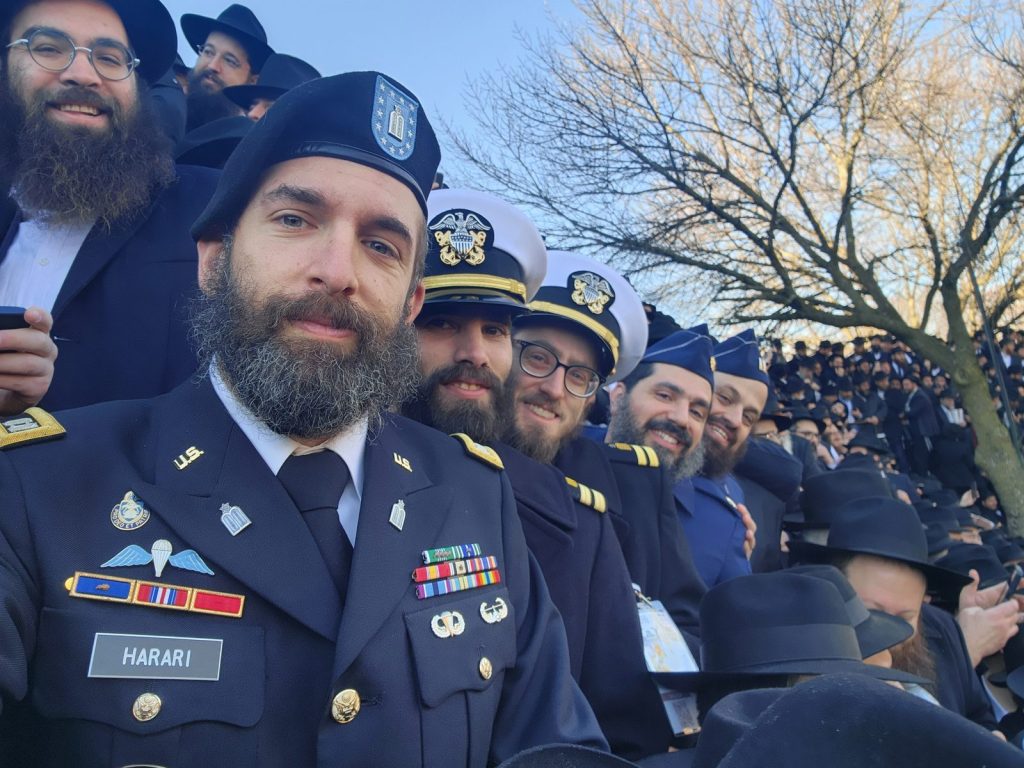
The breakthrough didn’t remain his alone. Following the precedent, the Department of Defense and the Army issued guidance in subsequent years that helped clarify the path for soldiers, chaplains, and other service members seeking religious accommodations. As a result, a wave of young rabbis began enlisting. “Today there are about 25 Chabad military chaplains, bearded, who enlisted without shaving at all,” Rabbi Stern counts. “And there are quite a few more from other circles, who shaved over the years and are now growing their beards back.”
There are now dozens of shluchim serving in military uniform and thousands of Jewish soldiers who today have someone to turn to, and it all began with one short answer on the phone: “I’m Jewish, I don’t shave.”
The military shlichus had launched. The Stern family moved to a military base in Missouri.
Pesach in Afghanistan
Adar 5774.
The Stern family is living on a military base in Missouri, the only Chabad family in the area.
Then the order arrives: Chaplain Stern is being deployed to Afghanistan for a tour beginning in early March and lasting until the end of May. Alone, of course. Families don’t travel to combat zones.
The implication is immediately clear: His wife and daughters would celebrate Pesach alone, on a remote base. The obvious solution: fly to the parents in New York for Yom Tov. Tickets were even booked.
As was their custom at every juncture, Mrs. Stern wrote to the Rebbe that her husband was heading to a war zone, and that she was traveling with the girls to New York for Pesach. She opened the Igros Kodesh and what appeared before her eyes? Rabbi Stern recounts: on one side of the page was a personal letter from the Rebbe to someone setting out on a journey, blessing him to travel safely and return safely. This was a direct answer to the first part of the pidyon nefesh.
On the other side of the same page appeared another letter, written to a shlucha who was struggling with difficulty in her shlichus. In it, the Rebbe wrote to her: “I sent you on a shlichus, and when a challenge arises, you want to run back to your parents’ home?”
Mrs. Stern read this and immediately understood the message. The trip to New York was called off, and she decided to stay on the base in Missouri and continue the shlichus where the family had been stationed.
And indeed, Pesach became a special experience spanning two sides of the world. With the help of two of Rabbi Stern’s brothers, Mrs. Stern organized a large Seder on the base in Missouri, attended by about 75 Jewish soldiers.
While she stayed on the base, he flew to Afghanistan where a shlichus awaited him unlike any other: “I was the only Jewish Chaplain in the southern region of the country,” he recounts. “I had to organize all the Pesach arrangements for more than 150 Jewish soldiers for the duration of the holiday. To do that, I had to visit every base throughout our region of Afghanistan and bring Yom Tov to the soldiers.”
At the Seder, 65 Jewish soldiers in uniform sat around set tables in the heart of Afghanistan, with matza, wine, and four cups. Thus, instead of being split between home and shlichus, the Yom Tov became yet another expression of the shared shlichus of the Stern couple.
How do you move between bases in a country as dangerous as Afghanistan?
By helicopter when available and in armored vehicle convoys when not.
The Second Deployment to Afghanistan
It seemed the short Afghan chapter was already behind him, but circumstances brought him there a second time.
After returning from the Pesach assignment in Afghanistan, Rabbi Stern was told that, per regulations, he would have at least a full year at his home base before any further deployment. He returned to his family in Missouri and tried to get back to a normal routine.
But one morning, at the start of the month of Elul 5774, about four months after returning from the combat zone, the phone rang. On the line was a representative from the Army Chaplain Corps at the Pentagon.
The rabbi who was supposed to go to Afghanistan for the Tishrei holidays and the Yomim Noraim had fallen ill, and the decision was made to send Rabbi Stern in his place.
“I asked them if they had already spoken with my commander,” Rabbi Stern recalls. “They told me they were about to, and I went out to morning formation as usual.”
When he arrived at formation, the battalion sergeant major approached him and ordered him to report immediately to the battalion commander.
“I got to the office just as the commander was finishing the call with the Pentagon,” he recounts. “The last words I heard were: ‘That’s not a problem, we’ll get him ready in time. I just have one request: that every soldier deploying gets the chance to have dinner with his family first.’”
The Pentagon agreed to delay the flight by two days.
“I remember it well,” says Rabbi Stern. “Thanks to that request, I managed to sit down for dinner with my wife and daughters before I left.”
A few days later he flew to Kuwait, and from there continued on to Afghanistan. Upon landing at Bagram airbase, he briefly met Rabbi Shmuel Felzenberg, who served as deputy command chaplain of the coalition forces in Afghanistan. Shortly afterward, he boarded a helicopter bound for Kabul.
Upon landing, a Marine captain was waiting for him. The officer helped him with his gear and led him to a ground convoy that was about to depart for the headquarters of the international forces.
On the way, the officer pointed to several burned-out vehicles on the side of the road.
“He said to me: ‘Look at them,’ he said, ‘I’ll explain what they mean later,’” Rabbi Stern recounts.
The convoy set out.
“Those were the most intense thirty minutes I had experienced in my life up to that point,” he recalls. “You sit in the vehicle not knowing at which second a powerful explosive device might detonate. Every movement on the roadside grabs your attention.”
Finally the convoy entered the gates of the international headquarters in Kabul. Only then did the Marine officer approach him and say the sentence he would never forget: “The vehicles you saw on the way? Your name was on them.”
Rabbi Stern looked at him in shock.
“Two days ago,” the officer explained, “the convoy that had originally been scheduled to take you was struck by a car bomb. Nineteen people were killed. You were supposed to have been on that movement.”
“I heard that and couldn’t believe it,” Rabbi Stern recounts. “I immediately thanked Hashem for the two-day flight delay. And in my heart, I thanked my commander for insisting that I get to have one more dinner with the children before I left…”
They Want The Holy Man…
Shortly after settling in Kabul, Rabbi Stern began preparing for the Tishrei holidays. He published the prayer schedules and began locating the Jewish soldiers scattered throughout the area.
The following day, an Afghan general encountered him.
“He grabbed my hand and started kissing it,” Rabbi Stern recalls. “He was speaking a language in which I couldn’t understand a single word. The only word I managed to recognize was ‘Mullah,’ a holy man…”
On Rosh Hashana itself, another incident occurred that left a deep impression on him.
In the middle of Shacharis, a senior officer in the U.S. Air Force, holding the rank of lieutenant colonel, rushed into the service.
“‘Am I late? Am I late?’ he asked, gasping from having run there.”
Rabbi Stern graciously invited him to join the tefilla and afterward asked him what had happened.
“The officer told me that he had served as the chief public affairs officer for American forces in Afghanistan. He knew the details of the car-bomb attack on the convoy that had been scheduled for the Jewish chaplain, and because of that he had asked his commander for a day off so that he could pray on Rosh Hashana.
“On the morning of the holiday, the commander called him and said, ‘We’re flying to Kabul.’
“The officer didn’t dare remind him that it was Rosh Hashana. Throughout the entire flight, he was convinced that something terrible was about to happen.
“When they landed, the commander noticed that he was pale and asked what was wrong. Only then did he tell him that it was Rosh Hashana and that he regretted not having mentioned it earlier.
“The general was upset with him for not saying anything from the outset, and immediately sent him to pray.”
“He told me all of this after the davening,” Rabbi Stern says. “And I thought to myself: Here is another reminder from Above that Hashem saved my life.
“A few weeks later, one of the aides from the office of General Campbell, commander of the forces in Afghanistan, came to my office. He had an unexpected request.”
The Afghan military leadership was holding a memorial ceremony for a unit that had suffered heavy losses that month, and they wanted Rabbi Stern to be one of the speakers at the event.
“I asked him if he was sure about this,” Rabbi Stern recalls. “‘They specifically want me? A visibly Jewish chaplain, with a beard and a yarmulke? Wouldn’t another faith representative be more appropriate for this ceremony?’”
A few hours later, the aide returned with a clear answer.
“They specifically asked for you and mentioned you by name.”
And why?
“They want the holy man,” he was told.
Rabbi Stern was invited to speak, pray, and honor the memory of the Afghan soldiers who had fallen in battle.
Among the fallen were soldiers killed in that same devastating car-bomb attack on the convoy he had originally been scheduled to join.
“I stood there and recited a memorial prayer,” he recalls. “And I couldn’t help thinking that this could have been my memorial service too…”
* * *
Your work encompasses people from the broadest possible spectrum; you work with Jews as well as with troops of other faiths and backgrounds. How do you incorporate the Rebbe’s singular and primary shlichus of preparing the world for the coming of Moshiach?
Just this past Shabbos, we spoke in a class about the pasuk, “And all the peoples of the earth shall see that the name of Hashem is called upon you.” That is one aspect. On the other hand, there is the verse that says that when Moshiach comes, “everyone will know Me, from the smallest to the greatest,” and everyone will see Hashem clearly, face to face. I expanded on this subject with a practical point: How do we actually put this into practice?
In practice, whenever I meet with Jewish soldiers, I speak with them about increasing their Torah study and mitzva observance as part of preparing the world for Geula. The world will then become holier, purer, and far more elevated. When speaking with non-Jewish troops, I share the same universal message by encouraging lives of faith, morality, and ethical conduct, consistent with the Rebbe’s call to strengthen the Seven Noahide Laws. This is the direction the Rebbe discussed in a talk with Rabbi Israel Drazin. That conversation, as I mentioned, gave me the push to take on the role of chaplain, and it is the foundation of my shlichus here.
As part of studying with the soldiers, I teach classes from JLI, and right now we are in the middle of a class entitled “The Journey of the Soul.” It is a class held every Shabbos morning and dozens of soldiers attend each time. We explore the idea that every person has a shlichus in this world and that this is why we came into the world. What we do is part of our shlichus in the world, and this applies both to Jews and to non-Jews.
Chaplain Stern, from Arlington to the Western Hemisphere
Arlington National Cemetery, on the outskirts of Washington, is one of the most hallowed places in America: long avenues lined with white gravestones, the final resting place of approximately 400,000 members of the U.S. military. For a time, one officer with a beard could regularly be seen walking among them.
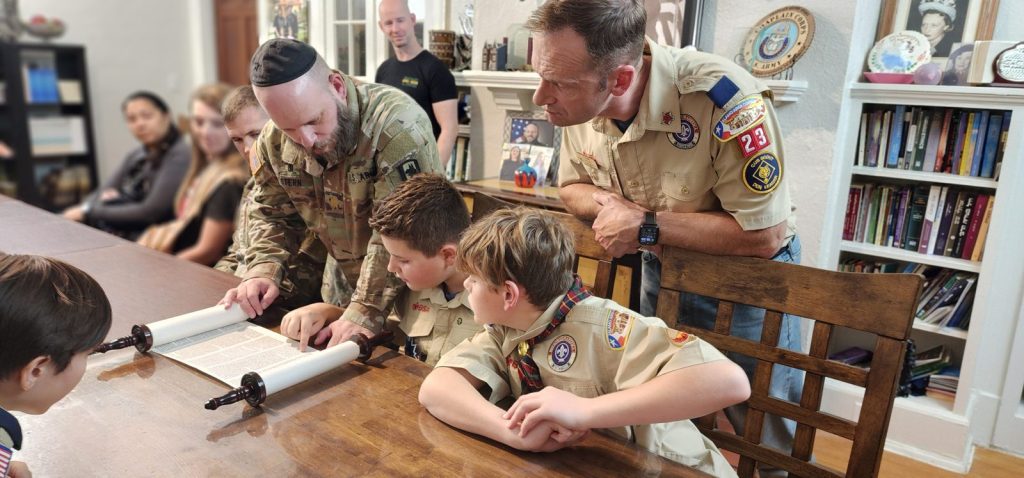
That was one of the roles Rabbi Menachem Stern went on to hold: one of seven military chaplains stationed at the national cemetery, and the only Jewish chaplain among them.
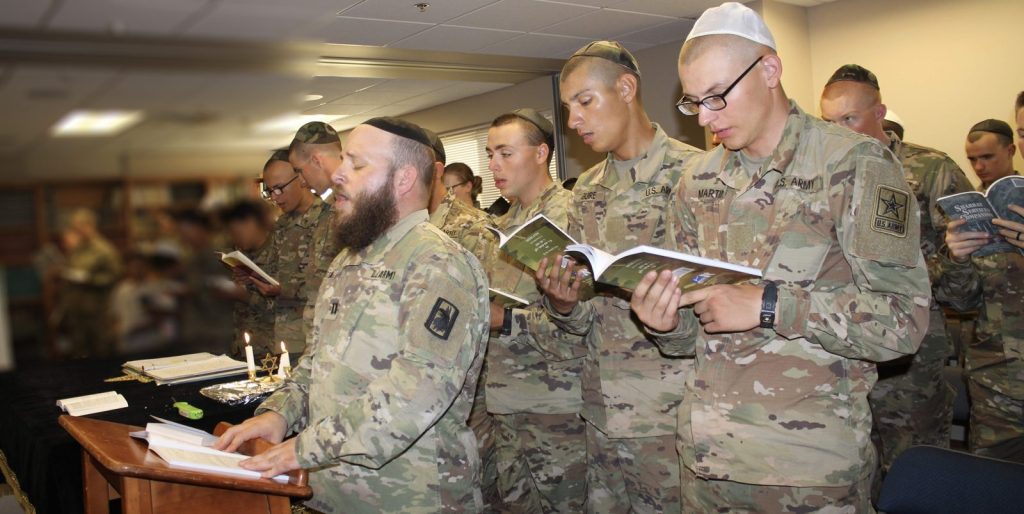
“My job there was to conduct funerals for Jewish soldiers, veterans, and their family members,” he explains. He conducted more than 75 military funerals, helped coordinate the ongoing religious support mission at the cemetery, and served as the Jewish military chaplain for the Washington area, supporting Jewish life for troops throughout the capital region.
Since being commissioned, he has been assigned wherever the needs of the military have taken him: New York, Missouri, Texas, South Korea, Afghanistan, Iraq, Washington, and beyond.
His current chapter has brought him back to Texas, where he was nominated to serve as the Operations Chaplain for United States Western Hemisphere Command. In that role, he helps provide religious support for homeland defense missions, defense support of civil authorities, and personnel recovery coordination, while also serving as the Jewish chaplain for Joint Base San Antonio–Fort Sam Houston.
Along the way, he also represented military rabbis at the lighting of the “National Menorah,” the giant Chanuka menorah standing in front of the White House, at an event broadcast to millions.
“That event is a symbol of Judaism and freedom going hand in hand,” he said then.
Most of his day, however, is filled with quiet work that is not photographed and rarely makes headlines.
Among the Jewish soldiers, he sees a unique phenomenon:
“There is some kind of sudden awakening. You see their neshama, even in soldiers who are disconnected from their Judaism. Look, the average American Jewish soldier did not grow up next to a shul. He is far removed from anything Jewish, and davka in the military, the spark can awaken.”
It is precisely for those sparks that the Stern family home is active.
“Last Shabbos, for example, we had 20 soldiers at our Kabbolas Shabbos service and Shabbos seuda,” he says. “On Shabbos morning they come to my house and we have a shiur together. We’re currently learning Tanya. After the class, we sit down for a grand Shabbos meal. That’s how it is every Shabbos, all year round: American soldiers, some of whom encountered their Jewish identity for the first time in the military, studying Tanya in our home.”
Behind every soldier supported and every duty station served, the mission was entirely a family calling. “My wife and daughters are the heartbeat of our shlichus,” Rabbi Stern emphasizes. “None of this happens in a vacuum. Through every move and deployment, Baila anchored our home, while our girls grew up carrying the purpose right alongside us. They set extra places at every Shabbos table, welcomed every soldier who stepped through our door, and bore the weight of service as a united front. This shlichus was never mine alone; we serve as a team.”
This home is part of a broader network: thousands of Jewish men and women serve across the U.S. military, alongside a growing cadre of Jewish military chaplains, including Chabad shluchim who serve on active duty and in the reserves.
“I’m on active duty,” Rabbi Stern says simply.
But perhaps the best way to summarize Rabbi Mendy Stern’s journey is to return to the answer he received at the beginning of his journey. At the time, he heard the Rebbe explain that there was no need to think about how to illuminate the entire world all at once; one should first illuminate the home, and the light would spread from there.
Since that first phone conversation, Rabbi Stern has gone on to additional assignments and deployments around the world. Afghanistan was not his final stop. In the years that followed, he returned to Afghanistan once again, where he printed the Tanya; served in Iraq; supported missions across Central America and elsewhere; and filled additional roles in places where each assignment brought more stories of shlichus, Jewish souls encountered along the way, and hashgacha pratis accompanying him step by step.
From a young married man searching for a shlichus and unable to find his place, through distant bases in Afghanistan, missions in Iraq and other corners of the world, to senior responsibilities in the U.S. military, the light has indeed continued to spread.
“In the end,” he says, “you try to light the lamp wherever Hashem has placed you. Then you discover that the light reached much farther than you ever imagined.”
When asked to summarize the long journey he has traveled, from the years of searching, through the years of struggling over his beard, the period when he was in limbo, and his military service alongside convoys in Afghanistan, he answers in a single sentence:
“My only regret is that I got into this only at age 29. If I had known about this shlichus at a younger age, I would have enlisted sooner.
“In my shlichus, you see hashgacha pratis all the time,” he returns to the point with which the conversation began, “because of the Rebbe’s koach in every single detail. Our goal is to make a kiddush Hashem, to do what the Rebbe says and hashgacha pratis always shows that it works.”
Beis Moshiach #1524 • י״ד תשרי תשפ״ז • pp. 20-34
© 2026 Beis Moshiach Magazine. All rights reserved.
This article originally appeared in Beis Moshiach #1524. You are welcome to share it with friends and family by email or in print, provided that you do not change, add to or omit any part of it, you credit the author and Beis Moshiach, and you include a link to archive.bmoshiach.org (written out in full in printed copies).
To republish this article in a newspaper, magazine, book or website, please request permission in advance at [email protected].