The Dollar That Survived Two Fires & Built A Mikva in Cozumel
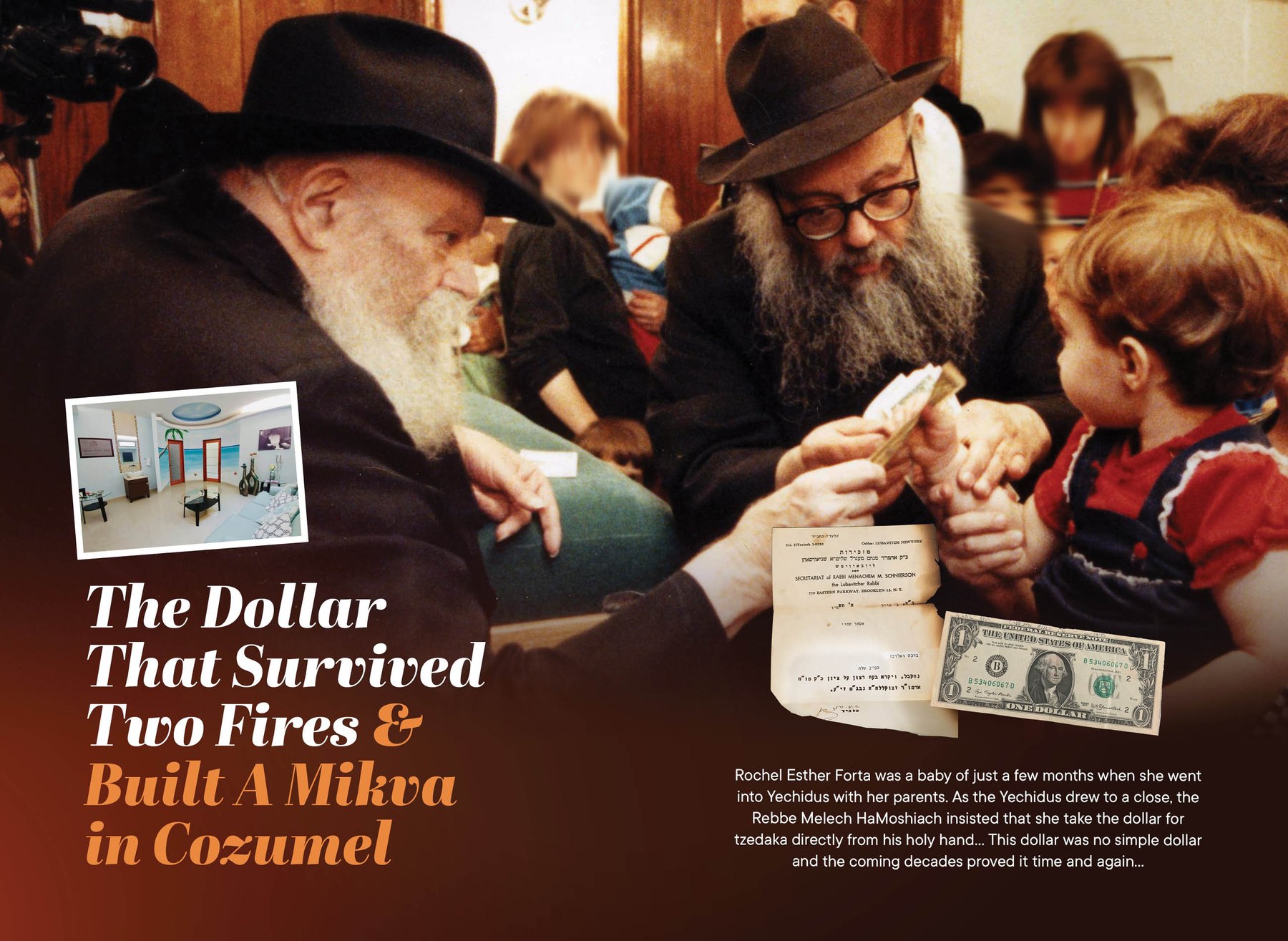
Rochel Esther Forta was a baby of just a few months when she went into Yechidus with her parents. As the Yechidus drew to a close, the Rebbe Melech HaMoshiach insisted that she take the dollar for tzedaka directly from his holy hand… This dollar was no simple dollar and the coming decades proved it time and again…
I
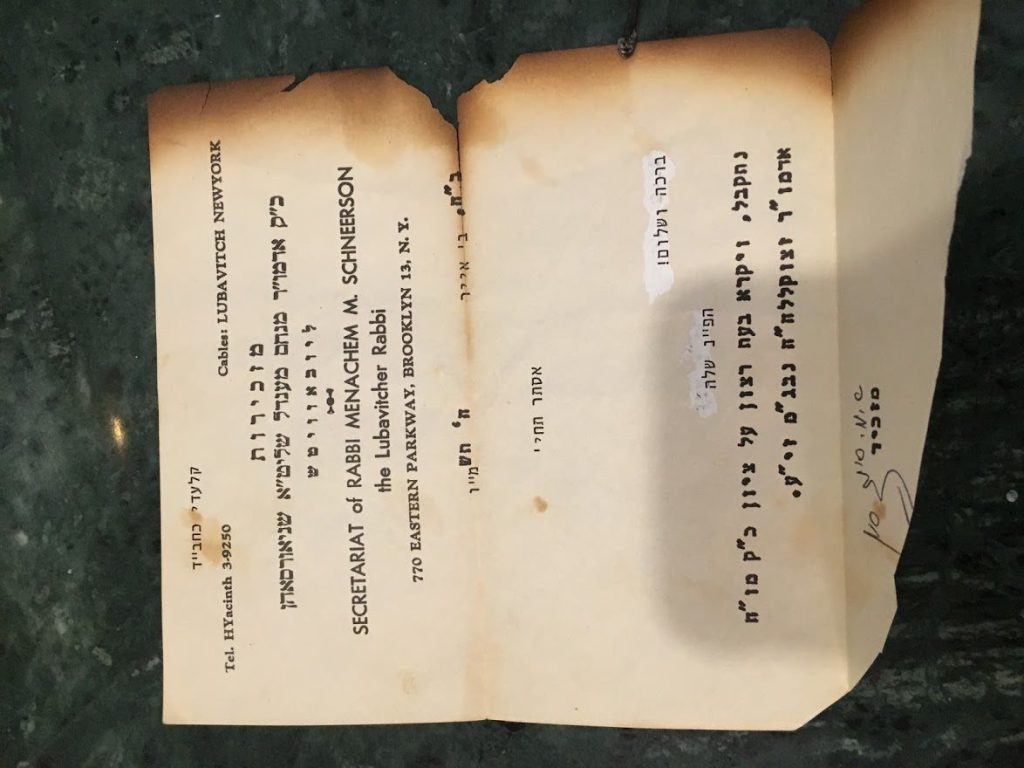
My name is Rochel Esther Forta, nee Kalachy. I was born in the winter of 5739 in the United States. Three days after my birth, my parents received a letter of blessing from the secretaries. After a while, they called the office and asked for an appointment for yechidus. They were given an appointment for 16 Tammuz.
My parents always told me the story of the yechidus and it always remained a mystery to me with the knowledge that one day I would understand.
After a long wait, my parents entered the Rebbe’s office at midnight. They were given five minutes because outside the door stood dozens of Chassidim who waited their turn. The Rebbe spoke with my parents about all of their issues. They always told me that the Rebbe encouraged them again and again about mivtzaim. He spoke about it with a sense of urgency.
Nearly fifteen minutes had passed and the secretary knocked on the door again and again. Then he opened the door and motioned, “That’s it; it’s time to leave.”
The Rebbe gave a dollar to each of my parents and then held out a dollar to me too, but I didn’t take it. I was a baby, just a few months old. A few seconds went by that my father said felt like forever. The Rebbe held out his hand again but I didn’t take the dollar. Again, there were some long seconds.
The third time, my mother with the help of the secretary pushed my hand toward the Rebbe but the Rebbe said, “No, she’ll take it with her hand.” My father said more long seconds passed of silence as the Rebbe focused his full attention on the baby to take the dollar from his hand and not with anybody’s help. The Rebbe insisted on this. I finally took it. That’s the story of my dollar.
The period of private yechidus ended and since then, like everyone else, we participated in general yechiduyos and then the dollar distribution and I collected a number of dollars, but it was the original dollar that interested me. From the story my parents told me, I knew it was a special dollar.
II
Throughout my childhood, my parents lived in Kfar Chabad. About fifteen years ago, they returned to the US. They left many of their important documents in my aunt’s house in Petach Tikva, as well as the precious dollars from the Rebbe.
One summer day, my aunt and uncle left the house, leaving the air conditioner on. At some point, the air conditioner caught fire. When they returned home there wasn’t much to save. My parents’ papers were in the room where the air conditioner was and everything was burned, including many green bills. Despite this, my parents’ bag remained intact! Not one dollar from the Rebbe was burned!
That summer, the dollars were sent to my parents in America. We were all astounded by the miracle. My mother called all the children and said that from now on, she wasn’t taking responsibility for the Rebbe dollars and each one should take their dollars. “It belongs to you, after all, to your families and children.” I was happy to get my dollars.
III
After I married I lived in Crown Heights on Crown Street. Every Shabbos, we hosted dozens of bachurim on Kevutza. Every Shabbos there was a new light in the house in the form of farbrengens late into the night. Hundreds of bachurim, precious tmimim, were hosted by us throughout the year, every year. My husband loved them; the atmosphere, the niggunim, it was “me’ein Olam Haba!”
One year, toward the end of the Kevutza year, the bachurim began saying where they were going after Kevutza. Some were going on shlichus, to Mexico, Venice; one to yeshiva in Eretz Yisrael and one to Australia or India. There were two who planned on going to Sri Lanka.
I was excited for them and suggested to my husband: Let’s also go on a year of shlichus to Sri Lanka. We’ll put regular life on hold and help the Chabad House. We’ll do something good and useful for the world.
I had given birth to my daughter two weeks before and my husband just patiently said, “Take it easy.”
As time went on, I got back into routine. We hosted thousands of guests at meals around the clock. The ‘normal’ events of Tishrei with the Rebbe were a once-a-year amazing experience. Your house turns into a Chabad House in front-line mode.
IV
In the summer of 5768, our landlord told us that we have to leave the apartment because he was selling the house. The Antians lived downstairs and they found another apartment. The pressure mounted for us. Looking for a three-room apartment in Crown Heights is a long story. All summer long we saw more and more hovels at the bargain price of $2000 a month. We found nothing. My husband promised me that we’d move before Rosh Hashana.
On Thursday, four days before Rosh Hashana, our good friend called and told us about a new building. He got the phone number of the landlord who said we could take a look at it and he would get back to us later.
We loved it. $2400 a month with three months’ payment upfront. We somehow put the money together and called him back but he didn’t answer. Hours went by and there was no response. Shabbos began with the feeling of Rosh Hashana is on Monday night and we don’t know where we are going to live.
Shabbos afternoon I sat on the porch with my neighbor, Mrs. Holtzberg (mother of Gavriel Noach, Hy’d) and she told me that she finished cooking all the meals for Yom Tov and censured me for always starting on the day of Yom Tov despite all the guests we have.
Sunday, we tried reaching the landlord of the new apartment. He finally answered at one in the afternoon. We signed a contract, got the key and it was time to get down to work. How to begin? What to move now and what to move after Yom Tov? We did a quick assessment of the situation and decided to move what was urgent: The Shabbos table, beds, and some clothes. The rest we would move more gradually.
The living room was full of huge black bags containing the children’s clothing, towels, linens. I was wiped out from the stress. A long night lay ahead of us. We finally decided: I would take the children to the new apartment and my husband would continue packing.
At night, I found it hard to sleep. An empty house… a different smell…
At five in the morning I got a call from my husband, “Don’t ask what happened! Come right away!”
“What? What happened?”
I ran toward our old house. As I reached the block, I already smelled a burning smell. The house was completely burned. Despite the early hour, the entire neighborhood was outside. Monday morning, erev Rosh Hashana 5769. The last day of the year.
My husband had dozed off in the house in the middle of packing and he suddenly woke to see flames. He began screaming, “Help!”
It was a five alarm fire. In the room that he slept in only the walls and the iron coils of the mattress remained. The rest had turned to ashes. I cried with mixed feelings; joy over the miracle that my husband was alive and sadness over being left with nothing. It was Rosh Hashana that night. What now?
Mrs. Holtzberg hugged me and I said to her: Oy, Freida, you cooked for the entire chag, what will you do now? The fire had burned half her house too. Boruch Hashem, at least they were insured.
I went into the house and I can’t even describe what it looked like. I saw my husband alive and well and was overcome by emotion. The only thing I could utter was: Where are the dollars from the Rebbe?
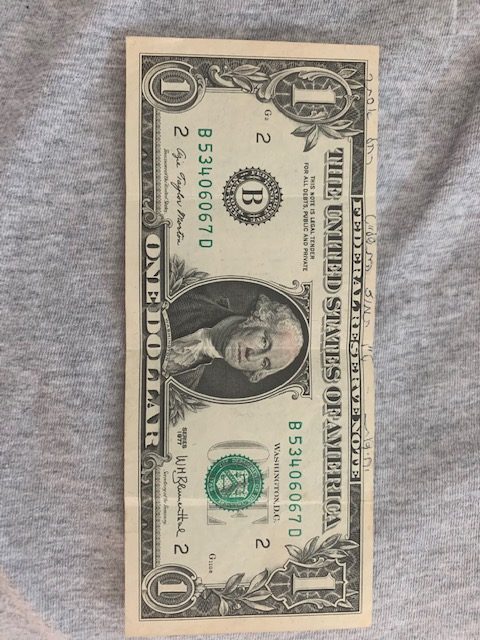
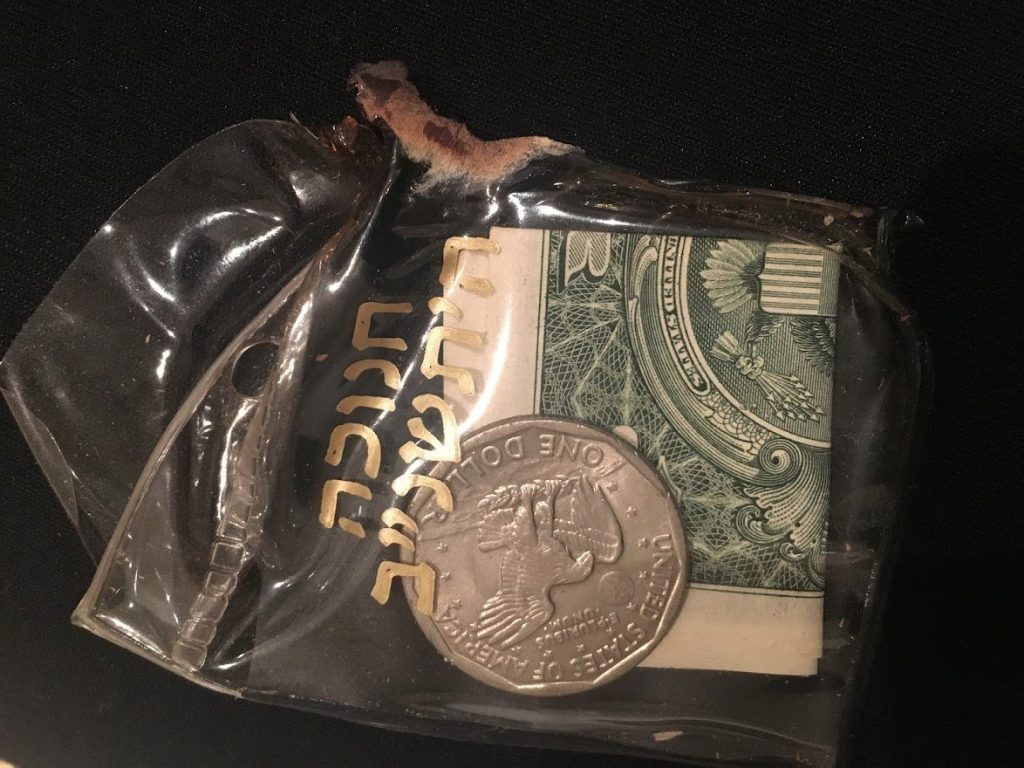
I went over to the library, or to be more precise, what was left of our library, on the right side, the top shelf, everything was burned. No! It couldn’t be… I reached and found a burned envelope. Deep inside, I knew… inside were the dollar bills, slightly blackened. Inside, there was another envelope with a special dollar from the Rebbe that I received in yechidus. Completely green. This dollar had been in a fire twice and was saved! What a miracle!
I went in further to what was once called a house. In the children’s bedroom, the wall had melted from the heat; nothing remained. The big bags in the living room had also burned. We were left without clothes, without a wig, without jewelry, without sefarim or couches. The electronic appliances had melted. All documents were destroyed including passports, social security, etc.
I suddenly felt that nothing mattered; the main thing was that I had the dollars from the Rebbe. The fire chief said, “Madam, you must thank G-d that you have a husband!” It was more than that. We could all have been in the house. The children’s bedroom should have been occupied and if it had been, there is no way anyone would have survived.
The neighbors downstairs who gathered around my husband reminded him that two years earlier, he had saved a woman from a burning house.
V
Two years before, a fire had broken out in a house near us. It was on Tisha B’Av. We were sitting on the back porch and suddenly smelled the strong smell of smoke. Before I even got to my front porch, everyone was screaming, “Help! Fire!”
They cleared out all tenants from the house except for one woman who lived on the top floor. She ran to the porch but she had gotten herself into a fire trap without being able to escape. Everyone yelled from down below, “Don’t worry, the firemen will soon be here to rescue you.” But many precious minutes passed before they arrived and the fire had spread and the woman was in a panic.
My husband got up his courage and ran inside and got her out. She and her husband kept thanking him for the miracle. The firemen arrived as they do in New York, with eight trucks. The entire block was closed off. It looked like a war; so many firemen, hoses, children, women and husbands.
It took three hours before everything quieted down. My husband didn’t stop coughing. He had inhaled too much smoke, but what did that matter when he had saved a woman from a fire.
VI
That Rosh Hashana 5769 we had mixed feelings. We ate out all the meals, which we hadn’t done in years. We had always hosted.
Yom Kippur, Sukkos. We, who had hosted 120 people at each meal, had no sukka. We decided to go to Detroit for a change of atmosphere. The entire trip we felt that these chagim were not the usual; everything was so different, so foreign.
The children went back to school and we tried to get back to routine but it wasn’t easy. Everything felt different. Scenes of the fire kept coming back to me, sweet memories of the home turned to ash.
Then came the horrific news about the murders of the Holtzberg couple, son of our neighbors. We were heartbroken. Gabi’s parents still hadn’t returned to their home after the fire. They were living temporarily in an old basement apartment.
For me, it was all too much. Getting up and then falling again. That’s the way it was all winter. Real estate plummeted and the parnassa of many families was affected. This was a very difficult time for my husband and I felt he needed a break.
We decided to go on vacation. It was very cold in New York and we wanted some sun, some hope. I asked Hashem to take us somewhere warm. We went to Cancun, Mexico. First, we called the Chabad House to ask if they needed anything. The shlucha had just given birth and she said she had recently returned from New York and brought whatever she needed.
They were happy to help us but said there wouldn’t be Shabbos meals in the area of the hotels because she was still recovering. We prepared for Shabbos ourselves with food, challa, wine, smoked meat and all the rest. We left our children with out parents.
We arrived in Cancun. It was my first time in Mexico. The sun was shining and it was hot outside. I said, “Thank you, Hashem! I didn’t expect a delightful warm sun in the middle of a snowy winter.” I felt the wonders of the Creator.
It was a beautiful place with amazing beaches in a color unlike anywhere else in the world. And there was snow in New York!
Erev Shabbos. We called the Chabad House to find out when candle lighting time is. The shliach who answered the phone said, “Just this morning, I checked my emails and saw that a Jewish delegation that sent me a message half a year ago, said they were coming for Shabbos, and I had completely forgotten about it. So, there will be a Shabbos with meals and you’re invited to join us.” I felt bad for the shlucha who had to arrange this at the last minute.
Our hotel was far from the Chabad House but we decided to go for the davening and meal anyway. As in many Chabad Houses, during the meal each guest said something about himself. I told them the story of the fire and the miracle of the Rebbe’s dollars.
After we returned home, feeling rejuvenated, I opened to an answer in the Igros Kodesh about the need to tell about miracles. The Rebbe wrote, “Thus shall you do and it’s good that you did so.”
VII
Pesach was coming. Cleaning, organizing, hosting, a good feeling about the holiday of freedom. Then, on Shevii shel Pesach, I asked my husband whether he had ever dreamed of the Rebbe. He answered with a mysterious smile, “Yes, several times.”
“How is it that you never told me?!”
“The last dream I had took place recently. One day, I’ll tell you.”
I was astounded and wanted some details. When, how, what did you see. Based on his reaction, I knew I had to wait patiently.
One day, he told me a dream. In our conversation afterward, he reminded me of the desire I had had to go on shlichus to someplace faraway.
“So, the time has come,” he said.
I smiled to myself and thought, who would have believed… I felt that something in our life was going to change. I knew that if we were going, it meant leaving the family, the business, the schools, and the conveniences of community life.
After Shavuos of that year, my husband and brother went to check out Cozumel in Mexico and to prepare for our coming. Boruch Hashem, they were successful and we began preparing to go on shlichus with all the children. The first thing we wanted to do was open a camp for children.
There weren’t many Jewish children in Cozumel, only seven, but we didn’t look at quantity; just quality. Out of every small sapling there will grow a big tree. That was the gist of the Rebbe’s first answer at that time.
We told our family and friends what was going on and they were supportive, even those who didn’t understand how we were going to a place that so many were fleeing because of a swine flu outbreak.
Throughout summer vacation, the children were excited about our shlichus. The truth is, we didn’t know for how long we were going, whether until after the chagim or for significantly longer.
In Crown Heights, children had left for camp, while we still didn’t have passports or tickets. We made countless trips and phone calls to various offices and they all asked for two pieces of identification for us and the children, but we had nothing. Everything had been destroyed.
Thank G-d, we finally managed to work things out. The passports finally arrived and we bought tickets. Because of the flu outbreak, prices had gone down drastically. That was part of the hashgacha.
When Gavriel Noach’s father heard we were going, he gave us the first check to buy equipment for the Chabad camp in Cozumel, named for his son and daughter-in-law, H’yd.
We packed everything up and all I had left to do was put the envelope with the dollars from the Rebbe into my personal bag. I washed my hands and said to myself, it’s been a long time since I’ve seen these dollars. I opened the burned envelope and inside was the second envelope with my special dollar.
Until that moment, I didn’t know what this dollar was for. I knew one thing: It was a special dollar that I received from the Rebbe and it went through two fires and remained unscathed. This thought alone was enough to move me greatly. Until that day, I hadn’t felt any special siman in connection with the dollar, and then suddenly, it happened.
I opened the second envelope and read out loud: 16 Tammuz 5739. Yechidus Pratis. My heart stopped for a second. Then it began pounding. That day was 16 Tammuz 5769, exactly thirty years since I received the dollar from the Rebbe.
My dollar finally had a purpose. I had always wanted to know what it symbolized and what its destiny was. The feeling was like that of working on something and suddenly finding the solution.
VIII
We arrived and were happy to meet with children and Jewish parents who live here. In short: our new family.
We began our shlichus. It wasn’t easy. After working for six to seven hours with children who barely understood me, I began feeling the difficulties of shlichus. The terrible heat. The nerve-wracking sweat, and mainly the mosquitoes that don’t stop biting. Ants everywhere, including the wall overhead. You can’t manage for a minute without air conditioning.
What did I do? Where did I go? I cried. At first, it was an inner cry but I quickly allowed myself to have a good cry until I started feeling better. That’s when I felt I could come to the decision to give myself over to the Rebbe. This is my shlichus and here is where I’d do my best to carry it out.
After a few days, we moved to a more spacious apartment and the Chabad House moved to our house. Every evening we hosted tourists for supper. We had Shabbos meals in the living room for about forty, just like we did in New York, but over here, it’s a different crowd. It fills you and changes you from within. Something about shlichus make you better, for yourself and for others.
IX
Tishrei 5770 was approaching. There was a lot to arrange. I went to the Rebbe for a week while my husband and a bachur continued the shlichus work.
On the way back to Mexico, a Jewish woman sat next to me and we got to talking. I told her about our move and our work and she promised to come for Rosh Hashana.
On the bus from the airport I met another Jew, an Israeli who was in middle of a trip. Of course, he would join us too. We collected Jews from all over: students, Israelis touring after the army, Jews from nearby cities and of course, the people in our community. We took care of Shabbos and holiday meals and the needs of tourists. We had farbrengens till the wee hours of the morning. With every passing holiday we had more and more stories of neshamos and hashgacha pratis. We didn’t even have to put on glasses; we saw Geula!
After Simchas Torah, our children learned with one of the bachurim who came to help us and the Jewish preschool in Cozumel opened with three children: my daughter Shaina, Shirel and her brother, Tal. I taught the children in the morning and in the evening, I gave shiurim to women.
Chanuka was approaching. Again, intensive work with public menorah lightings, a Chanuka party in our city and the neighboring city, learning about the chag, and a latke/doughnut party.
Then we suddenly had to move. The landlady was unwilling to extend our lease. We lived right near the Chabad House and every week we had many guests who attended farbrengens and Shabbos meals. The neighbors didn’t like the noise.
It’s an area with eighty apartments and many were available for rent but nobody would rent to us. We went to various real estate agents and even looked at an available apartment, but were told that the neighbors spoke with everyone and warned them not to rent to us. The challenge of finding an apartment became impossible. All apartments in the center of town were occupied.
If that wasn’t enough, it was the start of the season when Americans come to Mexico, fleeing the cold. They come to warm Cozumel and we didn’t have a place to host them. What would we do?
We looked for an apartment for two weeks but didn’t find one. We had to leave by Shabbos. We explained about the holiness of Shabbos and were told we could leave on Sunday.
Tefillos, only tefillos help!
Friday morning, I was in the preschool, in the middle of Shacharis. My husband and the bachur were waiting for me to finish davening. They told me about a Jew in Florida who has an empty apartment in Cozumel. They contacted him and he was willing to rent us his apartment. The problem was that his apartment was located on the northern side of the island, an hour’s walk from the Chabad House. We went to see it and suited us.
We tried not to think about the long walk on Shabbos in the Mexican heat; we were just happy about the miracle. We packed up with the help of the bachurim. The living room was chaotic, full of bags and packages.
We hosted many guests for Purim in our new home. We read the Megilla, danced, had mishloach manos and of course, a Purim seuda which turned into a long farbrengen.
On Pesach, we hosted some people, including locals. One of the prominent Jews on the island who always helps with the Rebbe’s inyanim, got up in the middle of the meal and said to us, “I will tell you a story about the Rebbe. I am a miracle of the Rebbe!”
He had been wounded in the army and doctors said he would be paralyzed forever. His parents were in New York at the time and his mother went to get a dollar from the Rebbe. When she passed by the Rebbe, she received a dollar but was unable to say anything. She had already walked out of the building when she was called back to the Rebbe. “The Rebbe is calling you!”
She stood before the Rebbe and the Rebbe said to her, “You have a son who is a soldier. This is for good news.”
“I recovered, against the odds,” said our guest. We were all stunned. He knew us for a while and had never told us this before.
X
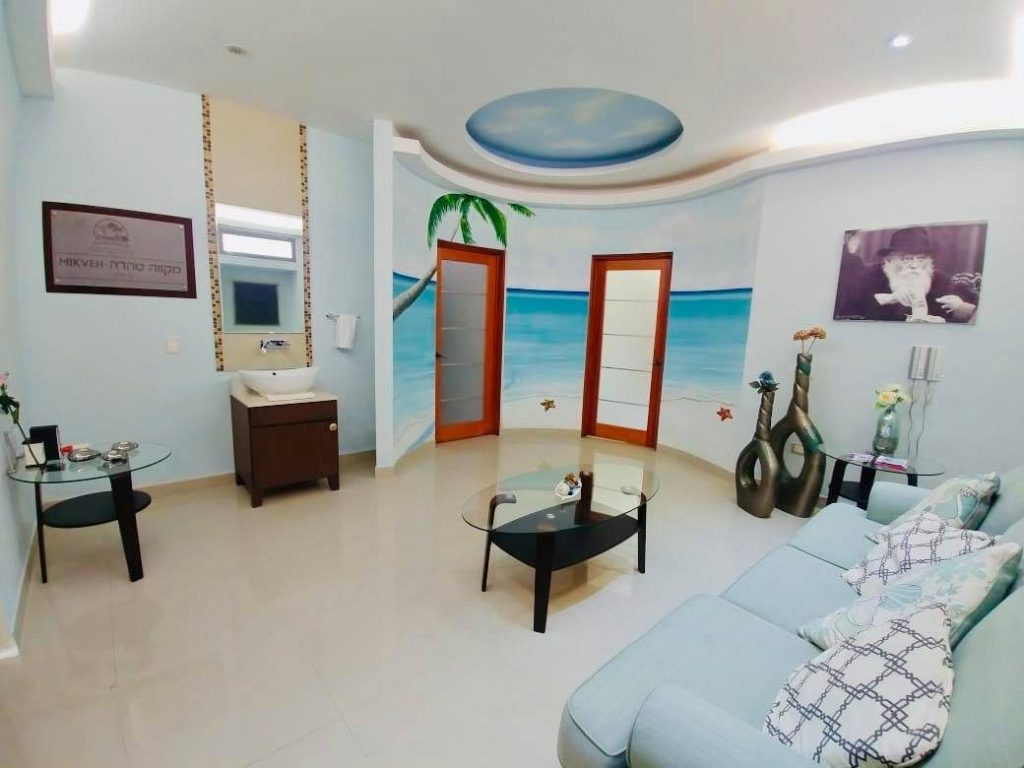
Our first year on shlichus came to an end and it was time to build a mikva. Until now, immersions were in the ocean and sometimes it bordered on the dangerous. We spoke about it with some Jews who came from Mexico City to spend Yom Tov with us. One of them promised he would help with a nice donation.
One summer Shabbos, we hosted a Chassid, Rabbi Shlomo Markowitz, who helps many shluchim. He came to the Shabbos meal with his wife and with another couple. They were so excited to see the work we do. In the middle of the meal, after saying l’chaim, we told them the story about my dollar. I added that after the fire in our house, my husband and I decided to go on shlichus for three months, even though we are business people and what did shlichus have to do with us.
It was on that Shabbos that I made the decision to donate my special dollar toward our work. Until now, it was my personal dollar; now, it would become dedicated to the shlichus.
After Shabbos, R’ Markowitz invited us and the bachurim, Dovid Caplin and Shlomi Peleg, to his hotel. We sat there and farbrenged. He said he remembered the story of the fire and how my husband had been miraculously saved as well as the precious dollar from the Rebbe.
“And you are donating this dollar toward the mikva,” he said emotionally, and began to cry. The truth is, we were a bit stunned.
When he calmed down, he began to relate:
“I came to the island in order to meet with a local businessman, a goy. He suddenly canceled the meeting and we remained stuck here and came to your Chabad House. After you told us about the dollar from the Rebbe and that you are donating it toward the mikva, I decided that the money I was supposed to give to the goy, I’d give to you, for the mivka.”
And he cried and cried, along with his wife.
“I had a son, Shachna, who went to camp and drowned in a river. I want to be a partner in the mikva, l’ilui nishmaso.” As he spoke, he got up and went inside and came back with an envelope with a nice amount of money to build a mikva.
The beginning was good but all beginnings are hard. For some reason, the mikva project dragged on and on. When I went to 770, I stood facing the Rebbe’s place and asked that we get land for the mikva. We had seed money but no land.
My father, Rabbi Yishai Kalachy was involved throughout. He felt it was his inyan. I kept updating him about what was going on and he strongly encouraged me.
XI
At a certain point, when I was back in New York after shopping before Rosh Hashana, I got a call from Cozumel and was told to go to Manhattan to meet with Mr. Albert Gad. He’s from a family that has many properties and businesses in Cozumel.
I went to meet with him and we miraculously got from him a piece of land in the most central part of the island. Since my father had constantly instilled in me the business side of shlichus through his smart advice and ideas, I called Mr. Gad and said, “A word is a word; we need your signature to transfer ownership.”
We held the cornerstone laying ceremony for the mikva and then many problems cropped up. The middle management people in the company were upset, why did he give us land in such a central location, for a mikva that was neither a business nor profitable.
The months passed and construction began a year later. Throughout this time, I opened to answers from the Rebbe about a mivka. The Rebbe wrote that a soldier cannot leave his position if there is no one else to take over.
I was busy all day doing outreach work with the tourists, the ladies of the community, the school and preschool – but hovering above all was the project of my life; the mikva. There was a point when I had enough and wanted to leave and return to New York. I called my mashpiah and she laid down the law; as long I had no replacement I couldn’t leave.
Shlomi Peleg was a chassan but he delayed after the wedding and had yet to return to Cozumel. We waited for him to come to give over the reins.
We ended up returning to New York after five years on shlichus and after ascertaining that Cozumel was in good hands. Three years passed and the mikva project was complete.
My father gave us a lot of advice, worth gold. Whatever he advised is how it worked out. He thought that the Rebbe’s dollar didn’t need to remain “stuck” in Cozumel. I did the work, meaning that the dollar had done its work and now it was time to move on. He knew that the dollar has spiritual power.
On 2 Iyar 5780, my father called and asked me to take my dollar and do a certain thing with it on the Rebbe’s shlichus, something urgent. I sadly told him that the dollar was still in Cozumel. He was disappointed. He wanted the dollar to always be with us and help us and be a kind of “shliach mitzva.”
“What else do you have from the Rebbe?” he asked me and I said I had a letter from the Rebbe from 2 Iyar (a letter I received on a special occasion from someone). My father asked me to go with the Rebbe’s letter and do what he asked. “Make sure your dollar comes back to you and bring it to other places where things need to happen.”
I considered this a testament from my father, that the dollar itself go on mivtzaim.
XII
Sukkos 5781. As I was in 770 for Shacharis, someone came over to me, a girl who had become interested in Yiddishkeit and Chassidus, and said, “Come. You must meet someone.”
She introduced me to Mrs. Rivka Zajac who told me a story from the Rebbe Rayatz and I suddenly began to cry. Someone had told her that I was sensitive since my father had passed away a few days before and his matzeiva had just been put up erev Sukkos.
I explained to her what was on my mind. “I feel that I didn’t do what my father wanted with the dollar.”
“Don’t worry,” she said. “Come to me after Yom Tov and I’ll give you a dollar from the Rebbe,” and she gave me a big hug which gave me so much strength. I felt that my father had sent a different dollar to me. After a long week of emotional turmoil, I suddenly felt calm.
Someone said to me, “See how your father, who spoke to you about the Rebbe’s dollar during his last weeks, saw your anguish from above and wanted you to be calm. In the end, a dollar came to you; a dollar from a special woman who was a devoted shlucha and went through two eras, that of the Rebbe Rayatz and of the Rebbe.”
After the first days, I went Mrs. Zajac’s home and she told me how the Rebbe Rayatz sent her father-in-law to Brazil in 5704, and how she had been in yechidus with her parents in 5707. The Rebbe was her mesader kiddushin in 5717 and for many years, she was a shlucha in South America.
XIII
Ten years passed since I donated my dollar for the mikva in Cozumel and suddenly, in Iyar, my father asked me about the dollar and said it had to continue its shlichus. When I said that I had already donated it to the work in Cozumel, he said to send another dollar in its place and to take mine back. I had thought the dollar’s destination was the mivka but my father didn’t think so.
I constantly think about what is the point of this dollar and what was behind my father’s request. In our family, we have other dollars we received from the Rebbe over the years and on different visits, but this dollar that the Rebbe insisted that I take when I was a few months old, on 16 Tammuz 5739, was the most precious to him. My father reminded me that in that yechidus the Rebbe spoke very strongly about mivtzaim. He felt there was a connection between this and the dollar that the Rebbe insisted I take by myself.
I know that this dollar helped us complete the mikva project in Cozumel, but it seems it didn’t finish its role. I need to ensure that “my” dollar continues its journey to serve as an impetus for mivtzaim, building and expansion etc. I want to ensure that the dollar reaches new places where practical action is needed and I can be contacted about borrowing this special dollar: [email protected].
Beis Moshiach #1433 • pp. 10-21
© 2026 Beis Moshiach Magazine. All rights reserved.
This article originally appeared in Beis Moshiach #1433. You are welcome to share it with friends and family by email or in print, provided that you do not change, add to or omit any part of it, you credit the author and Beis Moshiach, and you include a link to archive.bmoshiach.org (written out in full in printed copies).
To republish this article in a newspaper, magazine, book or website, please request permission in advance at [email protected].