Preventing the 6,000,001st Victim
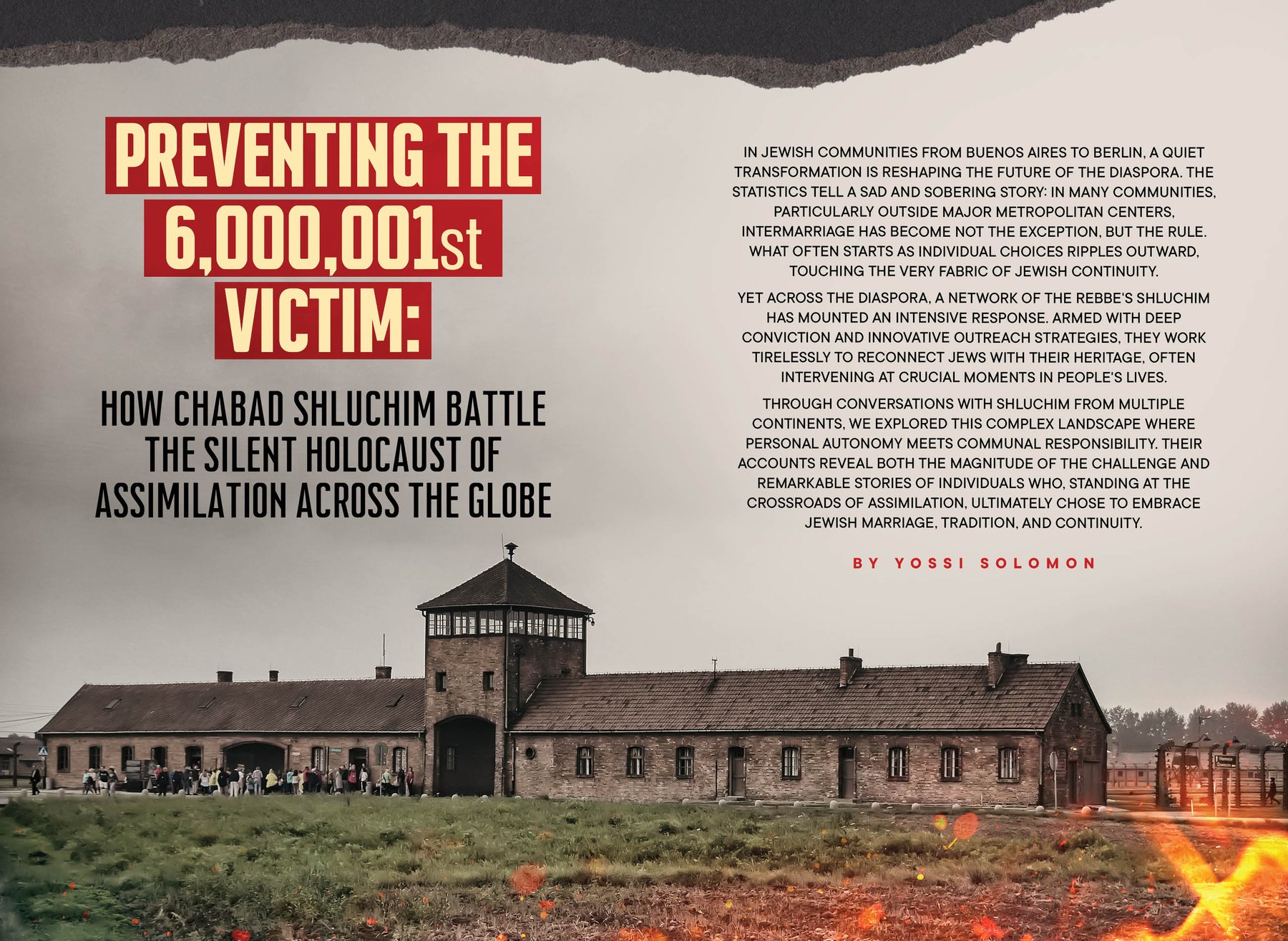
In Jewish communities from Buenos Aires to Berlin, a quiet transformation is reshaping the future of the Diaspora. The statistics tell a sad and sobering story: in many communities, particularly outside major metropolitan centers, intermarriage has become not the exception, but the rule. What often starts as individual choices ripples outward, touching the very fabric of Jewish continuity. Yet across the Diaspora, a network of the Rebbe’s shluchim has mounted an intensive response. Armed with deep conviction and innovative outreach strategies, they work tirelessly to reconnect Jews with their heritage, often intervening at crucial moments in people’s lives. Through conversations with shluchim from multiple continents, we explored this complex landscape where personal autonomy meets communal responsibility. Their accounts reveal both the magnitude of the challenge and remarkable stories of individuals who, standing at the crossroads of assimilation, ultimately chose to embrace Jewish marriage, tradition, and continuity.
Almost every Jew in the diaspora has encountered this up close: a friend who started a “friendly relationship,” a neighbor who met a non-Jewish woman, or a family member who abandoned our heritage and met a non-Jewish girl and the relationship with her grows stronger and stronger.
The phenomenon of assimilation determines the future of our people. No, this is not a social challenge, but a spiritual catastrophe; a quiet yet turbulent destruction of the Jewish people.
According to estimates, tens of percent of diaspora Jews marry non-Jews. In many communities – especially outside the major cities – assimilation is the norm and not an anomaly. It comes in the guise of openness, acceptance and personal freedom – but its results are deadly in terms of the existence of the Jewish people as well as Jewish identity.
Facing this harsh reality, the Rebbe’s shluchim fight with vigor, passion and a sense of responsibility with the goal of saving every Jewish soul.
Recently we spoke with shluchim from around the world, and heard from them about the phenomenon, about what really happens in the field. Is it possible and how can one fight assimilation in such a liberal era? We also heard stories about Jews who were on the verge of assimilation, but ultimately married k’das Moshe v’Yisrael.
From The Field: The Harsh Reality In Jewish Communities
How much is the issue of assimilation felt in your area of shlichus?
Rabbi Disraeli Zagury, the Rebbe’s shliach to Belém, Brazil: When we arrived here in 5744 (1984), assimilation rates stood at about 75%. Over time we began an outreach campaign to the city’s Jews that it is forbidden for a Jew to assimilate, since their children will be non-Jews and thus their Jewish lineage will end. Also the conversion process that is done only for the purpose of marriage is not genuine.
Over the years we managed to reduce the assimilation rates and at a certain stage we reached only about 10%! Unfortunately, it rose again and today it hovers around 25% in my estimation.
The Jewish community here today numbers about 800 people. Many young people married Jewish women from outside Belém, and left the city.
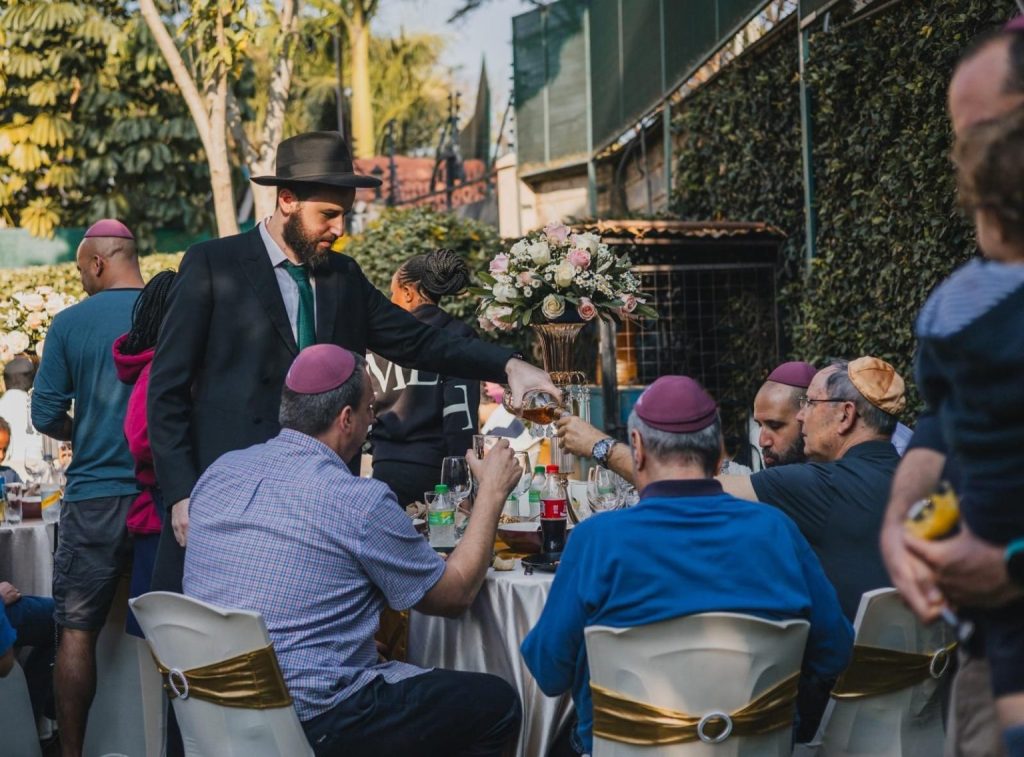
Rabbi Levi Notik, the Rebbe’s shliach to Kenya: We arrived here two years ago. The local community consists about 500 Jewish families. The phenomenon of assimilation here is estimated at about 80%. This is a sensitive issue that sometimes shluchim, without paying attention, flee from.
Why?
Because what, for example, would you tell an older man – to leave his wife with whom he has lived for decades?!
In Africa, this phenomenon of assimilation is a real epidemic. We decided in advance that we would tell the truth as it is, of course out of Ahavas Yisrael and with politeness, but without glossing over. There are non-Jewish women, wives of Jews, who come to community events such as Shabbos meals and there is nothing to do about that. But for events like an aliya to the Torah in the shul, or children’s camp activities – this is intended only for Jewish children.
Rabbi Yonasan Markowitz, the Rebbe’s shliach in Kiev: Assimilation is very noticeable since in the Soviet period many Jews tried to marry non-Jewish spouses. Of course there were also those who were particular about avoiding this.
I have a friend in his 70s, whose mother demanded that he marry only a Jewish woman, and made it clear that this was important. He thought his mother didn’t understand and married a non-Jewish woman to whom he is married to this day. I also have a friend whose partner is non-Jewish, but his daughter decided to convert, and last week I traveled to Eretz Yisrael in order to conduct her chuppa and kiddushin…
Rabbi Yossi Levy, the Rebbe’s shliach to Manila, Philippines: Assimilation here is definitely felt. The community is mainly composed of Israelis who came here, and it numbers about a thousand Jews and close to half of them assimilate. This is a problem that we are forced to deal with quite a bit.
When you arrived at your place of shlichus – was the issue of assimilation part of the goals you saw the need to address, or is this a phenomenon that became clear only once you were there?
Rabbi Disraeli Zagury: This is a very widespread phenomenon, not only here but throughout the world, especially in small communities like ours. When a Jewish young man has only three or four Jewish girls his age – the marital horizon is very limited, and then the phenomenon of assimilation increases. So I knew from the start that this is a fundamental issue that requires serious and deep attention.
Rabbi Levi Notik: Certainly, the issue of assimilation was at the forefront of our minds from the day we arrived here. One of the things that bothered me most when I heard about the possibility of going to Kenya, was that people said: “It’s shocking what happens there – but there’s nothing to be done.” And I said – “I’m sure it’s possible to put a stop to this.” Boruch Hashem, we’ve only been here two years, and we’re already seeing beautiful results.
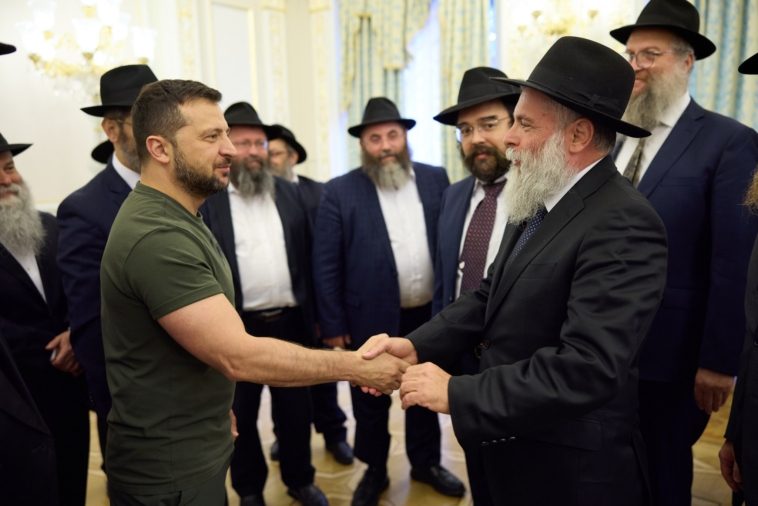
Rabbi Yonasan Markowitz: When we arrived on shlichus, we didn’t give it any special thought. We weren’t aware of how serious the phenomenon was. In fact, we discovered that most of the Jewish population is married to non-Jews. This was very surprising. We knew indeed that during the Communist period it was forbidden to maintain a Jewish way of life, but we thought they at least preserved marriages within the community. Unfortunately, we discovered that this was not the case.
Rabbi Yossi Levy: We didn’t imagine that we would need to deal with this issue on such a scale. This is an issue that went on to become central to our shlichus as we began to get to know the community’s situation in depth.
‘The Silent Holocaust’
The issue of assimilation is a difficult one, an open and bleeding wound in the Jewish people. The Rebbe invested great efforts to stop the bleeding, both through his shluchim around the world, and personally when he often convinced Jews not to marry non-Jewish women.
Assimilation has another harsh nickname: ‘The Silent Holocaust.’ Just as in the Holocaust the Jewish people lost six million of its people, so in assimilation the Jewish people loses millions and this causes the reduction of the Jewish people from generation to generation. ‘The Silent Holocaust’ is also an expression intended to sharpen the perception that assimilation is a holocaust, a disaster and destruction.
In this context, Israel’s Prime Minister Golda Meir is credited with the harsh statement that shocked many: “As far as I’m concerned, every assimilated person joins the list of the six million.”
About thirty years ago, young Knesset member Binyamin Netanyahu, today Prime Minister, stood at the Knesset podium, and called out sharply: “What has been created in the last half century, since World War II, is a threat of silent destruction, of a silent holocaust, through which many Jews disappear through assimilation, or through intermarriage, or through Jewish children who are not born.”
The shluchim with whom we spoke, from Africa and Ukraine, from Brazil and the Philippines, are not surprised. They know this disaster from up close, and they deal with it day by day.
Success Stories
Can you share a story where a Jew was facing marriage with a non-Jewish woman, and ultimately changed his mind?
Rabbi Disraeli Zagury: A Jew from the community met a non-Jewish woman and wanted to convert her in order to marry. I told him: “Your brothers also did this, but their wives don’t observe anything. If there’s no real acceptance of mitzvos and not just lip service – there’s no conversion here.” He claimed that unlike his brothers, he does observe mitzvos, so his wife will also observe following him.
During the conversation I suggested he come visit my house the next day. Afterwards I thought to myself “What did I do? We won’t convert her.” I called my rabbi and he told me: “Put on a show. Take candles, a thick sefer, speak only with the girl and tell her: ‘The Nazis wanted to destroy the Jewish people and didn’t succeed. If you marry him and don’t observe mitzvos, you’ll prevent the continuation of Judaism through his line. You’ll be worse than them…’”
I did so and she was frightened. Two days later he called and told me he separated from her. Today he davens at the Chabad house, puts on tefillin, observes Shabbos and kashrus…
Rabbi Levi Notik: When we arrived here, I met a young Jewish man from Belgium who had a Kenyan girlfriend. The two began talking about the possibility of marriage.
From when I arrived here, we have a good relationship; today we also have a chavrusa in Tanya that has been going on for over a year and a half. One day he came to me and said he understands there’s a problem with marrying a Kenyan, but it doesn’t bother him, and he’ll probably marry her. I told him that if it really didn’t bother him, he wouldn’t have come to talk to me about it… I explained to him at length that it’s not good for him personally – not only because the Torah says so – but also because I care about him personally.
Afterwards, I saw that the Rebbe speaks about how one needs to speak to a person from a place of personal concern. And indeed, after two hours of conversation he decided not to marry his non-Jewish girlfriend.
Last week a young man called me and said he wants to talk to me. I asked if he’s here with a partner, and he shared with me that he met “the love of his life.” I told him that now he thinks she’s the love of his life, but it’s not that simple. I explained to him that his children won’t be Jewish etc. He told me that it’s since he’s with her that he began to keep Shabbos…
I suggested that I sit and talk to him in order to present him with another angle on the subject. He said he very much appreciates this, and told me that until he was 25 he grew up in one of the large Chassidic courts in New York, and therefore he understands the importance of hearing another angle.
I told him that since my wife is about to give birth, I can’t invite him now, since my schedule can change in an instant, but he’s certainly welcome to talk after the birth.
After two-three days he called and told me that he thought a lot about what we discussed, and for now he’s not going to continue to further the relationship. He’s definitely waiting to talk with me, since it’s not so simple to marry a non-Jewish woman…
Rabbi Yonasan Markowitz: There were several such cases, and I’ll share with you one story among several:
My son, Rabbi Ariel Markowitz, is the rabbi of the young community in Kiev. One day a Ukrainian couple came to us who made aliyah to Israel and later returned here. They told us that their son met a talented non-Jewish woman, with advanced degrees from the university, daughter of a man in an important position in the state, and both had already decided to marry.
My son set up a conversation with the would-be assimilation statistic in which he explained to him about the importance of marriage specifically with a Jewish woman. Finally he understood that in such a step he harms himself and the continuation of his lineage, and as a result decided to leave his non-Jewish girlfriend. He later even married k’das Moshe v’Yisrael with a kosher Jewish woman.
Rabbi Yossi Levy: There was a Jew here who met a non-Jewish woman, and he wanted us to help her go through a conversion process. I told him that first of all she needs to come to the 7 Noahide laws programming that we run, and of course observe it. He himself needs to start keeping kosher and putting on tefillin every day, and then we can talk about conversion.
As soon as they started the process, they understood that it wasn’t suitable for them to marry, and they separated.
Through Tefillin And Kashrus – The Path To The Jewish Soul
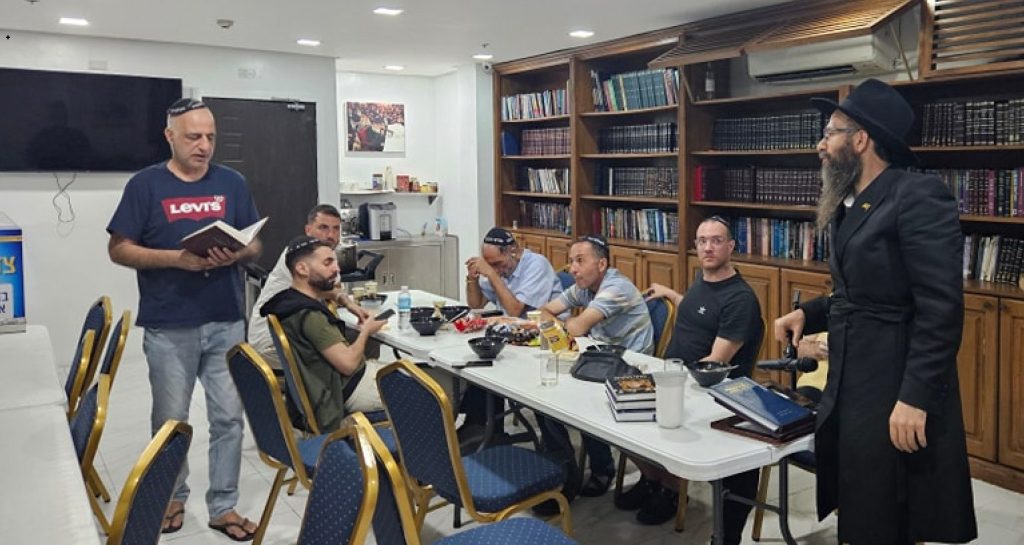
Were there cases where specifically through routine activities like putting on tefillin or a Torah class – an opening was created for conversation about relationships with non-Jewish women?
Rabbi Disraeli Zagury: Our Sages spoke extensively about not eating forbidden foods and said they cause dulling of the mind and heart. We therefore initiated a kosher and quality meat campaign at market-breaking prices. Through kashrus I saw more than once, that people’s hearts and minds opened. Since they began to observe kashrus, they started to understand the meaning of Torah and mitzvos. It’s not coincidental that the assimilation percentage dropped as a result. When a Jew begins to bring holiness into his mouth – it also affects the big and important choices of life.
Rabbi Levi Notik: We talk about the issue quite a lot, in shiurim too. The issue requires great sensitivity – because almost all the regular participants are married to non-Jewish women. But what has changed in the last two years is that today they’re already ready to admit the implications of their actions and they say openly: “My child is not Jewish, we won’t be able to make him a bar mitzva.”
I haven’t seen one Jew, including those who define themselves as atheists, who isn’t bothered in his heart by the fact that his son is not Jewish. I know a Jew who married a non-Jewish woman, whose 20-year-old son went to convert, but I’m not sure that’s a solution; most likely he’ll return to Kenya, and he too will marry a non-Jewish woman. This is an issue that surrounds us on all sides – in every event and activity.
Rabbi Yonasan Markowitz: Many times we ask ourselves – what’s the benefit of inviting someone to a Shabbos meal, if he doesn’t come to daven? But sometimes we see that even a meal moves worlds.
An American young man came to us with tattoos all over his body and of course we welcomed him with love. After the meal he asked to talk and we set up an appointment for a conversation for Sunday. He told me he grew up in a liberal family that educated him to come to synagogue once a year – on Yom Kippur. Since our conversation he began to come to shul every day, puts on tefillin and is becoming more observant.
Although there wasn’t a Torah class here, “only” a Shabbos meal, that’s what affected him. Of course – when a person becomes more committed – it also affects the place from which his future family will grow.
‘Ahavas Yisrael With Truth’ – The Chabad Approach
How do you respond when a Jew shrugs his shoulders and says “But I love her, what’s wrong with that?” How do you connect with him without pushing him away?
Rabbi Disraeli Zagury: I explain that they are not the problem, but the situation is. These marriages are the opposite of what the holy Torah expects from us. This needs to be resolved – but only from deep Ahavas Yisrael, without judgment and of course without reprimands. When they feel that our message comes from a real and deep place, they accept it.
Rabbi Levi Notik: I don’t tell him there’s something ‘wrong’ with him loving her. I explain to him that the problem is not in his love for her, but in the fact that she is not Jewish. If he really wants a proper and stable life – he needs to build a Jewish home and that’s only done with a Jewish woman.
I tell him about cases of intermarriage that we’ve seen here and experienced up close – that ended badly. On the other hand, I am also mechazek him that there’s a possibility to find a good Jewish woman. It’s not a distant dream. The problem here is that there aren’t enough Jewish women around which is why many fall into this. The truth is that everyone, deep down, wants a Jewish woman; that’s their ratzon pnimi (inner desire).
Rabbi Yonasan Markowitz: One needs to come with a personal approach, with simple truth. To speak as an equal, with honesty. When the conversation comes from love and caring – they get it. From experience – if we come from pressure or judgment – he’ll close his heart and distance himself. When speaking truly from compassion and understanding – real change can be created.
How do you implement the approach of closeness even when you need to speak the truth uncompromisingly?
Rabbi Disraeli Zagury: We have always insisted on telling the truth, even when it’s unpleasant. “Smoothing over” things is not Ahavas Yisrael; on the contrary, true Ahavas Yisrael means telling the harsh truth, but gently and with a pleasant demeanor.
There was a Jew here married to a non-Jewish woman who came to register his son for the Jewish school. I called my wife, and together we gently explained to him that the school is intended only for Jewish children, meaning: children born to a Jewish mother. Not only was he not offended – he said he appreciated us for being consistently honest.
A non-Jewish woman approached us who had lost her parents and was adopted in childhood by a Jewish family. She wanted to register her children in our school. I explained to her that she wasn’t the problem – but that it might confuse the children who would suddenly want kashrus and Shabbos at home while they are not obligated to do so at all, and this would create conflict. I explained things to her in a considerate manner, and she accepted it with understanding despite it being hard for her.
Rabbi Levi Notik: To approach such a conversation, you first need to define your goal and be prepared in heart and mind. I don’t come to judge him – I express my view because it pains me. I explain to him that what he’s going through truly touches me. When a person hears the truth from pain and caring – he receives it with love. When you tell the truth because that’s what the Torah requires – they appreciate it more.
Rabbi Yossi Levy: I always tell them the well-known story about the young man who consulted with the Rebbe about marrying a non-Jewish woman, and the Rebbe answered him: “I envy you for having such a struggle. This shows that you have a high neshama.” This approach elevates the Jew and instills in him a sense of mission and purpose.
Sometimes I also show them a video of the Rebbe speaking about intermarriage. The Rebbe’s holy words do their work – and the heart opens.
Tools For Prevention – Strengthening Jewish Identity Before It’s Too Late
What practical tools do you offer to young people to prevent them from reaching a situation of assimilation in the first place?
Rabbi Disraeli Zagury: We call intermarriage “assimilation,” but actually it’s the “last stop.” It’s the end of the process. Real assimilation begins much earlier – when one loses one’s Jewish identity, when there’s no community, when there are no Jewish customs to hold onto, and of course when there are no Jewish friends. It’s like a bus that passes through stops – if you don’t get on at the first stop, how will you reach the last stop?
Therefore, I emphasize: we need to create Jewish communal life: Jewish society, Jewish thinking, connection to Torah and tradition – and then intermarriage will naturally not be an option.
Rabbi Levi Notik: When single men come here, I don’t wait for something to happen; rather I speak with them immediately about this sensitive topic. I explain to them that no one is immune and everyone is human. The only way to protect yourself is by strengthening the neshama. Regular Torah study isn’t an extra, but direct protection from getting into a situation of assimilation.
There was a young man here, a security guard, who called me two weeks after arriving and told me with great openness: “I’m straying; I feel it’s not good or right for me.” He asked to study with me to protect himself. Since then we have a regular chavrusa learning session. He understood that one needs to care for the neshama – not just the body.
Rabbi Yonasan Markowitz: We don’t come from a condescending place to say: “We’re right and you’re wrong.” This approach doesn’t work. You need to come from a place of connection – to speak as an equal, and offer them to experience Judaism from the inside. When they see what a Jewish family is, what a Jewish soul is – they already understand on their own.
Rabbi Yossi Levy: I invite everyone to Torah and Chassidus classes. This is the main tool to keep the soul from reaching such a terrible state.
Looking To The Future – Is There Hope?
Do you see change over the years – for better or worse – in assimilation in your area?
Rabbi Disraeli Zagury: Unequivocally – we see positive change! This is thanks to a clear policy that our Chabad house doesn’t allow non-Jews to enter. People know this and appreciate it.
My cousin was married to a non-Jew and once asked to bring him to an event. I told her gently and with love: “If you’re willing to take responsibility for all the young people who will see you and think it’s okay to marry a non-Jew – bring him.” She understood – and didn’t bring him… Eventually she also divorced him… Sometimes when you go with the truth – people respect you and self-correct. Assimilation rates among us have dropped significantly because of a clear and consistent line.
Rabbi Levi Notik: It’s hard to see fundamental change in such a short period that we’ve been here, two years. But regarding the couple where the woman is now in the process of conversion, I hope people will look at them and understand that it’s possible to marry a Jewish woman. I admit this isn’t the ideal situation to convert and marry, but if you’ve reached such a situation, at least let her convert honestly and truly, even if it’s a long and exhausting process. The reality of life here doesn’t allow for marrying a Jewish woman; there are no Jewish women here.
Rabbi Yonasan Markowitz: As a result of the work of the shluchim who explain to people the importance of marrying Jewish women exclusively, assimilation rates have dropped. However, recently, following the war, many young people are afraid to leave home so they won’t be caught on the street and taken for military service on the front against Russia. This indeed directly harms community activity – and meetings between young Jewish men and women. This fear could cause an increase in assimilation, because the social frameworks through which they meet and connect to the community don’t exist. We need prayer, patience, and lots of support from afar.
Rabbi Yossi Levy: We see results. It doesn’t happen in one day, but after several years of activity in the form of Torah classes, personal conversations, exposure to videos from the Rebbe – people awaken and make decisions accordingly. The neshama is strengthened and the results come as a matter of course.
Jewish Assimilation Data in the Diaspora
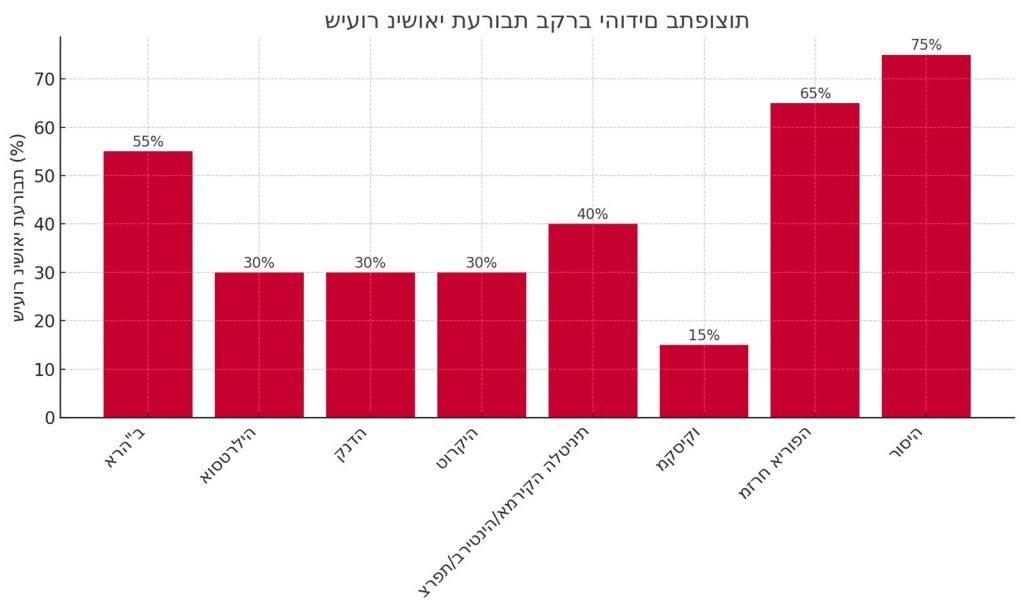
In an official report produced by the Knesset a little over a decade ago, it presents data on Jewish assimilation in the diaspora, and these are grim numbers:
The high rate of intermarriage is one of the distinct signs of Jewish assimilation in the world. In the last 50 years, the number of intermarriages in the diaspora has grown by 200%, and one of the main reasons for this is that Jewish identity doesn’t hold an important place in the consciousness of many Jews. Intermarriages are in many cases the beginning of religious assimilation, since Jews being a minority in the diaspora increases the chance that the descendants of mixed couples will not be Jewish.
Here are data on intermarriage in several countries in recent years:
In the USA (whose Jewish population is about five and a quarter million people) – 55% of all Jewish marriages are intermarriages.
In Australia, Canada, and Turkey, the rate of intermarriage ranges between 25% to 35%.
Among a large part of world Jewry, including France, Britain, and most of Latin America, the rate of intermarriage is 35%-45%.
In Mexico, the rate of intermarriage is less than 15%.
In Eastern Europe, including parts of the Commonwealth of Independent States, the rate of intermarriage is more than 65%.
In Russia, the rate of intermarriage is 75%.
In a survey published in 2013 in USA Today, it was found that the scope of Jewish assimilation in the USA is expanding, the number of Jews is decreasing, and children growing up in homes where one parent is not Jewish are not connecting to Judaism and its customs. Here are data from the survey:
47% of all Jews who married since 1996 married non-Jews.
The spouses of 31% of all married Jews are not Jewish.
96% of all children growing up in homes where both parents are Jewish – grow up as Jews.
Main Reasons for Assimilation in Western Countries:
For many Jews today, Jewish identity is not distinct.
Many Jews in the diaspora (and also in Israel) lack knowledge of tradition and Jewish history.
Jews are usually a minority in their countries of residence, and therefore there’s a significant chance they’ll meet a spouse who is not Jewish.
There’s a high chance that a child from a mixed marriage family will also marry a non-Jewish spouse in the future.
Beis Moshiach #1474 • pp. 12-23
© 2026 Beis Moshiach Magazine. All rights reserved.
This article originally appeared in Beis Moshiach #1474. You are welcome to share it with friends and family by email or in print, provided that you do not change, add to or omit any part of it, you credit the author and Beis Moshiach, and you include a link to archive.bmoshiach.org (written out in full in printed copies).
To republish this article in a newspaper, magazine, book or website, please request permission in advance at [email protected].