“Arabs 15 Kilometers From the Border Is the End of Tel Aviv”
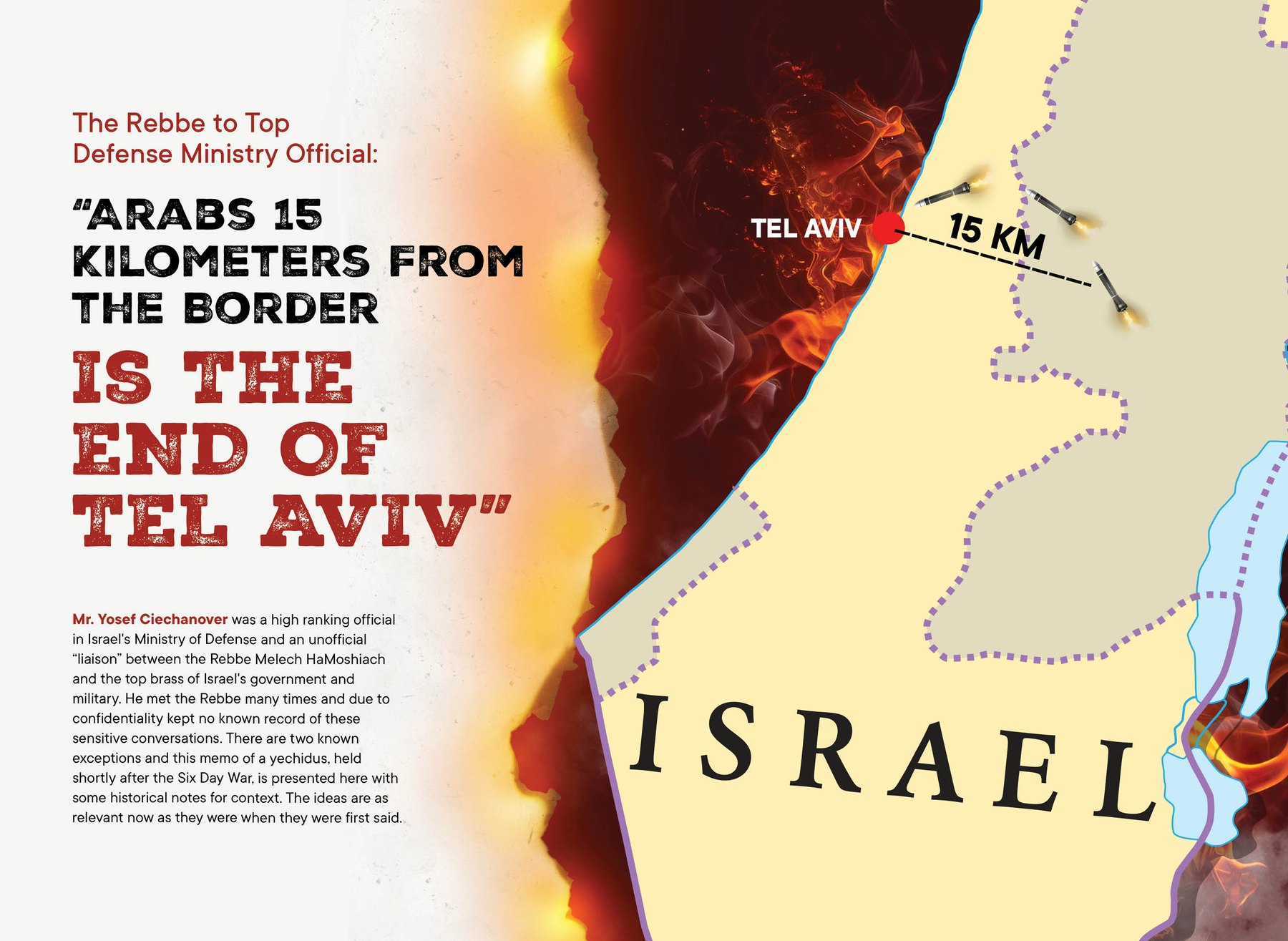
Mr. Yosef Ciechanover was a high ranking official in Israel’s Ministry of Defense and an unofficial “liaison” between the Rebbe Melech HaMoshiach and the top brass of Israel’s government and military. He met the Rebbe many times and due to confidentiality kept no known record of these sensitive conversations. There are two known exceptions and this memo of a yechidus, held shortly after the Six Day War, is presented here with some historical notes for context. The ideas are as relevant now as they were when they were first said
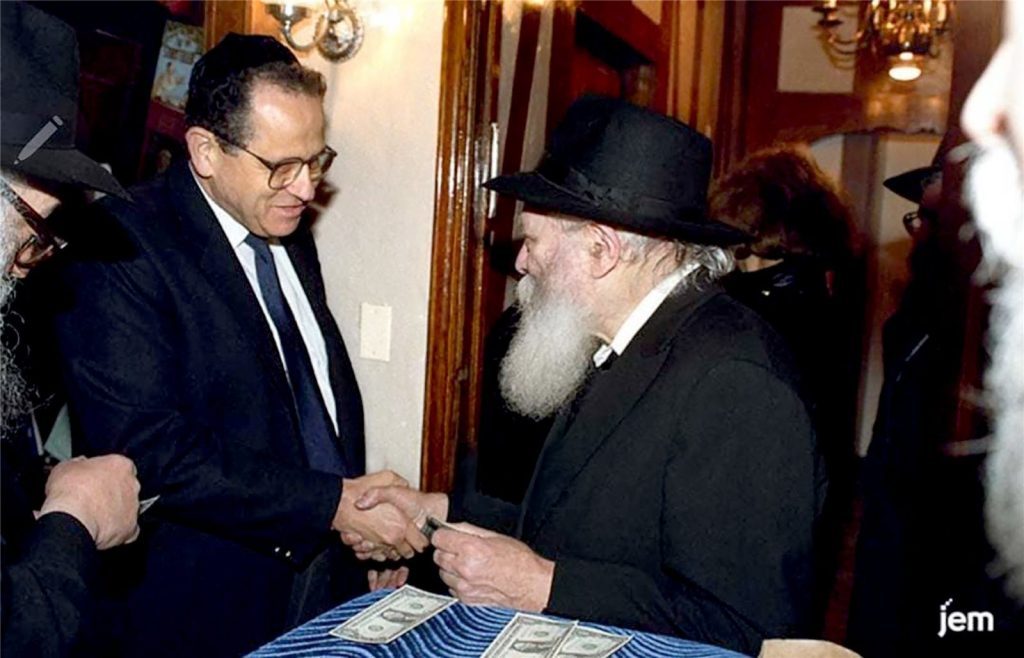
It was 1:10 in the morning and the streets of Crown Heights were quiet, but inside the building at 770 Eastern Parkway, the yechidus of Mr. Yosef Ciechanover, who was destined to become the “man in the shadows” of the Israeli security establishment and at the time was the head of the Defense Ministry’s purchasing delegation in the United States, had already begun.
Mr. Ciechanover, who passed away on 14 Elul, was one of the most influential figures in the field of Israeli security, though his name was not always known to the general public. For decades, he held senior positions in the Ministry of Defense, including as the ministry’s legal advisor and as the head of Israel’s security delegation to the United States. His important role in shaping Israel’s foreign relations, especially in mediating diplomatic crises, made him one of the central figures behind the scenes of Israeli diplomacy.
What is less known is Ciechanover’s deep and enduring connection with the Rebbe. From his first visit to 770 in his twenties, Ciechanover began to draw closer to the Rebbe. Over the years, he became one of the Rebbe’s trusted men within the Israeli security establishment, carrying out critical missions at sensitive times for the security of the state.
This yechidus takes place shortly after the Six-Day War. Israel is still intoxicated by the brilliant victory, but difficult questions are beginning to arise in the Israeli public: What will be the fate of the liberated territories? How to deal with the growing wave of terrorism? Is there a real chance for peace?
With these and many other questions, Mr. Ciechanover comes to a meeting with the Rebbe. He does not know it, but this conversation will last until 3:30 am. and will include far-reaching insights on Israeli security for many years to come.
In the coming years, Mr. Ciechanover will be privileged to enter the inner sanctum dozens of times, and even in years when the Rebbe did not hold private audiences – his status and influence within the Israeli security establishment gave him the privilege to continue to be received in the Rebbe’s holy chamber for private meetings. The things said in those private meetings were so secret that even Ciechanover did not record the content of the discussions. Only two private meetings did he put in writing, and one of them is the one before us, which was apparently held in the winter of 1970.
It seems that Ciechanover recorded the proceedings shortly after the yechidus, under the title “Meeting with the Rebbe of Chabad Chassidim,” but since the meeting lasted for more than two hours – the words were written in summary, and are not an exact quote of the Rebbe’s words. Therefore, they should be treated accordingly.
It is amazing to see how the Rebbe’s words remain valid and relevant even decades after that historic private meeting, containing practical instructions even for our present day.
We hereby present the private meeting with introductions, explanations, and important notes. Our thanks go to all who assisted, advised, and guided.
“Fully Updated on All Matters Relating to Israel”
“The meeting was scheduled for 12:00 at night. I was ushered in at 1:10 and we sat until 3:30,” Ciechanover writes in his notes. “The Rebbe made an impression. His eyes were blue, he was very kind.
“He is fully updated on all matters relating to Israel,” Ciechanover continues in his description, surprised to discover the extent of the Rebbe’s expertise in the current events in Israel. “Thus, immediately after the election of Ezer Weizman was announced, he asked about the election, or why the Defense Minister [Moshe Dayan] was going to ask schoolchildren to return to their studies after they had participated in demonstrations.”
Apparently, the reference is to the retirement of Mr. Ezer Weizman from his position as head of the Operations Division in the IDF, and his election as Minister of Transportation – in the winter of 1970. A year earlier, it was reported in the press about meetings of Defense Minister Mr. Moshe Dayan with Arab municipal leaders in Judea and Samaria, and his request from them to persuade the Arab students to return to their studies, after a period when the Arab students held daily demonstrations against the IDF (Lamerchav newspaper dated 29.10.1968).
“Return the Territories? That’s the End of Tel Aviv”
The conversation quickly turns to the burning issue: the future of the territories liberated in the Six-Day War. The Rebbe addressed the matter from a unique angle, expressing a firm position that surprises in its sharpness:
“Regarding the return of the territories,” the Rebbe begins, “there are only two alternatives: either to hold on to the territories for a long time, or to return them. And if to return them, then it must be done immediately.”
Ciechanover raises an eyebrow. Is the Rebbe really proposing to return the territories? But it soon becomes clear that this is not his intention.
“But you must know,” the Rebbe continues immediately, “that the return of the territories is a first-rate security issue. For the Arabs of today are not the Arabs of the past. And today, to settle Arabs within 15 km of Tel Aviv [approximately the distance from Tel Aviv to the Green Line marking the borders of Judea and Samaria] – that’s the end of Tel Aviv.”
The Rebbe emphasizes the futility of peace agreements on paper: “One cannot rely on a peace treaty, which is just a piece of paper. In 1957 [the Sinai Campaign] we had guarantees from the great powers, greater than Nasser [the President of Egypt] or Syria [the countries defeated in the Six-Day War], and we saw what their value was [that the agreements were of no use at all].”
Instead, the Rebbe proposes a long-term approach: “Therefore, one must hold on to the territories, not until a peace treaty, but until there is a fundamental change in the Arab states and their attitude towards Israel changes.”
After the miraculous victory in the Six-Day War, the Israeli government sent a delegation to Washington to announce that they captured Yerushalayim only ‘out of necessity,’ and they do not intend to hold all the territories, but they are willing to return the territories in exchange for ‘peace agreements.’
The Rebbe did not spare the rod of his criticism from the Israeli government. He expressed deep concern over the ministers’ statements regarding their willingness to return territories in exchange for a peace agreement:
With great anxiety, the Rebbe saw the statements of the government ministers immediately after the occupation [- the Six-Day War], in which they said that we would return the territories in exchange for a peace agreement, since what should it matter to Nasser [the President of Egypt] to sign some piece of paper and get the territories back.
The Rebbe concluded his position emphatically: We must hold onto the territories also out of [understanding and recognition] that there is no [possibility] of turning back the clock [that is, reverting the situation to a previous time]. And bringing Arabs 15 kilometers from Tel Aviv – that’s the end of the matter.
The War on Terror: “To Establish a Uniform and Strict Policy”
The conversation shifts to no less painful a topic: the wave of terror that has struck the Land of Israel. The Rebbe calls for a firm hand and says that only a clear policy against terrorism will provide an appropriate response to prevent attacks:
“One of the main factors in the increase of terrorism,” the Rebbe states, “is the lack of a consistent government policy and the conflicting statements made by various ministers. This increases the residents’ insecurity and creates a backdrop for the growth of terrorism.”
The Rebbe emphasizes the need for severe punishment:
“Acts of hostility must be punished with the full severity of the law. Prison is not the most appropriate punishment as there they rest, eat, sometimes more than at home. And they also avoid the danger of being sent for additional actions.”
Surprisingly, the Rebbe compares the situation to the Russian treatment of soldiers who fell into German captivity, from which it can be learned that sometimes imprisonment does not constitute a ‘threat’ or a deterrent tool:
In this regard, the Rebbe provides an example from Russia, that punished those who fell into German captivity after the war, knowing that some of the soldiers did not make enough effort to avoid being captured.
The Medical Analogy: “Cut Deep”
The Rebbe calls for decisive and immediate action: “A uniform and strict policy must be established. And to cut hard.”
To illustrate the urgency of the action, the Rebbe uses a fascinating medical metaphor:
“The example is that of a patient needing a complicated surgery, and then they come and tell him about his illness and decide ‘considering his special condition’ – to operate on him in parts – every few days a different part. If surgery is necessary, it should be done all at once and thoroughly, removing the affected and potentially affected parts. And it is good for the patient, the family, and the surgeon.”
And the Rebbe concluded: “And everything in one dissection.”
Collective Punishment? “Everyone Knew and Everyone Was Infected.”
In the winter of 1969, a cell of terrorists from the ‘Al-Fatah’ organization operating in the Chalchul area near Chevron was captured. The members of the cell hid in the village houses, and from there, they shot at IDF soldiers and killed an officer. Additionally, they were accused of numerous acts of sabotage against Jews (from the newspaper Hayom dated 28.11.1968).
In the next part of the yechidus, the Rebbe expressed his opinion on how to treat those who assist in terrorist activities or hide terrorist cells in their village. The Rebbe also addresses the sensitive issue of collective punishment, using a specific example:
“We must continue on the path we have chosen if it helps reduce terrorism, as reducing terrorism is ultimately in the interest of the population, and in such cases, anything is permissible. There is no doubt that in the village of Chalchul, everyone knew and everyone is implicated, even though only a few terrorists came out of the village of Chalchul, the situation is much worse. The villagers knew and helped them, and they also knew that the Israeli authorities knew.”
The Rebbe warns against the danger of inaction:
“They also need to know that for a long time, there was a link in the village, and if the authorities do not respond to the villagers, they will learn from the helplessness of the authorities, they and their friends.”
Surprising Approach: “Each Terrorist Should Not Be Prosecuted Separately.”
Following the previous topic, the Rebbe addressed the issue of prosecuting the terrorists. The Rebbe’s opinion is that there is no need to prosecute every terrorist in court, because there is not always evidence that incriminates them legally. And furthermore, this prolongs the issuance of the sentence and even gives the terrorists a ‘platform’ in front of the public. Contrary to the conventional approach, the Rebbe proposes a different course of action in dealing with terrorists:
“One should not bring every terrorist to trial and conduct a trial with them, because first, it will not be possible to personally prove the offense. But more importantly, this will drag on for many months, serve as a platform for lawyers and the defendants themselves, and greatly diminish the value of the trial. The judiciary and proceedings should not be transferred to regular channels in the territories, because the situation there is not like that. And it is permitted to take any action that, in the government’s opinion, contributes to this matter.”
It is fascinating to read these words from more than half a century ago and see how relevant they are to our times, as almost a year has passed since the Simchas Torah events, and the Israeli judicial system has yet to find a way to prosecute the Nukhba terrorists who murdered and slaughtered men, women, and children. Because indeed, in the regular judicial system, there are limitations that may lead to the release of terrorist murderers ‘due to lack of evidence’…
Beyond the Lines: The Rebbe on the Application of Israeli Law in the Territories
One of the most complex issues that arose in the conversation between the Rebbe and Ciechanover was the question of applying Israeli law to the territories liberated in the Six-Day War. During this period, there were many voices in Israel calling for the application of Israeli law to the new territories. However, to Ciechanover’s surprise, the Rebbe presented a completely different stance:
“Actions should be taken to increase the Israeli presence in the territories, but Israeli law should not be applied, as it would only lead to the introduction of various institutions and operations on one hand, and on the other hand, it poses a great risk to the existence of the State of Israel. The application of the law will allow them litigation, access to special services, and special arrangements. And above all, the power of the military government will be diminished.”
This position of the Rebbe is surprising on several levels, and it reflects the legal complexity involved in controlling the civilian population in the liberated territories.
Later in the yechidus, the Rebbe goes back and emphasizes the advantages of the military government in the current situation:
“In the Rebbe’s opinion, military rule is of great importance, especially considering the fact that here one person is responsible, decides, and executes. And if we implement the [standard] law, there will be many more to have a say – the Knesset, the government, and this will strengthen the existing situation.”
As an aside, it is important to add an important insight: from the content of the words, it seems that the Rebbe’s preference for military rule is only if it is indeed conducted properly. In other words, the Rebbe is not a blind supporter of military rule, but sees it as a more effective tool for managing the complex situation, provided that it is implemented properly.
A Moral Dilemma: On the Death Penalty for Terrorists
Another highly sensitive issue that came up in the conversation was the issue of the death penalty for terrorists. At that time, as well as today, the issue was the subject of fierce controversy in Israeli society. The Rebbe, in his direct and uncompromising approach, expressed support for this step:
The Rebbe found support in the Shulchan Aruch for the fact that in the situation we find ourselves, it is permissible to impose the death penalty. And in his opinion, this will be deterring.
Mr. Ciechanover does not write the halachic sources that the Rebbe pointed to, but it is possible that the reference is to Shulchan Aruch Yoreh Deah, section 158, paragraph 1, where the Mechaber rules that “the idolaters of the seven nations who are not among us and with whom we are not at war… we do not cause their death,” and the Sema comments “but in time of war, they would kill them with their own hands.”
The Rebbe also addresses the argument against the death penalty – the fear that the terrorists will become “shahids” (martyrs) in the eyes of the Palestinian public. He believes that this consideration should not be given too much weight, and believes that the deterrent effect of the death penalty will be more significant: “And one should not give too much weight to the fact that they will become martyrs.”
However, the Rebbe does not ignore the possible consequences of such a policy. He expresses concern about retaliation in the Arab countries, which could harm the Jews living within them:
“There is, however, a need to be wary of such actions in the Arab countries. For they may retaliate by executing Jews there.”
A Look to the Past, Insights for the Future
The positions expressed by the Rebbe in that private meeting – from opposition to the application of Israeli law in the territories to support for the death penalty for terrorists – were controversial then and continue to elicit lively discussion even today. They reflect a unique approach to Israel’s security, based primarily on the halacha in the Shulchan Aruch, and combining a long-term strategic vision with operational decisiveness in the short term.
In a world where the security reality is constantly changing, the long-term vision and firm approach that the Rebbe presented in that historic private meeting remain relevant and challenging even today.
Through the eyes of Ciechanover, we have been given a rare glimpse not only into the content of the conversation, but also into the way the Rebbe analyzed his positions. The use of halachic sources alongside modern geopolitical analysis, the ability to see the big picture while addressing the smallest details, and the willingness to express unpopular positions – all these reflect the Rebbe’s unique perspective as the Nasi HaDor and the true leader of the Jewish people, leading them to the True and Complete Redemption.
Beis Moshiach #1437 • pp. 14-21
© 2026 Beis Moshiach Magazine. All rights reserved.
This article originally appeared in Beis Moshiach #1437. You are welcome to share it with friends and family by email or in print, provided that you do not change, add to or omit any part of it, you credit the author and Beis Moshiach, and you include a link to archive.bmoshiach.org (written out in full in printed copies).
To republish this article in a newspaper, magazine, book or website, please request permission in advance at [email protected].